

EMARKETER Consent Management Platform in 2026: What the Market Signal Actually Means
If you are searching for emarketer consent management platform on August 12, 2026, you are probably not looking for a CMP product called EMARKETER.
You are more likely trying to make sense of the market conversation around consent and preference tools, publisher pressure, first-party data strategy, and privacy-led growth. That is a useful search, but only if you translate market language back into the live compliance job. A polished trend report does not block a tag, honor a browser signal, or prove that rejection was actually respected on a real site.
That reset matters more in 2026 because the legal and operational floor is still active. The European Commission still says valid consent must be freely given, specific, informed and unambiguous, and that withdrawal must remain as easy as giving consent. The UK’s ICO published final storage-and-access-technologies guidance on April 29, 2026 and says the guidance covers cookies, tracking pixels, device fingerprinting, and similar technologies, while consent tools should “function as intended.” In California, the Department of Justice still describes Global Privacy Control as a “stop selling or sharing my data switch” that covered businesses must honor, and CalPrivacy’s current CCPA law and regulations page still lists the current CCPA and CCPA Regulations as effective January 1, 2026.
If you want the adjacent shortlist first, start with our guides to best consent management platforms, consent management platform, and best privacy tools. This article is narrower. It is the buyer-intent translation layer I would use if the keyword is specifically emarketer consent management platform.

The short answer on emarketer consent management platform
The fastest useful answer is this:
- the keyword usually points to market research and vendor-evaluation intent, not a single software product;
- EMARKETER’s current privacy coverage frames CMPs as part of a larger shift toward privacy-led marketing, first-party data, and operational trust;
- but the real buying test still comes from live rules on consent validity, withdrawal, browser-level opt-out signals, and technical behavior on the page or in the app;
- so the right use of emarketer consent management platform is not to chase trend language, but to sharpen your shortlist criteria.
That is why this keyword is best answered as a decision guide, not a vendor demo recap.
What EMARKETER’s current CMP coverage is actually signaling
EMARKETER’s recent privacy coverage is useful because it shows where marketer attention is moving.
Its April 7, 2026 privacy trends report says privacy pressures are changing digital advertising fast and that pressure from regulators and the public is intensifying. Its November 6, 2025 article on privacy-led growth says consent and preference management platforms can streamline processes, support trust, and help brands organize user preferences across channels.
That is a reasonable market read. But notice what it does not do on its own:
- prove valid consent in Europe or the UK;
- prove that refusal is as real as acceptance;
- prove that browser-level California signals are honored;
- prove that Google publisher requirements are met if ad monetization matters;
- or prove that downstream systems actually stop or change behavior after a user opts out.
So if you came in through emarketer consent management platform, treat the research as a directional signal. The platform decision still has to be made at the implementation layer.
1. Separate CMP market language from the legal baseline
This is the first discipline that saves teams from bad purchases.
Market coverage often blends together privacy trust, first-party data quality, personalization, analytics, and revenue resilience. Those may all be real business outcomes. But the compliance baseline stays narrower and less forgiving.
The European Commission’s current guidance still centers the same core test: consent must be freely given, specific, informed, and unambiguous. It also still says users must be able to withdraw consent, and that the withdrawal path should be as easy as giving it.
That means a CMP does not pass because it promises stronger opt-in rates or better segmentation. It passes because it can capture a fair choice, preserve that record, and change real technical behavior after the user acts.
2. Decide whether you need a website CMP or a broader preference program
This is where EMARKETER-style market language can be genuinely helpful.
The November 2025 EMARKETER interview with Usercentrics describes consent and preference management platforms as tools that can help brands customize banners for apps and CTV, organize first- and zero-party preference data, and align with varying regulations. That points to an important buying distinction:
- some teams mainly need a website CMP that controls optional tracking on first load;
- other teams need a broader consent and preference management program that connects websites, apps, identity, marketing systems, and customer records.
Those are related, but they are not the same purchase.
If your main failure is still tags fire too early on the site, buy for runtime website control first. If the main failure is the user's choice never reaches downstream systems, buy for orchestration and enforcement across the stack.
3. Treat EU or UK consent and California opt-out as different jobs
This is one of the biggest operational mistakes in CMP buying.
For EU and UK flows, the live question often starts with whether non-essential storage-and-access technologies stay off until valid consent exists. The ICO’s current guidance is useful here because it reaches beyond old cookie-only language to include cookies, tracking pixels, fingerprinting, and similar technologies.
California can look similar on the surface while doing a different job underneath. The California DOJ’s current GPC page says the signal is a “stop selling or sharing my data switch” and that covered businesses must honor it as a valid request to stop sale or sharing.
That means a platform that looks strong in a European consent demo can still be weak for California browser-level opt-out handling. If you are comparing vendors after landing on emarketer consent management platform, force them to show both branches separately.
4. If you are a publisher, run the Google check separately
This is the place where many general-market overviews stay too abstract.
If you serve personalized ads through Google publisher products in the EEA, the UK, or Switzerland, Google’s current publisher help still says you need a certified CMP integrated with the IAB Transparency and Consent Framework. That is an additional platform requirement. It is not the whole legal analysis, but it can absolutely change the shortlist.
So if publisher monetization matters, ask two different questions:
- does this platform satisfy the Google publisher path;
- and does it still give us fair choice, real blocking or suppression, regional branching, and usable records outside that path?
A tool can be good at one and weak at the other.
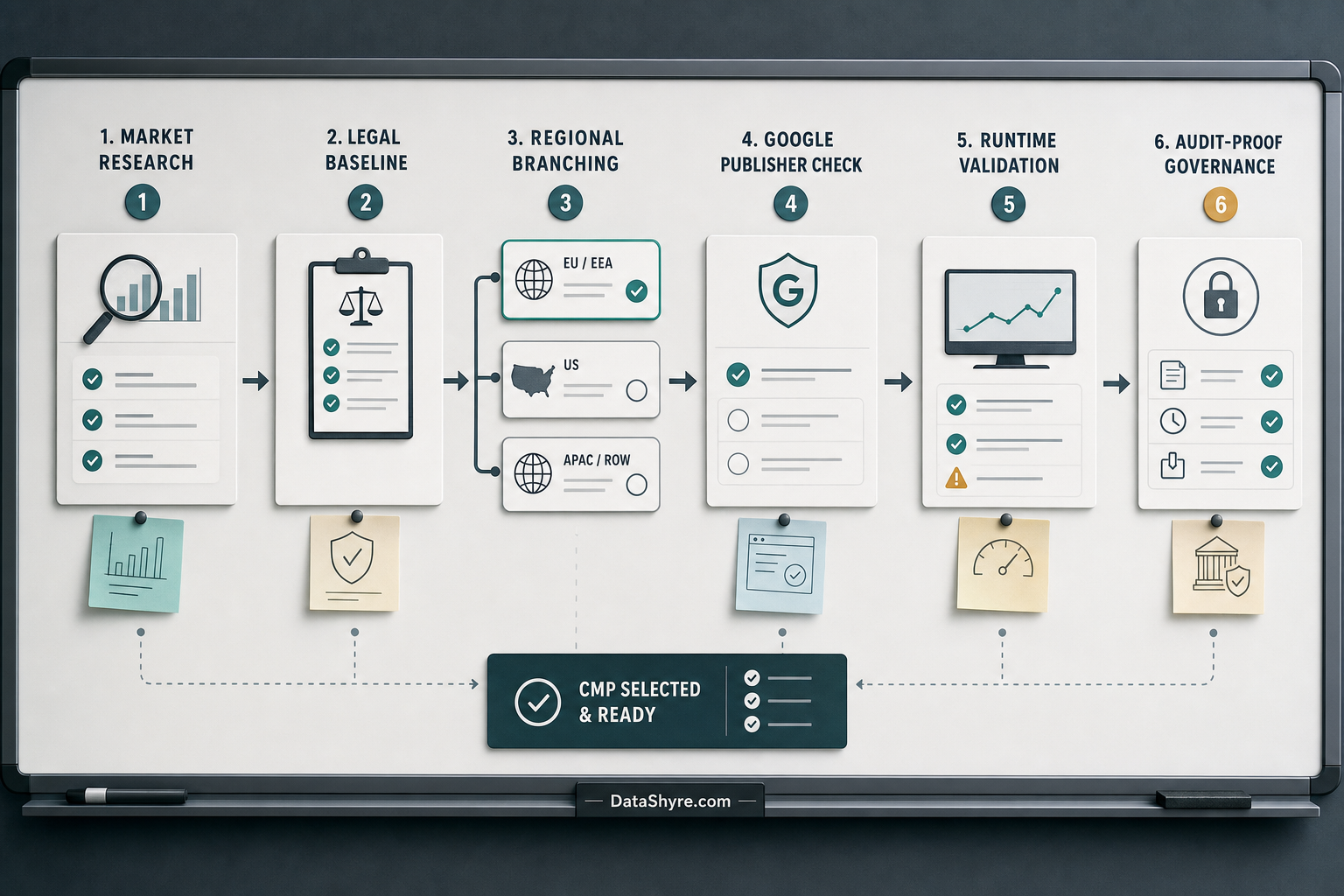
5. Make vendors prove runtime behavior, not just strategy language
This is where market excitement has to meet browser reality.
EMARKETER is right to frame privacy as a marketing and trust issue. But the vendor demo should still answer practical questions:
- what loads before the user chooses anything;
- what changes after reject, accept, and later withdrawal;
- whether the platform handles single-page-app state changes correctly;
- whether it passes the right signals into analytics, advertising, and embedded tools;
- and whether the same result appears in a clean browser session, not only in a staged demo.
The best CMP buying conversations in 2026 sound less like trend briefings and more like controlled QA.
6. Ask how the platform will age after launch
This is the check that market summaries almost always underrate.
Drift is what breaks privacy stacks: new embeds, new tags, changed templates, mobile SDK updates, a revised California workflow, a new app surface, a new data-sharing use case, or a reworked identity graph. The platform needs to stay understandable after those changes, not only at signing time.
For emarketer consent management platform, the strongest buyer question is often:
Will this tool still make sense after the next six releases?
That means checking for:
- clear records and change history;
- region-specific logic that other teams can understand later;
- a usable path for withdrawal and preference updates;
- downstream enforcement instead of front-end-only signaling;
- and ownership that survives staff turnover.
If the answer depends on one privacy engineer remembering every workaround, the platform is weaker than the demo suggests.
A practical shortlist sequence for this keyword
If I were translating emarketer consent management platform into a real buying process this week, I would do it in this order:
- decide whether the search is about website consent, broader preference management, or publisher monetization;
- set the legal baseline first using EU or UK consent rules, California opt-out handling, and any publisher-specific requirements that apply;
- ask the vendor to prove first-load behavior, reject behavior, withdrawal behavior, and recordkeeping;
- test regional branching instead of assuming one banner flow can do every job;
- check whether the platform’s value is operational enforcement or just cleaner reporting;
- and shortlist the product that removes the riskiest manual privacy work first.
That process gets much more value from the keyword than treating EMARKETER coverage like a product category page.
Bottom line
The phrase emarketer consent management platform is best read as a market-intent query.
It points to a real 2026 question: how do marketers turn privacy pressure, first-party data strategy, and CMP market noise into a buying decision that still holds up under live regulation and live browser tests?
The answer is to use EMARKETER for context, not for compliance proof. Let the research shape your shortlist, but let current regulator guidance, publisher requirements, and runtime technical behavior decide the winner.
Sources
- European Commission: When is consent valid?
- European Commission: What if somebody withdraws their consent?
- UK ICO: Final storage and access technologies guidance published
- California Department of Justice: Global Privacy Control
- CalPrivacy: Laws and regulations
- Google Ad Manager Help: Commonly asked questions about European regulations messages
- EMARKETER: Why privacy-led growth gives marketers better data and stronger trust
- EMARKETER: Digital Privacy Trends 2026
This post was updated on August 12, 2026 using current official regulator, government, platform, and live market-research materials available at publication time.