

Cookie Consent Message: 7 Copy Rules That Hold Up in 2026
If you are revising a cookie consent message, the real job is not polishing a few sentences. It is writing a first-layer notice that explains the choice honestly, shows refusal clearly, and matches what the site actually does after the click.
That is still the right test on August 1, 2026. On April 29, 2026, the UK ICO published final guidance on storage and access technologies covering cookies, tracking pixels, device fingerprinting, web storage, and similar tools. On July 14, 2026, the European Data Protection Board required the Belgian DPA to assess the merits of a cookie-banner complaint involving broadcaster VRT instead of closing it on procedural grounds. In California, the Department of Justice still says a valid Global Privacy Control signal must be honored by covered businesses, and its privacy enforcement page shows a February 11, 2026 Disney settlement that focused on whether an opt-out actually followed the consumer across connected services and devices.
If you want the broader context first, start with our guides to cookie consent, cookie consent message examples, and cookie consent tool. This article is narrower. It is about what a practical cookie consent message should say in 2026 if you want the wording and the behavior to line up.
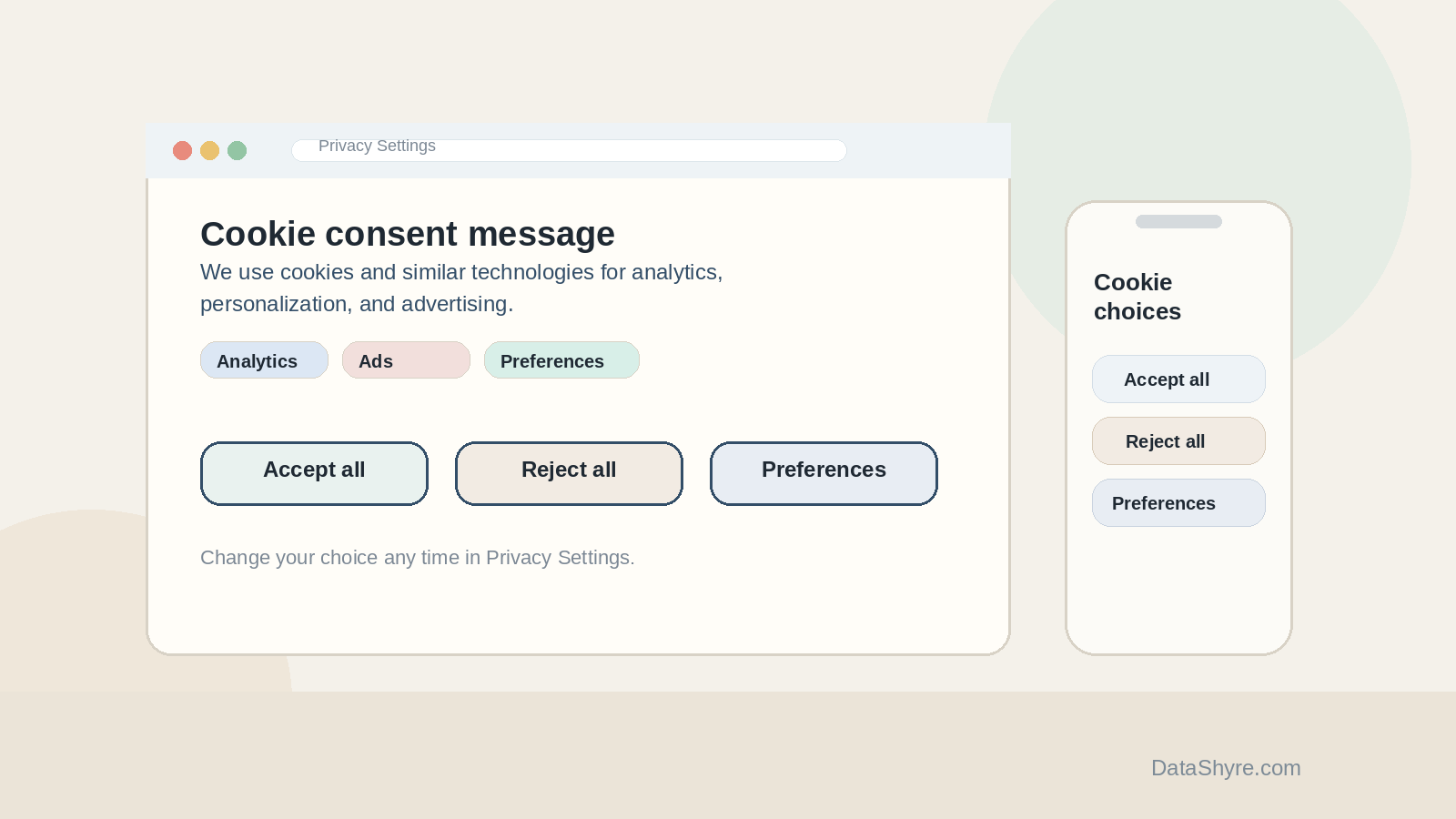
What a cookie consent message has to cover now
The phrase cookie consent message sounds narrower than the real compliance job.
The ICO’s 2026 guidance makes clear that the review can reach more than classic browser cookies. It can also reach tracking pixels, fingerprinting, scripts or tags, and similar storage-and-access technologies. That matters because many banners still talk as if the choice affects one tiny technical file while the real stack includes analytics, advertising, embedded media, session replay, and personalization tools.
The European Commission’s GDPR guidance still gives the cleanest baseline. Consent should be freely given, specific, informed, and expressed through a clear affirmative act. It also says people should be able to refuse or withdraw consent without disadvantage, and:
“It should be as easy to withdraw as to give consent.”
>
European Commission
That is a copy rule as much as a legal rule. If the banner promises a later settings path, the settings path has to be real.
A practical cookie consent message template
For many EU or UK websites, this is a strong first-layer starting point:
We use cookies and similar technologies for analytics, personalization, and advertising. You can accept all, reject non-essential use, or choose your preferences. You can update your choice any time in Privacy Settings.
For California-facing traffic where sale or sharing is in scope, the message often needs a different emphasis:
We use cookies and similar technologies for analytics, personalization, and advertising. You can manage your preferences here, and California visitors can use this control or a recognized browser signal to opt out of sale or sharing where applicable.
Neither template solves implementation by itself. A cookie consent message is only credible when the live site actually honors the path it describes.
7 copy rules for a stronger cookie consent message
1. Name the real purposes
Avoid vague lines such as we use cookies to improve your experience when the real purposes are analytics, advertising, personalization, embedded media, or measurement. A strong cookie consent message gives people a usable explanation of what optional tracking is for.
2. Show equal first-layer choices
If Accept all is visible on the first layer, Reject all should be visible on the first layer too. The CNIL put the point bluntly in its December 12, 2024 notice on dark patterns in cookie banners:
“Rejecting cookies should be just as easy as accepting them.”
>
CNIL
That applies to wording and layout together. If refusal is buried, low-contrast, or softened into a tiny link, the message is already drifting away from valid choice.
3. Do not rely on implied-consent language
Phrases like By continuing to browse, you agree... are weak because they blur the affirmative-action standard. Clear buttons and category choices are a safer pattern than trying to stretch passive browsing into consent.
4. Match the wording to the real technologies in scope
If the site uses pixels, tags, fingerprinting techniques, or web storage in addition to cookies, say cookies and similar technologies instead of pretending everything is just cookies. The first layer can stay plain without being misleadingly narrow.
5. Promise later control only if it really exists
Many banners say change your choice any time because it sounds reassuring. Do not say it unless there is a persistent Privacy Settings or Cookie Settings path that works on desktop and mobile and actually changes downstream behavior after withdrawal.
6. Keep EU or UK consent logic separate from California opt-out logic
One message can support multiple regions, but one sentence does not cover every rule equally well.
In the EU and UK, the operational question is often whether non-essential technologies stay off until valid consent exists. In California, the question often shifts toward sale-or-sharing opt-out handling and preference signals. The California Department of Justice says a user-enabled Global Privacy Control must be honored by covered businesses as a valid consumer request to stop the sale or sharing of personal information. Its 2026 Disney enforcement summary is also a useful operational reminder: an opt-out should not stall on one device or one surface when the business connects the same consumer across products.
That means a cookie consent message should not quietly imply that one generic consent sentence solves every regional obligation.
7. Re-check the message when purposes or vendors change
Consent copy drifts faster than teams expect.
New tags get added. A vendor is swapped. A chat tool or embedded player appears on a new template. Marketing turns on one more ad workflow. The banner still sounds fine, but the words no longer match the stack. When purposes or partner disclosures change materially, the cookie consent message should be reviewed instead of being treated like permanent furniture.
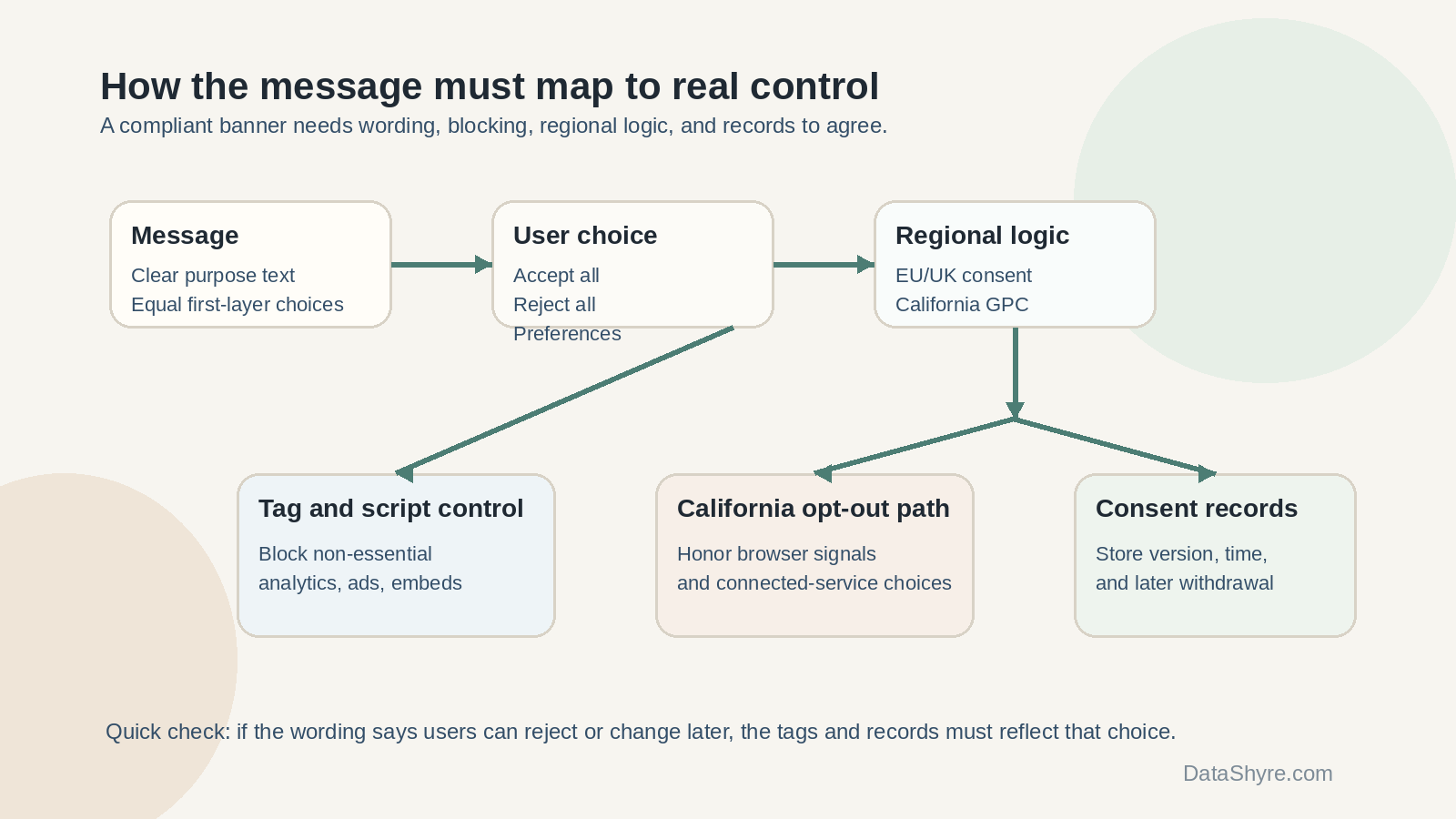
A five-minute review test before you publish
Before approving a new cookie consent message, run this sequence:
- Open the site in a clean browser session.
- Read only the first layer and ask whether the purposes and choices are understandable without translation.
- Click
Reject alland confirm optional analytics, advertising, or similar tracking does not fire where prior consent is required. - Reopen preferences and confirm optional categories are off by default unless exempt.
- Return later through the normal settings path and test withdrawal or revision.
- For California-facing traffic, verify how the site handles Global Privacy Control and any account-level sale or sharing opt-out logic.
That short review usually reveals more than a long copy debate.
Bottom line
The best cookie consent message in 2026 is short, specific, and honest about what the site wants to do. It names real purposes, shows a visible refusal path, avoids implying consent from passive behavior, supports later withdrawal, and matches the actual control behind the banner.
If the wording is clear but the live behavior is weak, users will feel it and regulators may too. If the wording and the implementation line up, you are much closer to a banner that reads credibly and holds up in production.
Sources
- UK ICO: Final storage and access technologies guidance published
- UK ICO: Guidance on the use of storage and access technologies
- European Commission: When is consent valid?
- European Commission: What if somebody withdraws their consent?
- European Data Protection Board: Belgian DPA must handle the merits of a NOYB cookie-banner complaint
- CNIL: Dark Patterns in Cookie Banners: CNIL issues formal notice to website publishers
- California Department of Justice: Global Privacy Control
- California Department of Justice: Privacy Enforcement Actions
- California Privacy Protection Agency: Law & Regulations
This post was updated on August 1, 2026 using current official regulator guidance and enforcement information available at publication time.