

Affordable Cookie Consent Management: 7 Checks Before You Buy a Budget CMP in 2026
Affordable cookie consent management is possible. What is not possible anymore is buying a cheap banner that looks compliant while your tags still fire, your reject path is buried, and nobody can prove what happened later.
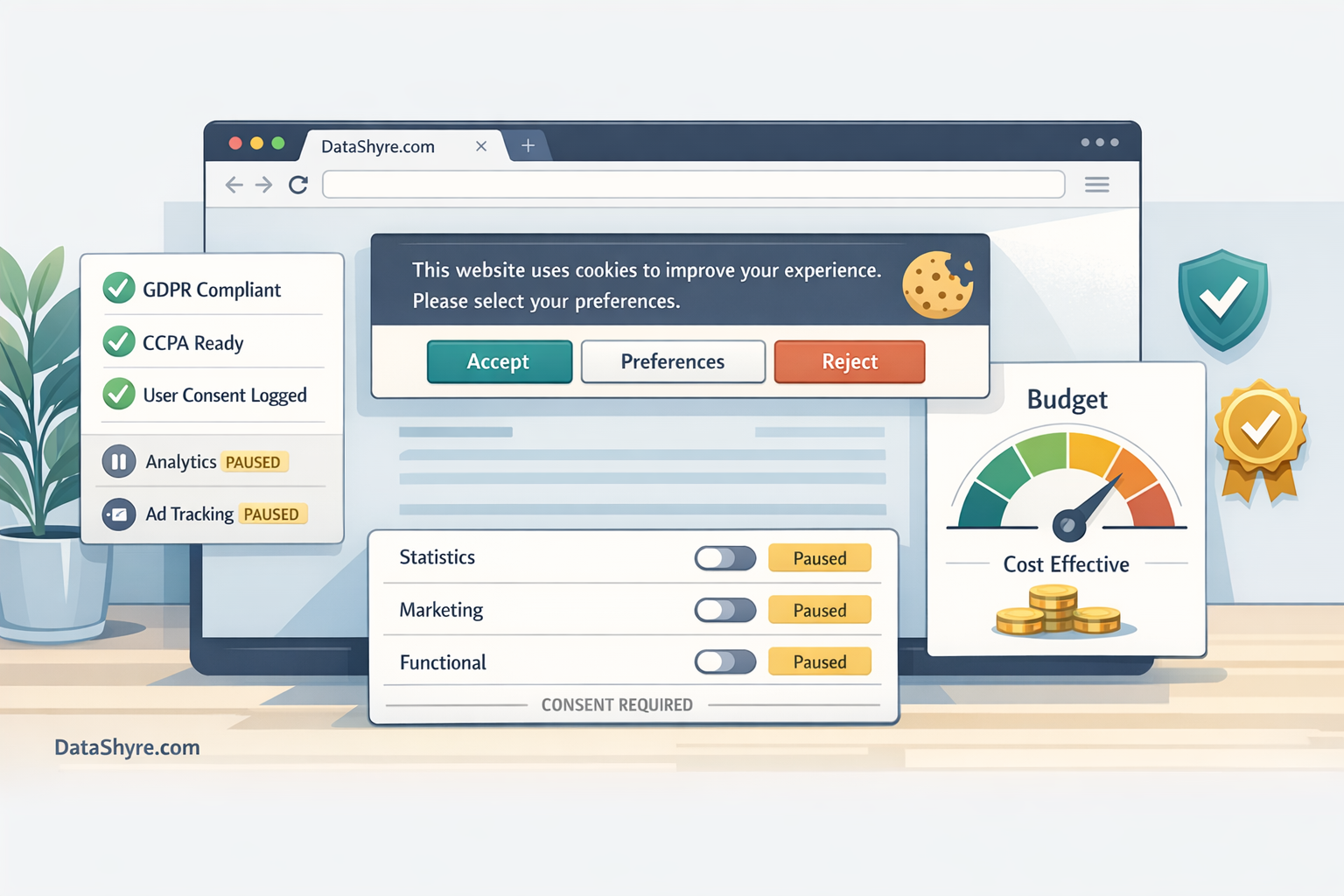
If you want the broader baseline first, see our guides to cookie consent, cookie consent manager, and consent management platform best practices. This article is narrower: how to buy a lower-cost setup without creating a higher-cost compliance problem.
Table of contents
- TL;DR
- What “affordable” should mean
- 7 checks before you buy a budget CMP
- Where cheaper tools usually break
- A simple buying rule
TL;DR
- A lower-cost CMP can be fine if it blocks non-essential tracking until the right signal exists.
- For EU and UK traffic, consent flows still need clear choices, no misleading design, and reliable proof.
- For California programs, your setup may also need opt-out handling and Global Privacy Control support where sale or sharing rules apply.
- The cheapest mistake is buying a banner. The better bargain is buying a control layer.
What “affordable” should mean
Good affordability is about scope, not shortcuts. Many teams do not need a large enterprise rollout, dozens of regional templates, or heavyweight procurement. They do need the basics to work every time.
That matters because regulators keep focusing on behavior, not branding. The UK ICO’s final 2026 guidance on storage and access technologies says online advertising uses of cookies, scripts, tags, and similar technologies require consent, and that consent controls must actually function as intended. Ireland’s Data Protection Commission says pre-checked boxes or toggles do not produce valid consent. The French CNIL said again in December 2024 that rejecting cookies should be as easy as accepting them and warned against misleading banner design.
So affordable cookie consent management should mean a smaller bill for software, not a smaller standard for choice, blocking, and proof.
7 checks before you buy a budget CMP
1. It blocks non-essential tags before consent
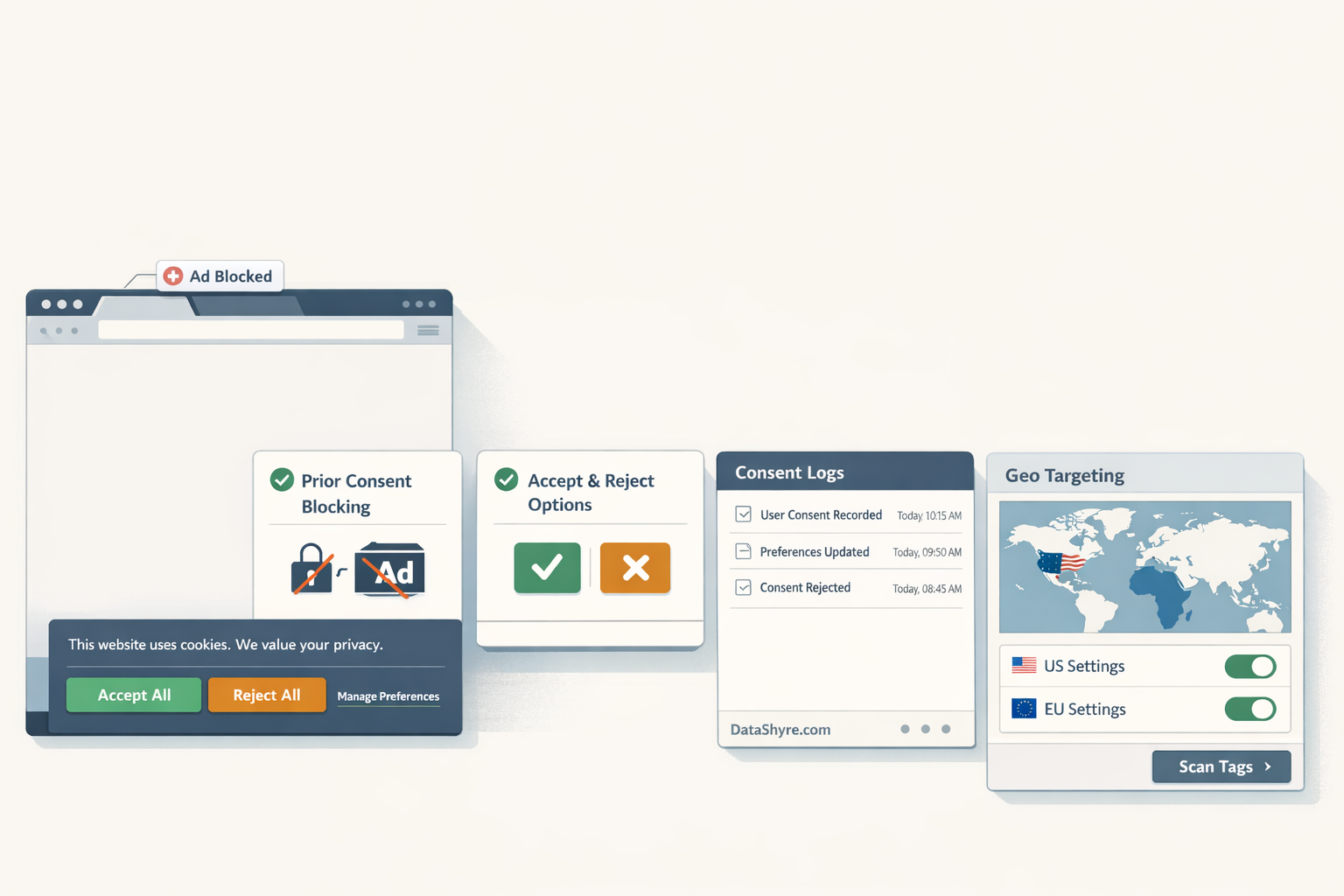
If the tool only changes the banner text while analytics or ad tech still fires, move on. The first job of a CMP is operational: stop non-essential tracking until the user has made the relevant choice.
2. Rejecting is as easy as accepting
This is where cheap tools often reveal themselves. A bright “Accept all” button paired with a faint text link is not a clever UX pattern; it is a risk pattern. As former UK Information Commissioner John Edwards put it, users should find it “just as easy to reject all non-essential cookies” as accept them.
3. The first layer explains enough to support a real choice
You do not need to cram your whole privacy policy into the banner. You do need plain-language purposes, a visible path to reject or customize, and enough clarity that users know what they are agreeing to. The ICO’s current consent guidance stresses clear and comprehensive information, while the DPC warns against hiding critical choices behind confusing toggles or off-position settings.
4. It keeps consent records you can export
Budget or not, your tool should log what categories were offered, what the user selected, when the event happened, and which configuration version applied. If a complaint lands or your site changes hands internally, screenshots alone will not save you.
5. It supports region-aware logic
One global banner can support multiple legal paths, but it should not force identical defaults everywhere. EU and UK traffic usually needs prior consent for non-essential tracking. California teams, meanwhile, should check whether the tool can support Global Privacy Control and opt-out flows where sale or sharing rules apply. The California Department of Justice says a user-enabled GPC signal is one acceptable method for online opt-out requests.
6. It connects cleanly to your tag stack
You do not need the fanciest interface. You do need a tool that can pass consent state into your tag manager, analytics setup, and advertising systems so choices change system behavior. If your marketing team has to maintain manual workarounds every time a script changes, the “budget” tool will get expensive fast.
7. It helps you catch drift
Websites change. Plugins get added. New vendors appear. Embedded forms bring their own trackers. A low-cost platform is still worth paying for if it can rescan properties, flag changes, or at least make audits easy enough to run regularly.
Where cheaper tools usually break
The failures are surprisingly repetitive:
- They load trackers before the banner has any chance to work.
- They treat “manage preferences” as the reject path and make users click through extra layers.
- They rely on generic third-party cookie descriptions instead of explaining the site’s own deployment.
- They collect consent, but cannot prove which scripts were governed by it.
That is why EDPB Chair Anu Talus said privacy options should be presented in an “objective and neutral way”. The line came from a dark-patterns decision outside the cookie-banner niche, but the principle travels well: if the interface nudges the answer, the budget savings are not worth much.
A simple buying rule
Here is the rule I would use: if a cheaper product can handle blocking, equal choice, proof, regional logic, and tag integration, it may be the right buy. If it cannot do those things, it is not affordable cookie consent management at all. It is deferred cleanup.
One more practical test helps. Ask the vendor to show:
- the banner in an EU flow;
- the reject path in one click or clearly equivalent effort;
- a consent log export;
- a live example of tags staying blocked until consent changes.
If the demo gets slippery on any of those, trust the demo. It is telling you what implementation week will feel like.
A light note: this is an operations guide, not legal advice. It is still the sort of buying discipline that can save a privacy team from needless rework.
Sources
- UK Information Commissioner’s Office
- Irish Data Protection Commission
- CNIL
- European Data Protection Board
- California Department of Justice