

OneTrust vs. lighter CMPs: what to compare before you buy in 2026
People searching onetrust vs are rarely looking for a generic feature grid. They are usually trying to answer a sharper question: do we need an enterprise consent stack, or would a lighter CMP handle the website, app, and ad-tech work without creating a heavier operating burden?
That is the right question to ask in 2026. Google’s publisher rules still require a Google-certified CMP integrated with the IAB Transparency and Consent Framework when serving personalized ads in the EEA, the UK, and Switzerland. Meanwhile, UK and French regulators still expect real choice, real blocking, and refusal that is as easy as acceptance. So this comparison is not just about banner design. It is about scope, proof, and whether the product fits the team that has to run it after launch.
If you need OneTrust setup detail first, start with our OneTrust cookie consent checklist, the OneTrust GTM implementation guide, or the broader Cookie Consent Manager OneTrust rollout guide.
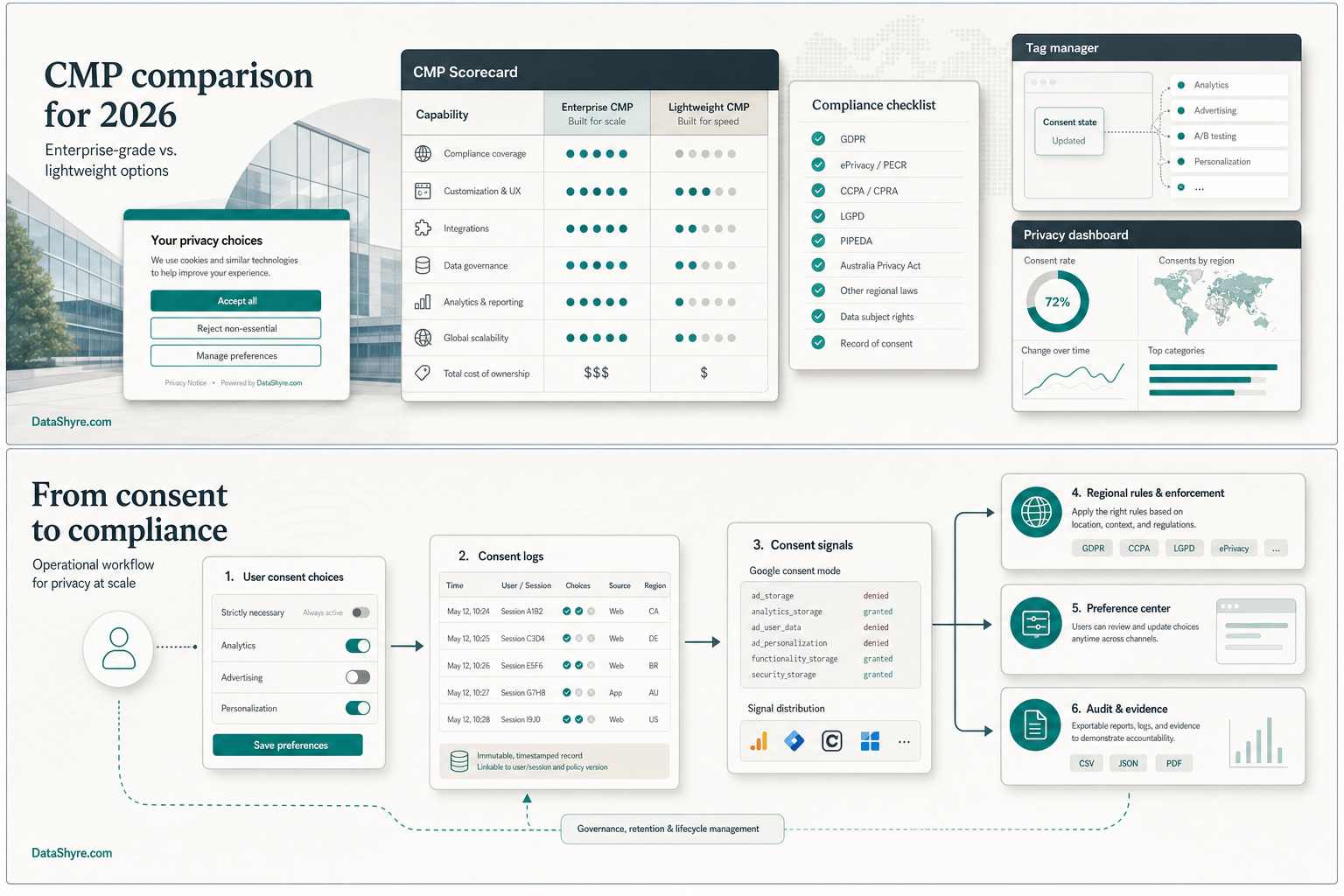
What OneTrust brings that smaller CMPs often do not
OneTrust’s current packaging makes the product boundary pretty clear. CMP Base covers consent capture across web, mobile, and CTV. CMP Suite expands that into notices and DSR support. Universal Consent & Preference Management goes further with preference centers, profile-level consent, and synchronization across marketing systems.
That matters because many lighter CMPs are still mostly web-banner products. They may be perfectly fine if your real need is cookie scanning, blocking, regional banners, and a straightforward consent log. But if you also need cross-domain syncing, app support, known-user preference orchestration, or a broader privacy operating model, OneTrust starts to pull away.
Leanne White, Data Privacy Manager at Samsung, said OneTrust helped provide users the “best possible experience.” That feels like the right test. A bigger platform should give you a better operating experience, not just a longer procurement process.
The five checks that make this comparison practical
1. Are you buying a website CMP or a broader consent program?
This is the first filter. If your problem is limited to one or two websites, modest traffic, and a basic need to block non-essential trackers until consent, a lighter CMP may be the cleaner answer.
If your problem includes apps, connected TV, multiple brands, known-user preferences, or downstream marketing systems, the balance changes. OneTrust’s current materials emphasize consent across websites, mobile apps, OTT apps, connected TVs, and synchronized customer journeys. A simpler CMP may still work, but only if you are sure you will not need those extra layers six months later.
2. Does your ad stack make certification non-negotiable?
If you serve personalized ads in Europe or Switzerland, this question gets easy fast. Google’s current publisher help says a certified CMP integrated with the TCF is required for personalized ads in the EEA and UK, and since July 31, 2024, in Switzerland as well. Google also lists Onetrust / CookiePro as a certified CMP across web, app, and CTV.
That does not automatically make OneTrust the best choice. It does mean any alternative needs to clear the same threshold. If your lighter CMP is not certified for the environments you use, the comparison is over before it begins.
You should also check consent mode support. Google’s consent mode guidance now includes ad_user_data and ad_personalization, and it expects those defaults and updates to be handled before measurement fires. In other words, the banner is only part of the job. The signal plumbing matters too.
3. Can the tool prove consent, not just collect it?
This is where teams get disappointed. A neat banner demo is not the same as usable evidence. You want to know whether the platform can show what fired, what was blocked, what the user chose, which rule applied, and how that record can be retrieved later.
OneTrust’s product and developer materials still lean into auto-blocking, geolocation-aware rules, and consent preference retrieval. That is useful. But it only counts if your implementation team actually turns those features into a reliable recordkeeping process.
John Edwards, the UK Information Commissioner, put the regulator’s view plainly: it must be “just as easy to reject” non-essential cookies as it is to accept them. The ICO’s current guidance says non-exempt technologies must stay off until valid consent exists, and the consent mechanism has to function as intended. Any vendor comparison that ignores proof and enforcement logic is too shallow.
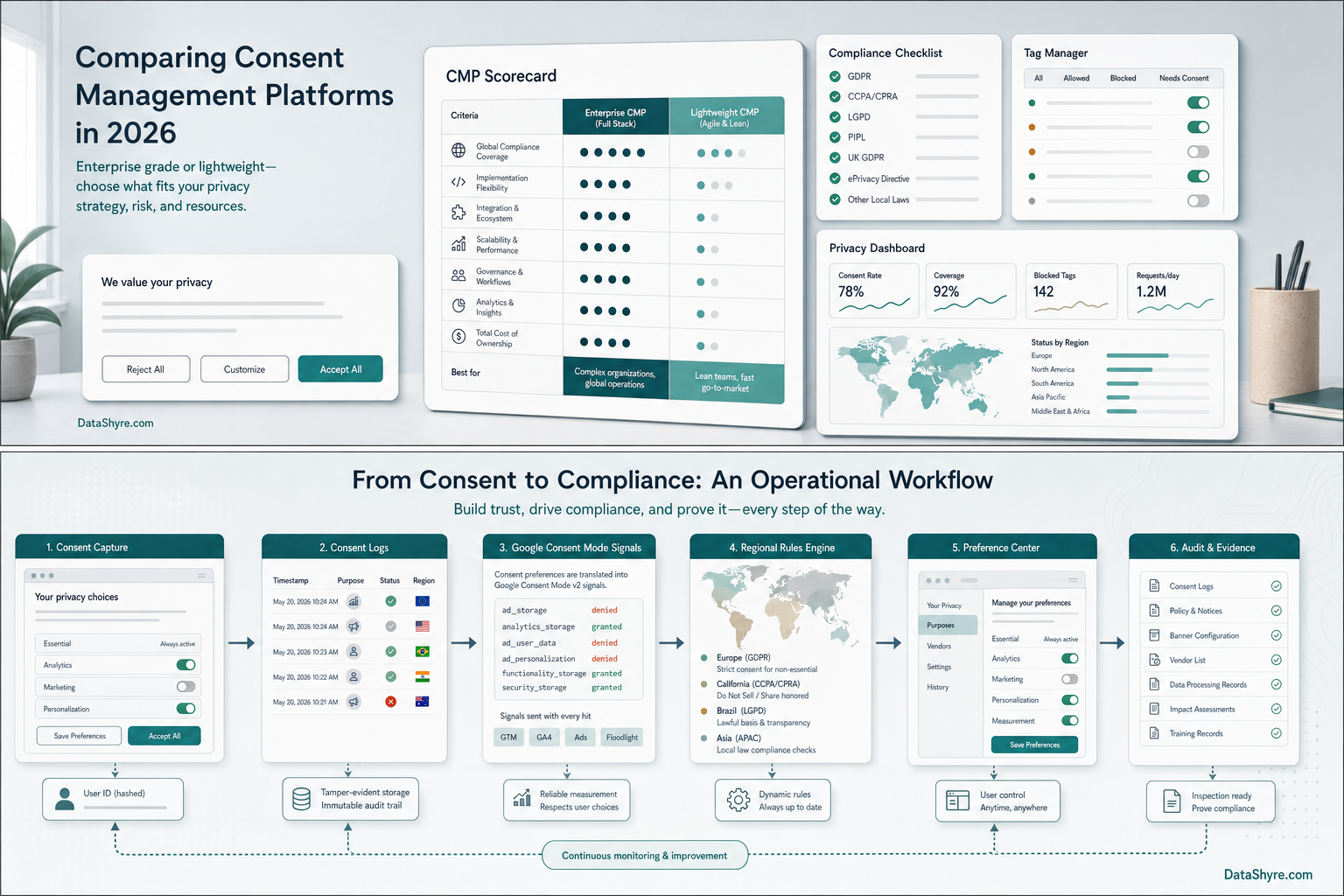
4. Is onetrust vs really a preference-management decision?
This is where the comparison usually stops being a pure CMP decision. If the real project includes email preferences, first-party data capture, known-user profiles, or syncing consent across Salesforce, Adobe, Snowflake, or other systems, then you are evaluating a broader consent-and-preferences layer, not just a cookie banner.
OneTrust has a real story here. Its current Consent & Preferences materials talk about unified profiles, preference centers, and synchronization across marketing systems. Many lighter CMPs do not try to cover that space. That is not a flaw if you do not need it. It is a problem if you discover mid-rollout that you do.
5. Can your team operate the product without living in it?
This is the least glamorous question and often the most important one. Bigger platforms solve bigger problems, but they also ask more from the team running them.
Ask who will own scans, categorizations, geolocation rules, consent templates, app releases, vendor updates, downstream integrations, and evidence pulls. If the honest answer is “nobody yet,” then a smaller CMP may be the safer choice. If the business already has privacy ops, marketing ops, and engineering support around the process, OneTrust may be a better fit.
Anu Talus, Chair of the EDPB, said privacy options should be “objective and neutral” and avoid manipulative design. That standard applies to software buying too. Do not let the flashiest demo steer you into a heavier stack than your team will realistically maintain.
A simple way to make the call
Choose OneTrust when you need multi-channel scope, certified ad-tech support, preference orchestration, and stronger operating controls around consent evidence.
Choose a lighter CMP when the job is mostly website-level consent, the operating model is lean, and you want less admin overhead without giving up valid blocking and logging.
onetrust vs is really a scope question disguised as a product comparison. Get the scope right and the buying decision gets much easier.
Bottom line
The best comparison is not OneTrust versus a logo wall of vendors. It is OneTrust versus the problem you actually have. If you need enterprise consent infrastructure, OneTrust can make sense. If you need a disciplined website CMP with less overhead, a lighter option may be the smarter buy. Either way, judge the tools on certification, proof, preference depth, and the day-two workload your team will inherit.
Sources
- Google Ad Manager Help
- Google tag platform consent mode guide
- UK Information Commissioner’s Office guidance on storage and access technologies
- UK Information Commissioner’s Office speech by John Edwards at IAPP UK 2024
- European Data Protection Board annual report and consent materials
- CNIL cookie enforcement notice
- OneTrust cookie consent product page
- OneTrust consent and preferences page
- OneTrust pricing and packaging page
- OneTrust developer documentation