

Nonprofit Consent Management Platform in 2026: 7 Checks Before You Trust It With Donor Data
If you are evaluating a nonprofit consent management platform on August 8, 2026, the fastest mistake to avoid is buying the same story a for-profit ecommerce team would buy.
Nonprofits usually have different pressure points. The traffic may come through donation pages, event signups, volunteer forms, supporter newsletters, advocacy tools, embedded payment providers, and fundraising analytics. The compliance picture is different too. California’s Department of Justice still says the CCPA generally does not apply to nonprofit organizations, while the European Commission still says valid consent must be “freely given, specific, informed and unambiguous” and that it must be “as easy to withdraw as to give consent.” In the UK, the ICO updated its charity guidance on April 28, 2026 to explain a new charitable-purposes soft opt-in for some supporter email, text, and messaging activity, while also keeping separate rules in place for tracking pixels and other storage-and-access technologies.
That is why this kind of platform should be reviewed as an operating control, not just a banner tool. If you want adjacent context first, start with our guides to consent management platform best practices, consent management provider, and user consent. This article stays narrower. It is the seven-check review I would use before trusting a nonprofit setup this week.

Why the nonprofit version is different
A lot of nonprofit teams inherit privacy tooling from agencies, donation vendors, or general website templates. That often creates a mismatch between the visible notice and the real data flow.
The real review has to follow the supporter journey:
- what runs on the donation page before the person acts;
- what analytics or ad tools activate around fundraising campaigns;
- how supporter marketing preferences are captured and updated;
- whether embedded forms, chat tools, or video platforms respect the same choice;
- what proof the organization can still show later.
That is especially important now because the ICO’s current storage-and-access guidance expressly reaches cookies, tracking pixels, fingerprinting, and similar technologies rather than only classic cookie banners. For nonprofits, that can affect not only the website but also email tracking and campaign tooling.
7 checks before you trust one
1. Make sure the platform governs real supporter-facing technologies
The first question is not whether the product can display a banner. It is whether it can control the things your nonprofit actually uses.
For many organizations, that means verifying control over:
- donation-page analytics and campaign measurement;
- fundraising or CRM embeds;
- video, chat, and event widgets;
- A/B testing or personalization tools;
- downstream preference signals for email or outreach systems.
If the tool mainly edits text, button colors, and category labels while your team still has to enforce the real behavior elsewhere, you are not buying much control. You are mostly buying a front end.
2. Separate website tracking consent from supporter marketing permissions
This is one of the biggest nonprofit-specific design traps.
The ICO announced on April 28, 2026 that charities can now use a new charitable-purposes soft opt-in for some supporter email, text, and messaging activity if the legal requirements are met. That change matters for fundraising and supporter engagement, but it does not turn every privacy choice into one combined permission. The ICO’s current electronic-mail guidance still says organizations normally need consent for unsolicited electronic mail marketing to individuals unless a soft opt-in applies, and its updated guidance also says tracking pixels in marketing emails are covered by PECR’s separate storage-and-access rules.
So a stronger platform should help you keep these flows distinct:
- donation-page or website tracking consent;
- supporter email and text permissions;
- broader account or profile preferences;
- campaign-specific opt-outs or unsubscribe events.
If your system treats one newsletter signup or one donation click as permission for every later tracking or outreach action, the records will look cleaner than the reality.
3. Do not let California exemptions create false confidence
California is still relevant, but not always in the way nonprofit teams assume.
The California DOJ’s current CCPA page says the law generally does not apply to nonprofit organizations. That means many nonprofits should avoid blindly copying a California for-profit privacy playbook and calling it done. The exemption is real, but it should not be read as a reason to stop reviewing tracking behavior altogether.
A nonprofit may still need a serious platform because:
- it serves UK or EU visitors whose tracking activity may require consent;
- it wants consistent supporter trust controls across fundraising properties;
- it relies on vendors whose tools behave differently once a preference changes;
- it needs clean records for internal governance, grants, partnerships, or board review.
The useful lesson is not “privacy tooling does not matter for nonprofits.” It is “the legal driver may be different, so the platform should be designed around the nonprofit’s actual flows.”
4. Verify prior blocking and fair refusal where opt-in consent is required
This is where many polished setups still fail.
The European Commission’s current guidance still says valid consent must be freely given, specific, informed, and unambiguous. The ICO’s storage-and-access guidance makes clear that these expectations apply to technologies such as cookies and tracking pixels when consent is required. That means the platform cannot be judged only by its first-layer copy. It has to be judged by runtime behavior.
The practical test is still simple:
- Open the donation page in a clean session.
- Check what optional analytics, advertising, or personalization tools fire before any click.
- Use
Reject allif the flow offers it and confirm the optional technologies stay off. - Reopen preferences and allow only one category to verify the change is narrow.
If refusal is harder than acceptance, or if optional trackers run before the choice, the platform is weaker than it looks.
5. Test withdrawal and later preference changes on the same page
Acceptance is not the hard part. Reversal is.
The European Commission still states the baseline plainly: it should be “as easy to withdraw as to give consent.” For a nonprofit, that matters because supporter trust is often tied to long relationships. A donor or volunteer who changes their mind should not have to guess where the control lives or wait for a later visit before the website behaves differently.
That means testing whether the platform can:
- reopen settings without friction;
- record a narrower choice after a broader one;
- stop optional tracking immediately where that change should affect the live page;
- pass the updated state into dependent tools without delay.
If the user can change the record but not the runtime behavior, the platform is only halfway implemented.
6. Keep proof that explains what supporters actually saw
Nonprofits often need evidence for more audiences than commercial teams do. It may be a privacy lead, an outside advisor, a funder, a partner organization, or a board member asking what happened on a campaign page.
The best record set is usually straightforward:
- the notice or preference version shown;
- the categories or purposes offered;
- the time and source of the choice;
- the region or rule logic applied;
- the downstream systems expected to change;
- later withdrawal, opt-out, or unsubscribe events.
This is also where nonprofit-specific flows matter. If your organization uses the new UK charitable-purposes soft opt-in in some places, the evidence should make clear where you relied on that route and where you relied on consent instead. Mixing those into one flat event history creates confusion later.
7. Follow the choice into fundraising, CRM, and campaign tools
The visible prompt is only the front edge of the system.
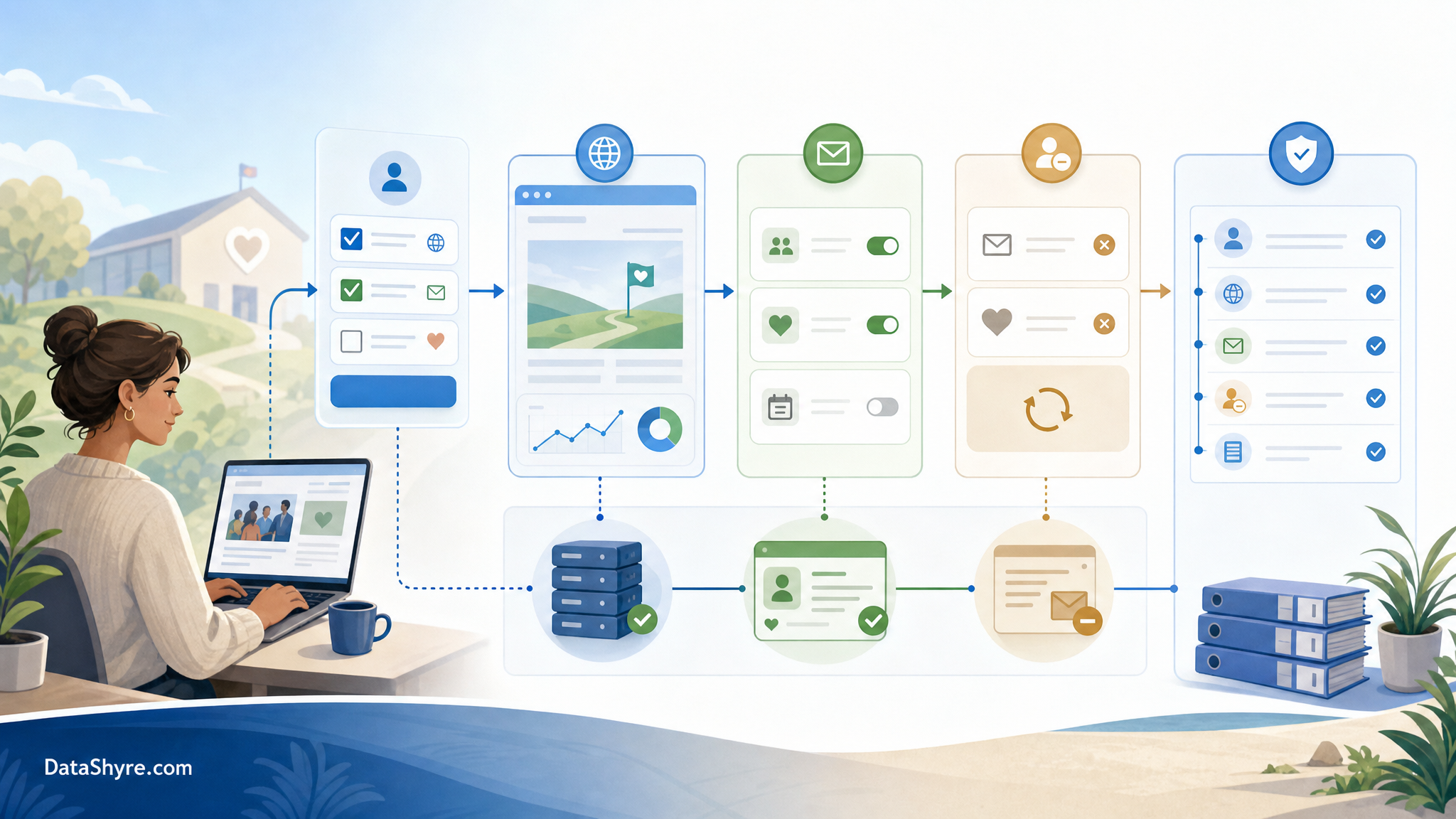
What matters more is whether the choice reaches the rest of the stack:
- analytics and tag managers;
- donation or checkout integrations;
- CRM and supporter databases;
- marketing automation tools;
- audience or advertising platforms;
- reporting views used by staff.
This is where a weak platform usually breaks. The banner stores a preference, but embedded vendors, CRM syncs, or fundraising analytics continue as if nothing changed. When that happens, the organization ends up with a record of a choice but not reliable enforcement of the choice.
A short review sequence I would use this week
If I were screening or rechecking a nonprofit setup right now, I would do this in order:
- Map the main supporter journeys: donation, signup, volunteer, event, and outreach.
- List every technology that stores, accesses, or acts on supporter data in those flows.
- Separate website tracking consent from supporter marketing permissions.
- Test prior blocking and refusal on the live donation and signup pages.
- Change the preference on-page and verify downstream systems react.
- Inspect the proof kept for consent, soft opt-in use, unsubscribe, and withdrawal events.
- Re-test after new campaign tools, embeds, or fundraising vendors are added.
That short sequence tells you more than a banner demo and more than a generic CMP feature comparison.
Bottom line
The right nonprofit consent management platform in 2026 is not the one with the nicest banner templates. It is the one that can separate tracking consent from supporter messaging permissions, reflect the nonprofit’s actual donor and volunteer flows, make withdrawal easy, and leave behind records another person can understand later.
If your current setup can prove those points on live pages and in downstream tools, you are in much better shape than most nonprofit teams running inherited templates. If it cannot, the fix probably starts in the operating model before it starts in the design panel.
Sources
- UK ICO: Guidance on the use of storage and access technologies
- UK ICO: Charities given new flexibility to contact supporters under data law change
- UK ICO: Guidance on direct marketing using electronic mail
- UK ICO: What else do we need to consider?
- European Commission: When is consent valid?
- European Commission: What if somebody withdraws their consent?
- California Department of Justice: California Consumer Privacy Act (CCPA)
This post was updated on August 8, 2026 using current official regulator and government materials available at publication time.