

GDPR Cookie Consent Requirements: 7 Rules for Valid Banners in 2026
A lot of cookie banners still look polished and still fail the legal test. The core gdpr cookie consent requirements are easy enough to summarize, but teams still get tripped up by timing, button design, vague categories, and weak consent records.
If you want design inspiration first, our roundup of GDPR cookie consent examples shows what better implementations look like. If your measurement stack is part of the problem, this guide to Google Analytics cookie consent is a useful companion.
The legal split is still straightforward. ePrivacy rules drive the need for consent before most non-essential cookies or similar trackers are set, and the GDPR sets the standard for what valid consent looks like. What has changed is the tolerance level. Regulators are now much less interested in whether you have a banner at all, and much more interested in whether the banner changes what actually happens on the page.
GDPR cookie consent requirements: the 7 rules that matter most
1. Get consent before non-essential cookies fire
This is the first filter. If analytics, advertising, personalization, or social media cookies load before the visitor decides, the flow is already in trouble. The EDPB’s cookie banner taskforce report treats pre-consent placement of non-essential cookies as a recurring problem, and CNIL’s cookie guidance says consent must come before reading or writing non-exempt trackers.
2. Consent has to be an active, specific choice
A banner cannot rely on silence, scrolling, or a box that is already ticked. In the Planet49 judgment, the Court of Justice of the EU made the point plainly: a pre-checked box does not produce valid consent. That lines up with GDPR Recital 32, which requires a clear affirmative act.
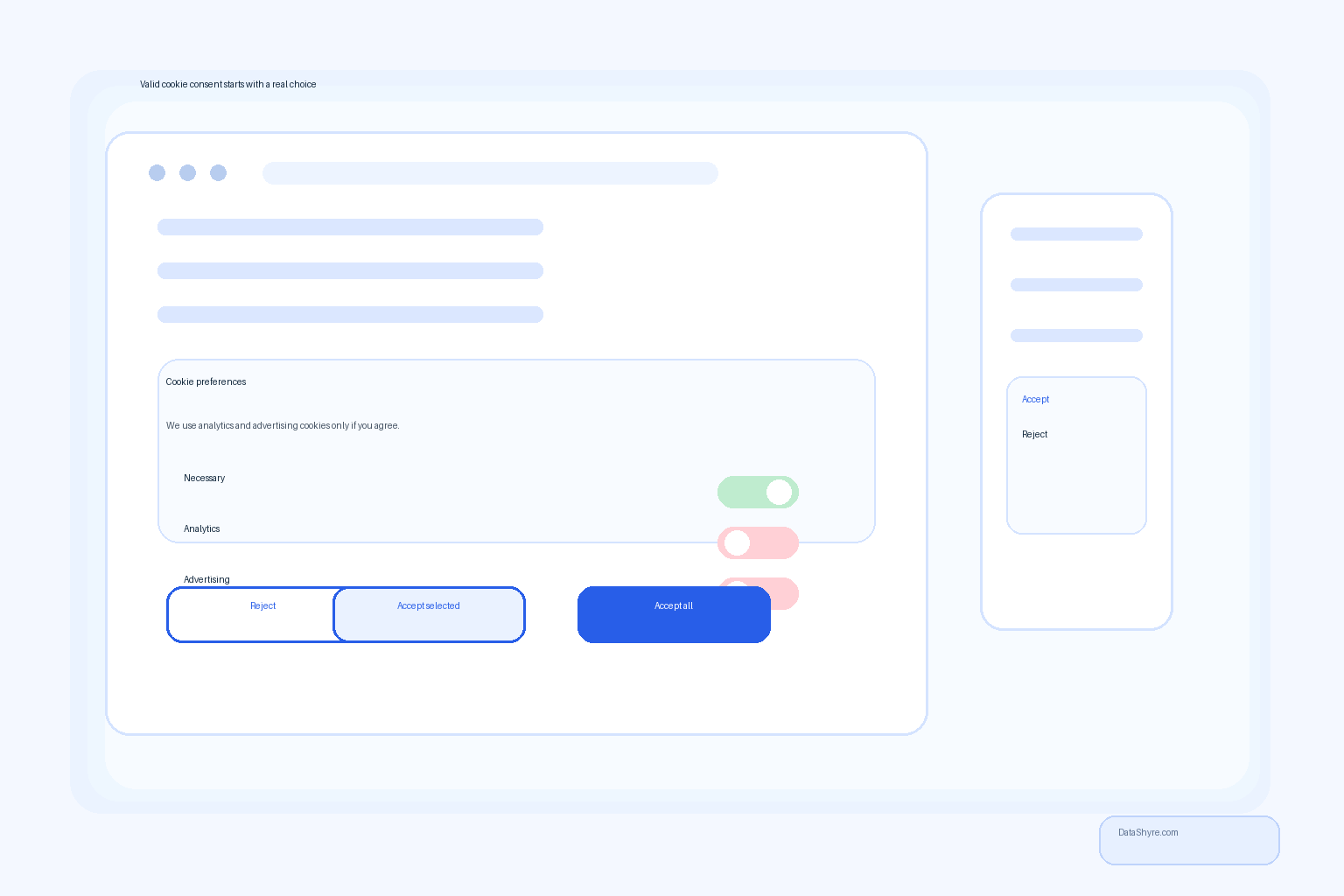
In practice, this means separate choices for real categories. Analytics, ads, and personalization should not be bundled into one fuzzy “agree” path.
3. Refusing should not feel harder than accepting
This is where many banners still drift into dark-pattern territory. A bright first-layer “Accept” button with a buried reject path is exactly the sort of design regulators keep examining. CNIL says users should be able to refuse cookies as easily as they accept them, and the EDPB taskforce also flagged misleading button contrast, deceptive wording, and harder refusal paths.
Max Schrems, chair of noyb, put the design standard neatly after an Austrian court decision on cookie banners in May 2026: users need “equally prominent ‘yes’ and ‘no’ options.” That is a good product rule as well as a legal one. If the reject path looks hidden, it probably is.
4. Tell people what each category actually does
“We use cookies to improve your experience” is still too vague. Users need clear information on purposes, categories, and, where relevant, third parties. If advertising or measurement tags send data to vendors, say so plainly.
This is where legal text and product UI often drift apart. The privacy notice talks about partners, processors, and purposes. The banner shows labels like “performance” or “experience” with no context. That gap matters because consent is only informed if an ordinary user can understand what they are being asked to approve.
5. Keep proof of consent and make withdrawal easy
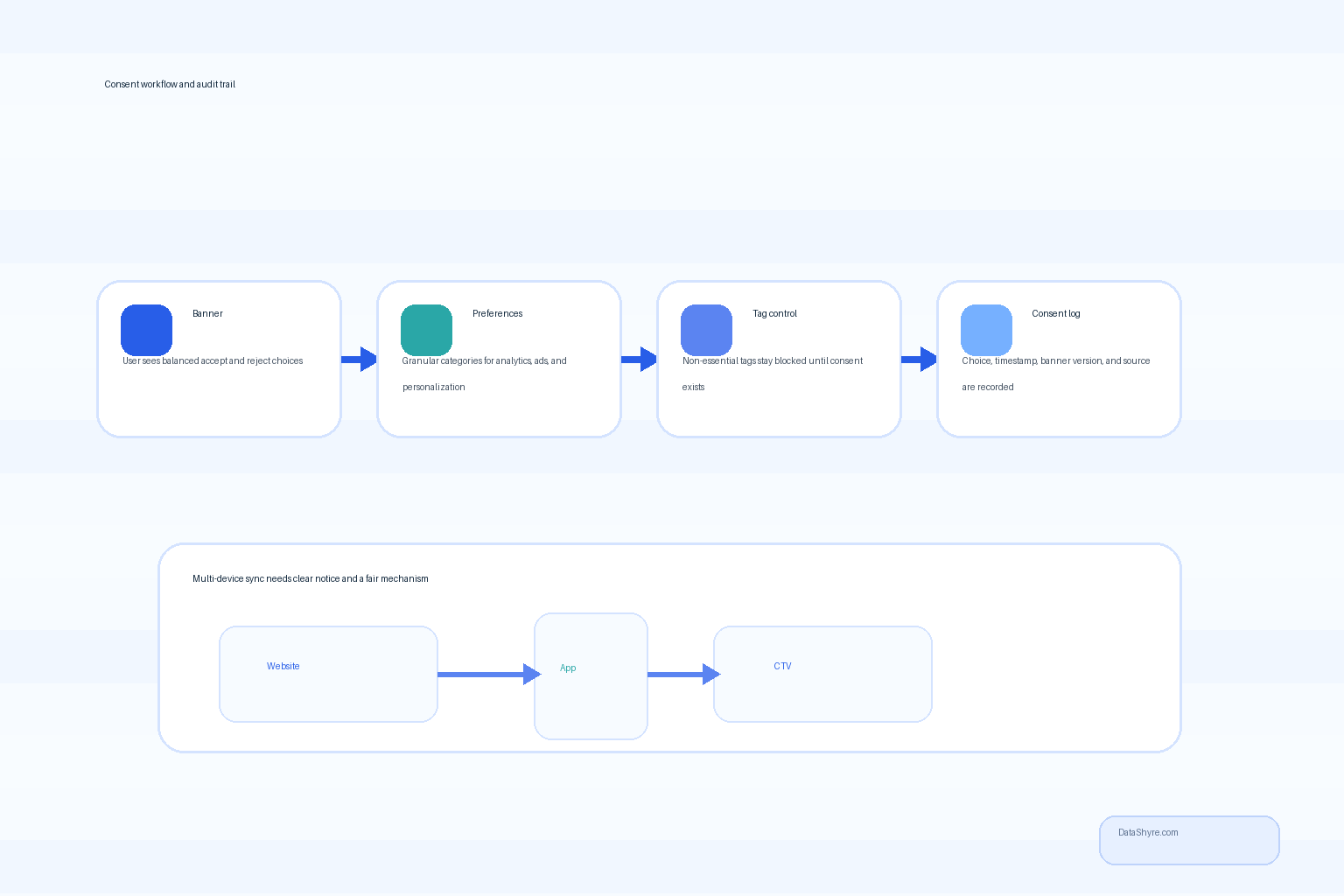
A valid banner is not just front-end design. You also need records that show what the user chose, when they chose it, and what version of the banner was shown at the time. Withdrawal matters just as much. If a user cannot reopen preferences later, the control is mostly cosmetic.
That is why consent logs, preference centers, and tag behavior have to line up. In April 2026, ICO Executive Director Regulatory Risk William Malcolm said people should be given “meaningful control” and “clear choices” over cookies and similar tracking. That applies neatly to cookie flows: if your stack keeps collecting after a refusal, the banner copy will not save you.
6. Use the “strictly necessary” exemption carefully
Some cookies do not require consent, but the exemption is narrower than many teams want it to be. It usually covers functions genuinely needed to provide a service the user asked for, such as authentication, security, or a shopping cart state. It does not automatically cover analytics, A/B testing, ad measurement, or convenience features just because the business finds them helpful.
That distinction keeps coming up because weak implementations still re-label borderline tools as necessary and move on. Regulators have seen that move for years.
7. Recheck multi-device and downstream behavior
The banner is only the start. In January 2026, CNIL published final recommendations on collecting consent across multiple devices in logged-in environments. The point is simple: if you apply a user’s choice across devices, the user has to be informed and the mechanism has to stay fair.
This is an easy place to miss downstream problems. A user may reject tracking on the website, but a connected app, TV app, or vendor sync can still undermine the result. For businesses with multiple domains, apps, or connected products, the real test is not the banner alone. It is what the whole system does afterward.
What enforcement is telling teams now
Recent enforcement is not subtle. In its 2025 sanctions summary, CNIL said cookies were one of the main subjects of enforcement that year, with cumulative fines across all sanctions reaching EUR 486,839,500. It also highlighted repeated failures around trackers being placed without consent, weak information, and failures to respect refusals or withdrawals.
That is a useful reminder that valid consent is not just a banner-copy issue. It touches ad products, account flows, consent records, and technical behavior.
If you are evaluating vendors at the same time, our checklist for choosing a consent management provider can help separate real controls from sales copy.
A quick business checklist
Before you approve the next banner release, check these five points:
- no non-essential tags fire before consent;
- reject is visible immediately or just as easy to reach as accept;
- categories are specific enough for a normal user to understand;
- consent records are stored and tied to the banner version shown; and
- withdrawal works later across the same environments where consent was collected.
That is not glamorous work. It is usually the work that decides whether a banner is defensible.
The takeaway
Meeting these rules in 2026 is less about polishing the banner text and more about fixing the machinery behind the choice. Buttons matter. Timing matters. Logs matter. Vendor behavior matters.
The teams that get this right usually stop treating the banner as a design widget and start treating it as a control point.
Sources
- European Data Protection Board
- Court of Justice of the European Union
- EUR-Lex
- CNIL
- Information Commissioner’s Office
- noyb