

GDPR Consent Requirements: The 2026 Checklist for Lawful, Provable Permission
A lot of teams talk about consent as if it were the safe default. It is not. The harder truth is that gdpr consent requirements are strict, and regulators usually pay more attention to the quality of consent than to the existence of a checkbox.
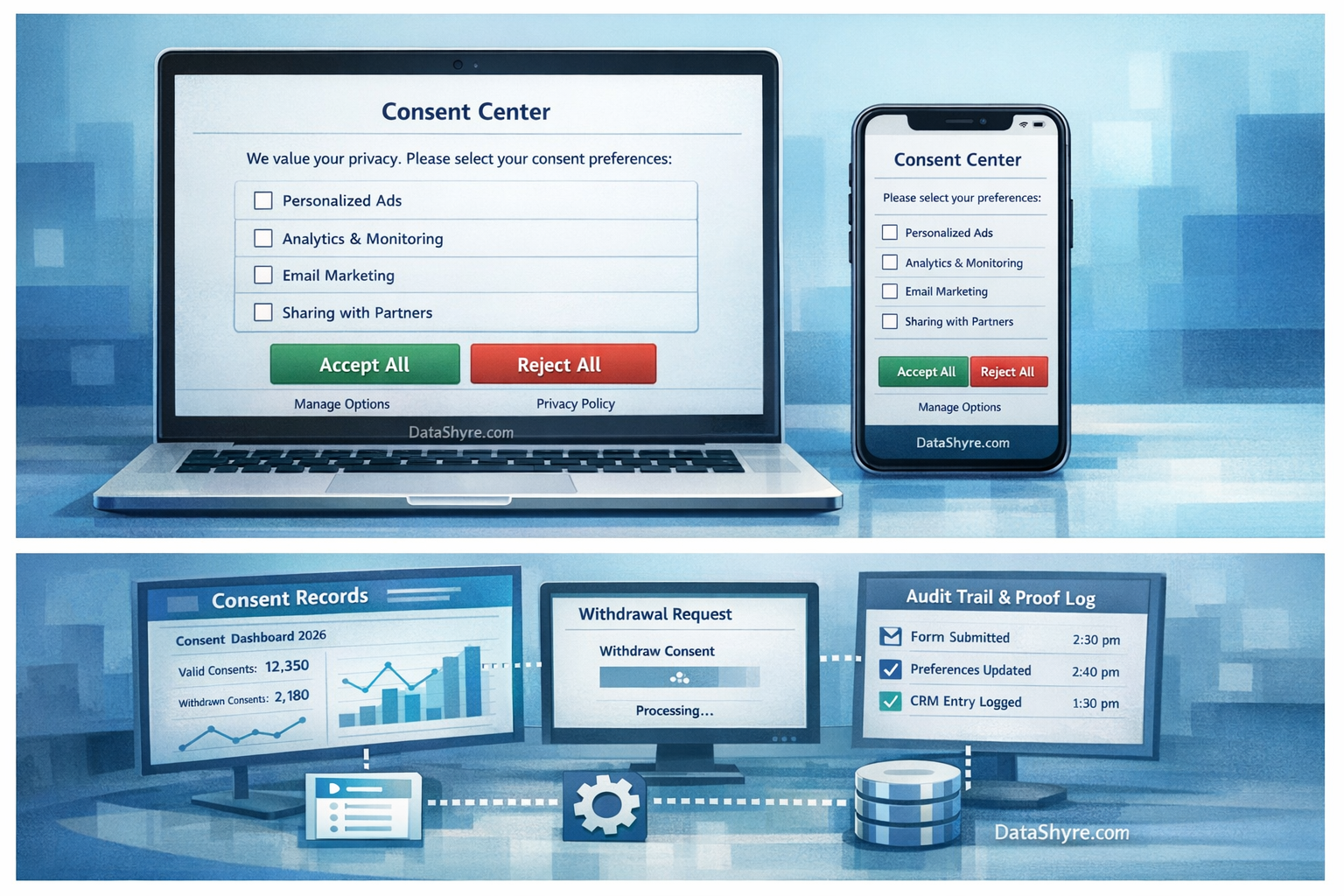
If you are still fixing the wording first, our guide to a GDPR consent form is a useful companion. If your consent problem sits inside email and lifecycle campaigns, this breakdown of GDPR marketing consent helps separate valid opt-in from overcollection.
GDPR consent requirements start with the right legal basis
The first requirement is easy to miss: only use consent when consent is actually the right legal basis. The European Data Protection Board’s small-business guidance says controllers must pick an appropriate legal basis up front, and that consent must be free, specific, informed, and unambiguous. It also makes a point many teams still gloss over: if people cannot withdraw easily, or if your service cannot function without the processing, consent may be the wrong basis.
That is why the work is partly a legal-basis exercise and partly a UX exercise. If product, CRM, analytics, and legal teams are not aligned, the interface ends up promising choice that the backend cannot honor.
A few operational red flags show up again and again:
- the form bundles several purposes into one yes/no decision
- the controller identity is vague or buried
- the request uses pre-ticked boxes or soft defaults
- the withdrawal path is harder than the opt-in path
- the business calls the flow “consent” even though the activity really depends on contract or legal obligation
The EDPB also notes that employment relationships usually involve an imbalance of power. In plain English: if a person may feel pressure to agree, consent is already on shaky ground.
What valid consent must look like in practice
Most of these consent rules can be turned into a short working checklist.
First, consent must be freely given. On April 17, 2024, EDPB Chair Anu Talus said platforms should give users “a real choice.” That line was about “consent or pay” models, but the standard travels well: if the user is cornered, nudged, or punished for saying no, the consent case gets weak fast.
Second, consent must be specific. Separate purposes need separate choices. If you want email marketing, third-party sharing, and personalized ads, ask for them separately.
Third, consent must be informed. The EDPB’s guidance says people should know the controller, purpose, data categories, recipients, and the right to withdraw. If your banner, form, or preference center hides that behind vague labels like “improve experience,” you are not there yet.
Fourth, consent must be unambiguous. The EDPB says this requires a clear affirmative action and no pre-ticked boxes. Silence, inactivity, or clever design tricks do not fix that.
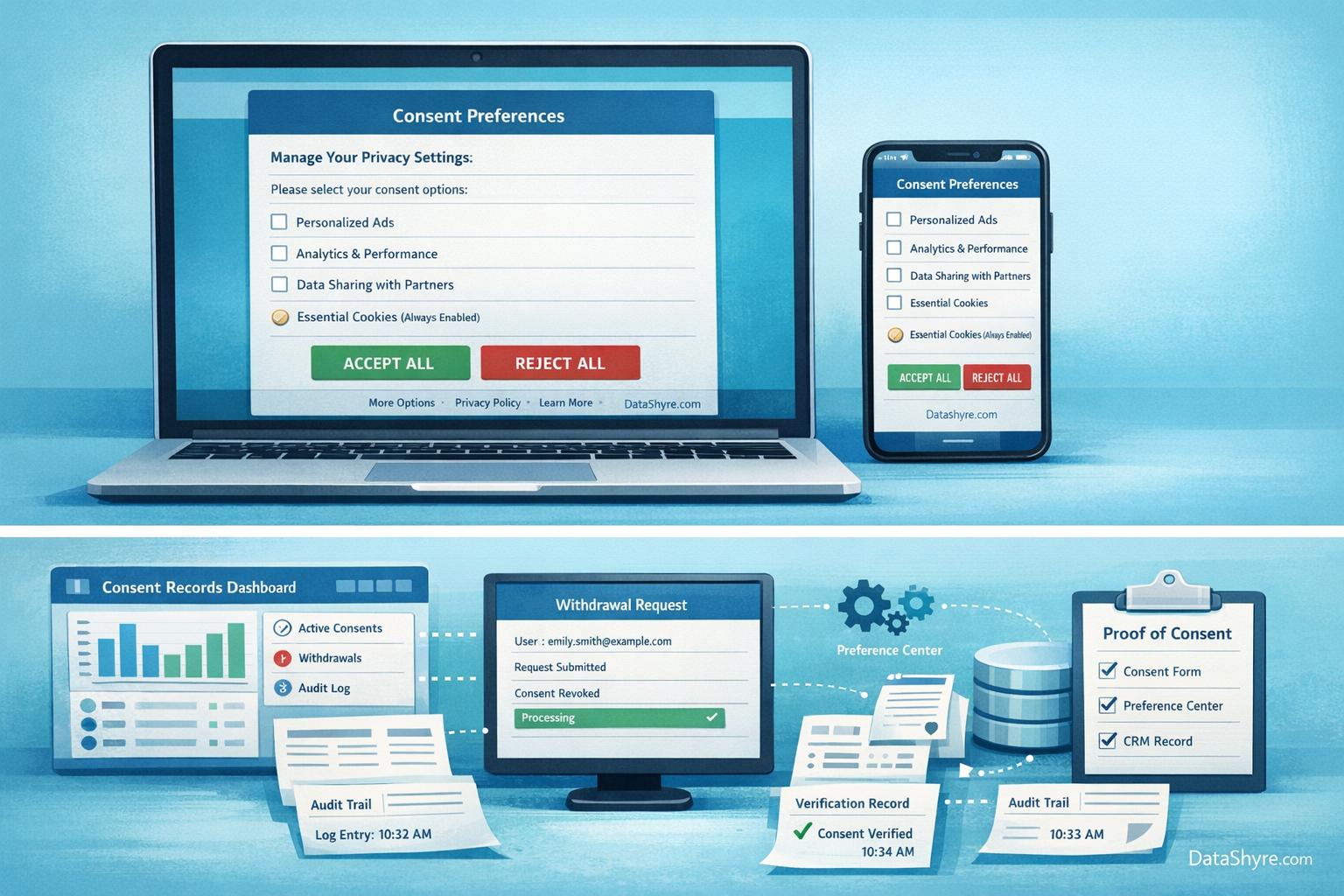
Fifth, withdrawal has to be easy. The European Commission’s GDPR guidance is blunt: it should be as easy to withdraw as to give consent. That means the preference center, unsubscribe path, or app setting has to be obvious and live, not hidden behind support tickets.
For special-category data, the bar is higher again. Consent needs to be explicit, so teams should avoid vague wording and keep a stronger record of the exact statement, timestamp, and context used at collection.
What regulators still care about in 2026
Regulators are not asking for theoretical compliance. They are looking at whether the interface and the underlying systems match.
In December 2024, France’s CNIL said rejecting cookies should be just as easy as accepting them and issued formal notices over misleading banner designs. Several of the practices it called out were painfully familiar: reject links that were visually downgraded, acceptance options repeated more than once, and refusal language that was harder to find or parse.
In the UK, the ICO published final Storage and Access Technologies guidance in April 2026, after consultations and updates linked to changes introduced by the Data (Use and Access) Act 2025. That Act received Royal Assent on June 19, 2025, and the government later brought most of the Part 5 data-protection and privacy provisions into force on February 5, 2026. In that ICO announcement, William Malcolm said organizations want “regulatory certainty” and that people need “meaningful control” over how their data is used. That is a good summary of where enforcement has landed: less patience for decorative consent, more focus on what the controls actually do.
If your program is heavily cookie-driven, our separate guide to GDPR cookie consent requirements goes deeper on banner design, prior consent, and records.
A practical 2026 checklist
Here is the version worth taking into a launch review:
- Confirm that consent is the right legal basis for each purpose.
- Split purposes so users can say yes to one and no to another.
- Keep the request plain: controller, purpose, recipients, and withdrawal rights.
- Remove pre-ticked boxes and any design that makes refusal harder.
- Make withdrawal immediate and easy across web, app, CRM, and support flows.
- Log proof: consent text, timestamp, source, user action, and later changes.
- Re-ask when the purpose changes or when new downstream use appears.
- Use stronger wording and records when explicit consent is required.
That is the core of these GDPR consent requirements in 2026. This is not about adding more banners or more boxes. It is about making sure the permission you collect is the permission your systems can actually respect.
One light note: this is an operating guide, not legal advice. For launches in sensitive sectors or multi-country programs, legal review is still worth the hour.
Sources
- European Data Protection Board
- European Commission
- Information Commissioner’s Office
- CNIL