

What Happens If a Business Does Not Use a Consent Management Platform?
If you are asking what happens if a business does not use a consent management platform on August 18, 2026, the first accurate answer is: not every business automatically breaks the law just because it did not buy a CMP.
A brochure-style site with no non-essential tracking, no ad-tech, no retargeting, no embedded third-party tools that require consent, and no California sale-or-sharing issues may not need a full consent management platform at all. But that answer changes quickly once the real stack includes analytics, marketing tags, session replay, embedded video, ad measurement, regional logic, or browser privacy signals that have to be honored consistently.
That is why the more useful question is not, Is a CMP legally mandatory in every case? It is, Can this business deliver valid consent, easy withdrawal, working opt-out signals, and usable proof without one?
If you want the adjacent setup guidance first, start with our posts on cookie consent requirements, consent management platform compliance software, and CCPA cookie consent requirements. This article is narrower. It is about what usually happens in practice when a business tries to operate without a consent management platform.
The short answer
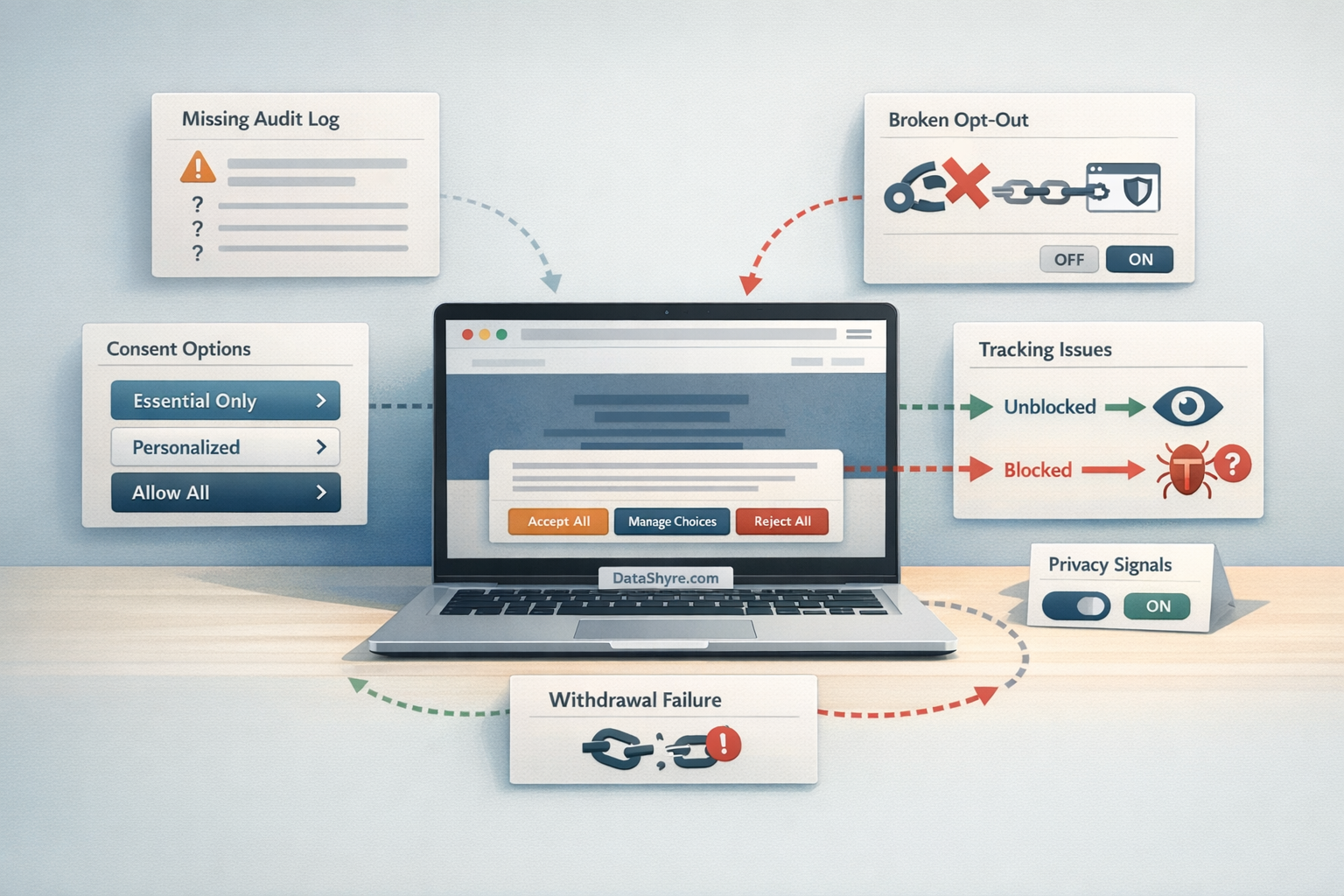
In 2026, what happens if a business does not use a consent management platform usually falls into one of three buckets:
- nothing dramatic, because the site is genuinely simple and does not rely on consent-heavy tracking;
- a growing operations burden, because the team has to recreate CMP functions manually;
- or a compliance gap, because consent, rejection, withdrawal, GPC, or downstream enforcement does not work the way the banner or policy says it does.
The legal problem is rarely the lack of the product by itself. The legal problem is failing the underlying duties that the product is often used to operationalize.
1. The business may still need all the same controls even without the software
This is the point many teams miss.
The European Commission’s current GDPR guidance still says valid consent must be freely given, informed, specific, and expressed through a clear affirmative act. It also says the request for consent must use clear and plain language, state the reasons for processing, and make withdrawal as easy as giving consent.
In the UK, the ICO’s final storage-and-access-technologies guidance published on April 29, 2026 now explicitly covers cookies, tracking pixels, device fingerprinting, and similar technologies. The ICO also added new discussion on what counts as “a simple means of objecting.”
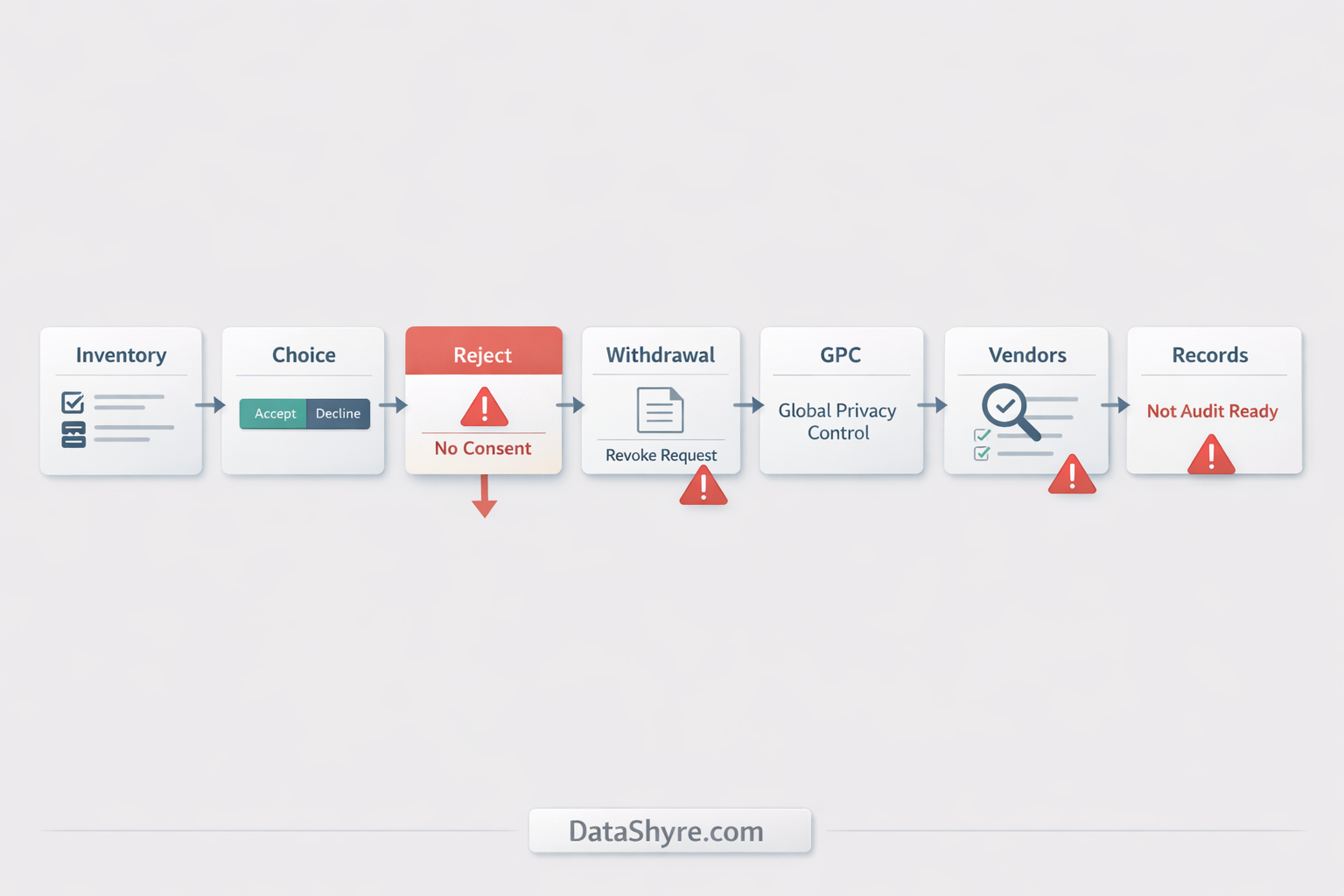
So if a business skips a CMP, none of those obligations disappear. The team still needs some reliable way to:
- decide when consent is required;
- block optional technologies before choice where that rule applies;
- present balanced options;
- remember the choice;
- make withdrawal easy later;
- and prove the mechanism actually worked.
Without a CMP, those jobs move onto engineering, product, marketing operations, legal, or an improvised mix of all four.
2. In the EU or UK, the most common failure is invalid or fragile consent
For European-facing sites, what happens if a business does not use a consent management platform is often not a dramatic homepage failure. It is a quieter runtime failure.
Maybe the banner appears, but analytics loads too early. Maybe reject is technically available, but much harder to find than accept. Maybe withdrawal exists only in the privacy policy footer and breaks on mobile. Maybe a new embed bypasses the original controls entirely.
That is why the current CNIL warning still matters. In its December 12, 2024 dark-pattern notice, CNIL said “Rejecting cookies should be just as easy as accepting them.” It also listed non-compliant patterns such as visually burying the reject option or emphasizing acceptance multiple times.
The EDPB’s July 14, 2026 decision requiring the Belgian DPA to assess the merits of a cookie-banner complaint involving VRT is another reminder that banner and consent-flow disputes are still active enforcement territory, not an old 2021 problem.
If a business operates without a CMP in this environment, it needs exceptional discipline in custom implementation and regression testing. Otherwise the site can slide into invalid consent without anyone noticing until a complaint, audit, or vendor review forces the issue.
3. In California, the bigger risk is often broken opt-out and GPC handling
California creates a different failure pattern.
For many adult-user scenarios, the question is less about prior opt-in to every cookie and more about whether the business actually honors privacy choices tied to sale or sharing, sensitive-information limits, and qualifying browser signals. The CPPA FAQ still says businesses subject to the CCPA must provide methods for consumers to exercise their rights, and it warns that consent does not count if it was obtained through dark patterns.
The California Department of Justice still describes Global Privacy Control as a “stop selling or sharing my data switch.” It also says covered businesses must honor it as a valid request to stop sale or sharing.
That becomes especially relevant when a business has multiple properties, devices, apps, or vendors. In the Attorney General’s February 11, 2026 Disney settlement announcement, California said Disney failed to fully effectuate opt-out requests across devices and streaming services and limited GPC handling to the specific device being used.
So what happens if a business does not use a consent management platform in California? Often the issue is not that the banner is absent. The issue is that the choice does not reach every system that matters.
4. The evidence problem gets worse fast
Even when a custom implementation seems to work, the proof burden remains.
If a regulator, customer, partner, or internal legal team asks what happened for a given user choice, the business may need to show:
- what prompt was shown;
- what the user selected;
- when the selection happened;
- what changed technically as a result;
- whether the choice propagated to tags, vendors, or account-linked systems;
- and whether later withdrawal or opt-out requests were honored.
A mature CMP is not magic, but it often centralizes logs, preference changes, categories, and downstream integrations. Without that layer, many companies fall back on partial server logs, tag-manager assumptions, stale screenshots, and internal guesswork. That is a weak place to be when a complaint turns into an evidence request.
5. Marketing and product changes usually break homemade consent controls
This is the operational reason many small custom setups age badly.
At launch, the custom script may have handled one analytics tag and one marketing tool. Six months later, the stack includes a new chat widget, a scheduling embed, video analytics, remarketing pixels, server-side routing, a mobile web variant, and a second region-specific choice flow. Nobody fully re-maps the logic, because no one owns the whole surface.
The ICO’s April 2026 announcement is useful here because William Malcolm said organizations wanted “clear, practical guidance they can rely on.” That is not just a regulator line. It reflects a real engineering problem. Consent flows fail when nobody can reliably say which technologies are in scope, which legal branch applies, and what exactly should happen after reject, withdraw, or GPC.
In practice, what happens if a business does not use a consent management platform is often a drift problem: the site keeps changing while the original privacy controls do not.
6. Some businesses can still operate without a CMP, but the bar is higher than they think
There are real cases where a CMP is not the best answer.
A business may reasonably stay without one if all of the following are true:
- the site uses only strictly necessary technologies, or the optional ones are extremely limited;
- the team has already mapped every cookie and similar technology in use;
- regional differences are minimal or handled deliberately;
- withdrawal, opt-out, and signal handling are built and tested clearly;
- and the business can document what happened when a person made a choice.
The more those conditions stop being true, the more the no-CMP decision becomes a cost-shifting exercise rather than a simplification.
7. The real consequence is usually one of these four outcomes
When teams ask me what happens if a business does not use a consent management platform, I usually narrow it to four real outcomes:
- You are fine without one because your digital footprint is small and your controls are genuinely simple.
- You build CMP functions yourself and spend more engineering and QA time than expected.
- You think you are compliant but are only partially compliant because one branch, vendor, or device path breaks the promise.
- You create an avoidable enforcement or complaint risk because the interface, runtime behavior, or audit trail does not hold up.
The fourth outcome is the one regulators keep pointing toward. CNIL keeps targeting unfair banner design. The ICO keeps emphasizing real control over storage-and-access technologies. California keeps focusing on friction, dark patterns, and whether opt-out signals actually work.
A practical test for this week
If your team is debating whether it can safely avoid a CMP, use this quick review:
- Inventory every cookie, pixel, SDK, embed, and similar technology currently live.
- Mark which ones are strictly necessary and which depend on consent or opt-out logic.
- Test first-load behavior in each region that matters.
- Test
Reject all, granular settings, withdrawal, and return visits. - Test qualifying browser signals such as GPC where California rules apply.
- Check whether the choice reaches downstream tags, vendors, and account-linked surfaces.
- Save enough evidence that another team could reconstruct the result later.
If that review feels hard to complete confidently, the business may already be at the point where a consent management platform is less a luxury than a practical control layer.
Bottom line
What happens if a business does not use a consent management platform in 2026 is not the same for every company.
Some businesses can operate safely without one. Many cannot do so for long once the stack gets more complex. The real risk is not failing to purchase a specific category of software. The real risk is ending up unable to deliver valid consent, easy refusal, simple withdrawal, working GPC handling, and defensible records across the technologies that are actually live.
If your site is simple, prove it and keep it simple. If it is not, the no-CMP path often becomes the more expensive and more fragile choice.
Sources
- European Commission: When is consent valid?
- European Commission: What if somebody withdraws their consent?
- UK ICO: Final storage and access technologies guidance published
- UK ICO: Guidance on the use of storage and access technologies
- CNIL: Dark Patterns in Cookie Banners: CNIL issues formal notice to website publishers
- European Data Protection Board: EDPB requires Belgian DPA to handle the merits of NOYB cookie banner complaint
- California Privacy Protection Agency FAQ
- California Department of Justice: Global Privacy Control
- California Privacy Protection Agency: Law & Regulations
- CPPA Enforcement Advisory Stresses the Importance of Avoiding Dark Patterns
- California Attorney General: Disney settlement over failures to effectuate opt-out requests
This post was updated on August 18, 2026 using current official regulator, enforcement, and guidance materials available at publication time.