Consent Management Platform Compliance Software in 2026: What to Buy for Control, Proof, and Google Fit
DataShyre StaffAug 4, 2026
8 min read
Consent Management Platform Compliance Software in 2026: What to Buy for Control, Proof, and Google Fit
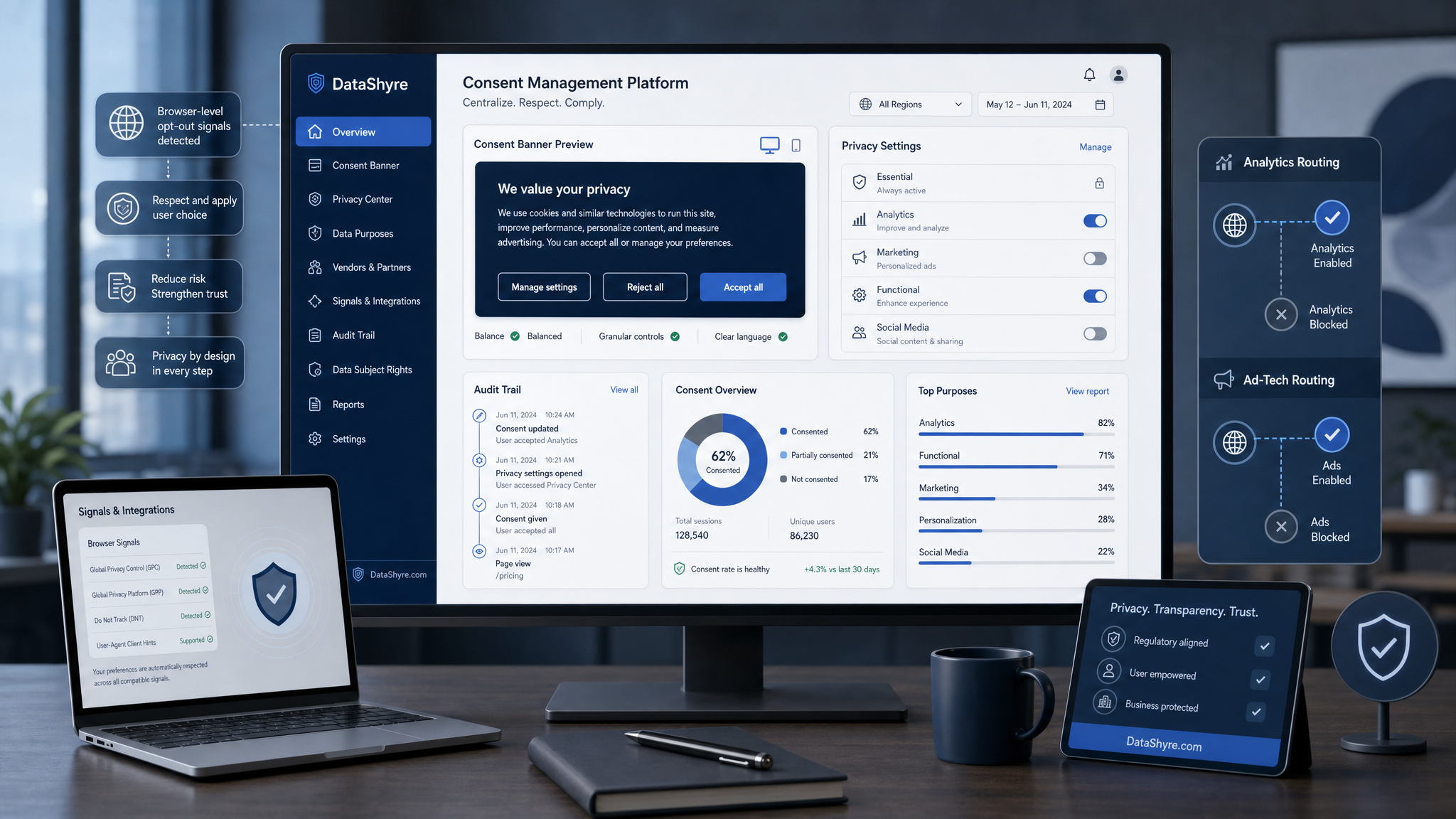
If you are searching for Consent Management Platform Compliance Software, the useful question is not which vendor has the cleanest banner editor. It is whether the software can turn a user’s privacy choice into real runtime behavior across tags, pixels, embeds, analytics, ad systems, and records your team can still explain later.
That matters more on August 4, 2026 than it did a year ago. The ICO published final storage-and-access technologies guidance on April 29, 2026 that reaches cookies, tracking pixels, device fingerprinting, and similar technologies. The European Commission still says valid consent must be freely given, specific, informed, and unambiguous. The EDPB required the Belgian DPA on July 14, 2026 to assess the merits of a cookie-banner complaint involving VRT instead of ending it on a procedural theory. In California, the CPPA’s updated regulations are effective as of January 1, 2026, and the California DOJ still says a valid Global Privacy Control signal must be honored.
If you want the surrounding category context first, start with our guides to consent management platform, consent management provider, and best CCPA compliance software. This article is narrower. It is the buying checklist I would use before signing a contract for Consent Management Platform Compliance Software this week.
What this category should mean in 2026
The phrase Consent Management Platform Compliance Software sounds broader than a CMP alone, and that is exactly how buyers should treat it.
In practice, teams often need three layers:
a consent and preference layer for banners, settings panels, and regional choice logic;
an execution layer that actually controls tags, analytics, ad tech, and embedded tools; and
an evidence layer that records what the user saw, what they chose, what changed downstream, and how that choice can later be withdrawn or updated.
The buying mistake is assuming one attractive interface automatically covers all three.
That assumption is weaker now because regulators keep focusing on actual behavior, not just what the first screen looks like. The ICO’s final 2026 guidance is one signal. So is CNIL’s current enforcement language on dark patterns. And California’s current enforcement posture keeps returning to a basic test: when the user says stop, does the business actually stop?
Why the standard moved
The legal and platform baseline has become more operational.
Under the European Commission’s current guidance, consent has to be freely given, specific, informed, and unambiguous. The request must be clear, concise, and distinguishable from other information. That already pushes software buyers beyond cosmetic configuration.
Then the UK ICO widened the practical review. Its final storage-and-access technologies guidance is not limited to classic browser cookies. It reaches pixels, fingerprinting, and similar storage-or-access methods, and William Malcolm said the aim is a tracking ecosystem that gives people:
“meaningful control over how their data is used.”
>
William Malcolm, ICO
France’s CNIL has been equally direct on interface design:
“Rejecting cookies should be just as easy as accepting them.”
>
CNIL
California adds another layer. The DOJ’s GPC page says browser-level opt-out should be easy and that a valid signal:
“must be honored”
>
California Department of Justice
That means software has to do more than collect a preference. It has to recognize the signal, map it correctly, and propagate the effect to the tools that would otherwise keep selling, sharing, measuring, or personalizing data.
The six checks that matter most
1. Verify the software controls runtime behavior, not just messages
Ask what the product can actually change on a live page or app surface before and after a choice.
The software should be able to influence:
analytics and measurement tags;
advertising and remarketing tags;
embedded tools such as chat, video, and forms;
downstream consent states used by platforms like Google; and
later withdrawals, not just first-page accepts.
If optional technologies still require custom engineering for every meaningful block or update, you may be buying a design layer, not a compliance layer.
2. Test refusal symmetry on the first layer
Weak platforms still make refusal the harder path.
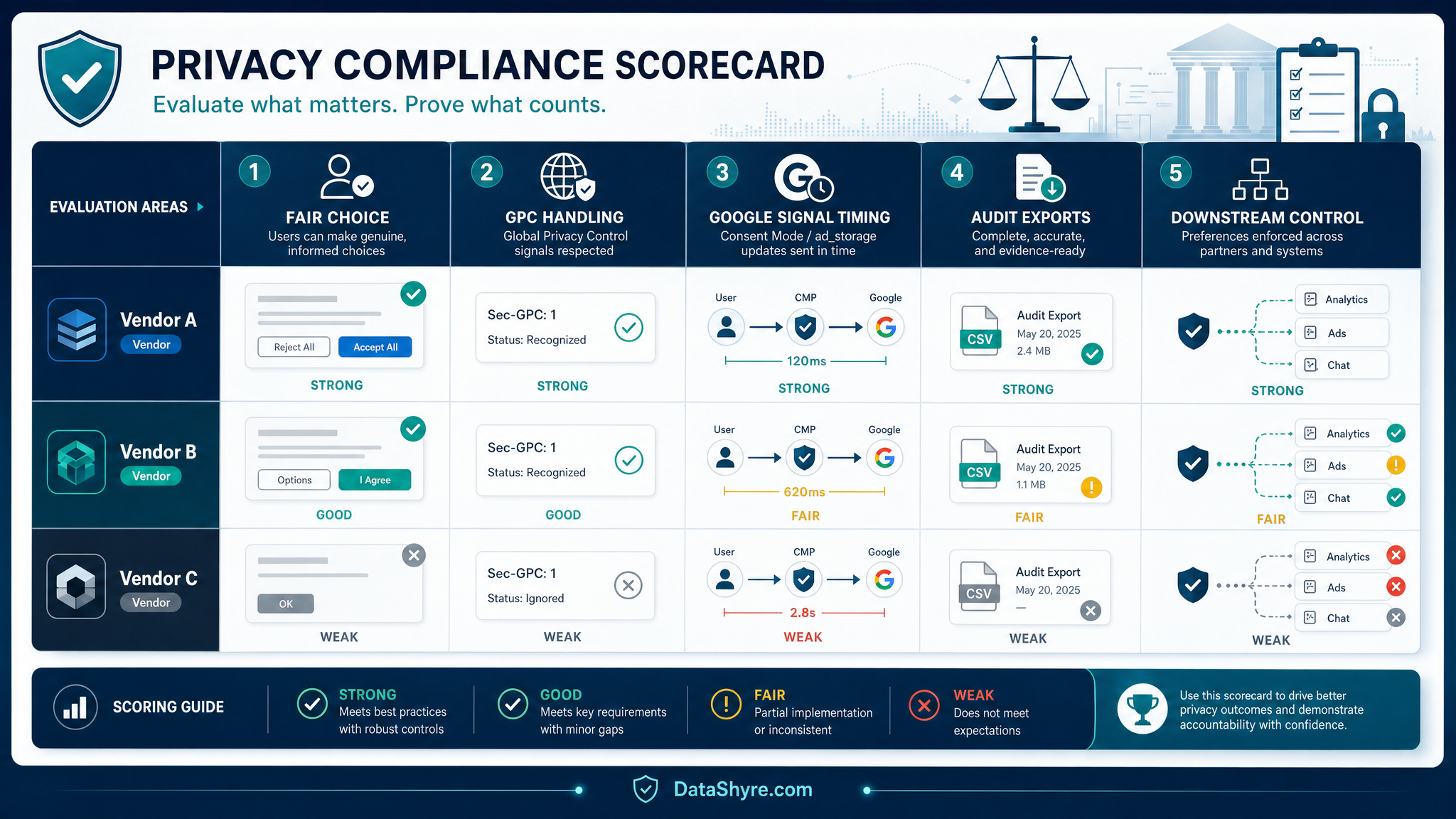
That is not a minor UX detail. It is often the fastest signal that the vendor treats compliance as styling rather than governance. Review the first screen on desktop and mobile. Check whether Reject all is visible, equally weighted, and not buried behind extra taps that Accept all avoids.
This is one of those cases where a five-minute demo review can eliminate a vendor early.
3. Separate European consent logic from California opt-out logic
One global privacy flow is rarely enough.
In the EU and UK, the software often needs prior-consent behavior for non-essential tracking. In California, the harder problem often becomes sale-or-sharing opt-out handling, GPC recognition, and request orchestration. The CPPA’s current FAQ also says the agency finalized ADMT, privacy risk assessment, and cybersecurity audit regulations effective January 1, 2026, with certain compliance deadlines phased into 2027 and 2028.
So if a vendor says it handles “global privacy” with one universal banner pattern and one generic preference store, ask how that actually differs by region. A mature product should not flatten California into a copy of an EU cookie flow.
4. Check Google stack behavior on purpose
This is where a lot of compliance software still looks stronger in screenshots than in production.
Google’s current Tag Manager help says each web container includes a Consent Initialization – All Pages trigger. Google’s current consent-mode guidance also still expects implementations to manage states such as ad_storage, analytics_storage, ad_user_data, and ad_personalization. And Google’s Analytics help says that when analytics_storage='denied', cookieless pings are sent and Analytics cookies are not set, accessed, or read from the device.
For software buyers, that changes the demo script. Do not ask only whether the vendor “supports Consent Mode.” Ask:
when the default denied state is set;
how consent updates are sent;
whether timing is early enough to matter;
how the product behaves after a later withdrawal; and
what proof the software keeps that those updates actually occurred.
If the answer is vague, the integration is probably weaker than the sales language.
5. Keep Google certification separate from broader compliance
This matters if your site serves ads through Google publisher products.
Google’s current publisher help says a certified CMP integrated with the IAB TCF is required when serving personalized ads to users in the EEA, the UK, or Switzerland. Google also says only traffic from a certified CMP is eligible for personalized ads in those cases. At the same time, Google’s own CMP documentation says the Google CMP supports European regulations in the EEA, UK, and Switzerland and privacy messages for users in US states.
That creates an important buying distinction:
Google fit is a monetization and platform-eligibility question.
Broader privacy compliance is still a legal, UX, and implementation question.
The best Consent Management Platform Compliance Software should help with both, but buyers should not confuse one for the other.
6. Demand exportable proof
Sooner or later, someone will ask what happened for a specific user, banner version, or change date.
Your records should let another team answer:
what notice or settings panel was shown;
what categories, purposes, or vendors were presented;
what the user chose and when;
what downstream tools were allowed, blocked, or updated; and
whether the user later changed or withdrew the decision.
If those answers live in screenshots, support tickets, or disconnected logs, the software is not as audit-ready as the demo suggests.
A shortlist framework I would use this week
I would divide vendors into three lanes before any pricing discussion:
CMP-first tools focused on banner delivery, regional choice, and signal capture.
Privacy workflow tools focused on request intake, orchestration, and audit history.
Broader privacy operations platforms that combine consent, rights handling, data inventory, retention, and vendor governance.
Then I would run the same five tests on every serious candidate:
Show a first visit with refusal available immediately.
Show what fires before user interaction on a real page.
Send a GPC or equivalent opt-out and prove the downstream effect.
Demonstrate Google consent-state timing and later updates.
Export a usable record of the decision and the technical outcome.
That sequence usually tells you more than a feature matrix.
Bottom line
In 2026, Consent Management Platform Compliance Software should not mean a banner, a logo wall, and a promise. It should mean software that can collect a fair choice, translate that choice into actual technical behavior, preserve regional differences, fit Google-dependent stacks where needed, and leave behind proof your team can defend later.
If a product cannot do those things on a live implementation, it is not really compliance software. It is presentation software with privacy branding.