

OneTrust Product Reviews in 2026: What Buyers Should Verify Before They Trust the Demo
If you are searching for onetrust product reviews on August 11, 2026, you are probably trying to collapse a messy buying question into something simpler.
Can OneTrust really handle the consent, privacy, and preference-management work your team needs, or is it heavier than the problem in front of you?
That is the right question, because current public materials and current review marketplaces point in the same broad direction. OneTrust still presents its current Consent Management Platform as a wide-scope system that can capture and signal consent across web, mobile, and CTV, maintain regional logic, block trackers until consent is received, store consent receipts, and synchronize consent across touchpoints. Its developer documentation is also explicit that cross-domain and cross-device consent can be linked through shared user profiles, but that setup depends on operational details like user identifiers, JWT handling, consent groups, and updated scripts.
That gap between platform breadth and implementation effort is why onetrust product reviews tend to be useful but incomplete. The reviews can tell you whether customers value the breadth. They cannot decide whether your stack actually needs it.
If you want adjacent context first, see our guides to OneTrust comparison, OneTrust consent tool, and best consent management platforms. This article stays narrower. It is about how to read onetrust product reviews without mistaking public sentiment for implementation proof.
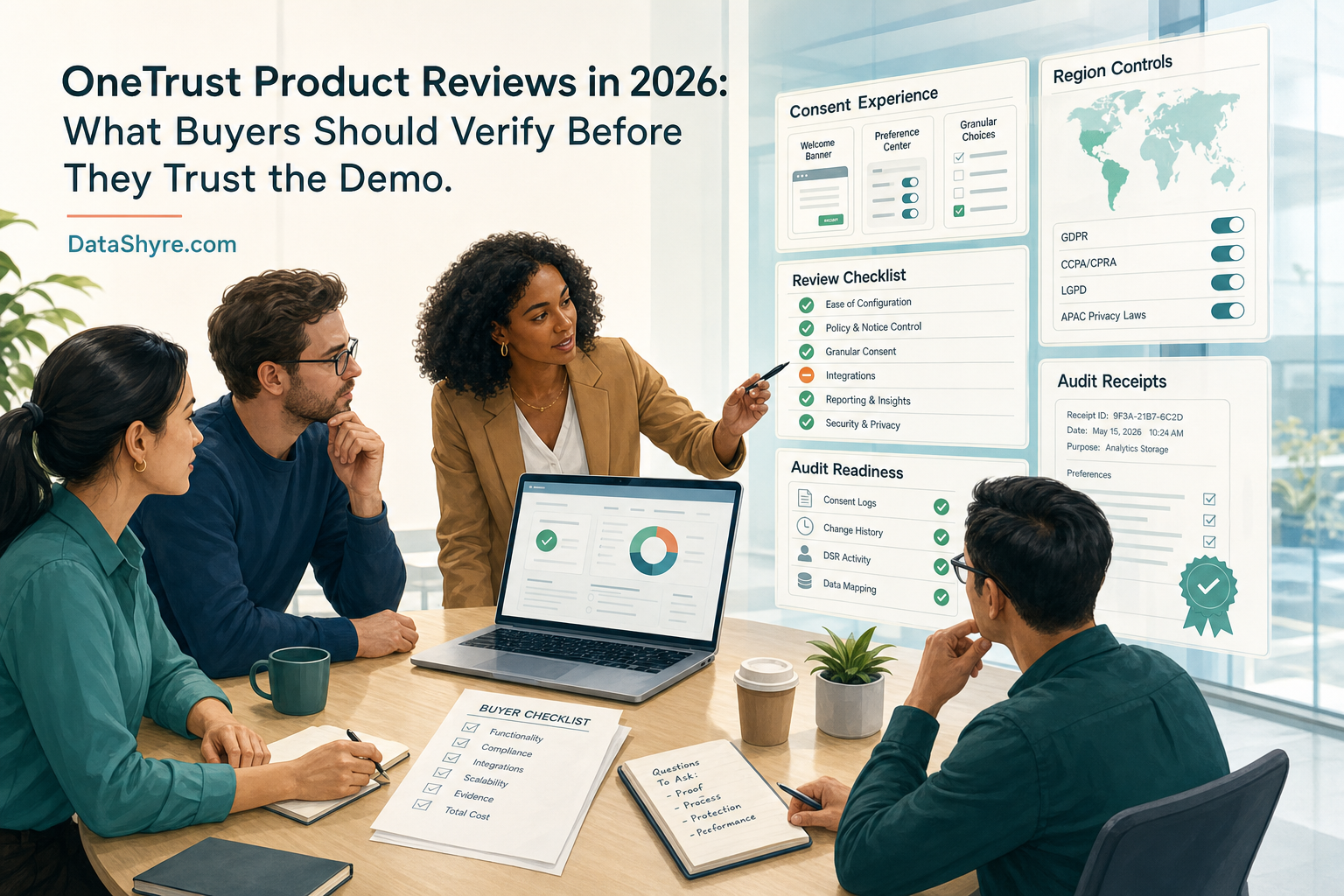
Why onetrust product reviews often split in two directions
The split usually is not random.
Buyers with broad requirements often like the same things:
- one platform spanning consent, privacy operations, and governance;
- support across websites, apps, and connected-TV surfaces;
- centralized records and policy controls;
- stronger fit for large, regulated teams with many stakeholders.
Buyers with narrower needs often focus on different tradeoffs:
- higher implementation overhead than a website-only banner tool;
- more configuration work than expected;
- broader packaging than a small or mid-sized team will actually use;
- a procurement and rollout path that can feel heavy if the real need is only web consent.
That pattern lines up with OneTrust’s own current positioning. Its public CMP page does not describe a lightweight banner widget. It describes a system for purpose-based consent, tracker discovery, regional configuration, cross-device consistency, audit-ready receipts, and downstream signaling. In other words, the product story itself tells you why onetrust product reviews can sound very positive and very skeptical at the same time.
Both groups may be telling the truth from inside different operating models.
1. Start with the job, not the brand
This is the most important filter for onetrust product reviews.
If your real need is one or more of these:
- a website CMP for a multi-brand business;
- consent and preference controls across web and mobile;
- unified records for legal, marketing, and engineering teams;
- regional routing across EU, UK, California, and other jurisdictions;
- cross-domain or cross-device preference syncing;
then current OneTrust materials will probably feel relevant.
If your real need is only:
- a clean cookie banner;
- basic GA4 or GTM signaling;
- a small-site WordPress install;
- a narrow website-only opt-in layer;
then many favorable onetrust product reviews may still point to a product that is larger than you need.
That is why I would treat reviews as use-case clues, not verdicts.
2. Read the product scope against the current legal baseline
Reviews matter more when they are grounded against what the product actually has to do.
The European Commission still says valid consent must be freely given, informed, specific, and expressed through a clear affirmative act. It also still says withdrawal must be as easy as giving consent. The UK’s ICO finalized its current storage-and-access-technologies guidance on April 29, 2026 and says a good consent mechanism should make it “as easy to refuse consent as it is to accept.” In California, the Department of Justice still describes Global Privacy Control as a “stop selling or sharing my data switch” that covered businesses must honor as a valid request.
Those official standards matter because they translate review language into something more concrete.
When reviewers praise flexibility, ask:
- can the product actually support equal refusal, not just equal styling;
- can it hold back non-exempt trackers before consent where required;
- can it adapt by region without turning into a maintenance burden;
- can it prove what the user saw and chose later.
When reviewers complain about complexity, ask:
- is that complexity unnecessary overhead;
- or is it the unavoidable cost of satisfying a real multi-region, multi-surface consent job.
That distinction makes onetrust product reviews much more useful.
3. Separate public platform breadth from live implementation quality
This is where buyers often over-credit review pages.
OneTrust’s current CMP materials promise:
- consent across domains, devices, and geographies;
- branded and geolocation-aware experiences;
- audit-ready consent receipts;
- no-code blocking and script control;
- synchronization across websites, mobile apps, and OTT or CTV properties.
Its developer docs go further and show what cross-domain and cross-device consent can involve in practice:
- user identification before script or SDK load;
- JWT creation and public-key management;
- shared consent-group design;
- careful handling of profile syncing and banner reappearance.
That means a strong onetrust product reviews profile should not make you skip a live technical review.
The useful buyer question is not does the platform support this somewhere. It is can our team implement this correctly in our stack without creating a second project six weeks later.
4. Treat reviewer praise for breadth as a signal, not proof
Public review hubs still show OneTrust with meaningful review activity in 2026, and the tone is familiar: reviewers often praise breadth, centralization, and support for structured privacy programs.
That is a real signal. It suggests OneTrust continues to resonate with teams that need a larger privacy operating system rather than a single consent widget.
But breadth only matters if your environment can use it.
For onetrust product reviews, I would pressure-test positive feedback with five buyer questions:
- Which modules are the reviewer actually using?
- Is the reviewer describing privacy operations, consent, or a wider governance stack?
- Does the reviewer have a large legal or compliance team that can absorb configuration work?
- Is their problem account-level preference management, or just website tagging?
- Would the same praise still apply if your team only needs a faster, smaller deployment?
Without that translation layer, glowing reviews can push buyers toward scope they will never use.
5. Treat negative comments about cost or complexity the same way
The other mistake is overreacting to the harder reviews.
Some negative onetrust product reviews should absolutely be taken seriously, especially if they point to:
- implementation drag;
- administrative overhead;
- rollout friction across teams;
- cost sensitivity for narrower deployments;
- difficulty keeping the runtime behavior aligned with the policy story.
But even those complaints need context.
A global company trying to unify consent, preference management, and downstream governance across web, mobile, and CTV may accept more complexity because the alternative is running several separate systems badly. A smaller digital business may see the same design as overbuilt from day one.
So the right response to tougher onetrust product reviews is not automatic rejection. It is controlled scoping:
- what exact use case produced the complaint;
- whether that use case matches yours;
- whether the complaint reflects poor fit or poor implementation;
- whether a narrower tool would reduce risk or only relocate it.
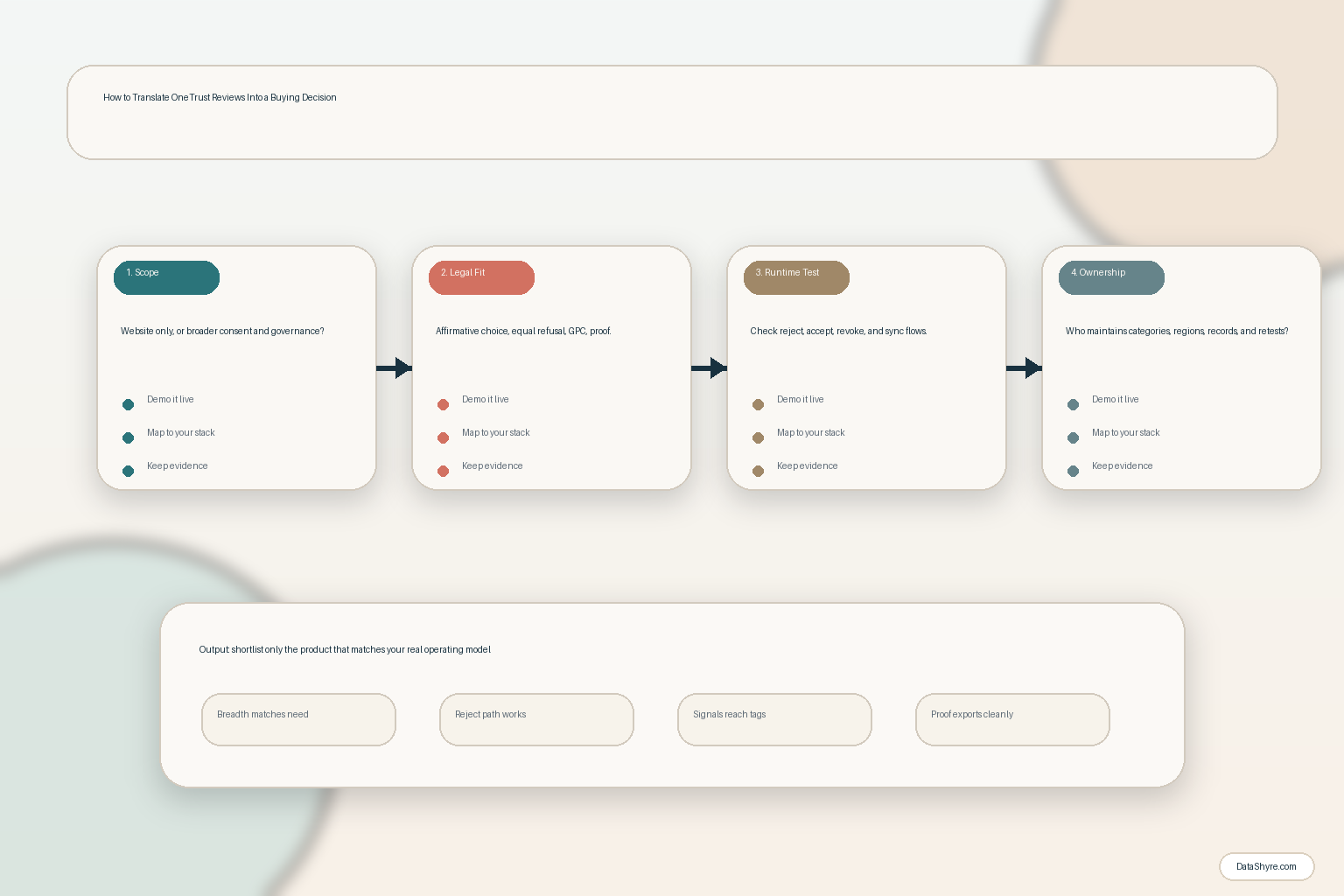
6. The demo should answer what the reviews cannot
This is the moment that matters most.
For onetrust product reviews, the live demo should force answers in four areas:
Scope
Ask the vendor to show the exact product path for your use case:
- website consent only;
- app consent;
- cross-domain syncing;
- authenticated cross-device preferences;
- publisher or ad-tech signaling;
- California opt-out and GPC handling.
Runtime behavior
Do not stop at configuration screens. Ask what actually happens when a user:
- rejects all;
- accepts analytics only;
- changes preferences later;
- arrives from a different domain or device;
- is known on one surface and anonymous on another.
Governance overhead
Ask who in your organization will own:
- taxonomy and purpose mapping;
- geolocation logic;
- consent-record audits;
- script and SDK recategorization;
- re-testing after tracker or app changes.
Proof
Ask what evidence your team can export when someone asks:
- what banner version ran;
- what the user chose;
- what trackers were blocked or allowed;
- whether a downstream system received the right signal;
- whether the user later withdrew or changed that choice.
If the demo cannot answer those, onetrust product reviews have already told you as much as they can.
A short decision frame for this week
If I were evaluating onetrust product reviews today, I would use this order:
- Define whether the job is website consent, multi-surface consent, or broader privacy operations.
- Read OneTrust’s current public scope and decide whether that breadth is valuable or excessive for your stack.
- Use reviews to identify recurring strengths and recurring friction, but only within matching use cases.
- Test the product against current regulator expectations for affirmative choice, equal refusal, tracker control, and preference proof.
- Make the vendor demonstrate your hardest workflow, not their easiest one.
That is the point where review reading turns into buyer judgment.
Bottom line
In 2026, onetrust product reviews are most useful when you stop asking whether OneTrust is good in the abstract.
The better question is whether OneTrust is the right weight for the consent and privacy operating model you actually have.
Its current public materials still show a broad platform with serious coverage across web, mobile, and CTV, plus consent records, regional configuration, and cross-touchpoint syncing. Official regulator guidance still keeps the bar high on affirmative choice, equal refusal, and honoring user signals. Review-marketplace sentiment can help you see how buyers experience that reality, but it cannot replace a scoped demo and a live workflow test.
If your program is broad, regulated, and multi-surface, the breadth behind the better onetrust product reviews may be exactly the point. If your need is much smaller, the more skeptical reviews may be warning you about fit, not quality.
That is the version of onetrust product reviews worth trusting this year.
Sources
- OneTrust: Consent Management Platform
- OneTrust Developer Portal: Cross Domain and Cross Device Consent
- European Commission: Legal grounds for processing data
- UK ICO: Guidance on the use of storage and access technologies
- UK ICO: How do we manage consent in practice?
- California Department of Justice: Global Privacy Control (GPC)
- G2: OneTrust Privacy Automation Reviews
- Capterra: OneTrust Reviews
This post was updated on August 11, 2026 using current official OneTrust, regulator, and review-marketplace materials available at publication time.