

OneTrust Cookie Consent Pricing in 2026: What the Official Metering Model Means for Buyers
If you are searching for onetrust cookie consent pricing on September 12, 2026, the most useful change is that OneTrust now explains the pricing structure publicly even though it still does not publish a simple rate card.
That matters because the buying conversation is easier to scope than it used to be. OneTrust’s official pricing page now says its Consent Management Platform (CMP) Base and CMP Suite packages are priced by average daily visitors aggregated across all channels and properties, while Universal Consent & Preference Management (UCPM) is priced by total data subject profiles captured.
So the real budgeting question is no longer only, “How much does OneTrust cost?” It is:
- which OneTrust package are you actually buying;
- what usage meter drives the contract;
- which compliance and implementation requirements will push you into a larger package.
If you want adjacent implementation context first, our guides to OneTrust cookie consent, Google Consent Mode V2, and consent management and GDPR are useful companion reads. This article stays narrower. It is about how to interpret onetrust cookie consent pricing before you start a procurement cycle.
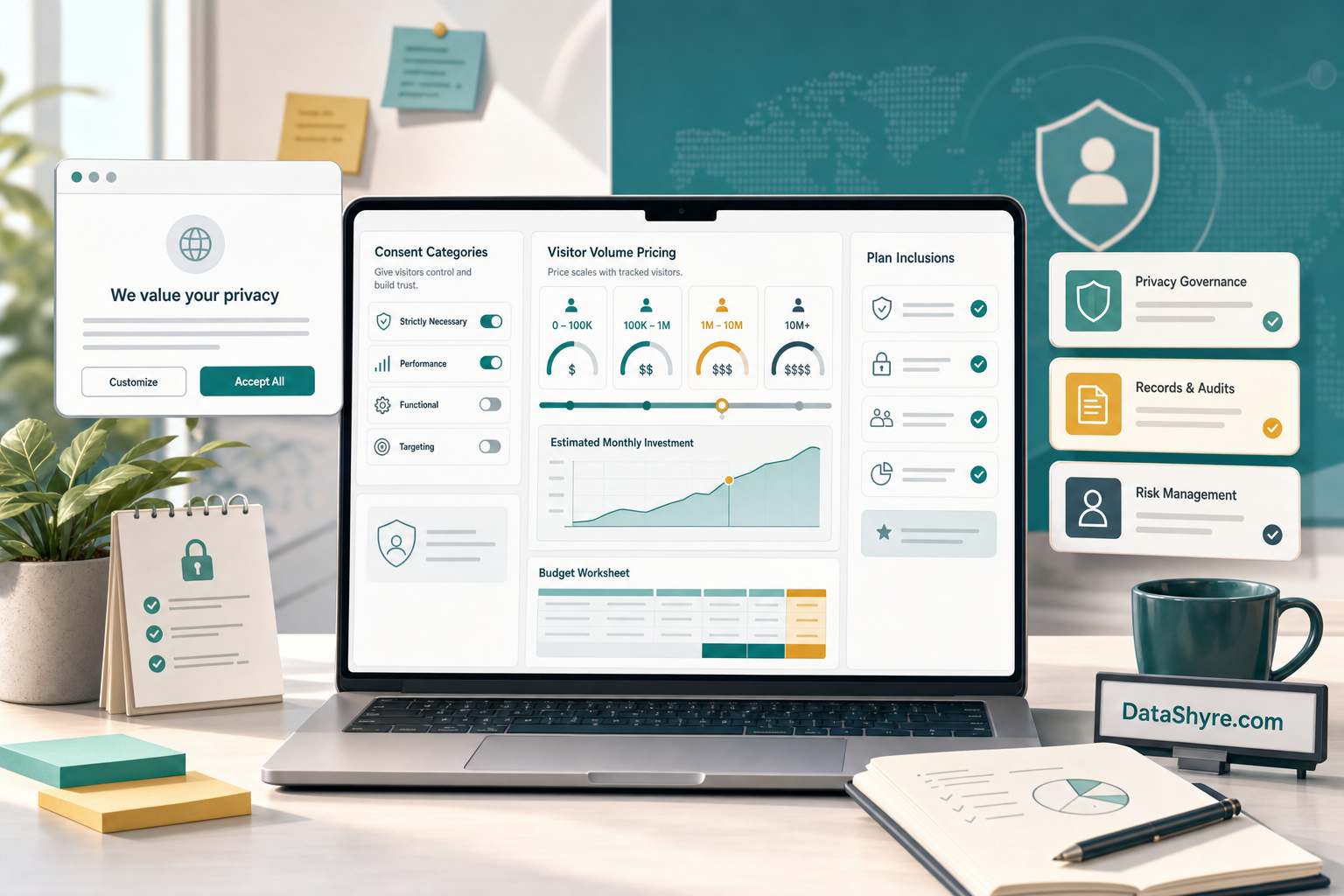
What OneTrust officially shows about pricing now
OneTrust’s current pricing page gives buyers three important clues.
First, the consent side of the platform is packaged, not sold as one flat cookie-banner tool. The public page separates:
- CMP Base
- CMP Suite
- Universal Consent & Preference Management
Second, the pricing meter changes by product scope.
For CMP Base and CMP Suite, OneTrust says pricing is based on “average daily visitors aggregated across all channels and properties.” That should immediately change how you budget. A company with several domains, a mobile app, connected TV inventory, or a region-heavy publishing footprint is not shopping for the same commercial profile as a single-site SaaS brand.
For UCPM, OneTrust says pricing is based on total data subject profiles captured. That means the buyer is no longer just solving banner and cookie control. The project is moving toward broader preference management across the customer journey.
Third, OneTrust still keeps the actual quote custom. The same official pricing page pushes buyers to Request Demo, Talk to Sales, or schedule a quick call for a personalized quote. In practical terms, OneTrust now publishes the meter more clearly than the dollar figure.
What usually increases the price of a OneTrust cookie consent rollout
When teams research onetrust cookie consent pricing, they often focus too much on banner design and not enough on scope drivers. The current OneTrust materials suggest the real cost pressure tends to come from breadth:
1. More channels than a simple website
OneTrust positions Consent & Preferences as a way to deploy consent across web, mobile, and CTV properties. If your use case spans more than one surface, your visitor counts and implementation effort usually rise together.
2. More than basic consent collection
The pricing boundary changes once you need preference centers, richer identity-aware profiles, and synchronized consent across marketing systems. That is where UCPM becomes a different buying discussion from ordinary cookie consent.
3. More jurisdictions and legal logic
The software cost is only part of the pricing story. The runtime behavior has to satisfy the regions you serve. The ICO’s current guidance says a consent mechanism should make it “as easy to refuse consent as it is to accept” and must function as intended so the stored choice actually controls the technologies on the site. California’s Department of Justice also says Global Privacy Control is a valid opt-out request and describes it as a “stop selling or sharing my data switch.”
That means budget should cover more than the license. It should also cover testing, regional configuration, and proof.
4. Publisher and ad-tech requirements
If you serve Google publisher ads in the EEA, UK, or Switzerland, Google says publishers using AdSense, Ad Manager, or AdMob for personalized ads must use a certified CMP integrated with the IAB TCF. Even when the tool choice is already leaning toward OneTrust, that requirement can expand the project from a banner refresh into a revenue-critical controls rollout.
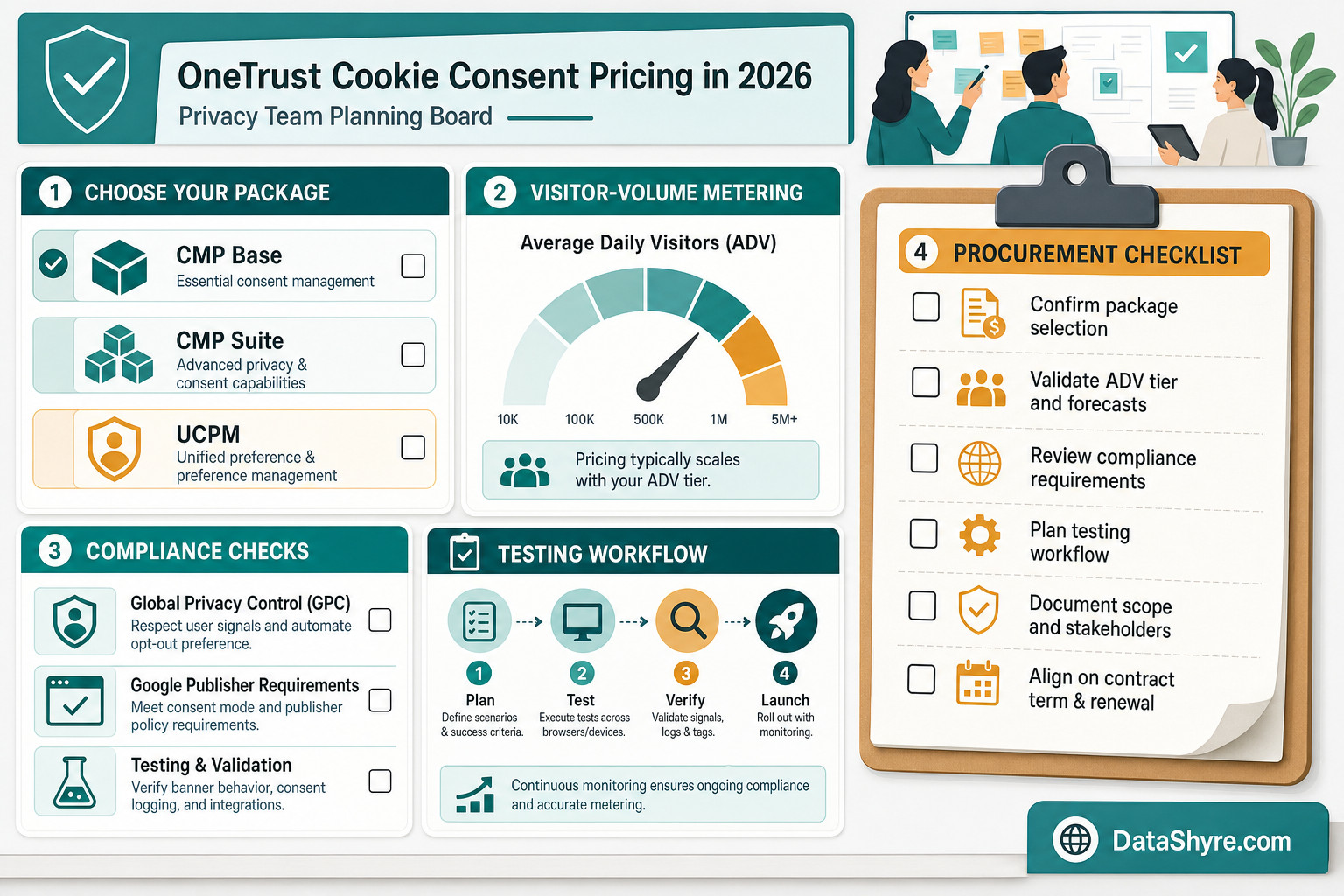
Six questions to ask before you accept a quote
1. Is this quote for CMP Base, CMP Suite, or UCPM?
Do not let the conversation stay at the product-family level. The official page makes clear these are different packages with different scope and metering logic.
2. How is average daily visitor volume being counted?
OneTrust says visitor pricing is aggregated across all channels and properties. Ask exactly which domains, apps, subdomains, environments, and traffic sources are in scope for the proposal.
3. Are you buying only consent collection or also downstream preference management?
If the commercial proposal quietly assumes profile capture, preference centers, or cross-system sync, the budget logic will differ from a simple cookie consent deployment.
4. What implementation work is not included?
The license is only part of onetrust cookie consent pricing. You still need someone to map categories, test blocking, verify consent-mode behavior, check GPC handling, and confirm withdrawal works in production.
5. Which compliance scenarios matter to your site this year?
If you serve UK or EU traffic, the reject path, granularity, and prior blocking behavior matter. If California is in scope, you should also ask how the design and workflow handle Global Privacy Control and sale-or-sharing opt-outs. If publishing is in scope, ask how certified-CMP and TCF workflows are being handled.
6. What will move you into the next pricing tier?
OneTrust’s FAQ says each solution package uses one or more value-based usage meters and that customers who consistently exceed a current tier may be moved to the next tier. Ask what your likely growth trigger is before you sign, not at renewal time.
When OneTrust pricing usually makes sense
The current public packaging makes the fit clearer than before.
OneTrust is easier to justify when you have:
- several sites or brands rolling into one consent program;
- a mix of web, app, or CTV properties;
- meaningful downstream marketing and preference orchestration needs;
- internal teams that need centralized controls, evidence, and ongoing governance.
In those cases, the higher price is often tied to operational breadth, not just a prettier banner.
When the price may feel heavy
If your organization mainly needs a straightforward website CMP for one or two properties, the official metering model can make onetrust cookie consent pricing feel bigger than the problem you are solving.
That does not automatically make OneTrust the wrong choice. It does mean you should compare the quote against the job:
- simple banner and preference center needs;
- limited regions;
- no app or CTV surface;
- lighter ad-tech dependencies;
- no broader consent-profile program.
If your requirements live mostly in that lane, the cost gap between OneTrust and smaller CMPs can become harder to defend.
Bottom line
The best current answer to onetrust cookie consent pricing is not a public dollar number.
It is this: OneTrust now tells buyers what the pricing meter is.
For cookie consent, the official commercial logic is mainly visitor-based across channels and properties. For broader preference management, it shifts toward profile-based pricing. Once you understand which meter applies, the smarter next step is to price the compliance workload around it: equal refusal, working controls, GPC handling where relevant, and publisher requirements if ads matter.
That is how to stop treating the quote like a mystery and start treating it like a scope decision.
Sources
- OneTrust Pricing and Packaging
- OneTrust Consent & Preferences
- ICO: How do we manage consent in practice?
- California DOJ: Global Privacy Control
- Google AdSense Help: Google consent management requirements for serving ads in the EEA, the UK, and Switzerland (for publishers)
This post was updated on September 12, 2026 using current official vendor, regulator, and platform sources available at publication time.