

Google Consent Mode V2 in 2026: 7 Live Checks Before You Trust the Setup
If your team is working through google consent mode v2 on September 11, 2026, the useful question is not whether somebody says “we already upgraded.”
It is whether the four core consent signals are present, whether denied defaults land before measurement starts, whether refusal and withdrawal work in real runtime conditions, and whether linked Google products still obey the same choice after the 2026 control changes.
That is the right frame because Google still treats consent mode as an implementation chain, not as a banner by itself. Its core developer documentation was last updated on July 30, 2026, and the setup guide still says consent mode now includes additional parameters for advertising user data and personalization. The UK ICO’s final storage-and-access-technologies guidance, published on April 29, 2026, is useful alongside that because it keeps the legal test practical: consent mechanisms should make refusal as easy as acceptance and should function as intended.
If you want the adjacent implementation context first, start with our guides to Google consent mode, Consent mode Google Ads, and Google Tag Manager cookie consent. This article stays narrower. It is the seven-part live review I would run before trusting google consent mode v2 on a production stack this week.
Why Google Consent Mode V2 deserves its own review
Many teams use google consent mode v2 as shorthand for one small task: adding two fields and moving on.
That is too narrow.
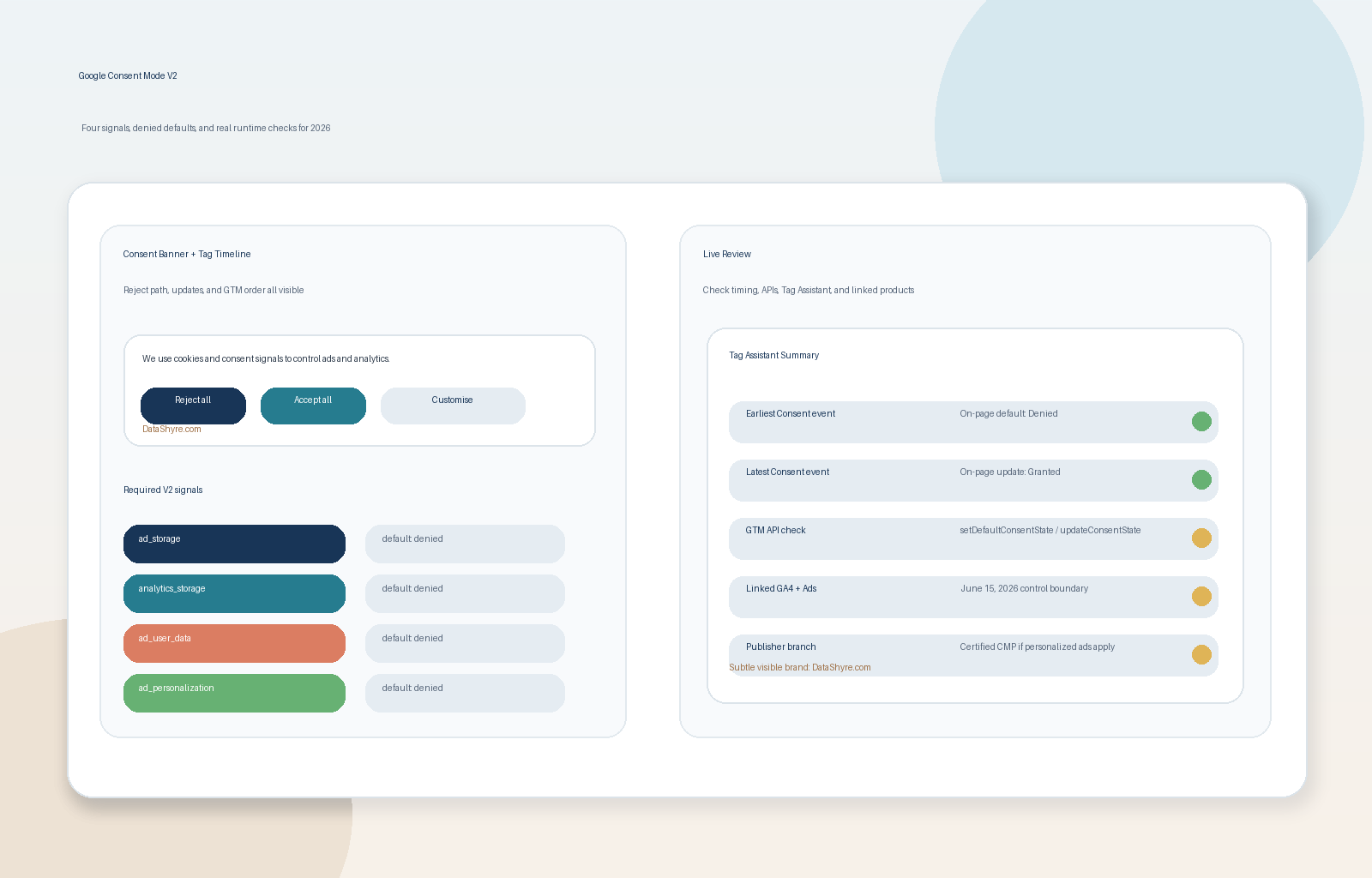
Google’s setup guide still says the November 2023 update added two extra parameters, ad_user_data and ad_personalization, on top of the older storage controls. In practice, that means a V2 review has to answer four questions, not two:
- Did you set
ad_storagecorrectly? - Did you set
analytics_storagecorrectly? - Did you set
ad_user_datacorrectly? - Did you set
ad_personalizationcorrectly?
If your implementation only checks the old storage toggles, google consent mode v2 may be present in name while still being incomplete in behavior.
1. Confirm all four V2 consent signals are actually in scope
This is the first easy miss.
Google’s current website setup guide still says the default consent state example should include:
ad_storagead_user_dataad_personalizationanalytics_storage
And Google’s consent mode reference is still explicit about why the extra V2 signals matter. If ad_personalization='denied', personalized advertising features such as remarketing do not receive data. If ad_user_data='denied', Google says using personal data for online advertising is disabled, including user-provided data flows. Google also says both ad_user_data and ad_personalization need to be granted to enable personalized advertising in Google advertising platforms.
So before you review code, write down which Google branches are real in your environment:
- GA4 measurement;
- Google Ads conversion tracking;
- remarketing;
- enhanced conversions or user-provided data;
- linked GA4-to-Ads sharing;
- server-side tagging.
That turns google consent mode v2 from a vague label into a checkable control.
2. Set denied defaults before any measurement command can act
This is still the most common implementation failure.
Google’s current developer guidance says to call gtag('consent', 'default', ...) on every page before any commands that send measurement data such as config or event. Its example still shows all four core consent values denied by default.
That timing is not decorative.
If the denied default lands after tags begin acting, the configuration can look fine in a screenshot while the live first visit is already too early. Google also still says consent updates should be tracked on the page where they occur before any page transition.
This is also where asynchronous CMP loading becomes important. Google’s setup guide says wait_for_update can be used when the banner may not run before Google tags and gives a 500 millisecond example for that handoff. If your banner is late and you have not handled that timing deliberately, google consent mode v2 can degrade quietly.
3. Use the right implementation path for GTM, not just the right words
Teams often know the concept and still wire it incorrectly.
Google’s current setup guide makes a technical distinction that matters for google consent mode v2 in Tag Manager. It says GTM implementations should use the Tag Manager consent APIs setDefaultConsentState and updateConsentState. It also warns not to substitute gtag('consent','update',...) in place of updateConsentState in Tag Manager flows because gtag commands are queued after other pending messages and may not be processed before the next event begins.
That is one of the easiest ways to create a setup that looks upgraded and still behaves inconsistently.
So for GTM-based stacks, I would check:
- whether consent is initialized on the Consent Initialization trigger;
- whether the CMP template or custom template is writing defaults early enough;
- whether updates use the GTM consent APIs rather than a late custom HTML workaround;
- whether non-consent tags wait until consent has actually been initialized.
If those answers are fuzzy, your google consent mode v2 review is not finished.
4. Choose basic or advanced mode on purpose
Google still supports both models, and the difference is operational, not cosmetic.
Google Ads Help says basic consent mode blocks Google tags until the user interacts with the banner and sends no data to Google before that interaction. It says advanced consent mode loads the tags earlier, uses denied defaults unless configured otherwise, and while consent remains denied sends “cookieless pings.”
That can be a reasonable design choice, but only if it is a deliberate one.
For google consent mode v2, the useful review questions are:
- which model did we choose;
- why did we choose it for these regions and products;
- did legal and marketing understand the difference;
- did we test runtime behavior against that choice, including denied states.
The wrong move is to inherit advanced behavior from a vendor default and then talk about it internally as if the stack is simply “blocked until consent.”
5. Verify accept, reject, granular choice, and withdrawal in Tag Assistant
Banner previews are not enough. Runtime evidence is better.
Google’s current Tag Assistant guidance and Google Ads verification steps still say to inspect the earliest Consent event and confirm that ad_storage, ad_personalization, ad_user_data, and analytics_storage were set, with the on-page default shown as Denied. Then inspect the most recent Consent event and verify the updated values after interaction.
That is the Google side of the check. The regulator side is still important too.
The ICO’s 2026 guidance says a consent mechanism should make refusal “as easy to refuse consent as it is to accept” and should “function as intended.” It also says silence or inactivity does not qualify as consent.
That means a serious google consent mode v2 review should test at least:
- accept all;
- reject all;
- one granular choice such as analytics yes, ads no;
- later withdrawal from the settings path;
- the first uncached page load, not only a repeat visit.
If the stored value changes but the tags behave the same way before and after the user acts, the implementation is weaker than the dashboard suggests.
6. Re-check linked GA4 and Google Ads controls after the June 15, 2026 change
This is one of the easiest 2026 details to miss.
Google Analytics Help says that for linked properties, starting June 15, 2026, Google Analytics transitions to using Consent Mode within Google Ads as the single control for data, so users’ privacy selections managed through Ads Consent Mode settings exclusively govern how data is collected and used. It also says the Google Signals setting in Analytics then only controls the association of Analytics-sourced data with signed-in user information for behavioral reporting.
That means google consent mode v2 is not only a tagging concern anymore. It is also a cross-product control concern.
If GA4 is linked to Google Ads, I would explicitly verify:
- which control your team thinks governs Ads-related data;
- whether that matches Google’s current June 15, 2026 model;
- whether
ad_personalizationandad_user_datachoices still line up with the audiences and advertising use cases actually in scope.
A team can believe Analytics still owns the critical toggle when Google has already moved that control boundary.
7. If you are a publisher, run the CMP certification branch separately
Not every google consent mode v2 implementation is a publisher problem, but some are.
Google’s current AdSense publisher guidance still says that partners using AdSense, Ad Manager, or AdMob must use a Google-certified CMP integrated with the IAB TCF when serving personalized ads to users in the EEA and UK as of January 16, 2024, and in Switzerland as of July 31, 2024. The same guidance also says only traffic from a certified CMP is eligible for personalized ads and that Google does not check CMPs for full compliance with privacy laws.
That is a separate branch from your ordinary site-tagging review.
So if publisher monetization matters, ask two different questions:
- does our google consent mode v2 implementation behave correctly in runtime;
- does our CMP satisfy the current Google publisher requirement where it applies.
Combining those into one vague “Google compliant” conclusion hides useful risk.
A short review sequence for this week
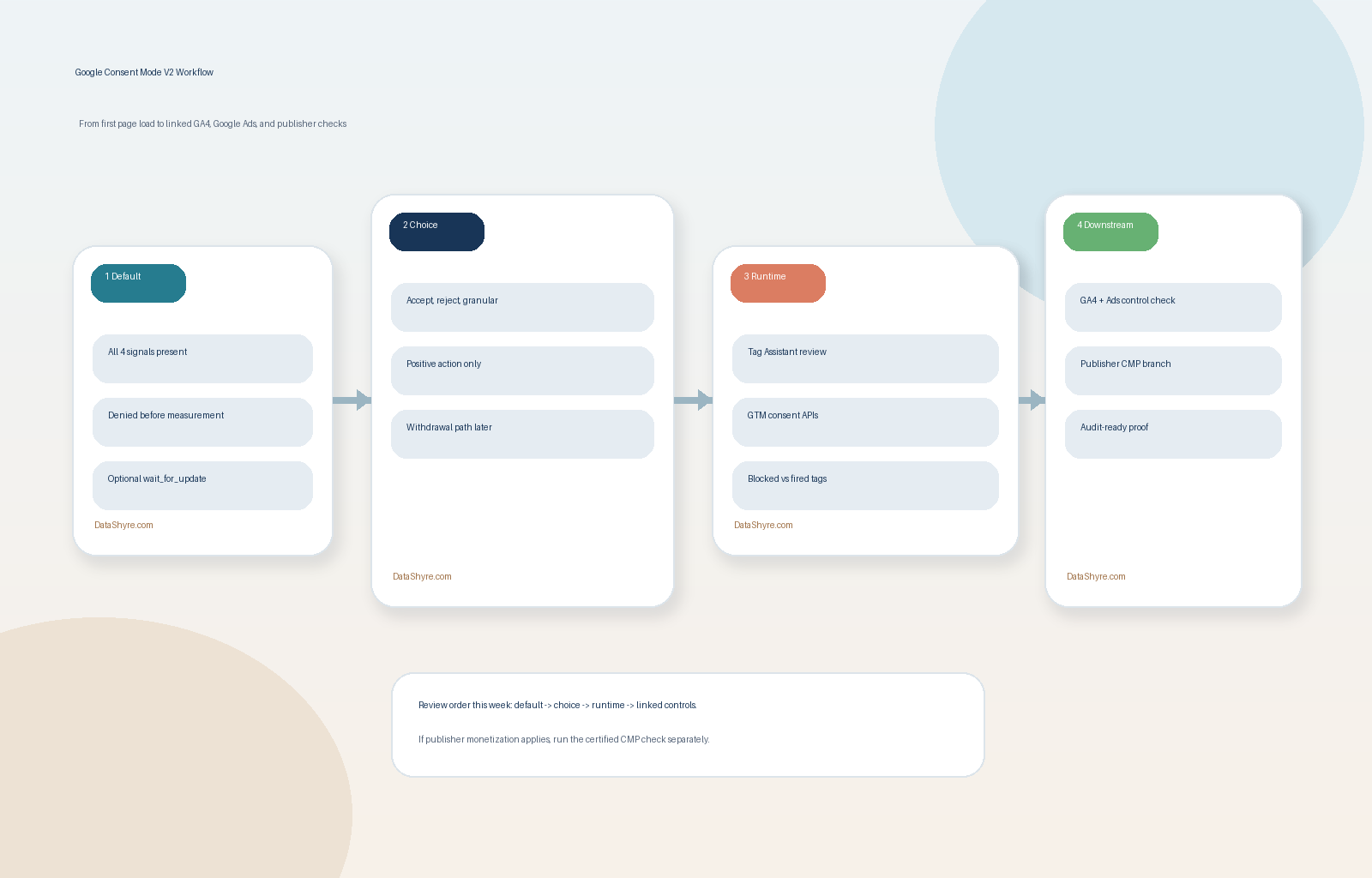
If I were checking google consent mode v2 right now, I would do it in this order:
- map every Google feature in scope;
- confirm all four V2 consent signals exist where they should;
- verify denied defaults load before measurement commands;
- confirm GTM uses the correct consent APIs if GTM is in the stack;
- test accept, reject, granular, and withdrawal flows in Tag Assistant;
- re-check linked GA4 and Ads control assumptions after June 15, 2026;
- run the certified-CMP publisher branch separately if monetization makes it relevant.
That sequence usually finds more real defects than another round of banner design review.
Bottom line
The best answer to google consent mode v2 in 2026 is not, “we added the V2 fields.”
It is, “we set all four signals intentionally, denied by default where required, handled GTM timing correctly, verified live runtime behavior, re-checked the GA4 and Ads control boundary, and treated publisher CMP requirements as their own branch.”
Do that, and the upgrade becomes an operating control. Skip it, and google consent mode v2 may look complete while still being fragile underneath.
Sources
- Google for Developers: Set up consent mode on websites
- Google for Developers: Consent mode overview
- Google for Developers: Troubleshoot consent mode with Tag Assistant
- Google Tag Manager Help: Consent mode reference
- Google Ads Help: Set up consent mode
- Google Ads Help: Verify consent mode implementation
- Google Analytics Help: Updates to Google Analytics Data Controls
- Google AdSense Help: Google consent management requirements for serving ads in the EEA, the UK, and Switzerland (for publishers)
- ICO: Final storage and access technologies guidance published
- ICO: How do we manage consent in practice?
This post was updated on September 11, 2026 using current official Google and regulator materials available at publication time.