

European Cookie Law in 2026: 7 Live Checks for EU Website Teams
If you are searching for european cookie law on November 14, 2026, the useful answer is not put up a banner and move on.
It is separate the narrow exemptions from optional tracking, collect consent before non-essential technologies fire, and make refusal and withdrawal work on the live site.
That is still the practical baseline for EU-facing teams.
The official sources have not become vague. Your Europe still says websites generally need consent before installing non-essential cookies and that “Not all cookies require your consent.” The European Commission still says valid consent must be “freely given”, informed, specific, and obtained through a clear affirmative act using “clear and plain language.” Planet49 still kills the old pre-ticked-box pattern. And the EDPB cookie-banner taskforce still treats the “absence of refuse/reject/not consent options” as not in line with valid consent.
If you want the nearby companion reads first, start with our guides to cookie law, cookie policy, and GDPR cookie consent. This page stays narrower. It is the european cookie law review I would use this week before approving an EU banner rollout.
If your team needs help connecting the banner to the real implementation, DataShyre can help with consent management, runtime privacy testing, and implementation cleanup. The expensive mistake is rarely forgetting the banner entirely. It is shipping one that sounds compliant while the live site still loads optional tracking too early.
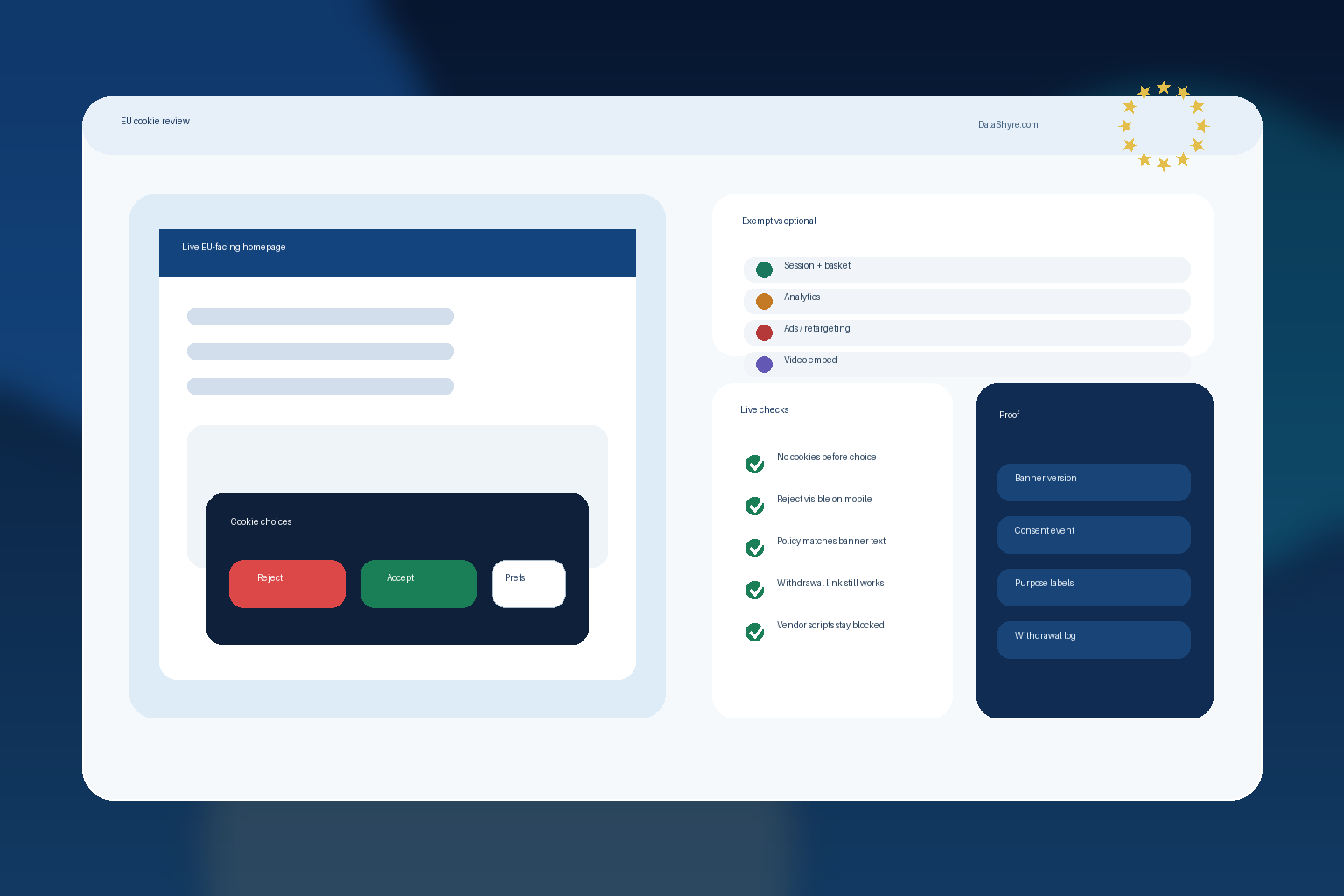
1. Treat European cookie law as a stack, not one banner rule
The first european cookie law mistake is acting as if GDPR alone answers every cookie question.
It does not.
For an EU-facing website, the practical review usually spans:
- rules on storing or accessing information on the user’s device;
- GDPR standards for any related personal-data processing;
- banner and policy transparency duties; and
- operational controls for refusal, withdrawal, and later proof.
That stack is why a clean-looking banner can still fail a real european cookie law test.
2. Use the exemptions narrowly instead of treating every first-party cookie as necessary
This is the highest-value classification step.
Your Europe still describes the core exceptions in simple terms: cookies used only for carrying out the transmission of a communication, and cookies that are strictly necessary to provide an online service the user explicitly requested, do not require consent.
That does not turn all first-party cookies into exempt cookies.
For a serious european cookie law review, classify the live technologies into buckets like:
- login or session continuity;
- shopping basket or form-completion support;
- security or fraud-prevention controls;
- analytics;
- advertising and retargeting;
- personalization; and
- embedded third-party services.
If analytics, ad tech, or convenience features keep getting relabeled as necessary, the rest of the audit is already drifting.
3. Test the no-choice state on the real page before debating the copy
Many european cookie law failures are timing failures, not wording failures.
The practical question is not did the banner appear.
It is:
- what cookies, pixels, tags, or local-storage writes happen on first load;
- which third parties receive data before any choice;
- whether a clean browser run differs from an accepted-consent run; and
- whether campaign pages, embedded flows, and logged-in areas behave the same way.
If optional technologies already fire before the user acts, the banner is mostly decoration.
4. Kill pre-ticked boxes, passive consent, and bundled consent shortcuts
Planet49 is still the cleanest reminder here.
The Court of Justice made clear that consent is not valid when cookie permission is driven by a “pre-checked checkbox” the user must deselect. That matters beyond old checkbox designs. The same logic cuts against patterns that try to count silence, continued browsing, or bundled agreement as a real yes.
So a practical european cookie law audit should check whether:
- optional categories default to off when consent is required;
- the site relies on a real affirmative act rather than inactivity;
- consent for multiple purposes is not blurred into one vague motion; and
- the team can explain exactly what action triggered the signal.
If the answer is still the user stayed on the page, the control is weak.
5. Make reject paths obvious enough to survive regulator scrutiny
This is where many banners still tell on themselves.
The EDPB cookie-banner taskforce said a vast majority of authorities viewed the absence of refuse or reject options on a banner with a consent button as not in line with valid consent. That does not mean every Member State words the UI rule identically, but it is a strong operational signal.
For a live european cookie law review, I would confirm:
- the first layer makes the choice clear;
- refusal is not hidden as a small text link inside a paragraph;
Rejectis not materially harder thanAccept;- the mobile design does not bury the no-path; and
- the banner does not imply access is impossible unless the user agrees, unless the team has assessed that model separately and very carefully.
If the interface is steering rather than asking, the legal theory is already under stress.
6. Explain purposes and recipients in plain language
The European Commission’s consent guidance still points teams toward language that is clear, visible, and specific about the reasons for processing.
That matters because weak european cookie law implementations often say something like:
We use cookies to improve your experience.
That sounds friendly, but it often says very little.
A stronger review checks whether the banner and the linked policy explain:
- which categories are optional;
- what those categories actually do;
- whether third parties receive data;
- how users can revisit the choice later; and
- whether the banner language matches the fuller policy page.
If the words stay generic, the user’s understanding stays generic too.
7. Test withdrawal and keep evidence that still makes sense later
European cookie law does not stop at the first click.
The same consent logic that requires a real affirmative choice also expects people to be able to reverse that choice without friction. In practice, the team should be able to show:
- where the user can reopen preferences later;
- what happens in the runtime after withdrawal;
- which banner version and category logic were live at the time;
- whether multilingual or multi-country variants stay aligned; and
- whether the record still makes sense when a complaint arrives weeks later.
If the team can prove only that a banner existed, not what the site actually did afterward, the european cookie law posture is still fragile.
A practical European cookie law review for this week
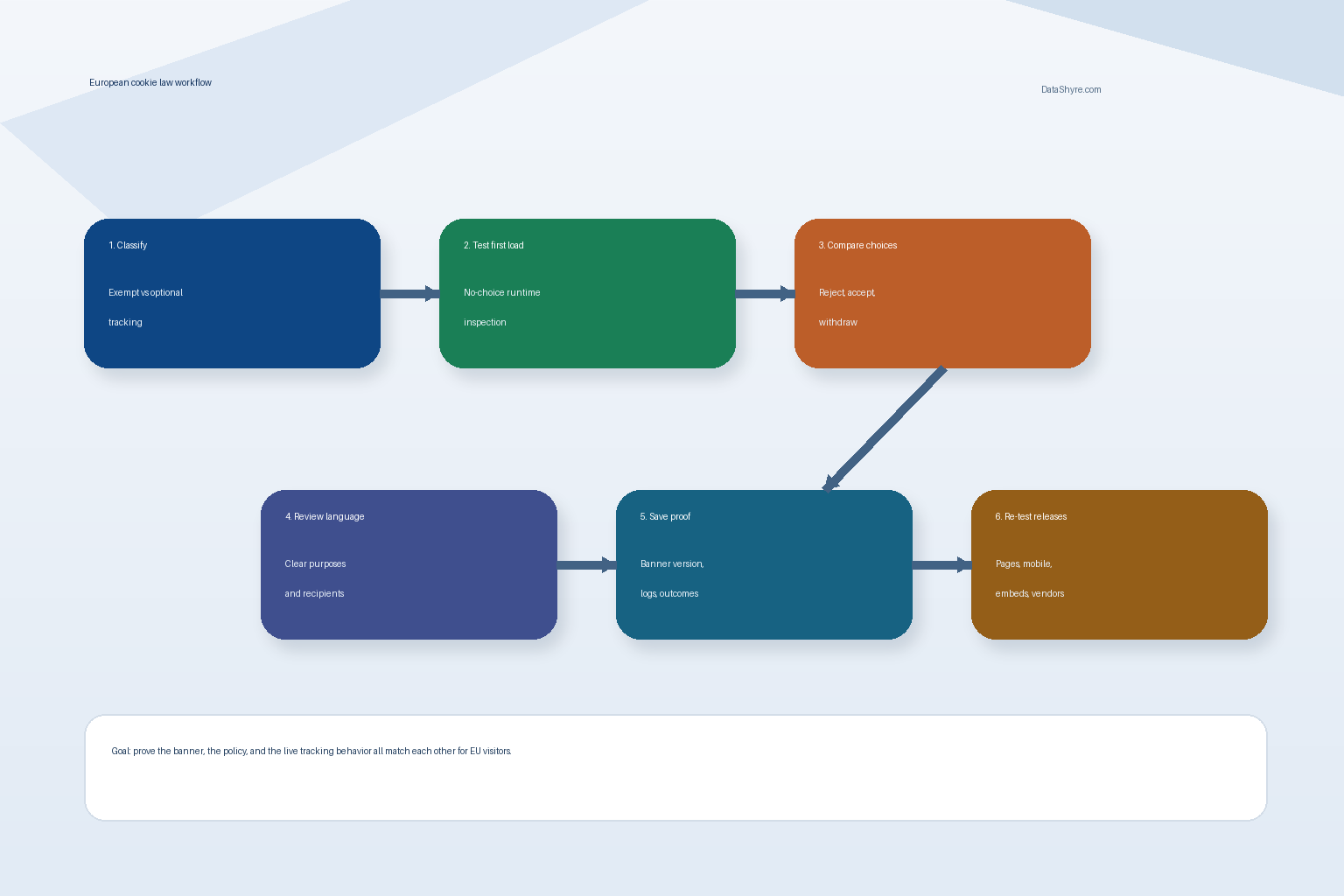
If I were auditing an EU-facing site this week, I would do the work in this order:
- inventory the live cookies and similar technologies on a clean page load;
- separate narrow exemptions from analytics, ads, personalization, and optional embeds;
- test whether optional technologies truly wait for consent;
- compare the accept path and reject path on desktop and mobile;
- check whether the banner language names purposes and links cleanly into the fuller policy;
- test withdrawal and re-open paths; and
- save evidence that connects the wording, the user action, and the runtime behavior.
That order reveals more truth than banner copy review alone.
FAQ
Is European cookie law the same thing as GDPR?
Not exactly. GDPR matters whenever personal data is processed, but website teams also have to think about the separate rules on storing or accessing information on a user’s device. In practice, the two layers work together.
Do analytics cookies always need consent in Europe?
Usually, teams should assume analytics cookies and similar optional tracking need consent unless a narrow local exemption clearly applies and the implementation really fits it.
Can I rely on an accept-only banner in Europe?
That is risky. The safer operating assumption is that consent needs a real choice, and EU regulators have repeatedly focused on missing or obscured reject paths.