

Cookie Law in 2026: 7 Live Checks Before You Trust Your Banner
If you are searching cookie law on November 12, 2026, the useful question is not which banner looks compliant.
It is whether your site actually separates necessary technologies from optional tracking, asks at the right time, and honors the choice afterward.
That is where most weak implementations break.
The official guidance is still pretty clear. The ICO finalized its 2026 guidance on cookies, pixels, fingerprinting, scripts, tags, and similar tools under the broader label “storage and access technologies.” The European Commission still says consent must be “freely given, specific, informed and unambiguous” and that the request must be clear and distinguishable. Your Europe also keeps the basic rule simple: websites generally need consent before installing non-essential cookies, but “Not all cookies require your consent.”
If you want nearby context first, start with our guides to cookie banner, cookie policy, and website privacy checker. This page stays broader. It is the cookie law review I would use this week before telling a team their banner is good enough.
If your team needs the banner, policy, consent logic, and runtime behavior to match, DataShyre can help with consent management, implementation review, and cleanup. The expensive mistake is not forgetting the banner entirely. It is shipping a banner that says one thing while tags, pixels, or local storage do something else.
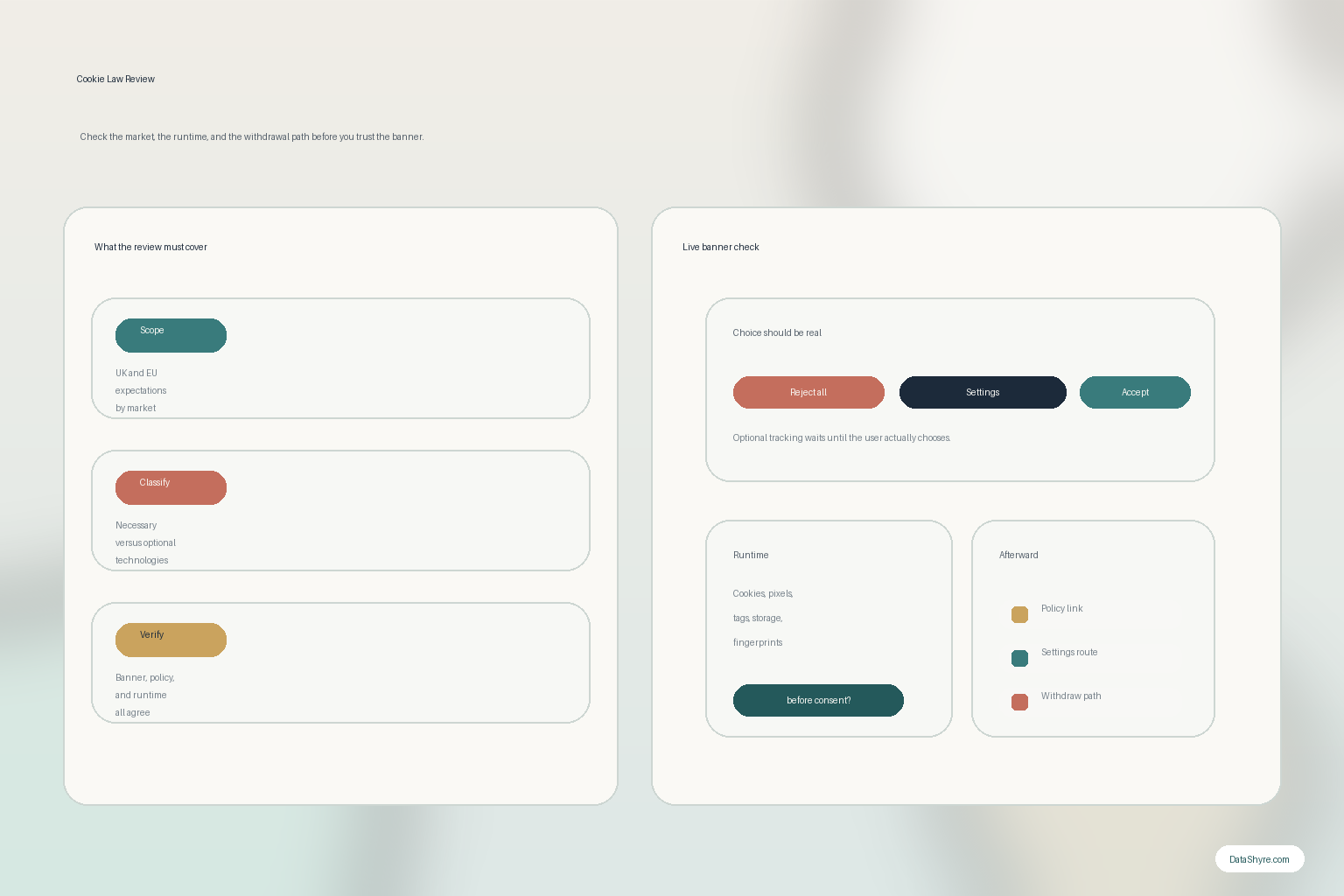
1. Stop treating cookie law like one widget problem
The first cookie law mistake is acting like there is one magic banner pattern that solves everything.
In practice, teams are usually dealing with overlapping rules:
- rules about storing or accessing information on a device;
- consent standards for optional tracking and related personal-data use;
- transparency duties in the banner and the fuller policy;
- operational duties to honor the choice later.
That is why the banner alone is not the job.
For a live cookie law review, I would ask:
- which markets the site actually serves;
- which properties, templates, and apps use tracking technologies;
- whether the team has one banner pattern or several;
- who owns updates when tags, vendors, or embeds change.
If nobody can answer those four questions quickly, the compliance problem is already larger than the banner.
2. Separate strictly necessary technologies from optional ones before you redesign anything
This is the fastest useful audit step in any cookie law project.
Your Europe still highlights the classic exceptions: some cookies used only for transmission or that are strictly necessary to provide a service the user asked for do not require consent. It gives familiar examples like load balancing, shopping baskets, and form-completion flows.
That does not mean every first-party cookie is necessary.
Before rewriting the banner, classify what the site is actually doing:
- session and login support;
- checkout or basket continuity;
- fraud prevention or security controls;
- analytics;
- advertising or retargeting;
- personalization;
- embedded third-party tools.
If analytics, ads, or personalization are mixed into the necessary bucket because the labels are vague, the rest of the review will drift too.
3. Make sure optional technologies wait for consent
Many cookie law failures are not wording failures. They are timing failures.
The official standard remains straightforward: if a technology does not fit an exception, do not set it before the user has actually chosen. The ICO’s 2026 guidance matters here because it extends the review beyond traditional cookies into scripts, tags, web storage, pixels, and fingerprinting techniques.
So the test is not only did the banner appear.
It is:
- what loads on first page view before any click;
- which vendors or scripts fire before consent;
- whether
Reject allproduces a different runtime fromAccept all; - whether mobile, logged-in, and campaign landing pages behave the same way.
If the banner promises choice but the network is already busy with optional tracking, the banner is decorative.
4. Make refusal as easy as acceptance
This is one of the most practical cookie law checks because it is easy to test and hard to fake.
The ICO’s consent guidance says a practical test is whether the mechanism makes it “as easy to refuse consent as it is to accept.” The ICO’s late-2025 cookie enforcement update used the same standard while checking major websites and consent-management providers.
So when I review a banner, I check:
- whether
Reject allis visible on the first layer when the design depends on prior consent; - whether refusing takes no more effort than accepting;
- whether color, size, and placement push people heavily toward accept;
- whether the banner behaves the same way on mobile.
If refusal is dim, buried, or delayed behind extra taps, the interface is telling on itself.
5. Explain the real purposes in plain language
A cookie law review should always hit the copy after the runtime and choice design.
The European Commission’s current guidance still says consent requests must be clear, concise, easy to understand, and distinguishable from other text like terms and conditions. People should be told what the processing is for and that consent can be withdrawn.
That means a weak banner usually sounds like this:
We use cookies to improve your experience.
That sounds friendly, but it often says almost nothing.
A stronger cookie law review asks whether the banner and linked policy explain:
- what each optional category is for;
- whether third parties receive data;
- whether the purpose is analytics, advertising, personalization, or something else;
- where the user can revisit the choice later.
If the words stay blurry, the legal and product risk stays blurry too.
6. Keep the withdrawal path visible after the first visit
This is where many cookie law setups quietly fail months after launch.
The European Commission’s public guidance says people must be told about the possibility to withdraw consent. CNIL’s cookie FAQ also points teams toward an always-available settings route, such as a cookie-management icon or module available across the site.
That means the banner is only the beginning.
For a live cookie law review, test:
- whether users can reopen settings from every page type that matters;
- whether withdrawal changes the runtime behavior, not only the saved preference text;
- whether the path is still visible on mobile;
- whether logged-in and logged-out states both keep the route alive.
If acceptance is easy on day one but withdrawal becomes a scavenger hunt on day two, the setup is not finished.
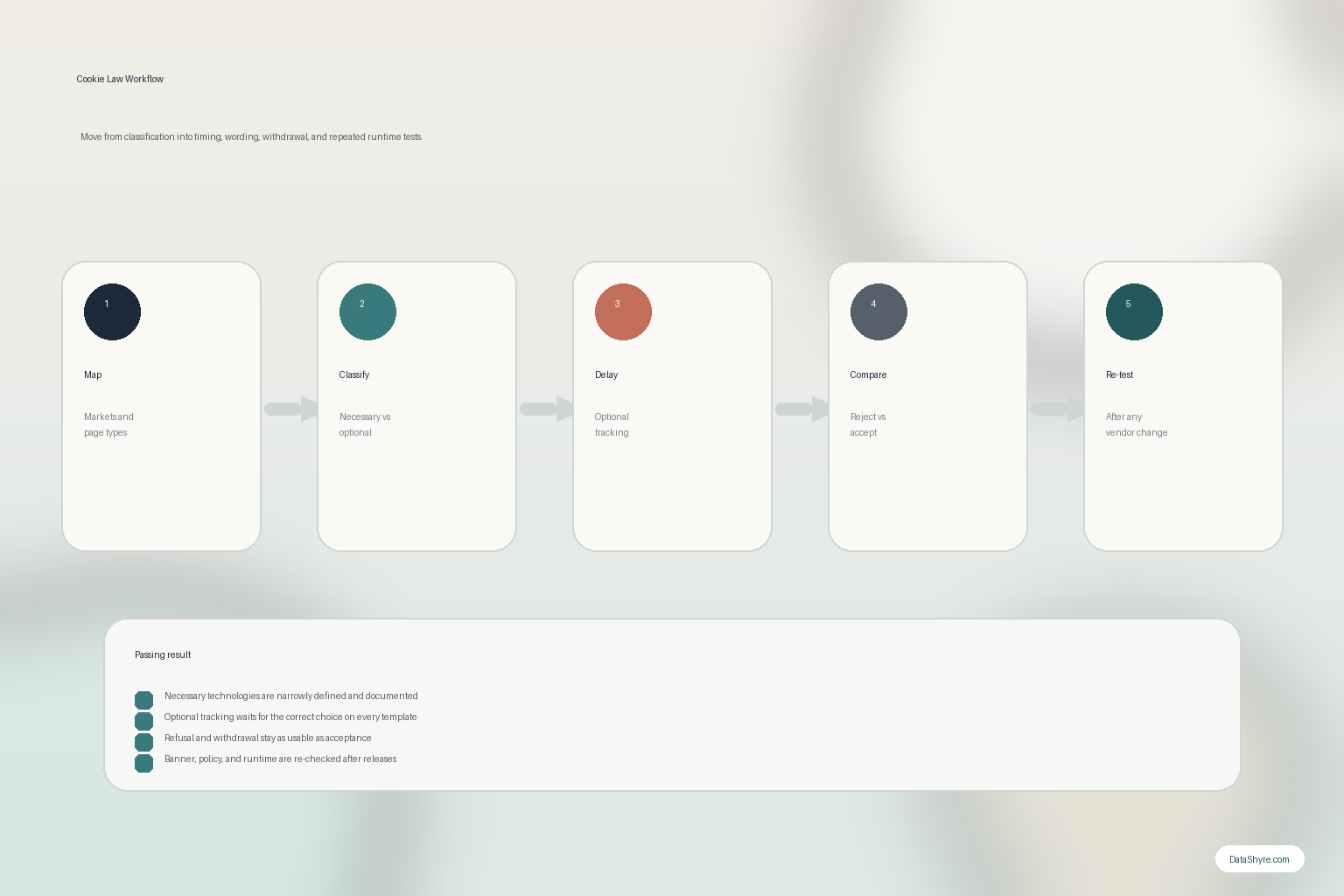
7. Re-test after every vendor, tag, or template change
The long-term cookie law problem is usually drift.
A team adds a heatmap tool.
Someone embeds a new video provider.
Marketing changes the tag-manager container.
The banner copy and policy stay frozen.
That is how a once-defensible setup becomes misleading.
I would re-run a cookie law check any time:
- a new analytics or advertising vendor is added;
- the CMP or tag-manager logic changes;
- a new embedded tool or chatbot appears;
- a market expansion changes the applicable rules;
- the privacy or cookie policy is updated.
If release changes do not trigger a privacy re-test, drift is almost guaranteed.
A practical 7-step cookie law review for this week
If I were reviewing cookie law exposure for a live site today, I would use this order:
- list the markets and page types that matter;
- classify each technology as necessary or optional;
- test what loads before any user choice;
- compare the effort required to accept versus refuse;
- rewrite vague purpose language into plain English;
- test the withdrawal route after the banner is gone;
- repeat the runtime test after tag or vendor changes.
That sequence usually reveals the real problem faster than another banner redesign.
FAQ
Is cookie law just another name for GDPR?
No. People often use cookie law as shorthand, but the real compliance work usually combines device-access rules, consent standards, and privacy-transparency duties.
Do all cookies need consent?
No. Official EU guidance still distinguishes between cookies that are strictly necessary for a requested service and optional technologies such as many analytics or advertising tools.
If my banner looks balanced, am I done?
No. A balanced banner can still fail if optional tags fire before consent, the policy is inaccurate, or withdrawal does not actually change what the site loads.
Bottom line
The practical meaning of cookie law in 2026 is not put up a banner and move on.
It is:
- classify the technologies honestly;
- delay optional tracking until the right choice exists;
- make refusal and withdrawal genuinely easy;
- keep the banner, policy, and runtime aligned over time.
If those checks pass, the banner starts to mean something.
If they do not, the banner is mostly interface theater.