

Cookie Policy in 2026: 7 Live Checks Before You Publish
If you are searching for a cookie policy on November 1, 2026, the useful answer is not where can I find a template.
It is this:
a cookie policy only helps if it matches the technologies actually running on the site and the choices users can really make.
That is where the current official guidance still lines up. The ICO’s finalized storage-and-access-technologies guidance says users need “clear and comprehensive information” about what technologies are used, why they are used, whether third parties are involved, and how long they last. The European Commission still says consent requests should use “clear and plain language” and make withdrawal as easy as giving consent. California’s Department of Justice still says a privacy policy should be updated at least once a year and should explain what is collected, why, how it is used, and which third parties receive it.
So a strong cookie policy in 2026 is not filler for the footer.
It is part disclosure layer, part quality-control checkpoint, and part evidence that the site is saying something true about its tracking behavior right now.
If you want nearby context first, start with our guides to website cookies, privacy policy template, and what is cookie consent. This page stays narrower. It is the cookie policy review I would use this week before publishing or revising one on a live site.
1. Start with the real technologies, not the policy draft
The most common cookie policy failure is writing from assumptions.
That usually sounds polished and still ends up wrong.
The ICO’s current guidance says the disclosure layer should cover what storage and access technologies are used, their purposes, any third parties involved, and how long they remain on the device.
That means your first job is not drafting.
It is inventory.
Before editing a cookie policy, confirm:
- which cookies or similar technologies are active;
- which provider sets each one;
- which purpose each one supports;
- whether it is necessary or optional; and
- how long it persists.
If the live stack changed after the last scan, the page may already be stale even if the language still sounds careful.
2. Explain purpose, provider, and duration in plain language
A weak cookie policy says we use cookies to improve your experience.
That is not specific enough to help a user or protect your team from drift.
The current ICO guidance is unusually practical here because it points directly to the information people need: purpose, third-party involvement, and duration. The European Commission’s consent guidance adds the readability test: the explanation should be clear, visible, and written in plain language.
So the page should tell people, in ordinary terms:
- what category the technology falls into;
- what the category actually does;
- whether your company or another company is involved;
- how long the identifier stays active; and
- where the person can manage the choice later.
If the page needs a privacy professional to decode it, the writing is too abstract.
3. Separate necessary functions from optional tracking
This is where many cookie policy pages become misleading without meaning to.
The ICO says non-exempt technologies need consent before use, while strictly necessary technologies depend on whether they are essential from the user’s point of view rather than merely convenient for the publisher.
That should change the way the page is structured.
A working cookie policy should clearly distinguish:
- security, login, cart, or load-balancing functions;
- measurement or analytics technologies;
- personalization features;
- advertising or cross-site tracking; and
- embedded tools that introduce third-party tracking behavior.
If everything is grouped into one generic paragraph, users cannot tell what is essential, and your policy is doing too little work.
4. Make the policy agree with the banner, reject path, and withdrawal path
A cookie policy cannot be true on its own.
It has to match the live consent experience.
The ICO says users must be able to withdraw consent as easily as they give it. CNIL’s current cookie FAQ says websites must provide a way to refuse non-essential trackers and strongly recommends that refusal be available on the same screen and with the same ease as acceptance. It also recommends keeping users’ choices for about six months as a good practice in many cases.
So for a cookie policy, test whether the page matches:
- the first-layer banner language;
- the
reject allandaccept allcontrols; - the category labels inside the CMP or settings panel;
- the later
manage cookiesorprivacy settingsroute; and - the actual behavior after a user changes their mind.
If the policy says users can withdraw consent at any time, that route should be easy to find on mobile as well as desktop.
5. Cover third-party embeds and similar technologies, not only classic cookies
Another common cookie policy gap is acting as if the page only needs to describe traditional browser cookies.
The ICO’s April 2026 guidance is broader than that. It covers tracking pixels, device fingerprinting, scripts, SDKs, and similar storage-and-access technologies. CNIL’s current FAQ also warns that external content and some CAPTCHA or sharing tools can introduce tracker behavior that still needs the right consent and disclosure logic.
That means your cookie policy review should include:
- video and map embeds;
- chat widgets;
- CAPTCHA tools;
- social share modules;
- mobile SDKs; and
- third-party scripts delivered through tag managers.
If the page only reflects what someone saw on one browser load, it may miss the branches that matter most.
6. Keep the cookie policy aligned with the wider privacy notice
A cookie policy should go deeper on tracking details.
It should not try to replace the broader privacy notice.
California’s Department of Justice says a privacy policy should give users a broad picture of collection, use, sharing, and sale practices, and should explain categories of data, sources, purposes, and categories of third parties. That wider policy layer is where users expect the full rights and disclosure structure. The cookie page should support it by being more precise about technologies, categories, providers, duration, and controls.
In practice, that means:
- the cookie page explains tracking technologies and user controls;
- the privacy policy explains the wider collection, use, sharing, retention, and rights picture; and
- both pages should agree on providers, purposes, and user-choice routes.
If those two documents tell slightly different stories, trust breaks fast.
7. Add update triggers so the page does not freeze while the stack changes
The best cookie policy is still only a snapshot.
That is why the maintenance rule matters.
California’s DOJ says the privacy policy should be updated at least once a year. For cookie-specific disclosures, that annual floor is not enough when the actual stack changes sooner.
I would re-check a cookie policy whenever:
- a new analytics, ad-tech, or personalization vendor is added;
- a plugin or embed changes the scripts on page;
- consent categories or defaults change;
- a new region or property goes live;
- a tag-manager container is updated; or
- a previously named third party stops or starts receiving data.
That is where DataShyre can help. If your page says one thing while the live runtime does another, DataShyre can help audit the stack, map third-party behavior, and tighten the consent flow so the policy becomes operational instead of decorative.
A practical cookie policy review order
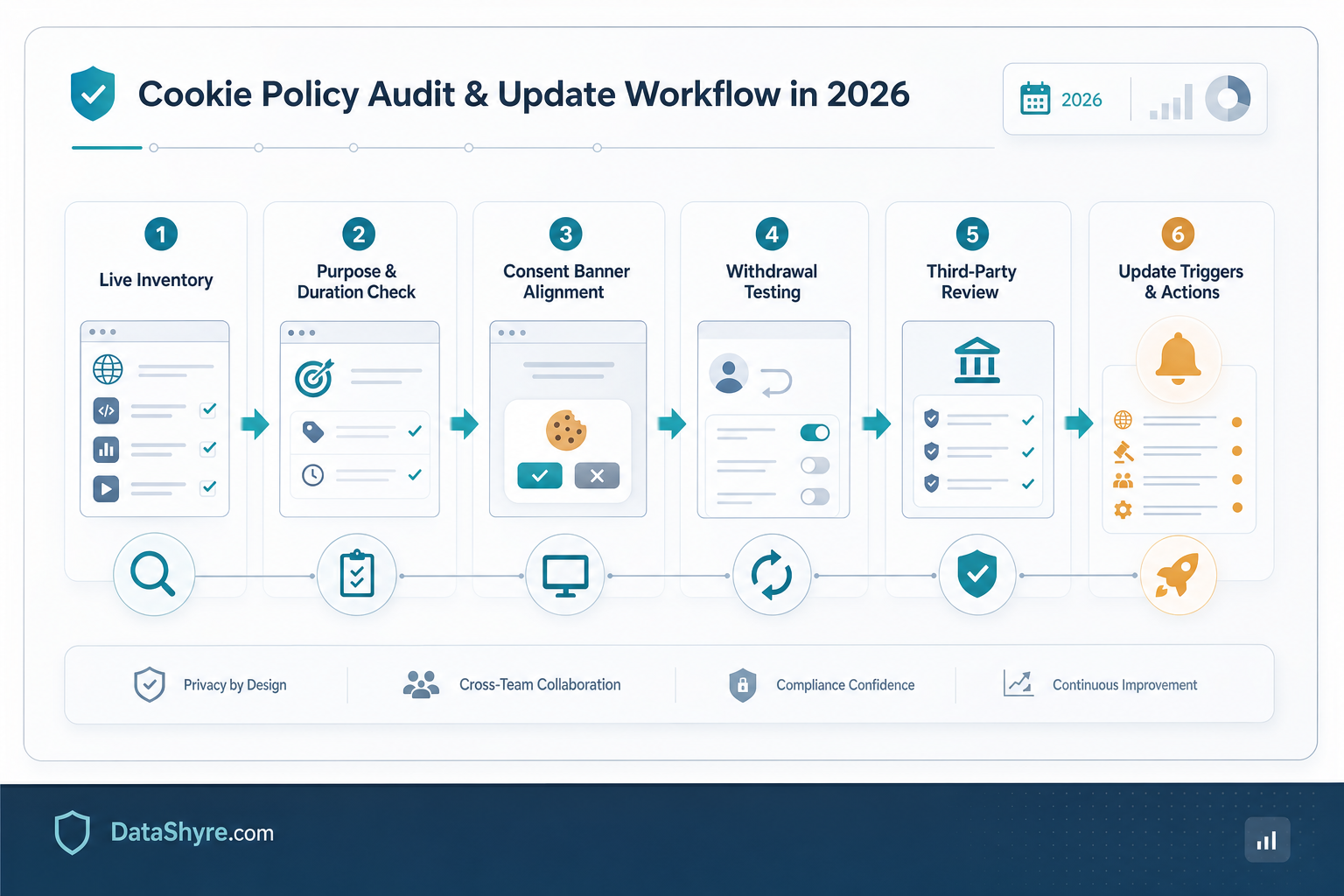
If I were reviewing a cookie policy today, I would use this order:
- inventory the live technologies and related providers;
- classify necessary versus optional behavior;
- document purpose, duration, and third-party involvement;
- compare the page against the banner and settings flow;
- align it with the broader privacy policy; and
- set the next re-review trigger before the next release.
That usually catches the real problems faster than polishing wording first.
FAQ
Does every website need a separate cookie policy?
Not always as a separate standalone URL, but the cookie-related disclosures still need to be clear, easy to find, and consistent with the live consent experience. Many teams publish a separate page because it makes the detail easier to maintain.
What should a cookie policy include?
At minimum, it should explain what technologies are used, what they are for, whether third parties are involved, how long they last, which ones need consent, and how users can refuse or withdraw later.
Is a cookie policy the same as a privacy policy?
No. A cookie policy goes deeper on tracking technologies and controls. A privacy policy covers the broader collection, use, sharing, retention, and rights picture.
Bottom line
The strongest cookie policy in 2026 is not the one with the most template paragraphs.
It is the one that stays specific about purpose, provider, duration, refusal, withdrawal, and third-party involvement because those details still match the site users are actually visiting.
Sources
- ICO, What are the PECR rules?: https://ico.org.uk/for-organisations/direct-marketing-and-privacy-and-electronic-communications/guidance-on-the-use-of-storage-and-access-technologies/what-are-the-pecr-rules
- ICO, Guidance on the use of storage and access technologies: https://ico.org.uk/for-organisations/direct-marketing-and-privacy-and-electronic-communications/guidance-on-the-use-of-storage-and-access-technologies/
- European Commission, Legal grounds for processing data: https://commission.europa.eu/law/law-topic/data-protection/information-business-and-organisations/legal-grounds-processing-data_en
- California Department of Justice, How to Read a Privacy Policy: https://oag.ca.gov/node/36676
- California Department of Justice, California Consumer Privacy Act (CCPA): https://oag.ca.gov/privacy/ccpa
- CNIL, Questions-réponses sur les lignes directrices modificatives et la recommandation « cookies et autres traceurs »: https://www.cnil.fr/fr/cookies-et-autres-traceurs/regles/cookies/FAQ