

Cookie Consent Platforms in 2026: 7 Checks Before You Trust One
If you are comparing cookie consent platforms in 2026, the useful question is not which one gives you the prettiest banner in the shortest demo.
The useful question is which platform can keep optional technologies off until the right moment, make refusal and withdrawal genuinely usable, route different visitors into the right legal path, and leave records your team can still explain after the next release.
That standard is still visible in current official guidance. The European Commission still says valid consent requests should use “clear and plain language.” The UK’s ICO finalized its storage-and-access-technologies guidance on April 29, 2026, and that guidance says consent mechanisms should “function as intended.” Google’s current consent documentation still starts from “Before a user grants consent” you block collection and set defaults. California’s DOJ still describes Global Privacy Control as a “stop selling or sharing my data switch.”
If you want nearby context first, start with our guides to cookie consent requirements, cookie consent banner examples, and consent management platform. This page is narrower. It is the seven-check review I would use this week before trusting any of the current cookie consent platforms on a live site.
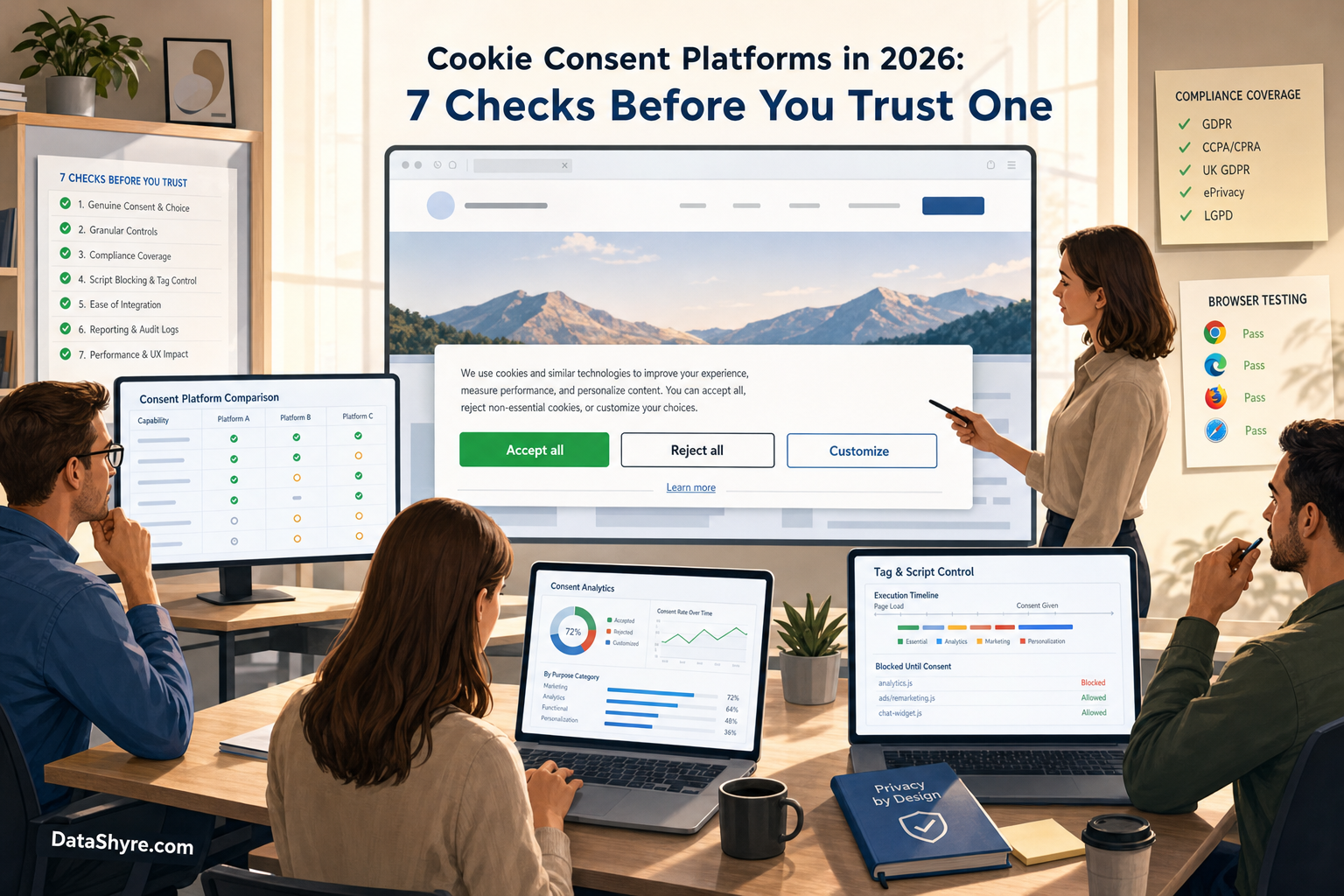
1. Start with the legal model, not the UI demo
The first mistake with cookie consent platforms is assuming every region wants the same thing from the same interface.
In the UK, the ICO’s current guidance still says prior consent is required for storage and access technologies unless an exception applies, and the final 2026 guidance makes clear that this scope is broader than classic cookies. It covers cookies, tracking pixels, device fingerprinting, scripts, and similar technologies too.
California often begins from a different operational question. The current CCPA materials still focus on the right to opt out of sale or sharing, including via GPC, rather than treating every flow as a prior-consent event. That means a capable platform needs regional branching, not just nicer button colors.
So before you compare feature grids, ask:
- where the platform is enforcing prior consent;
- where it is honoring opt-out or browser-level signals;
- where it supports different rules for ads, analytics, embeds, or cross-context behavioral advertising.
If a platform cannot explain its legal model cleanly, it is risky no matter how polished the interface looks.
2. Test what the platform really blocks before a choice exists
The next review should happen in the browser, not on the pricing page.
The ICO’s current guidance says your consent mechanism must “function as intended.” In practice, that means optional technologies should stay off until the platform has the right signal to let them run.
For cookie consent platforms, I would test at least:
- first page load in a clean browser session;
- a page with video, maps, chat, or social embeds;
- a page with ad-tech or remarketing scripts;
- post-rejection refresh behavior; and
- post-acceptance persistence across later pages.
This is where weak platforms tend to leak. A banner can say Reject all while optional tags still run first because of timing, a custom snippet, or a vendor script that bypasses the platform.
3. Check whether rejection is as visible and usable as acceptance
This is still one of the fastest ways to separate strong and weak cookie consent platforms.
The ICO’s current checklist says the consent mechanism should make it “as easy to refuse consent as it is to accept.” CNIL’s formal notices on dark patterns in cookie banners still say rejecting cookies should be just as easy as accepting them, and warn against designs where the accept path is emphasized while rejection is obscured.
So the first layer should be reviewed bluntly:
- is
Reject allpresent where prior consent applies; - is it comparable in prominence to
Accept all; - is
Customizeclear without hiding refusal behind it; - on mobile, is the refusal path still obvious.
If people can accept in one click but need a scavenger hunt to refuse, the platform is not solving the real risk.
4. Verify Google timing and keep the publisher branch separate
For many teams, the hardest part of cookie consent platforms is not the banner. It is orchestration.
Google’s current consent-mode guide still says you should set defaults before commands that send measurement data, and its current setup guide says to block Analytics collection before the user grants consent in a basic setup. Tag Manager’s consent documentation still says the Consent Initialization trigger fires “before all other tags.”
That turns platform evaluation into a sequence test:
- do denied defaults land early enough;
- does acceptance update the right consent states on the page where the user acts;
- does rejection keep those states denied;
- do non-Google vendors obey the same runtime state.
There is also a separate publisher branch. Google’s current AdSense guidance still says that publishers serving personalized ads in the EEA and UK must use a Google-certified CMP integrated with the IAB Transparency and Consent Framework as of January 16, 2024, and that the same requirement applies in Switzerland as of July 31, 2024.
That publisher requirement matters, but it is not the same thing as full privacy compliance. Google also says its CMP checks do not confirm full legal compliance. Strong cookie consent platforms should therefore be tested on two tracks when ads matter: regulatory usability and Google’s product-specific publisher path.
5. Run a California branch on purpose
Not every cookie consent platforms review should stop after the EU or UK path passes.
California’s DOJ still says consumers have the right to opt out of sale or sharing, including via GPC. The same current guidance still describes GPC as a “stop selling or sharing my data switch.” And on February 11, 2026, Attorney General Rob Bonta said in the Disney settlement announcement that asking a business to stop selling data “should not be complicated or cumbersome.”
That means you should test a California branch deliberately:
- enable GPC in the browser;
- load the site fresh;
- confirm sale-or-sharing related behavior changes where it should;
- verify any
Do Not Sell or ShareorYour Privacy Choicespath matches runtime behavior; - confirm the choice carries across connected surfaces where the business treats the user as one account.
One elegant banner is not enough if the opt-out model fails when the browser sends a valid signal.
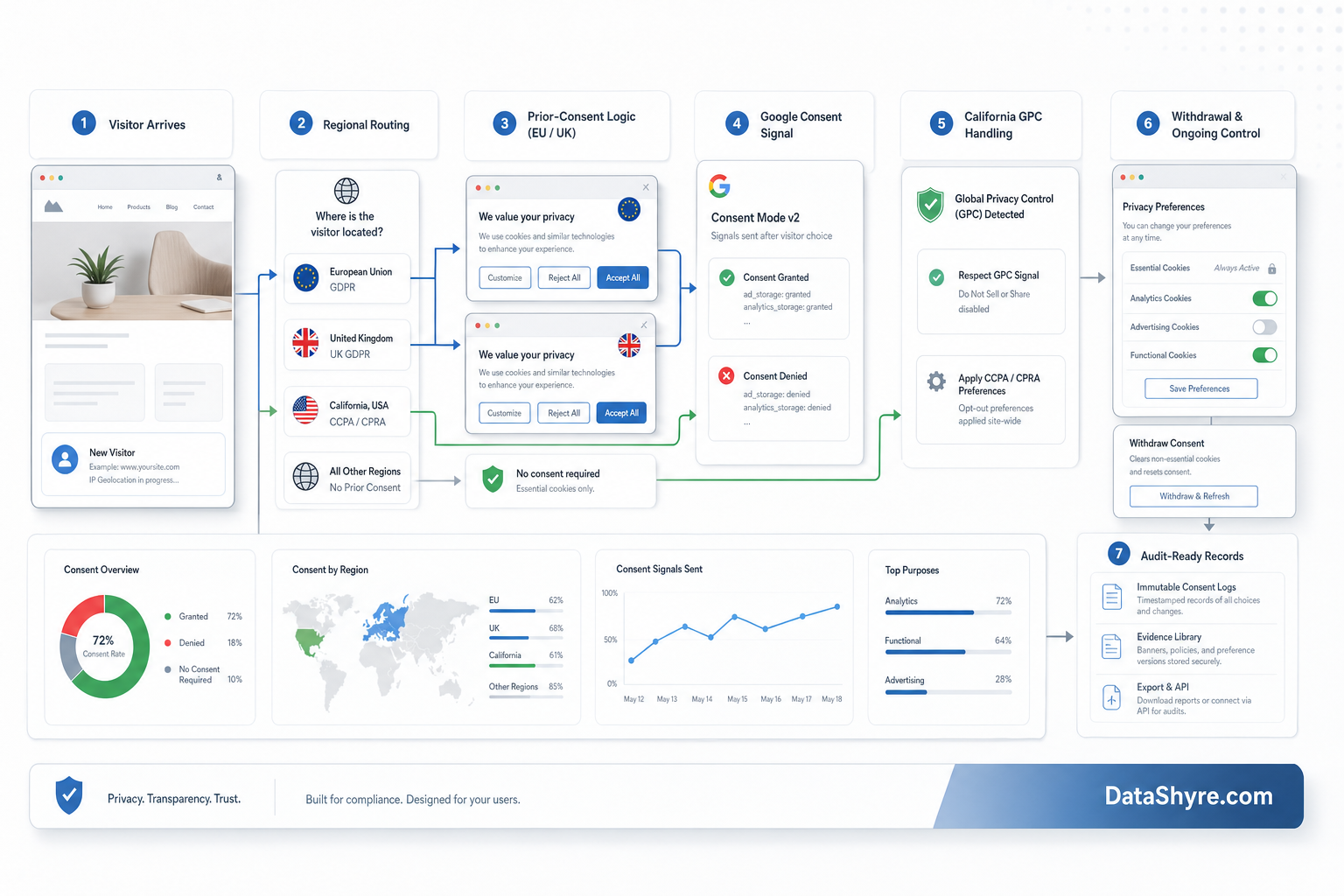
6. Inspect withdrawal, vendor disclosure, and proof together
Good cookie consent platforms should not only capture an initial click. They should support an explainable system after that click.
The European Commission still says it must be as easy to withdraw consent as to give it. The ICO’s current guidance also says users should have accessible mechanisms for making and changing choices, and that organizations need to tell users about third parties and purposes.
So I would check whether the platform gives you:
- a persistent way for users to reopen settings;
- category labels that match what the site actually does;
- meaningful vendor or third-party disclosures where relevant;
- evidence showing what version of the banner or preference layer was shown;
- records linking the choice to the purposes selected and the time it was made.
This is where a lot of cookie consent platforms start to look like UI products instead of operating controls.
7. Re-test after vendor, tag, and site changes
This is the part buyers regularly underrate.
The ICO’s 2026 guidance says that if you introduce a new technology or new purpose, you must obtain fresh consent. In practice, the platform therefore has to survive ordinary drift:
- new tags or vendor scripts;
- GTM changes;
- new embeds or landing page tools;
- cache, CDN, or script-order changes;
- region-routing updates.
The strongest cookie consent platforms are not the ones that win the launch demo. They are the ones that still hold together after the next marketing experiment, analytics reconfiguration, or monetization change.
A short review order before you buy or switch
If I were comparing cookie consent platforms on a live property today, I would work in this order:
- identify which legal paths the business actually needs to support;
- test first-load blocking in a clean browser session;
- verify rejection is as easy and visible as acceptance;
- inspect Google timing and separate the publisher branch if ads matter;
- run a California GPC and opt-out test deliberately;
- inspect withdrawal, disclosures, and records together;
- repeat the checks after a stack change.
That process tells you more than any comparison chart full of integrations.
Bottom line
The best cookie consent platforms in 2026 are not the ones with the flashiest banner gallery.
They are the ones that can keep optional technologies off until the right moment, make refusal and withdrawal genuinely usable, respect regional differences such as GPC and publisher-ad requirements, and leave evidence your team can defend later.
If a platform cannot do that on the live site, it may still be a banner vendor while your consent system remains unfinished.
Sources
- https://commission.europa.eu/law/law-topic/data-protection/information-business-and-organisations/legal-grounds-processing-data_en
- https://ico.org.uk/about-the-ico/media-centre/news-and-blogs/2026/04/final-storage-and-access-technologies-guidance-published/
- https://ico.org.uk/for-organisations/direct-marketing-and-privacy-and-electronic-communications/guidance-on-the-use-of-storage-and-access-technologies/
- https://ico.org.uk/for-organisations/direct-marketing-and-privacy-and-electronic-communications/guidance-on-the-use-of-storage-and-access-technologies/how-do-we-manage-consent-in-practice/
- https://www.cnil.fr/en/dark-patterns-cookie-banners-cnil-issues-formal-notice-website-publishers
- https://developers.google.com/tag-platform/security/guides/consent
- https://support.google.com/tagmanager/answer/10718549?hl=en
- https://support.google.com/adsense/answer/13554116?hl=en
- https://oag.ca.gov/privacy/ccpa
- https://www.oag.ca.gov/news/press-releases/california-wont-let-it-go-attorney-general-bonta-announces-275-million
—
Published: October 17, 2026. Updated using current official European Commission, ICO, CNIL, Google, and California DOJ materials available at publication time.