

Cookie Consent Management Platform in 2026: 7 Live Checks Before You Buy
If you are searching for a cookie consent management platform in 2026, the useful question is not which vendor ships the prettiest banner.
The useful question is whether the platform can turn a person’s choice into real behavior across scripts, tags, embeds, regions, and later withdrawal.
If you want nearby context first, start with our guides to cookie consent manager, consent management platform, and what is a consent management platform CMP. This page is narrower. It is the seven-check review I would use this week before trusting any cookie consent management platform on a live property.
Why a cookie consent management platform should be judged as runtime control
A cookie consent management platform sits between the visible message and what the site actually does next.
That means it should be reviewed as a control layer, not a design asset.
The current official material still points in the same direction. The European Commission says consent requests should use “clear and plain language” and that withdrawal should be “as easy to use as giving consent.” The ICO’s final storage-and-access-technologies guidance, published on April 29, 2026, also makes the scope broader than classic cookies by covering scripts, pixels, fingerprinting, and similar technologies. So a serious platform review has to go beyond banner copy alone.
1. Check whether the first-layer choice is fair before you compare features
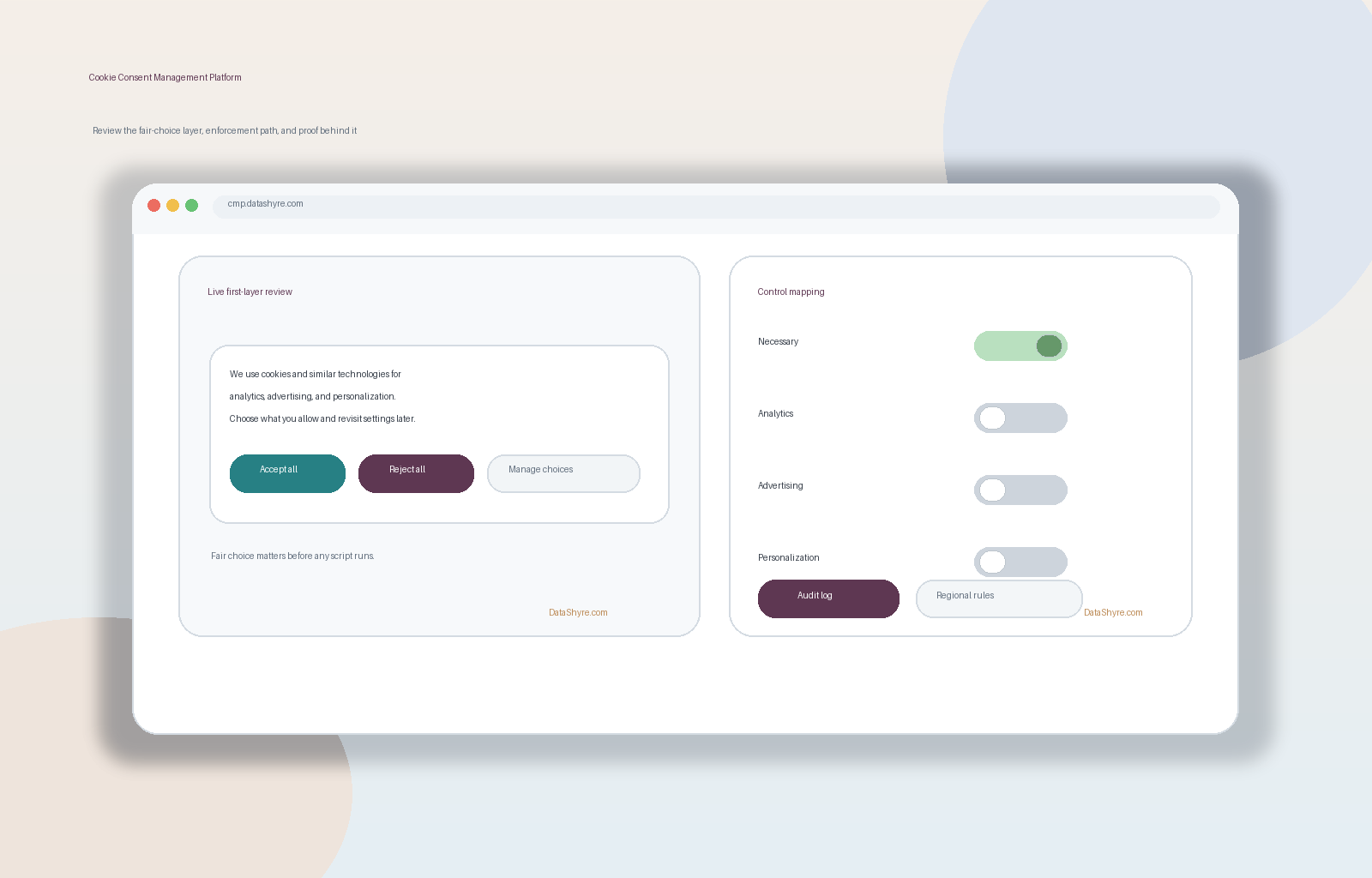
The first review question for any cookie consent management platform is whether the person sees a fair choice on the first screen.
That is still where many implementations fail.
CNIL’s current position remains direct: rejecting cookies should be “just as easy as accepting them.” The CPPA’s dark-pattern advisory frames the same idea from the California side with a short warning: “Dark patterns aren’t about intent, they’re about effect.”
So before you compare vendor dashboards, inspect the live first layer:
- is
Reject allavailable whereAccept allappears; - is the privacy-protective path equally visible on mobile;
- are purposes explained in plain language instead of euphemisms; and
- does the interface avoid nudging through color, hierarchy, or extra clicks.
If the platform fails here, the rest of the feature list matters much less.
2. Verify prior blocking on the templates that usually leak first
A cookie consent management platform earns its keep by controlling behavior before optional technologies begin acting where prior consent is required.
That means you should test more than the homepage.
The ICO’s 2026 guidance is useful because it talks about storage and access technologies broadly, not just one browser cookie. In practical terms, you should test the pages where the stack is most likely to bypass the platform:
- landing pages with analytics and ad tags;
- product or pricing pages with personalization tools;
- article templates with video or social embeds;
- pages that load chat, heatmaps, or replay tools; and
- pages served through caching, CDNs, or tag-manager shortcuts.
If optional technologies still wake up before the consent state exists, the cookie consent management platform is documenting a choice more than enforcing one.
3. Test the consent sequence, not just the stored preference
Many teams check only whether a platform records accepted or rejected.
For a cookie consent management platform, that is too shallow.
The harder and more important question is whether the sequence is correct:
- default state is set before optional measurement starts;
- the user makes a choice;
- downstream tags and scripts receive the update on the same page;
- later page loads honor the stored choice; and
- withdrawal actually changes behavior after the user changes their mind.
The EDPB’s current practical examples still say scrolling or swiping is not a clear affirmative action for consent. So if the platform depends on passive behavior or vague continuation logic, it is already off course.
4. Review categories and purposes the way a normal person experiences them
A cookie consent management platform can look sophisticated in admin screens while still being confusing to the person who has to choose.
That is why category design deserves its own check.
The European Commission’s standard still works well here: the request should be specific, informed, and written in language people can understand. In practice, the platform should let you present categories and purposes such as:
NecessaryAnalyticsAdvertisingPersonalization
Then it should let you map vendors, scripts, and tags into those categories without creating a mismatch between the words on screen and the technologies running underneath.
If the platform cannot keep that mapping clean, the explanation layer gets weaker every time the stack changes.
5. Treat regional routing as a core feature, not a later setting
One cookie consent management platform may serve visitors in the EU, UK, California, and other U.S. states at the same time.
That does not mean one default interaction fits every region.
For EU and UK traffic, the key question is often whether non-essential technologies stay off until the right consent exists. In California, the platform may also need to support opt-out handling and browser-based privacy signals where sale or sharing is in scope. California’s Department of Justice still describes Global Privacy Control as a “stop selling or sharing my data switch” and says covered businesses must honor it as a valid request where applicable.
So the platform review should test separate branches on purpose:
- EU or UK first visit with no saved preference;
- California visit with opt-out and GPC logic in scope;
- return visits after prior consent or refusal; and
- mixed-device or cross-domain situations if the stack claims to support them.
If a platform cannot explain how it handles those branches, it is not ready for a multi-region deployment.
6. Keep Google’s publisher requirement separate from the general website check
This is where a cookie consent management platform review often gets blurred.
General website consent hygiene and Google publisher eligibility overlap, but they are not the same test.
Google’s current publisher guidance still says partners using AdSense, Ad Manager, or AdMob must use a Google-certified CMP integrated with the IAB Transparency and Consent Framework when serving personalized ads to users in the EEA and UK as of January 16, 2024, and in Switzerland as of July 31, 2024. Google also says its CMP review does not check a platform for full compliance with applicable privacy laws.
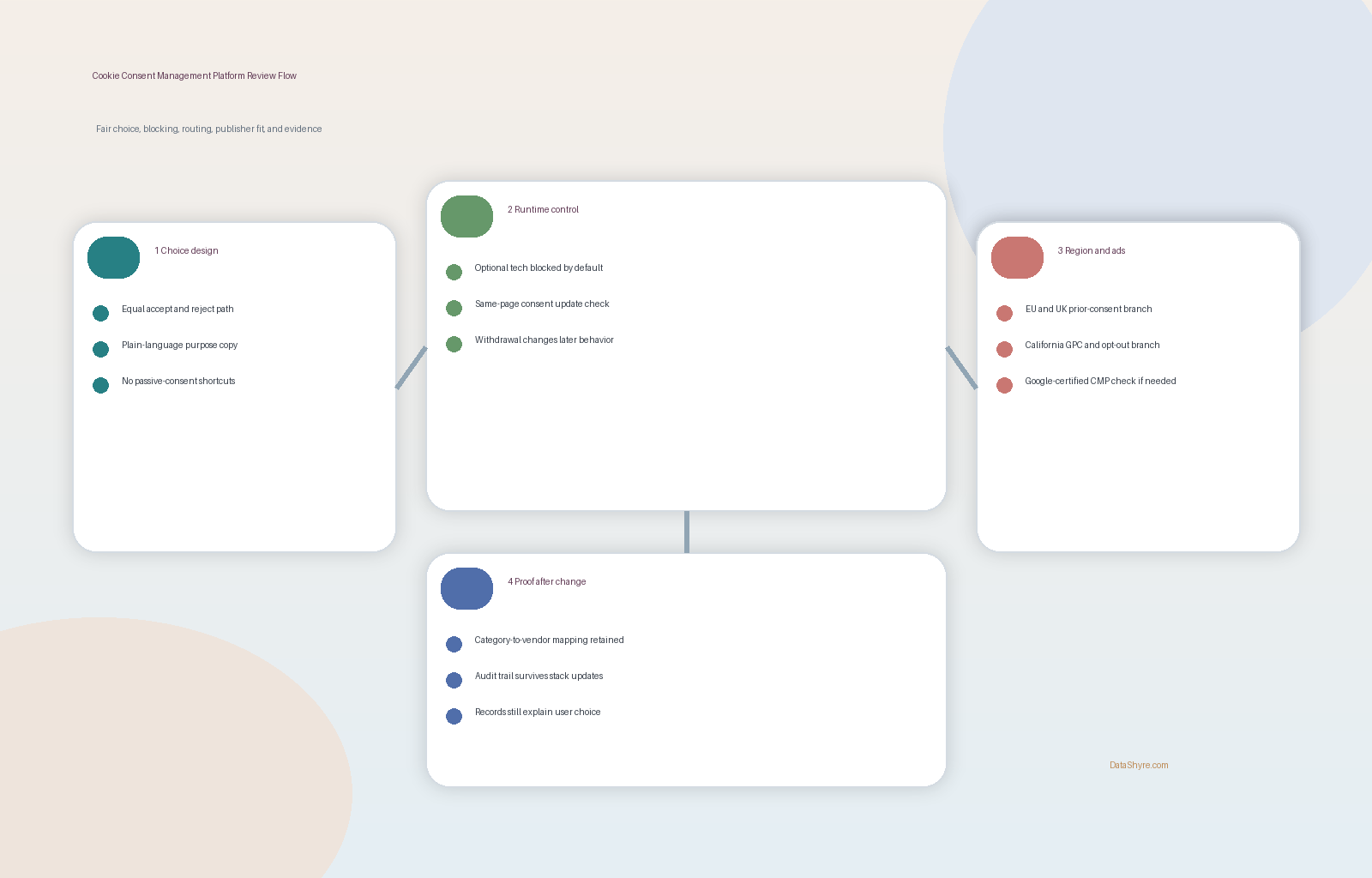
That means the clean review order is:
- does the site collect and honor consent or refusal fairly;
- does the runtime behavior match that choice; and
- if publisher ads matter, does the chosen platform also satisfy Google’s separate product requirement.
A cookie consent management platform can pass one of those checks and fail another.
7. Ask whether the platform leaves behind usable proof after ordinary change
The visible banner is only the start.
The long-term test for a cookie consent management platform is whether your team can still explain what happened after the next release, campaign, plugin install, or tag update.
That means the platform should help you answer questions like:
- what categories existed when the user made the choice;
- which scripts or vendors were tied to those categories;
- when the preference changed;
- whether withdrawal was honored in runtime; and
- who updated the rules when the site changed.
The European Commission’s withdrawal standard still matters here because it makes the later path part of consent quality, not an optional extra. If the platform records a choice but makes later change difficult, the operating model is weaker than it looks.
A short review order for this week
If I had ten minutes to pressure-test a cookie consent management platform before purchase or renewal, I would do this in order:
- inspect the first-layer accept and reject path on desktop and mobile;
- test whether optional technologies stay off before the right choice exists;
- confirm downstream updates happen in the right sequence after consent changes;
- simplify categories until a normal visitor could understand them;
- verify California and GPC handling separately from EU and UK routing;
- run the Google publisher branch separately if ads matter; and
- check whether the records would still make sense after a site change.
That sequence usually tells you more than another demo call.
FAQ
Is a cookie consent management platform just a banner tool?
No. A real cookie consent management platform is the control layer behind the banner. It should manage the first-layer choice, technical enforcement, later withdrawal, and evidence you can still use later.
Does scrolling count as consent for a platform workflow?
No. The EDPB’s current practical examples still say scrolling or swiping is not a clear affirmative action for consent.
Can a Google-certified CMP be noncompliant in other ways?
Yes. Google’s own publisher guidance says its CMP review does not check a platform for full compliance with applicable privacy laws. Certification can matter for publisher ads without answering every legal or operational question.
Bottom line
The best cookie consent management platform in 2026 is not the one with the most polished interface.
It is the one that gives people a fair first choice, keeps optional technologies aligned with that choice, routes the right visitors into the right regional model, supports separate publisher checks when needed, and leaves behind records your team can still trust after the stack changes.
That is the review standard worth using before you buy, renew, or expand one.
Sources
- European Commission: Legal grounds for processing data
- EDPB: Practical examples on consent
- ICO: Final storage and access technologies guidance published, April 29, 2026
- CNIL: Dark Patterns in Cookie Banners: CNIL issues formal notice to website publishers
- California Department of Justice: California Consumer Privacy Act and Global Privacy Control
- CPPA: Enforcement Advisory Stresses the Importance of Avoiding Dark Patterns
- Google AdSense Help: Google consent management requirements for serving ads in the EEA, the UK, and Switzerland (for publishers)