

Cookie Consent for Banks in 2026: 8 Live Checks for Security Cookies, GLBA Notices, and Tracking
If you are reviewing cookie consent for banks on October 24, 2026, the expensive mistake is treating it like a generic banner project.
A bank website usually has two privacy layers running at once. One is the financial-data notice and information-sharing layer shaped by GLBA and Regulation P. The other is the device-tracking layer shaped by cookies, pixels, tags, SDKs, and similar technologies. Those layers overlap, but they are not the same control.
That framing matters because the official sources are fairly direct now. The FTC’s GLBA guidance still says financial institutions must notify customers about their information-sharing practices and, where applicable, provide an opt-out path. CFPB’s November 12, 2024 report warns that when a consumer “merely visits a website” even for a bank or credit card, third parties can learn about that interaction and track the consumer across the web. The ICO’s storage-and-access guidance, finalized on April 29, 2026, still says cookies essential to “ensure security in online banking” can fall within the exemption, but non-essential uses still need consent. CNIL also fined American Express Carte France EUR1.5 million on December 3, 2025 after finding cookie-rule failures on its website. And the European Commission still says consent requests must use “clear and plain language” and withdrawal must be “as easy to use as giving consent.”
If you want the surrounding website context first, start with our guides to cookie consent requirements, website privacy checker, and GDPR vs. CCPA. This page stays narrower. It is the live review I would use this week before trusting cookie consent for banks on a production site or authenticated customer journey.

1. Separate security and fraud-prevention cookies from optional tracking
This is the first distinction that keeps the whole review honest.
Banks often have a stronger case for certain session and security technologies than a typical marketing site. The ICO still treats some cookies as exempt when they are strictly necessary to provide the service the user actually requested, including session cookies that are essential for security in online banking.
But that exemption is narrower than many teams want it to be.
For cookie consent for banks, I would explicitly separate:
- authentication and session continuity;
- fraud prevention and account security;
- load balancing and service integrity;
- analytics and experimentation; and
- advertising, retargeting, and audience building.
Only the first group should start from a strict-necessity argument. The rest should earn their own legal and operational treatment.
2. Keep the GLBA notice path separate from the cookie-and-pixel path
This is where bank teams often blend unlike obligations together.
The FTC’s GLBA guidance still says privacy notices must be “clear and conspicuous” and that consumers must receive a reasonable opportunity to opt out before certain nonpublic personal information is shared with nonaffiliated third parties outside the main exceptions. Regulation P also still says annual website notice delivery works only if the customer uses the website electronically, agrees to receive notices there, and the notice stays continuously available in a clear and conspicuous manner.
That matters because cookie consent for banks is not solved by posting a GLBA notice or model privacy form link in the footer.
A GLBA notice helps explain financial-data sharing. It does not automatically prove that optional trackers on public pages, calculators, appointment flows, rate pages, or logged-in dashboards are correctly blocked, scoped, or withdrawn. Treat those as related but separate controls.
3. Inventory every third party on public pages and logged-in journeys
The bank-specific risk is often not the banner text. It is the vendor surface.
CFPB’s 2024 report is useful here because it makes the modern web problem explicit: even before a full account relationship exists, a person’s visit to a bank website can leak enough context for third parties to profile that person or use the interaction for later marketing.
So for cookie consent for banks, I would inventory at least these areas separately:
- public marketing pages;
- branch or ATM locator pages;
- mortgage, loan, or credit-card application flows;
- support chat, scheduling, and callback tools;
- customer portals and authenticated dashboards;
- mobile webviews inside banking apps; and
- embedded vendors such as analytics, session replay, testing, consent tools, video, maps, and ad platforms.
Banks often review the homepage and miss the higher-risk journey where a person checks rates, starts an application, or logs in.
4. For EU and UK traffic, use prior consent only for what is truly optional
This is where cookie consent for banks becomes region-specific instead of one-size-fits-all.
The European Commission still says valid consent must be freely given, specific, informed, and shown through an affirmative act. It also says the request should use clear and plain language and make withdrawal as easy as giving consent. In the UK, the ICO still says organisations must tell people what cookies do and why, and must get consent unless the technology falls within a narrow exception.
That means a bank serving EU or UK visitors should ask:
- which technologies are strictly necessary to deliver the requested banking or security function;
- which technologies are only useful for analytics, product optimization, personalization, or marketing;
- whether those optional technologies are blocked before consent; and
- whether rejection and later withdrawal actually change runtime behavior.
If the answer is only “our CMP is installed,” the review has not gone far enough.
5. Put advertising, profiling, and cross-site measurement into a separate branch
Banks sometimes assume their industry sensitivity alone makes this an easy call.
Operationally, it should do the opposite.
The ICO’s current advertising guidance still says the use of storage and access technologies for online advertising requires consent, including associated tracking and profiling. It also says contextual advertising is generally easier to align with privacy obligations than behavioral advertising.
That is a practical dividing line for cookie consent for banks:
- contextual promotion tied to the page a person is viewing is one branch;
- cross-site tracking, behavioral targeting, audience building, and retargeting are another branch;
- ad measurement that depends on the advertising stack should not be treated like a harmless internal metric.
For many banks, the most defensible answer is not “how do we keep targeted advertising?” but “do we really need it on a banking property at all?”
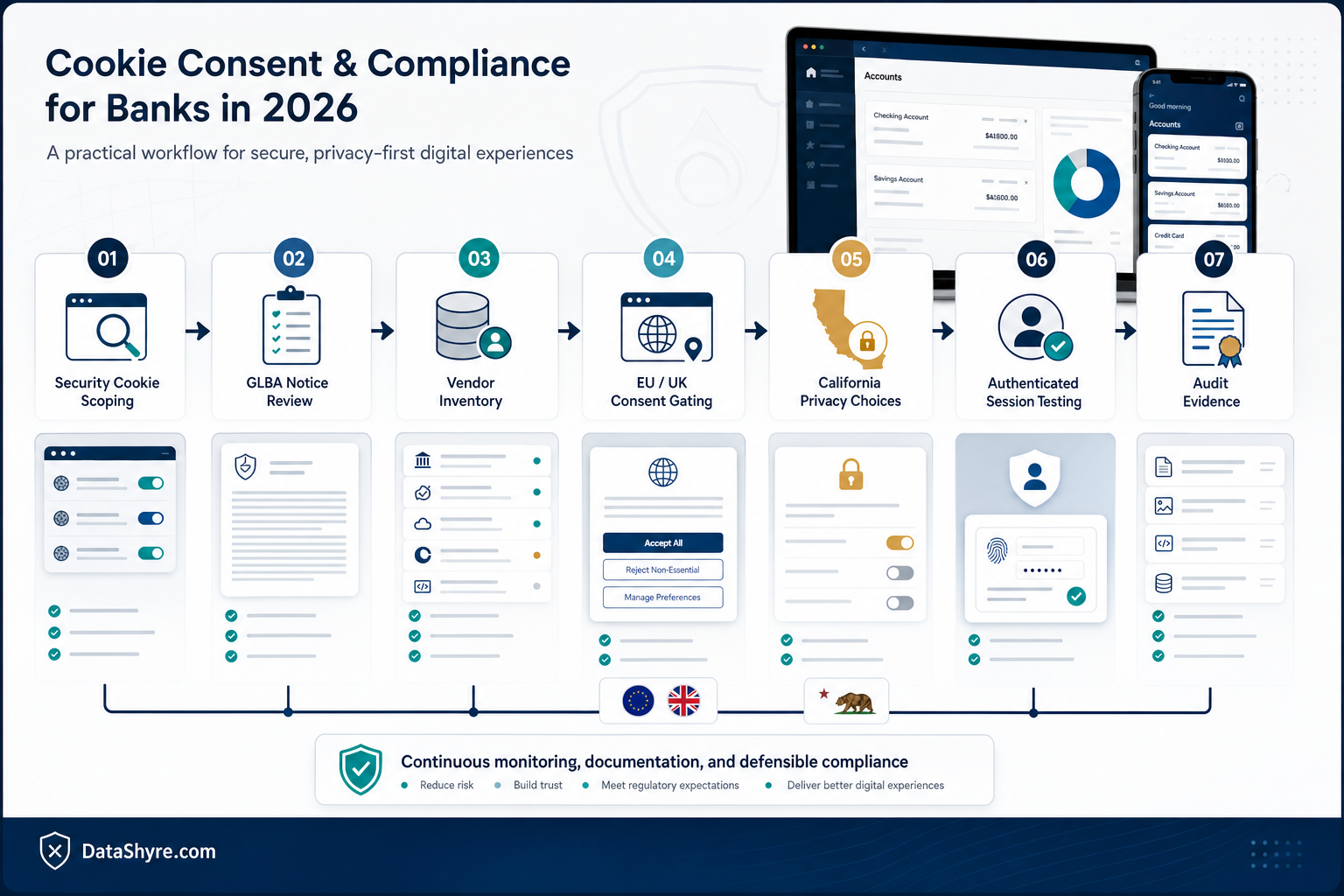
6. Build a California branch if the site uses sharing, targeted advertising, or sensitive data flows
This is the U.S. branch that often gets simplified too aggressively.
California’s privacy materials still say consumers can opt out of sale or sharing, including through an opt-out preference signal, and that covered businesses often need a clear website link such as “Do Not Sell or Share My Personal Information” or “Your Privacy Choices.” The CPPA also still treats financial account information and credentials as sensitive personal information.
At the same time, the CPPA FAQ still notes that some entities and information can be exempt to the extent they are covered by laws such as GLBA. CFPB’s 2024 report is a good reminder that those exemptions do not magically erase all modern tracking risk or all policy gaps.
So for cookie consent for banks, the California question is rarely just “Are banks exempt?” It is:
- what information and entities are actually in scope for the relevant state-law branch;
- whether any site behavior amounts to sale or sharing for cross-context behavioral advertising;
- whether opt-out preference signals and website privacy-choice links are handled correctly where required; and
- whether sensitive-data flows are being minimized instead of casually expanded through vendor tools.
That scoping step should happen before anyone declares the website “covered” or “not covered.”
7. Test authenticated sessions, returns, and withdrawal like a bank examiner would
This is where cookie consent for banks usually fails in production.
A clean first visit on the homepage proves very little if the real tracking starts after login, after account-preference sync, after a support widget opens, or after a returning visitor comes back with old identifiers still readable.
My minimum test set would cover:
- first visit with no choice made;
- explicit reject;
- explicit accept;
- later withdrawal;
- return visit after rejection;
- authenticated session after login; and
- mobile webview or app-browser behavior if the bank relies on embedded journeys.
CNIL’s American Express case is useful here because the failures were not abstract. The regulator found cookies being deposited before choice, despite refusal, and still being read after consent was withdrawn. That is exactly the kind of runtime proof problem a bank should want to catch early.
8. Save evidence another team can understand six months from now
The strongest cookie consent for banks program is the one that survives personnel changes, vendor changes, and the next redesign.
I would keep at least this evidence pack:
- a cookie and vendor inventory by journey;
- screenshots of first layer, settings layer, and withdrawal entry point;
- notes showing which technologies fire before choice, after reject, after accept, and after withdrawal;
- region-specific notes for EU, UK, California, and any other state branch that matters;
- the GLBA notice version and where it is presented;
- the release date, deploy ticket, or change record tied to the review.
That turns cookie consent for banks from a one-time banner decision into a repeatable operating control.
FAQ
Do banks always need a cookie banner?
No. The answer depends on geography, the purpose of the technology, and the actual journey. Security and session technologies that are strictly necessary for online banking can be treated differently from analytics or advertising tools.
Does a GLBA privacy notice replace cookie consent?
No. A GLBA privacy notice addresses financial-information sharing disclosures and opt-out rights in its own framework. It does not automatically solve device-level tracking, optional analytics, advertising pixels, or consent withdrawal on the website itself.
Should banks treat logged-in pages differently from marketing pages?
Yes. Logged-in journeys often have a stronger argument for certain necessary security technologies, but they also carry a higher risk if optional vendors, profiling tools, or support widgets are left uncontrolled.
Bottom line
The best answer to cookie consent for banks in 2026 is not “install a banner and move on.”
It is to separate necessary security controls from optional tracking, keep GLBA notice delivery distinct from web-tracking control, inventory every third party across public and authenticated journeys, handle EU or UK consent and California choice signals in their own branches, test withdrawal on the live site, and keep proof that another team can verify later.
If your current setup cannot survive those eight checks, it is not strong enough for a banking environment simply because the footer says “Privacy.”
Sources
- Federal Trade Commission, How To Comply with the Privacy of Consumer Financial Information Rule of the Gramm-Leach-Bliley Act: https://www.ftc.gov/business-guidance/resources/how-comply-privacy-consumer-financial-information-rule-gramm-leach-bliley-act
- Consumer Financial Protection Bureau, 12 CFR Part 1016 – Privacy of Consumer Financial Information (Regulation P): https://www.consumerfinance.gov/rules-policy/regulations/1016/
- Consumer Financial Protection Bureau, Section 1016.9 Delivering privacy and opt out notices: https://www.consumerfinance.gov/rules-policy/regulations/1016/9/
- Consumer Financial Protection Bureau, State Consumer Privacy Laws and the Monetization of Consumer Financial Data: https://www.consumerfinance.gov/data-research/research-reports/state-consumer-privacy-laws-and-the-monetization-of-consumer-financial-data/
- Information Commissioner’s Office, Cookies and similar technologies: https://ico.org.uk/for-organisations/direct-marketing-and-privacy-and-electronic-communications/guide-to-pecr/cookies-and-similar-technologies/
- Information Commissioner’s Office, Guidance on the use of storage and access technologies: https://ico.org.uk/for-organisations/direct-marketing-and-privacy-and-electronic-communications/guidance-on-the-use-of-storage-and-access-technologies/
- Information Commissioner’s Office, How do the rules apply to online advertising?: https://ico.org.uk/for-organisations/direct-marketing-and-privacy-and-electronic-communications/guidance-on-the-use-of-storage-and-access-technologies/how-do-the-rules-apply-to-online-advertising/
- European Commission, Legal grounds for processing data: https://commission.europa.eu/law/law-topic/data-protection/information-business-and-organisations/legal-grounds-processing-data_en
- California Privacy Protection Agency, Frequently Asked Questions: https://cppa.ca.gov/faq
- California Department of Justice, California Consumer Privacy Act (CCPA): https://oag.ca.gov/privacy/ccpa
- CNIL, Cookies: la CNIL sanctionne AMERICAN EXPRESS d’une amende de 1,5 million d’euros: https://www.cnil.fr/fr/cookies-la-cnil-sanctionne-american-express-dune-amende-de-15-million-deuros
—
Published: October 24, 2026. Updated using current official regulator, government, and financial-privacy materials available at publication time.