

GDPR vs. CCPA in 2026: 7 Differences That Still Change Privacy Operations
If your team still treats gdpr vs. ccpa as a geography question, it will probably build the wrong controls.
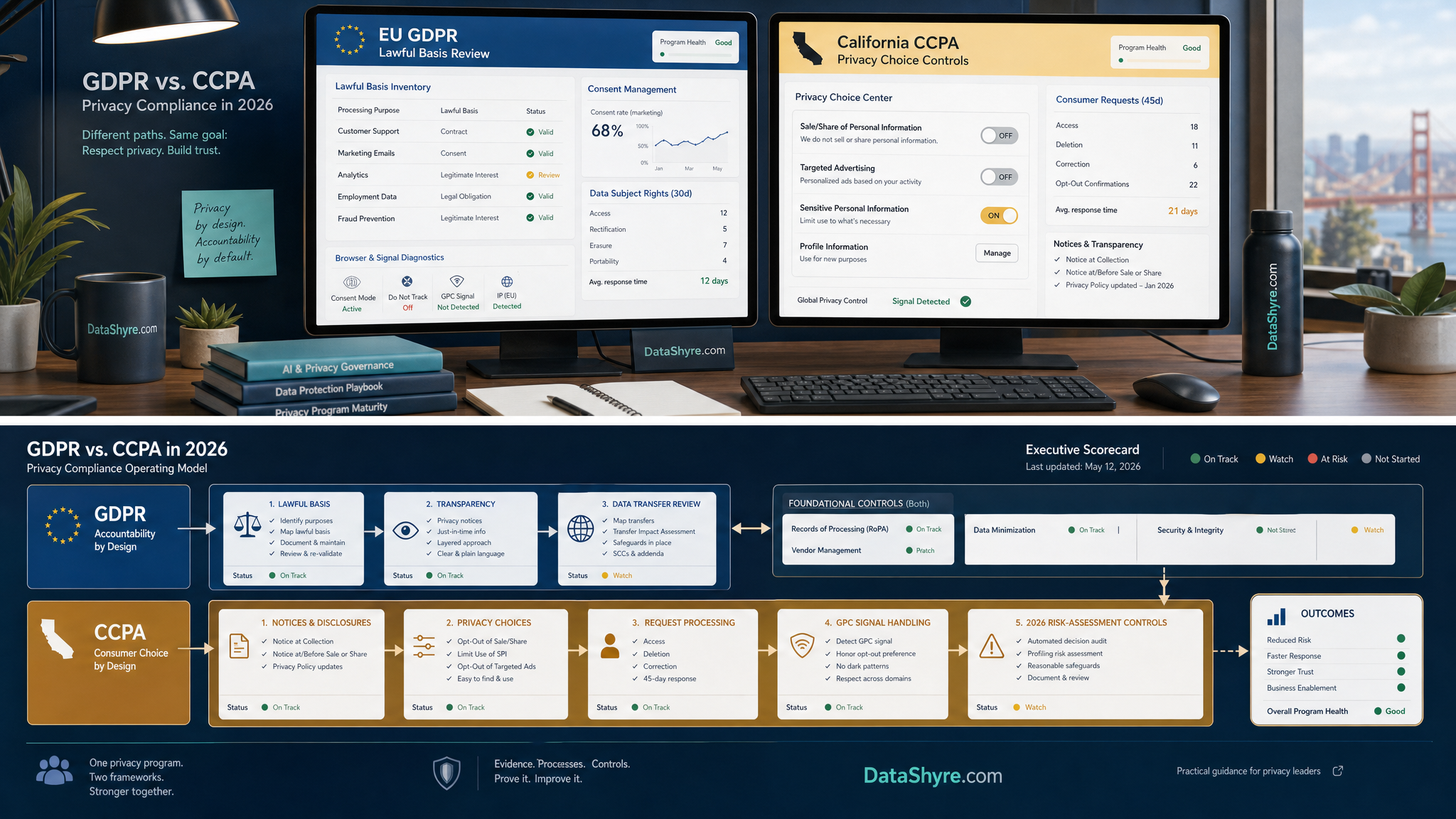
In 2026, the cleaner comparison is operational. GDPR still asks whether the processing itself is justified, transparent, and properly governed. CCPA, as amended by the CPRA, still leans harder on disclosure, consumer choice, request handling, and technical follow-through once a California resident exercises a right.
If you want adjacent context first, start with our guides to GDPR compliant privacy notice, California consumer privacy, and CCPA cookie consent requirements. This page is narrower. It is the comparison I would use this week before deciding whether a privacy task belongs in your EU branch, your California branch, or both.
The short answer
The shortest useful answer to gdpr vs. ccpa is this:
- GDPR is a lawful-basis regime with stricter structural rules around why data may be processed.
- CCPA is a consumer-rights and disclosure regime with heavier pressure on opt-out mechanics, request handling, and downstream suppression.
- They overlap on transparency and accountability, but they do not organize the privacy program the same way.
That is why the same website may need an EU consent branch, a California privacy-choices branch, and a shared internal workflow that can still prove what happened later.
7 differences that matter in practice
1. Scope starts in different places
The first important difference in gdpr vs. ccpa is basic applicability.
GDPR applies to organizations established in the EU when they process personal data in the context of those activities. It also reaches companies outside the EU when they offer goods or services to people in the EU or monitor their behavior there.
CCPA starts from a different gate. It applies to certain for-profit businesses doing business in California that meet threshold tests. The current CPPA FAQ still lists the revenue threshold as $26.625 million, alongside the 100,000 consumers or households threshold and the 50% of annual revenue from selling or sharing personal information threshold.
So the first scoping question is not the same:
- GDPR: are we processing personal data in a way that pulls us into the EU framework;
- CCPA: are we a covered California business under the current thresholds.
That difference changes which organizations even enter the program.
2. GDPR needs a lawful basis; CCPA usually needs notice plus choice
This is still the operating split most teams miss.
The European Commission continues to point organizations to multiple lawful bases under GDPR, including consent, contract, legal obligation, vital interests, public task, and legitimate interests. That means a GDPR review usually begins before the banner, not at the banner.
CCPA does not use that same general lawful-basis model for ordinary business processing. In most cases, the work is more about whether the business made the right disclosures, offered the right methods, and honored the consumer’s choices when sale, sharing, or sensitive-information limits are in scope.
If teams flatten those two models into one, they often over-collect consent where notice and opt-out logic were the real job, or under-build their governance where a lawful-basis analysis was the real job.
3. The user-facing interface is not solving the same problem
The front-end experience can look similar, but the legal work underneath is different.
Where consent is the chosen or required GDPR basis, the European Commission still says valid consent must be freely given, informed, specific, and given through an affirmative act. It also says the request should use “clear and plain language” and that withdrawal should be as easy as giving consent.
Under CCPA, the more common consumer-facing pattern is not a GDPR-style opt-in wall. It is a combination of notice, a “Do Not Sell or Share My Personal Information” or “Your Privacy Choices” path where required, and signal handling that actually changes downstream behavior.
California’s Department of Justice still describes Global Privacy Control as a “stop selling or sharing my data switch” and says that, under law, it “must be honored” by covered businesses as a valid consumer request to stop sale or sharing.
That means a team can build a clean EU consent flow and still be weak in California if its opt-out and signal plumbing are incomplete.
4. Rights handling overlaps, but the timelines do not
On paper, both frameworks give individuals meaningful rights. In production, the timing model feels different.
GDPR rights workflows are commonly designed around a one-calendar-month response deadline, with limited extensions for complex cases.
The CPPA FAQ still sets out a more segmented California timing model:
- requests to delete, correct, or know must be confirmed within 10 business days;
- those requests must be substantively answered within 45 calendar days;
- businesses may extend to 90 days total if they notify the consumer;
- opt-out of sale or sharing and requests to limit use of sensitive personal information must be handled as soon as feasibly possible and no later than 15 business days.
That is why one intake form is not enough. A real gdpr vs. ccpa process needs routing logic behind the form.
5. Sensitive data and children’s data branch differently
Another important gdpr vs. ccpa difference is how each framework treats more sensitive categories of data.
GDPR has a specific regime for special categories of personal data and tighter rules around how those categories may be processed.
CCPA uses a different structure. California gives consumers a right to limit the use and disclosure of sensitive personal information in certain scenarios, and it keeps a separate opt-in rule for minors when selling or sharing data is involved. The California Department of Justice still says a business can sell a child’s personal information only if it has affirmative authorization when the consumer is known to be under 16.
That means the California build often centers on sale-or-sharing analysis, request architecture, and sensitive-information use limits, while the GDPR build more often centers on lawful basis, necessity, and special-category justification.
6. The 2026 updates are pushing each regime in different ways
The legal baseline is not static, and this is where gdpr vs. ccpa becomes especially current in 2026.
For GDPR, the EDPB announced on March 19, 2026 that its Coordinated Enforcement Framework for 2026 is focused on transparency and information obligations under the GDPR. That matters because it puts fresh pressure on layered notices, intelligible explanations, and the difference between saying something in a policy and actually making it understandable.
For CCPA, the CPPA’s major regulations covering risk assessments, cybersecurity audits, ADMT rights, and related updates became effective on January 1, 2026. That raises the operational weight of California compliance well beyond footer links and request forms.
So if your internal privacy roadmap still treats GDPR as the deep program and CCPA as the light one, 2026 is a good year to re-check that assumption.
7. Cross-border vendor review is still much heavier under GDPR
This is one of the clearest structural differences in gdpr vs. ccpa.
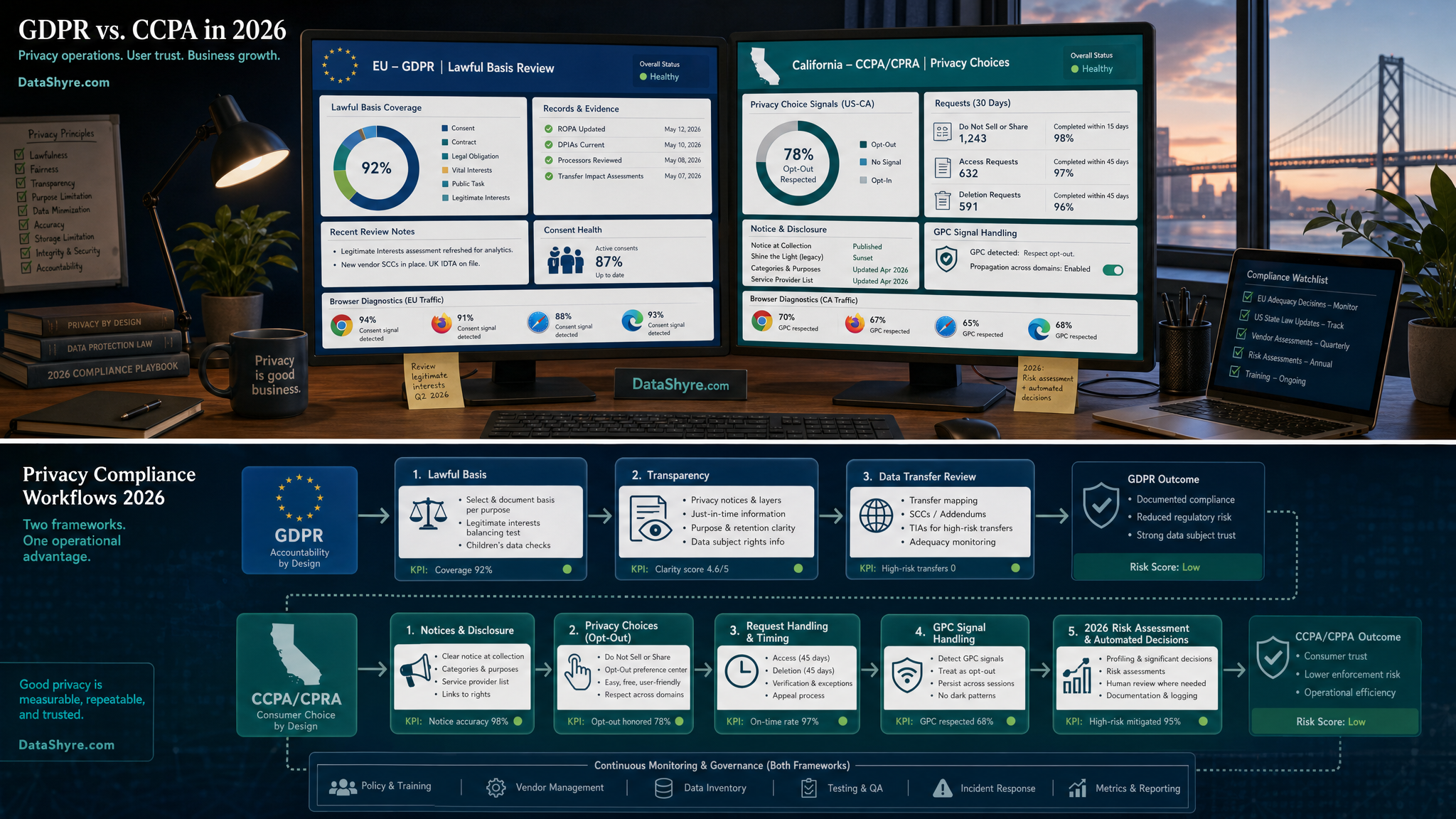
The European Commission still frames the GDPR transfer toolkit around mechanisms such as adequacy decisions, standard contractual clauses, and binding corporate rules. So if EU personal data is moving across borders, vendor review often becomes a first-class design task.
CCPA does not mirror that with a standalone international-transfer regime. California still cares deeply about what happens downstream, but it usually reaches that problem through service-provider and contractor controls, sale or sharing analysis, privacy disclosures, and request enforcement rather than through a separate GDPR-style transfer chapter.
In practice, GDPR vendor review usually asks, “What is the legal path for this transfer?” California review more often asks, “What exactly is this recipient allowed to do, and does the consumer still have a working choice path?”
A practical build sequence for mixed-region teams
If I were reviewing a live site for both frameworks today, I would do this in order:
- decide whether the processing is in scope for GDPR, CCPA, or both;
- map each EU-relevant use case to a lawful basis instead of assuming consent is always the answer;
- separate California opt-out and GPC handling from EU consent logic instead of forcing one banner flow to do both jobs poorly;
- verify request routing and timing for access, deletion, correction, objection, opt-out, and limit requests;
- inspect whether the California branch actually suppresses sale or sharing signals after a request;
- review transfer and vendor controls for any GDPR-relevant international data path;
- test notices and layered disclosures against the 2026 transparency pressure, not just against last year’s copy.
That sequence catches more real failures than debating which acronym is tougher.
FAQ
Is GDPR always stricter than CCPA?
Not in a simple all-purpose sense. GDPR is usually stricter about legal basis, consent structure, and transfer governance. CCPA can be more operationally demanding around consumer-choice execution, signal handling, and 2026 California-specific controls.
Do I need both a consent banner and a California privacy-choices path?
Often yes, if your audience and data practices trigger both frameworks. The clean approach is to separate the EU consent job from the California opt-out and signal-recognition job rather than pretending one screen solves both.
Why does this comparison matter so much in 2026?
Because 2026 adds fresh pressure on both sides: EDPB scrutiny on transparency for GDPR, and already-effective CPPA regulations on risk assessments, cybersecurity audits, and ADMT rights for CCPA.
Bottom line
The useful answer to gdpr vs. ccpa in 2026 is not that one law is European and the other is Californian.
It is that they ask different first questions.
GDPR asks whether the processing itself is justified, transparent, and properly governed. CCPA asks whether the consumer was told enough, can exercise the right choices, and whether the business actually follows through once those choices are exercised.
Once you separate those models, your notices get clearer, your consent and opt-out flows stop fighting each other, and your technical controls become much easier to defend.
Sources
- European Commission, application of the GDPR: https://commission.europa.eu/law/law-topic/data-protection/information-business-and-organisations/application-gdpr_en
- European Commission, legal grounds for processing data: https://commission.europa.eu/law/law-topic/data-protection/information-business-and-organisations/legal-grounds-processing-data_en
- European Commission, rules on international data transfers: https://commission.europa.eu/law/law-topic/data-protection/international-dimension-data-protection/rules-international-data-transfers_en
- European Data Protection Board, CEF 2026 transparency action: https://www.edpb.europa.eu/news/cef-2026-edpb-launches-coordinated-enforcement-action-on-transparency-and-information_en
- ICO, time limits for responding to data protection rights requests: https://ico.org.uk/for-the-public/time-limits-for-responding-to-data-protection-rights-requests/
- California Privacy Protection Agency, FAQs: https://cppa.ca.gov/faq
- California Privacy Protection Agency, updated monetary thresholds in CCPA: https://cppa.ca.gov/regulations/cpi_adjustment.html
- California Privacy Protection Agency, 2026 CCPA updates: https://cppa.ca.gov/regulations/ccpa_updates.html
- California Department of Justice, California Consumer Privacy Act: https://oag.ca.gov/privacy/ccpa