

Best GDPR Software in 2026: 6 Tools Worth Shortlisting and 7 Checks Before You Buy
If you are searching for the best GDPR software in 2026, the useful question is not which platform has the busiest demo.
The useful question is which system can turn privacy promises into runtime control, usable records, and repeatable workflows after the next tag change, vendor rollout, campaign launch, or rights request.
That is why this guide does not force one universal winner. Different teams need different strengths. Some need a strong consent layer. Some need DSAR automation. Some need data mapping, RoPA support, and audit-ready evidence across dozens of systems.
If you want the surrounding context first, it helps to read our guides to consent management platforms, gdpr compliant privacy notice, and best privacy tools. This page is narrower. It is the shortlist and buying sequence I would use this week for the keyword best GDPR software.
Why “best” GDPR software is an operations question now
The legal baseline still points in the same direction, and it is more operational than many buying guides admit.
The European Commission still says valid consent must use “clear and plain language” and be withdrawable in a way that is “as easy to use as giving consent.” On April 29, 2026, the UK’s ICO published final storage-and-access-technologies guidance covering cookies, tracking pixels, device fingerprinting, and similar technologies, which is a useful reminder that banner design alone is not the whole job. In 2026, the EDPB also launched a coordinated enforcement action focused on transparency and information obligations under Articles 12, 13, and 14 GDPR. And Google’s current setup guidance still says consent defaults should be set “before any commands that send measurement data.”
That combination changes how I score software.
The best GDPR software should help a team do five things reliably:
- present a fair and understandable first-layer choice;
- hold optional tracking or processing back until the right signal exists;
- route consent, objection, and rights workflows into the right regional branch;
- keep records another team can still understand later; and
- survive ordinary operational change without reopening old risks.
If a tool cannot do that, the dashboard quality matters less than the sales team suggests.
The shortlist: 6 GDPR software options worth comparing
These are not ranked as a universal top six. They are the six options I would shortlist by use case based on current public product materials and the control problems they appear built to solve.
1. OneTrust
Best for: large organizations that want broad consent and preference management inside a wider privacy governance stack.
OneTrust’s current consent materials emphasize purpose-based consent, tracker discovery, geolocation-aware experiences, blocking before consent, and consent receipts stored in exportable logs. That makes it a natural shortlist candidate for enterprises that want a large control surface across web, mobile, OTT, and multiple regions.
The live question is not whether OneTrust has enough features. It is whether your team will actually configure categories, templates, and regional logic well enough to use them. For bigger programs, that can still be a good trade if you need breadth.
2. Usercentrics
Best for: web and app teams that care heavily about consent UX, publisher requirements, and implementation speed.
Usercentrics currently positions itself as a Google-certified CMP, supports TCF-aligned use cases, and offers web, app, and cross-domain consent capabilities. If you have advertising or publisher requirements in the EEA, UK, or Switzerland, that matters because Google’s current publisher policy still requires a certified CMP integrated with the IAB Transparency and Consent Framework in those regions when serving personalized ads.
This is usually a strong shortlist option when consent collection is the center of gravity and you do not need the heaviest enterprise governance suite first.
3. Osano
Best for: mid-market teams that want clearer compliance guardrails and a unified consent-and-preferences operating layer.
Osano’s current CMP materials focus on global language and regulation support, unauthorized tag blocking, unified preference handling, and reporting. Its messaging also leans into reducing dark-pattern risk through templates and guardrails.
That can be attractive for teams that want to move quickly without building every choice path from scratch. The practical buying test is whether the default workflows line up with your real legal review process, not only your banner deployment checklist.
4. Transcend
Best for: engineering-led organizations that want enforcement deeper in the stack than a classic cookie banner.
Transcend’s current consent documentation describes its product as an intelligent privacy firewall and emphasizes network-level enforcement, regional experiences, privacy signal detection, and a shared privacy center for ongoing preference management.
That makes it especially interesting when your bigger problem is not just visual consent collection, but controlling how data actually moves through websites, mobile apps, and server-side flows after the person has made a choice.
5. BigID
Best for: companies where GDPR software needs to connect consent with discovery, RoPA, assessments, and DSAR fulfillment.
BigID’s current privacy materials are much broader than a website CMP. The product story centers on discovery, identity-aware correlation, rights automation, consent and opt-outs, RoPA support, assessments, and downstream enforcement.
If your privacy program fails more often in data inventory and fulfillment than in banner design, BigID belongs on the shortlist. This is a better fit when privacy operations are deeply tied to data estate visibility and cross-system evidence.
6. DataGrail
Best for: teams that need practical request handling, workflow visibility, and system detection alongside privacy operations.
DataGrail’s current materials highlight request management, workflow states, exports, dashboards, intake customization, and system detection for automated data mapping. That makes it a credible choice when DSAR throughput and operational follow-through matter more than advanced banner experimentation.
For many organizations, this is the more realistic buying center. The hardest GDPR problem is often not collecting a preference. It is fulfilling requests, proving outcomes, and keeping system inventories current enough to trust them.
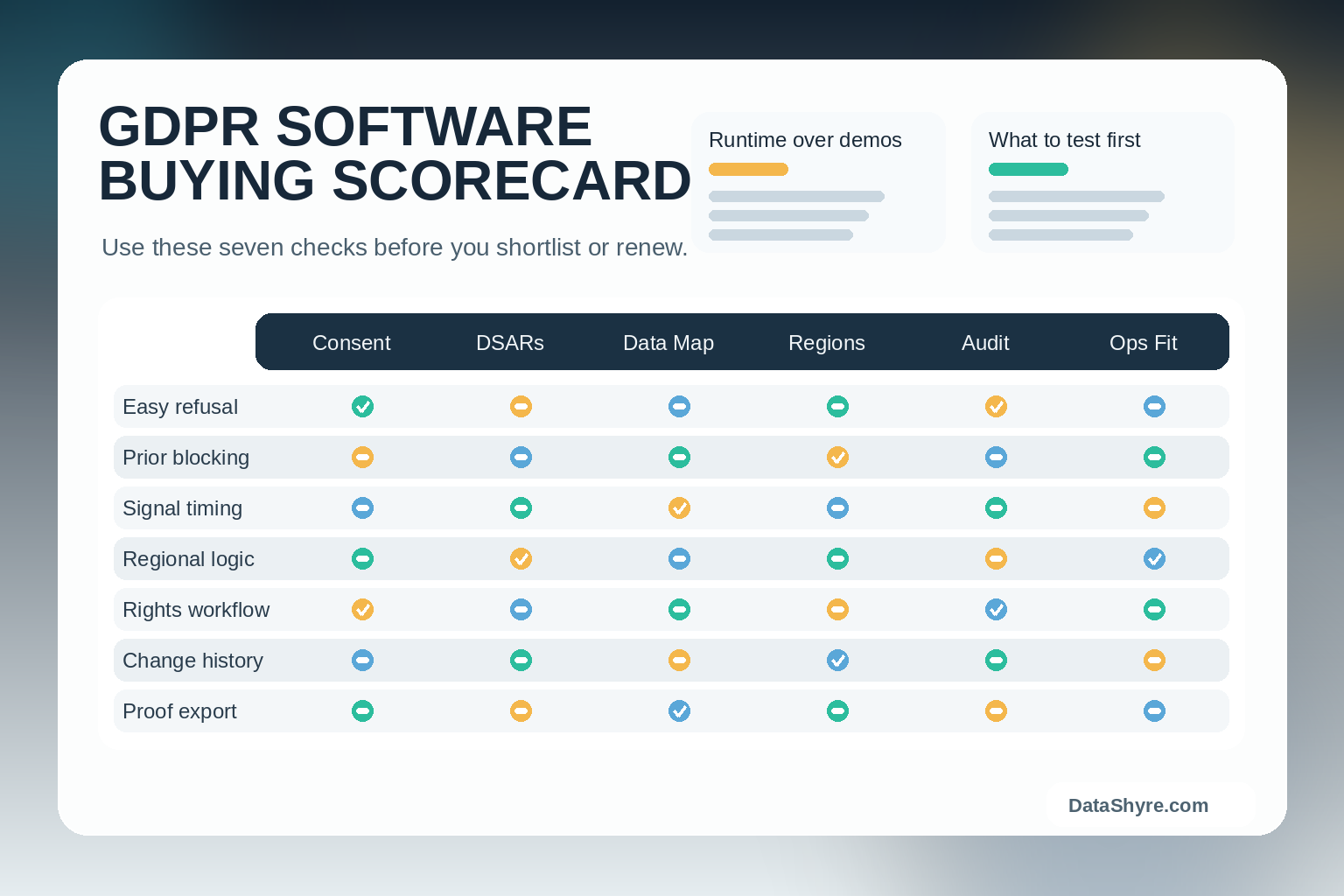
7 checks to run before you buy any GDPR software
The easiest way to waste budget on best GDPR software is to compare only feature lists. I would run these seven checks live instead.
1. Check whether refusal is genuinely easy
CNIL’s current position is still blunt: rejecting cookies should be “just as easy as accepting them.” That should shape your product demo review.
Look at the first layer on desktop and mobile. If the privacy-protective path is hidden, softened, or delayed, the software may create extra work for your team before implementation even starts.
2. Check prior blocking where the site is most likely to leak
Do not test only the homepage.
Test templates with analytics, embedded video, chat, social widgets, heatmaps, and tag manager complexity. The right GDPR software should help keep optional technologies from acting before the right signal exists where prior-consent rules apply.
3. Check signal timing, not just stored preferences
Google’s current guidance still says consent defaults should be called on every page before any commands that send measurement data such as config or event.
That matters because many stacks save a preference correctly but communicate it too late. A platform that looks compliant in storage and fails in execution timing is weaker than it appears.
4. Check regional routing deliberately
The buying test should include more than one geography.
Run at least:
- an EU or UK first visit with no prior preference;
- a California visit if opt-out logic or GPC matters to your business;
- a return visit after refusal;
- a return visit after acceptance.
If the vendor cannot explain those branches clearly, the implementation risk is higher than the demo suggests.
5. Check whether rights workflows are actually manageable
The European Commission’s current guidance still says organizations should reply to rights requests without undue delay and in principle within one month.
That makes request orchestration a software issue, not only a legal issue. Ask to see the intake path, verification handoff, queue logic, export path, and evidence trail for access, deletion, correction, and objection workflows.
6. Check whether records can stay useful after change
The ICO still says organizations can document processing activities in different ways, from basic templates to “specialist software packages.”
The right question is whether the records in that software will still make sense after the next site redesign, new processor, or new business unit rollout. If the answer depends on heroic manual upkeep, the platform may not scale with the program.
7. Check whether the product fits your real failure point
This is where many buying decisions go wrong.
If your real problem is consent signaling, buy for consent signaling. If your real problem is data mapping and RoPA drift, buy for discovery and records. If your real problem is rights fulfillment, buy for request execution and vendor coordination.
The best GDPR software is usually the one that solves the failure you actually have, not the one that scores highest on a blended marketing grid.
A faster way to separate the shortlist this week
If I had to narrow six tools to two this week, I would do it in this order:
- identify whether consent, rights workflows, or data mapping is the primary gap;
- test first-layer choice and prior blocking in a live demo;
- verify timing and downstream signaling, not just saved state;
- check whether regional logic is configurable without becoming fragile;
- inspect exportable logs, change history, and evidence retention;
- confirm the operating model fits the size and technical depth of your team.
That sequence usually reveals more than an RFP spreadsheet does.
FAQ
Is the best GDPR software always a consent management platform?
No. For some companies, consent is the highest-risk surface. For others, the bigger problem is DSAR fulfillment, data mapping, or proving what changed after a release. GDPR software is a wider category than CMPs alone.
Do I need Google-certified CMP support to buy GDPR software?
Not always. You need to test that branch if you serve personalized ads through Google publisher products in the EEA, UK, or Switzerland. If that does not apply to your business, it may be helpful but not central.
Should I buy one suite or several specialized tools?
That depends on where your program breaks. A suite can help when the team needs one operating layer. Specialized tools can be stronger when one workflow, such as consent enforcement or DSAR handling, is much more mature than the rest.
Bottom line
The best GDPR software in 2026 is not the one with the longest feature page.
It is the one that matches your main privacy failure point, supports fair user choice, enforces that choice in time, routes regional differences cleanly, and leaves behind evidence your team can still trust after ordinary change.
That is the buying standard worth using before you shortlist, pilot, renew, or migrate.
Sources
- European Commission, legal grounds for processing data: https://commission.europa.eu/law/law-topic/data-protection/information-business-and-organisations/legal-grounds-processing-data_en
- European Commission, dealing with requests from individuals: https://commission.europa.eu/law/law-topic/data-protection/information-business-and-organisations/dealing-requests-individuals_en
- ICO, final storage and access technologies guidance published: https://ico.org.uk/about-the-ico/media-centre/news-and-blogs/2026/04/final-storage-and-access-technologies-guidance-published/
- ICO, guidance on the use of storage and access technologies: https://ico.org.uk/for-organisations/direct-marketing-and-privacy-and-electronic-communications/guidance-on-the-use-of-storage-and-access-technologies/
- ICO, how do we document our processing activities?: https://ico.org.uk/for-organisations/uk-gdpr-guidance-and-resources/accountability-and-governance/documentation/how-do-we-document-our-processing-activities/
- EDPB, coordinated enforcement action on transparency and information obligations: https://www.edpb.europa.eu/news/cef-2026-edpb-launches-coordinated-enforcement-action-on-transparency-and-information_fr
- CNIL, dark patterns in cookie banners: https://www.cnil.fr/en/dark-patterns-cookie-banners-cnil-issues-formal-notice-website-publishers
- Google for Developers, set up consent mode on websites: https://developers.google.com/tag-platform/security/guides/consent
- Google AdSense Help, consent management requirements for publishers: https://support.google.com/adsense/answer/13554116
- OneTrust, consent management platform: https://www.onetrust.com/products/consent-management/
- Usercentrics, website consent management platform: https://usercentrics.com/website-consent-management/
- Osano, consent management platform: https://www.osano.com/solutions/consent-management-platform
- Transcend, consent management: https://docs.transcend.io/docs/articles/consent-management
- BigID, privacy and compliance: https://bigid.com/solutions/privacy-and-compliance/
- DataGrail, request manager: https://www.datagrail.io/platform/request-manager/
—
Published: October 22, 2026. Updated using current official regulator, government, Google, and primary vendor materials available at publication time.