

GDPR Consent Management Platform in 2026: 7 Live Checks Before You Trust It
If you are evaluating a gdpr consent management platform in 2026, the useful question is not which tool can launch a banner fastest.
The useful question is whether the platform can turn a person’s choice into real behavior across tags, scripts, embeds, regional rules, and later withdrawal without your team losing the evidence trail two releases later.
That is the right frame now because the official materials still point in the same direction. The European Commission still says consent must be freely given, specific, informed, and shown through a clear affirmative act, with requests written in “clear and plain language.” The UK’s ICO finalized its storage-and-access-technologies guidance on April 29, 2026 and made clear the review is broader than classic cookies alone. On March 19, 2026, the EDPB launched a coordinated enforcement action focused on transparency and information obligations under Articles 12, 13, and 14 GDPR. And on July 14, 2026, the EDPB said the Belgian DPA must handle the merits of a NOYB cookie-banner complaint involving broadcaster VRT instead of closing it on procedural grounds.
If you want the adjacent context first, start with our guides to consent management platform best practices, cookie consent manager, and GDPR compliant privacy notice. This article stays narrower. It is the seven-check review I would use this week before trusting any gdpr consent management platform in production.

Why a GDPR consent management platform is really a runtime control layer
A serious gdpr consent management platform is not only a banner designer.
It is the control layer that should connect:
- the legal basis or consent rule that applies;
- the text and choices shown to the user;
- the runtime behavior of tags, scripts, and vendors before and after a choice;
- the withdrawal path and future preference changes; and
- the proof your team will need later.
That broader scope matters because many weak deployments still pass design review while failing technical review. A clean first layer is not enough if optional analytics, advertising, personalization, or embedded tools still wake up before the user actually chooses.
1. Start by checking whether consent is really the right control for the processing
One of the easiest mistakes in any gdpr consent management platform project is trying to solve every privacy decision with the same interface.
Under the GDPR, consent is only one legal basis. The European Commission’s guidance still lists several possible lawful grounds, and it still warns that consent is not freely given if it is bundled into a condition for unnecessary processing. So the first question is not whether the CMP can collect a yes or no click. The first question is whether the processing at issue actually depends on valid consent in the first place.
In practice, that means splitting your review into three buckets:
- optional technologies that should wait for consent;
- strictly necessary functions that should not be mislabeled as optional;
- other processing that may rely on a different legal basis and needs a different explanation path.
If the product tries to flatten those into one generic control, the implementation will get harder to trust as the stack grows.
2. Test whether the first layer gives a fair, usable choice
This is still the fastest way to rule weak vendors out.
The Commission says the request for consent should be written in “clear and plain language” and that withdrawal must be “as easy to use as giving consent.” CNIL’s current banner enforcement message remains even more direct: rejecting cookies should be “just as easy as accepting them.”
So when you review the first layer, do not stop at colors and copy. Test whether:
Reject allis present whereAccept allis present;- the privacy-protective path is equally visible on mobile;
- category or purpose labels are understandable without legal decoding;
- the banner avoids passive-consent shortcuts such as browsing or scrolling;
- the refusal path takes no more effort than acceptance.
If a vendor still treats rejection as a secondary link, a buried second screen, or a softer-colored afterthought, I would mark that down immediately.
3. Verify prior blocking on the templates most likely to leak
Many teams still test the homepage, approve the banner, and miss the templates where the real failures happen.
The ICO’s finalized 2026 guidance matters here because it emphasizes storage and access technologies beyond named cookies, including pixels, fingerprinting, scripts, and similar tools. That means a gdpr consent management platform should be judged on live behavior, not just on cookie-table language.
The minimum live test set should include:
- landing pages with advertising or analytics tags;
- article or content pages with video, chat, maps, or social embeds;
- forms or product pages with personalization or experimentation tools;
- cached or edge-served pages;
- tag-manager paths that marketing teams can update without a full engineering release.
If optional technologies still fire before choice on any of those paths, the CMP is recording preferences after the fact instead of enforcing them beforehand.
4. Check whether consent signals actually reach the rest of your stack
A banner without downstream enforcement is a decoration layer.
The stronger gdpr consent management platform deployments can show, live, how the initial state lands before optional measurement starts, how an updated choice changes behavior on the page, and how that state is preserved on later visits.
This is also where vendor and platform dependencies matter. If your site serves personalized ads through Google’s publisher products in the EEA, UK, or Switzerland, Google’s current help materials still require a certified CMP integrated with the IAB Transparency and Consent Framework. Google also says its CMP certification review does not check CMPs for full compliance with applicable privacy laws.
That creates a useful split:
- the platform-specific publisher requirement; and
- the broader legal and operational review under GDPR and related guidance.
Passing the first does not guarantee the second.
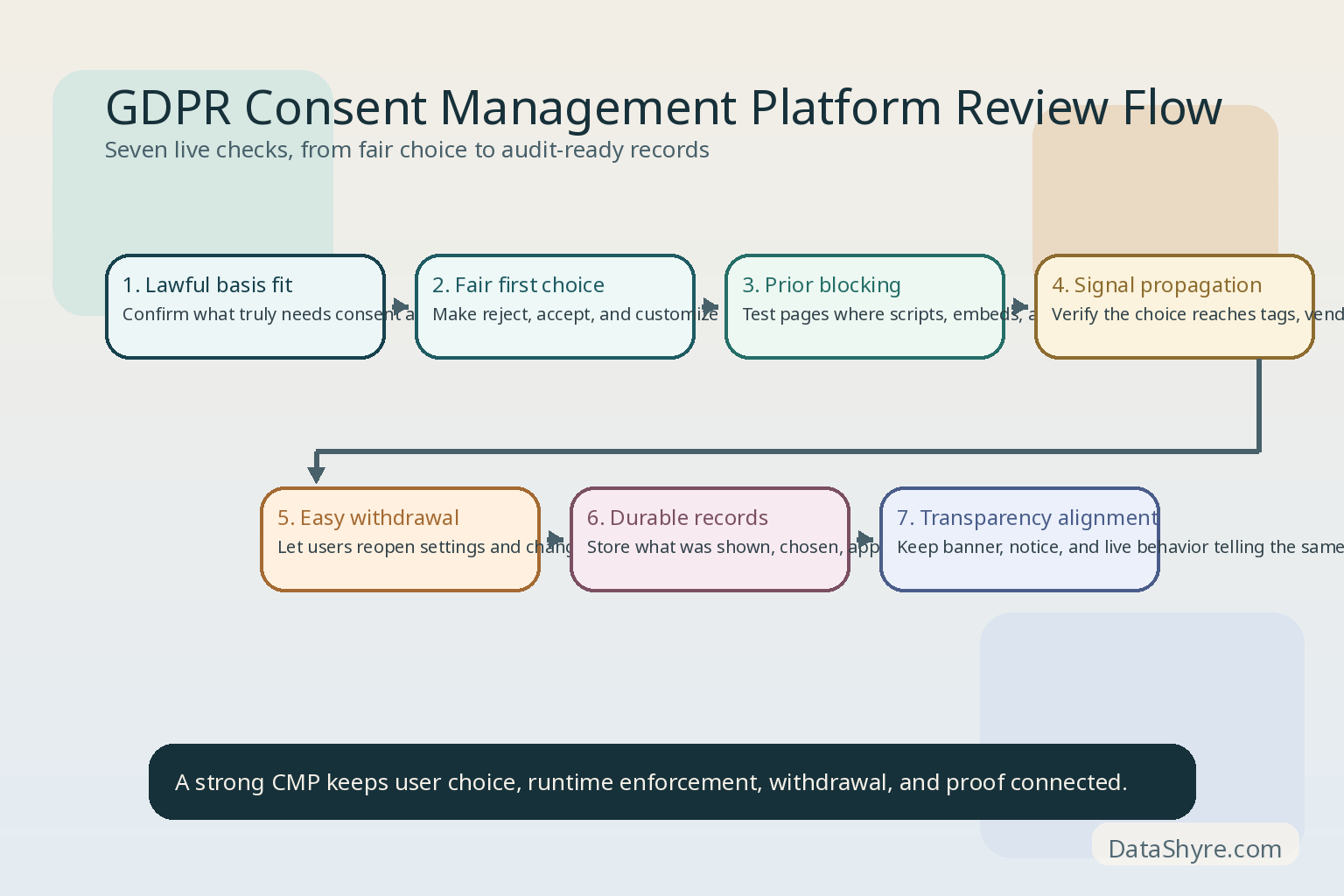
5. Make withdrawal easy enough to survive real use
Withdrawal is where many setups reveal that they were designed to collect consent, not manage it.
The European Commission still says it must be as easy to withdraw consent as to give it. So a working gdpr consent management platform should give users a persistent way back to settings, let same-session changes update live behavior, and preserve those changes on return visits.
I would want to verify:
- a visible path back to privacy settings after the banner closes;
- a working refusal or category-change path without logging a support ticket;
- downstream suppression or activation updates after the user changes direction;
- a plan for re-consent when purposes or technologies change materially.
If withdrawal exists only in theory, the platform is not doing the control job it claims to do.
6. Review the records as if another team will have to explain them later
The record layer is less glamorous than the UX layer, but it is usually what determines whether the deployment survives scrutiny.
For a gdpr consent management platform, the evidence should help another person answer:
- what banner or preference-layer version was shown;
- which categories or purposes were offered;
- what the user selected and when;
- which rule set or region applied;
- what runtime behavior followed that choice;
- whether the user later changed or withdrew the decision.
If legal, engineering, support, and marketing would all interpret the stored record differently, the proof layer is thinner than it looks.
7. Keep transparency aligned across the banner, notice, and live implementation
The EDPB’s 2026 coordinated enforcement action is focused on transparency and information obligations for a reason. Privacy programs often drift when the banner copy, preference center, privacy notice, and live technology stack evolve on different schedules.
That makes this the final live check for any gdpr consent management platform:
- does the banner describe the same purposes the privacy notice describes;
- do category labels match the technologies actually controlled;
- are new vendors, tags, or embeds reflected in the user-facing explanation;
- can the team show that the text and the runtime behavior still tell the same story.
The VRT complaint decision is a useful reminder that cookie-banner issues are still squarely inside active European enforcement attention. Even where the procedural path gets messy, regulators are not treating banners as a solved problem.
A short review order for this week
If I were comparing vendors today, I would review a gdpr consent management platform in this order:
- compare
Accept all,Reject all, andCustomizeon desktop and mobile; - map the real technologies and purposes behind each category;
- test prior blocking on the pages most likely to leak;
- watch how the consent signal propagates into tags and vendors;
- test withdrawal in the same session and on the next visit;
- separate Google’s publisher requirement from your broader legal review if ads matter;
- inspect whether the records still explain the full user journey.
That sequence usually tells you more than another polished sales demo.
Bottom line
The right gdpr consent management platform in 2026 is not the one with the smoothest animation or the prettiest preference center.
It is the one that helps your team make the first choice fair, block optional technologies where required, push consent signals into the rest of the stack, support real withdrawal later, and preserve records that still make sense after the next release.
If those parts line up, the CMP starts acting like infrastructure instead of decoration.
Sources
- European Commission, legal grounds for processing data: https://commission.europa.eu/law/law-topic/data-protection/information-business-and-organisations/legal-grounds-processing-data_en
- EDPB, Guidelines 05/2020 on consent under Regulation 2016/679: https://www.edpb.europa.eu/sites/default/files/files/file1/edpb_guidelines_202005_consent_en.pdf
- EDPB, CEF 2026 coordinated enforcement action on transparency and information obligations: https://www.edpb.europa.eu/news/cef-2026-edpb-launches-coordinated-enforcement-action-on-transparency-and-information_en
- EDPB, Belgian DPA must handle the merits of NOYB cookie banner complaint: https://www.edpb.europa.eu/news/edpb-requires-belgian-dpa-to-handle-the-merits-of-noyb-cookie-banner-complaint_ga
- ICO, final storage and access technologies guidance published: https://ico.org.uk/about-the-ico/media-centre/news-and-blogs/2026/04/final-storage-and-access-technologies-guidance-published/
- ICO, guidance on the use of storage and access technologies: https://ico.org.uk/for-organisations/direct-marketing-and-privacy-and-electronic-communications/guidance-on-the-use-of-storage-and-access-technologies/
- CNIL, dark patterns in cookie banners: https://www.cnil.fr/en/dark-patterns-cookie-banners-cnil-issues-formal-notice-website-publishers
- Google AdSense Help, Google consent management requirements for serving ads in the EEA, the UK and Switzerland (for CMPs): https://support.google.com/adsense/answer/13554020?hl=en-GB
- Google AdSense Help, Google consent management requirements for serving ads in the EEA, the UK and Switzerland (for publishers): https://support.google.com/adsense/answer/13554116?hl=en-GB
—
Published: October 22, 2026. Updated using current official regulator, government, and platform materials available at publication time.