Consent Management Platform GDPR in 2026: 7 Checks Before You Rely on One
DataShyre StaffAug 5, 2026
8 min read
Consent Management Platform GDPR in 2026: 7 Checks Before You Rely on One
If you are searching consent management platform gdpr on August 5, 2026, you probably do not mean, “Which vendor can show a banner?” You usually mean, “Which platform can actually help us collect valid consent under GDPR, keep non-essential tracking off before the click, and leave us with proof that still makes sense later?”
That is the better question in 2026. The European Commission still frames valid consent around free choice, specific purpose, clear information, and an affirmative act. The UK’s ICO finalized updated storage-and-access guidance on April 29, 2026, and that guidance reaches beyond old cookie-banner language into pixels, scripts, tags, fingerprinting, and similar technologies. Then, on July 14, 2026, the EDPB required the Belgian DPA to assess the merits of a cookie-banner complaint involving VRT instead of letting the matter end on procedure alone.
If you want the surrounding baseline first, start with our guides to GDPR cookie consent requirements, best consent management platform, and Google Tag Manager cookie consent. This article stays narrower. It is the seven-check review I would use when the real goal is GDPR-grade consent control, not just vendor demos or ad-stack compatibility.
Why this keyword still matters
The wording is awkward, but the intent behind consent management platform gdpr is common. Teams are trying to separate three different questions that often get blurred together:
does the platform collect a legally defensible consent choice;
does it actually control what fires on the live site; and
does it satisfy any extra platform rules tied to advertising or publisher monetization?
Those are not the same thing. A CMP can look polished and still fail GDPR basics. It can also satisfy a platform requirement for personalized ads while falling short of broader legal expectations.
The 7 checks that matter most
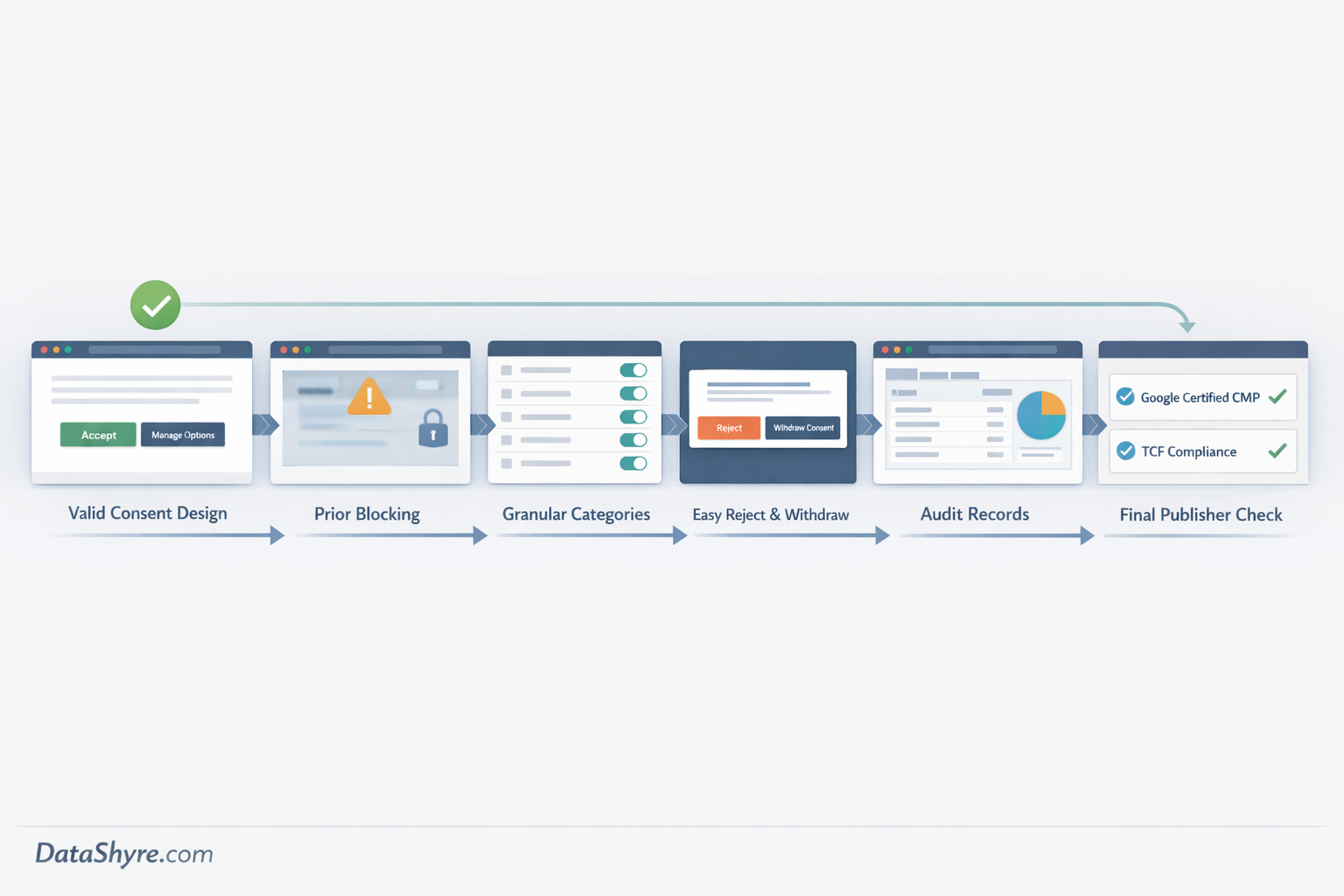
1. The CMP is built for valid consent, not just fast acceptance
The European Commission’s current guidance still says valid consent must be freely given, informed, specific, and expressed through a clear affirmative act. It also says the consent request must use clear and plain language and make withdrawal as easy as giving consent.
That should shape the buying review immediately. A serious consent management platform gdpr workflow should ask:
can the first layer support a real refusal path;
can the experience separate purposes cleanly instead of bundling everything together;
can the copy explain purposes in plain language; and
can the team avoid treating silence, scrolling, or forced continuation as consent?
If the platform is optimized mainly to lift accept rates, it may already be pulling against the legal objective.
2. Non-essential tracking stays off before consent
This is where many evaluations get too theoretical.
The ICO’s final storage-and-access guidance, published on April 29, 2026, makes clear that the compliance review is not limited to traditional cookies. It reaches tracking pixels, fingerprinting, tags, scripts, and similar technologies. So a consent management platform gdpr review has to test runtime behavior, not just banner appearance.
On a clean first visit, the platform should be able to keep non-essential technologies from firing before a valid choice. That means checking:
direct scripts on the page;
tag-manager rules;
embedded third-party content;
analytics and advertising calls; and
race conditions introduced by caching or optimization layers.
If the banner says one thing while the network panel shows another, the network panel wins.
3. Reject is as easy as accept
France’s CNIL put this in unusually plain language in its December 12, 2024 notice on dark patterns in cookie banners:
“Rejecting cookies should be just as easy as accepting them.”
>
CNIL
That one sentence is still one of the best design tests available.
For consent management platform gdpr, it means the review should not stop at “Does the platform allow reject all somewhere?” It should ask whether reject is available at the right layer, with comparable effort, comparable visibility, and no manipulative detours.
4. Granular choices and purpose labels stay understandable
The European Commission’s guidance says users need clear information about why data is processed and what consent covers. The ICO’s consent guidance likewise stresses genuine choice, control, and granular consent options where appropriate.
In practice, a consent management platform gdpr setup should let teams separate purposes in a way users can understand, such as analytics, advertising, personalization, or embedded-content functions, without turning the choice into a maze.
That review should cover:
whether categories are meaningful instead of vague;
whether third-party involvement is disclosed clearly enough;
whether the same label is being used for very different activities; and
whether the consent interface still makes sense on mobile.
Granularity is only useful when the user can tell what changes after the choice.
5. Withdrawal is persistent and easy after the first visit
The Commission says the request for consent must clearly state that withdrawal is possible, and the ICO says people must be able to withdraw consent easily at any time.
So a consent management platform gdpr review should treat post-banner control as part of the product, not as a nice extra. A footer link, persistent icon, account-level control, or other stable settings entry needs to exist and actually work.
The technical check is just as important as the UX check:
does the visible preference change;
do downstream tags update quickly;
do denied categories remain blocked after withdrawal; and
does the old state stay gone across sessions where it should?
If the settings panel says “saved” but the live site quietly restores old behavior, the CMP is not finished.
6. Proof is detailed enough to defend later
A CMP for GDPR is also a records system.
The ICO’s consent guidance says organizations should keep evidence showing who consented, when, how, and what they were told. That matters because a screenshot of a banner does not prove the site respected the resulting choice.
A stronger consent management platform gdpr record set usually includes:
timestamp and regional logic;
categories accepted or refused;
banner or preference-center version;
the mechanism used to capture the choice; and
enough implementation detail to explain what the site did next.
This is where vendor evaluations often get shallow. Audit proof is not just whether exports exist. It is whether the exports connect the visible request to the technical behavior that followed.
7. Publisher and ad-stack requirements stay in their own lane
This is the part that many teams misunderstand.
Google’s current AdSense help says publishers using AdSense, Ad Manager, or AdMob for personalized ads in the EEA, UK, or Switzerland must use a Google-certified CMP integrated with the IAB Transparency and Consent Framework. Google’s Ad Manager help also says TCF v2.3 is mandatory for new TC strings generated on or after March 1, 2026.
Those are important platform rules, but Google also says it “does not check CMPs for full compliance with the TCF or applicable privacy laws.”
That means a consent management platform gdpr review should keep two separate checkpoints:
Does the CMP meet your legal consent and control requirements?
If publisher monetization is in scope, does it also meet Google’s current platform expectations?
Confusing those two questions is how teams end up with traffic that is operationally eligible for ads but still weak on broader consent quality.
What current enforcement is signaling
The pattern is not subtle anymore. Current official materials keep pointing back to the same problems:
weak or distorted refusal paths;
non-essential tracking firing before consent;
vague or incomplete purpose information; and
complaint handling that has to examine what the banner really did.
The CNIL’s 2024 dark-pattern notice and the EDPB’s July 14, 2026 VRT decision both reinforce the same practical lesson: this area is judged as live behavior, not as a design mockup.
A short buyer worksheet for this week
If I were reviewing a consent management platform gdpr decision this week, I would ask:
Can the first layer support a real, visible refusal path?
Can the platform block non-essential technologies before consent across scripts, tags, and embeds?
Can it separate purposes cleanly enough for meaningful user choice?
Can users withdraw later without hunting for the control?
Can the implementation prove which version of the request the user saw and what happened next?
Can the regional logic stay accurate across the EU, UK, and any additional jurisdictions you support?
If ads matter, is the publisher path aligned with Google’s current certified-CMP and TCF expectations?
That sequence usually gets a team closer to the truth than another round of banner styling.
Bottom line
The most useful way to read consent management platform gdpr in 2026 is as a control-and-proof question, not as a banner-shopping question.
If the platform can support valid consent, keep optional technologies off before the click, make refusal and withdrawal genuinely usable, preserve granular control, and produce records that match the technical reality, then it is doing the part that matters most under GDPR. Everything else is secondary.