GDPR Cookie Consent Requirements in 2026: 7 Live Checks for Compliant Banners
DataShyre StaffAug 4, 2026
6 min read
GDPR Cookie Consent Requirements in 2026: 7 Checks Before You Ship the Banner
If you are reviewing gdpr cookie consent requirements on August 4, 2026, the question is not whether the banner looks tidy. The question is whether non-essential tracking stays off until the user makes a valid choice, whether refusal is genuinely easy, and whether the choice keeps working after tags, CMP logic, and downstream vendors get involved.
That is where teams still get caught. The GDPR standard for consent has not softened, and current regulator guidance still pushes toward prior consent, clear affirmative action, granularity, easy withdrawal, and proof. The 2026 wrinkle is that enforcement keeps focusing on real behavior, not just front-end wording.
If you want the surrounding baseline first, start with our guides to GDPR cookie consent, cookie consent banner examples, and Google Tag Manager cookie consent. This article is narrower. It is the seven-check review I would run before approving a live release against gdpr cookie consent requirements.
Why this still matters in 2026
The legal structure is familiar. GDPR sets the standard for valid consent, while cookie and similar-tracking rules require consent before most non-essential technologies are stored on or read from a device. But the practical scope is broader than many teams still assume.
On April 29, 2026, the UK ICO finalized its storage and access technologies guidance and made clear that the rule set reaches beyond classic cookies to tracking pixels, scripts, tags, device fingerprinting, and similar technologies. In the announcement, ICO executive director William Malcolm said the goal is to give people “meaningful control” over how their data is used online.
That line is a useful product test. If the user clicks reject, do your analytics tags, ad pixels, personalization tools, embedded players, and vendor calls actually change behavior? If the answer is “mostly,” the control is not ready.
The 7 checks that matter most
1. Non-essential cookies and similar technologies stay blocked until consent
This is the first gate, and it is still the most common failure.
The ICO’s current guidance says consent is required for non-essential storage and access technologies, and the CNIL continues to treat pre-consent placement as an enforcement issue. In its November 27, 2025 sanction notice concerning vanityfair.fr, the CNIL said cookies requiring consent were placed as soon as users arrived on the site, before they interacted with the banner.
So the first check is mechanical, not rhetorical:
first page load with no action should keep optional tags off;
reject should keep them off;
category-level refusal should block only the denied categories; and
cached pages, tag managers, and embeds should not reintroduce the same trackers out of order.
If your banner is correct but your scripts still fire too early, you are not meeting the baseline.
2. Consent is an active, specific, informed, and unambiguous action
GDPR’s consent definition still matters because many banners compress it into one vague “OK” flow. The Regulation defines consent as a freely given, specific, informed, and unambiguous indication of wishes expressed by a clear affirmative action. The European Commission’s current lawful-basis guidance restates the same core test.
That means:
no pre-ticked boxes;
no reliance on silence, scrolling, or passive browsing;
no bundling unrelated purposes into one switch; and
no collapsing analytics, advertising, and personalization into a single unexplained choice.
Granularity does not mean building a maze. It means the user can understand what they are approving and act on separate purposes where that separation matters.
3. Reject is as easy to reach and use as accept
This is where design teams often create risk while thinking they are improving conversion.
The ICO’s updated guidance includes a dedicated discussion of what a simple means of objecting looks like. CNIL has repeated for years that refusing cookies should be as easy as accepting them, and its December 12, 2024 dark-pattern notice kept pressure on website publishers whose banners pushed users toward agreement. The EDPB’s 2024 consent-or-pay opinion used a different phrase, but the same principle: users need “real choice.”
In practice, this means a first-layer experience where reject is not hidden behind several extra taps, reduced contrast, or manipulative wording. If your banner offers a bright primary accept button and a weak text-only exit that opens a second panel, you should treat that as a review item, not a stylistic preference.
4. The banner explains categories and purposes in plain language
A short banner can still be informative, but only if it says enough for a normal person to understand the request.
The ICO says users need clear and comprehensive information about what you want consent for and what choices they have. The European Commission’s GDPR guidance says purpose information cannot stop at a generic statement that data will be collected and processed.
For cookies and similar technologies, that usually means explaining:
which categories exist;
what each category does;
whether third parties are involved; and
where the user can review more detailed information without losing the thread of the choice.
Labels like “performance” or “experience” are not automatically wrong. They become weak when the user cannot tell whether they mean anonymous service measurement, behavioral advertising, session replay, or something else entirely.
5. Withdrawal is persistent, easy, and actually changes the live state
Giving consent is only half of the control.
The ICO’s consent guidance says withdrawal must be as easy as giving consent and should be easily accessible. For websites, that usually means a persistent settings entry, footer control, account-level control where relevant, or another stable re-entry point that does not depend on the user rediscovering the original banner.
This is also where many teams mistake stored preference for enforced preference. A proper withdrawal check should confirm that:
the visible preference changes;
the CMP or consent layer updates downstream tools quickly;
denied categories stop firing after withdrawal; and
previously granted states do not quietly return because of caching, race conditions, or old tag templates.
If the interface says “saved” and the browser network panel tells a different story, trust the network panel.
6. You keep proof that matches the banner version and the user action
Consent needs evidence.
The GDPR itself requires controllers to be able to demonstrate consent where they rely on it, and the ICO’s consent guidance recommends keeping records that show who consented, when, how, and what they were told at the time.
For a cookie-consent program, the useful record set usually includes:
timestamp and jurisdiction logic;
the categories accepted or refused;
the banner or preference-center version shown;
the mechanism used to capture the choice; and
enough implementation detail to explain what the site did after the choice.
This matters because a screenshot of the banner is not the same as proof that the site obeyed the banner. The stronger record is the one that links the displayed request to the technical behavior that followed.
7. Your ad-tech and publisher stack fits the current operating rules
For publishers, valid consent is not only a regulatory problem. It is also an interoperability problem.
Google’s Ad Manager help says publishers using the IAB Europe TCF need TCF v2.3 for new TC strings generated on or after March 1, 2026. Google also says requests from the EEA, UK, or Switzerland that lack the expected TCF signals may default to limited ads, and a CMP that is not certified by Google can trigger non-personalized or limited-ad handling.
That does not turn Google’s requirements into the law. It does mean a banner can look compliant and still fail operationally if the consent signal never reaches the tags and vendors that actually depend on it.
For teams serving ads, this check should cover:
whether the CMP is appropriate for the monetization stack;
whether the TC string is present and valid where it needs to be;
whether consent mode or tag-layer updates happen early enough; and
whether reject and category-denied states propagate all the way to the ad request path.
What current enforcement is telling teams
The enforcement pattern is not mysterious anymore. Regulators keep returning to the same themes:
trackers placed before consent;
refusal harder than acceptance;
incomplete or unclear information; and
user-facing choices that do not match the technical reality underneath.
CNIL’s 2025 cookie enforcement actions against Google and SHEIN, its 2025 vanityfair.fr decision, and the EDPB’s July 14, 2026 VRT cookie-banner action all point in the same direction. Cookie compliance is being judged as a live control system, not as a copywriting exercise.
That is why gdpr cookie consent requirements are best reviewed by testing behavior, not by only reading the privacy or design spec.
A fast release-day audit
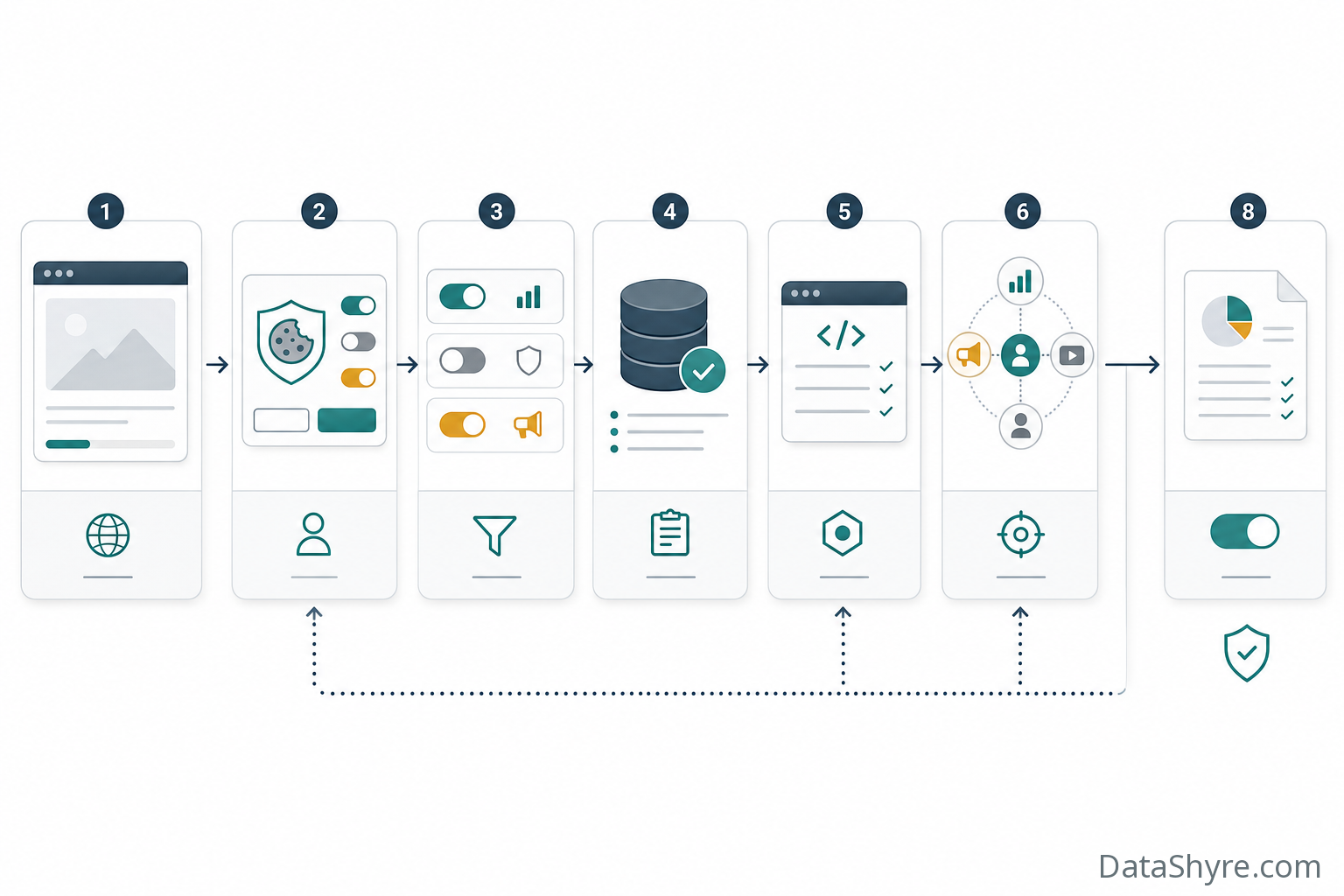
Before your next deployment, run this short pass:
Test a first visit and confirm optional trackers do not fire before consent.
Test reject on the first layer and confirm it is visually and mechanically comparable to accept.
Test category-level choices and verify the denied categories stay blocked.
Test the persistent settings path and confirm withdrawal works after the first session.
Test tag-manager, ad-tech, and embedded-content behavior after both accept and reject.
Check that consent records capture the version, timing, and categories involved.
Re-test with caching, optimization, and regional logic enabled.
That checklist catches more real defects than another round of banner copy edits usually does.
Bottom line
The safest way to read gdpr cookie consent requirements in 2026 is to treat them as an engineering-and-proof problem with a UX surface, not as a banner-design project with a legal footer.
If optional tracking stays blocked until a clear affirmative choice, reject is genuinely easy, withdrawal remains available, records are defensible, and publisher signals propagate correctly, you are much closer to a consent flow that can hold up in practice.