

GDPR Consent Form Examples in 2026: 7 Patterns That Still Hold Up
If you are searching for gdpr consent form examples on November 11, 2026, the useful question is not which checkbox text sounds most legal.
It is which example still gives the person a real choice, makes the purpose obvious, keeps optional processing off by default, and leaves behind proof your team can still explain later.
That is still where the current official guidance points. The European Commission says valid consent must be freely given, informed, specific, and based on a clear affirmative act, with wording in “clear and plain language.” The ICO’s current consent guidance says active opt-in can include “equally prominent yes/no options” and still rejects silence, pre-ticked boxes, and bundled defaults. The EDPB’s current consent materials keep repeating the same product lesson: users need a real choice, not a forced path dressed up as consent.
If you want the closest companion reads first, start with our guides to GDPR consent form, GDPR email consent examples, and GDPR requirements. This article is narrower. It focuses on gdpr consent form examples that are actually worth borrowing in 2026.
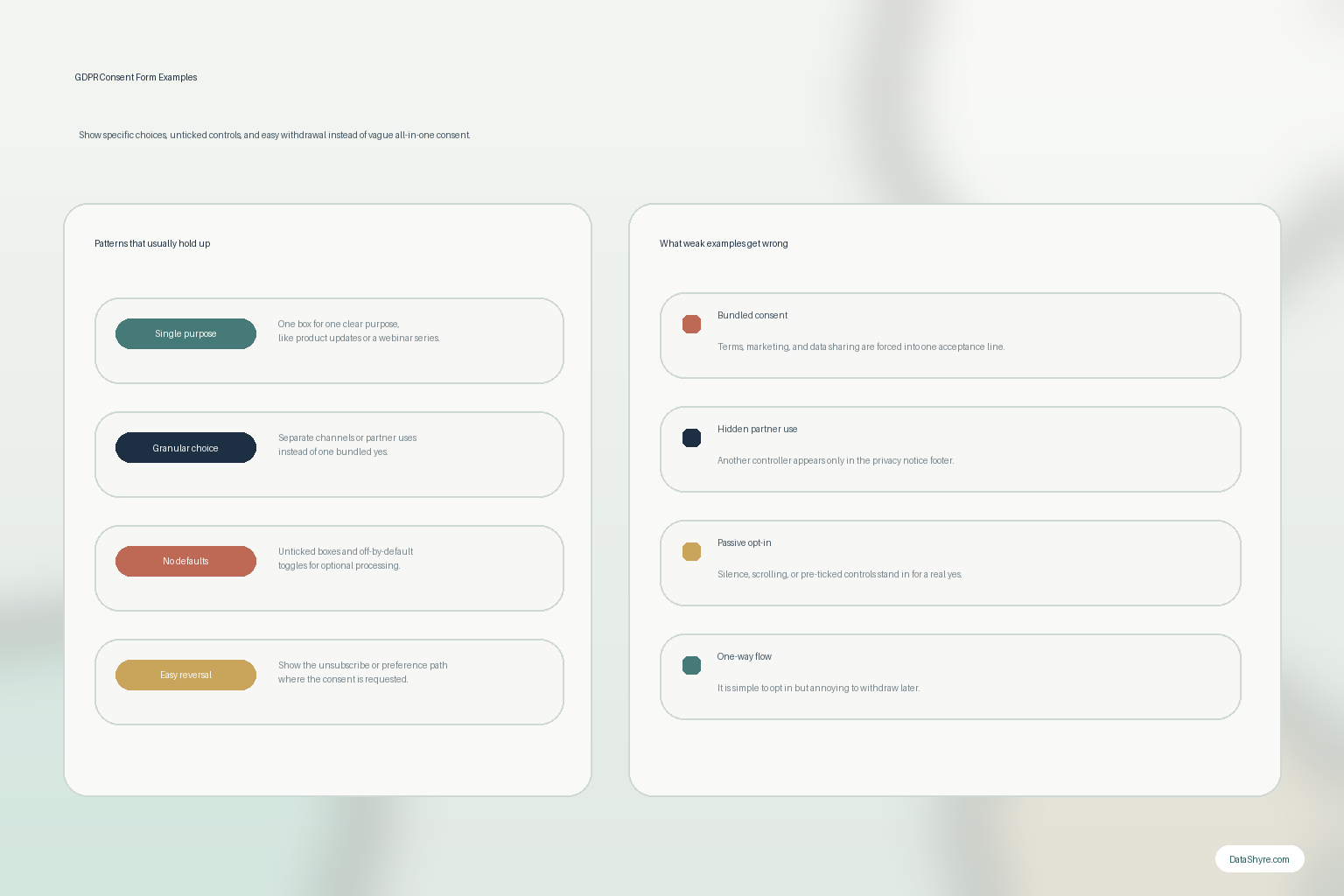
What the strongest GDPR consent form examples still have in common
Before getting into specific gdpr consent form examples, it helps to notice the shared structure.
The official sources are not mysterious here:
- consent should be used only when consent is the right lawful basis;
- the request should be separate from unrelated terms;
- the purpose should be specific enough to understand;
- the person should actively opt in;
- withdrawal should be easy later;
- the controller should be able to prove what happened.
That means the best gdpr consent form examples usually feel simpler than the bad ones.
They ask for less at once, split optional purposes cleanly, and avoid pretending that a long paragraph fixes a weak interface.
1. The single-purpose newsletter form
This is still the cleanest starting point.
A strong gdpr consent form example for a newsletter signup normally does one thing only: asks whether the person wants a defined category of email from a named sender.
The form tends to work better when it says something like:
Email me product updates and privacy insights from DataShyre. I can unsubscribe at any time.
Why this pattern holds up:
- one sender;
- one channel;
- one recognizable purpose cluster;
- one visible withdrawal path.
What weakens it is the usual creep: adding partner promotions, event invites, offers, and general personalization into the same checkbox.
2. The gated-download form with separate optional marketing consent
This is one of the most useful gdpr consent form examples because teams still get it wrong.
If someone wants a whitepaper, checklist, or template, the download itself should not depend on agreeing to unrelated marketing if the marketing is optional.
The EDPB’s consent examples keep making the same point in different settings: when the core service depends on accepting unnecessary processing, the choice stops looking freely given.
A better pattern looks like this:
- fields for the download itself;
- a separate unticked checkbox for later marketing;
- short wording that explains exactly what the later messages are;
- a visible no path that still delivers the resource.
This is boring in the best way. It is also much easier to defend later.
3. The event-registration form with separate channel choices
Many event forms collect consent too broadly.
A stronger gdpr consent form example splits communications when a person would reasonably see them as different decisions.
For example:
- one optional checkbox for future webinar invitations by email;
- one optional checkbox for product follow-up from sales;
- one optional checkbox for sponsor or partner outreach, if you are truly going there at all.
That split matters because the European Commission still frames valid consent as purpose-specific, and the ICO still says the person needs to understand exactly what they are agreeing to.
If the form turns all future outreach into one vague yes, the example is weaker than it looks.
4. The preference-center form with equally clear yes and no controls
Some of the best gdpr consent form examples do not appear only at acquisition.
They show up later inside an account area or preference center.
That can work well if the interface still treats consent as a real choice. The ICO’s current guidance explicitly includes “equally prominent yes/no options” as one valid opt-in pattern. That sounds small, but it is a strong design rule:
- the yes path should be obvious;
- the no path should be just as obvious;
- optional toggles should start off, not on;
- the change should update downstream systems quickly enough to mean something.
This is the example I trust most when teams need users to revisit preferences later instead of only once at signup.
5. The partner-marketing form that names the other controller up front
Most teams should use this pattern sparingly.
Still, among real-world gdpr consent form examples, it matters because partner marketing is where weak consent records often collapse.
If another organization will use the data for its own direct marketing, the person should be able to tell that before opting in. A generic phrase like trusted partners is usually too soft to do the job well.
So the stronger pattern is:
- name the other organization or category clearly enough to understand;
- separate that choice from your own marketing;
- explain the channel and purpose;
- avoid making the transfer feel required for the primary interaction.
If that level of clarity feels awkward, that is often a useful warning that the consent flow is asking for too much.
6. The explicit-consent form for sensitive data
Not every gdpr consent form example deserves the same review depth.
When the form touches health data, biometrics, political views, religious beliefs, or other special-category data, the pattern should be treated as higher risk from the start.
In practice, the better examples usually:
- isolate the consent from other permissions;
- explain the sensitive category plainly;
- explain the exact use and retention logic;
- preserve stronger proof of the statement and the action;
- trigger a stricter internal review before release.
This is where short, generic checkbox copy becomes especially dangerous.
7. The child-directed form with parental checks built in
This is the example many teams forget until late.
The European Commission still says online services offered directly to a child need parental or guardian consent up to a Member State-defined age threshold between 13 and 16. It also says organizations should make reasonable efforts to verify that consent and write child-facing information in language a child can understand.
So a child-directed gdpr consent form example should usually include:
- an age gate or age check;
- a parental-consent branch where required;
- wording that avoids adult legalese;
- verification steps proportionate to the service.
If your audience could include children, this should not be treated as a last-minute copy edit.
A simple review rule for borrowing consent-form examples
When people collect gdpr consent form examples, they often copy surface details first.
That is backwards.
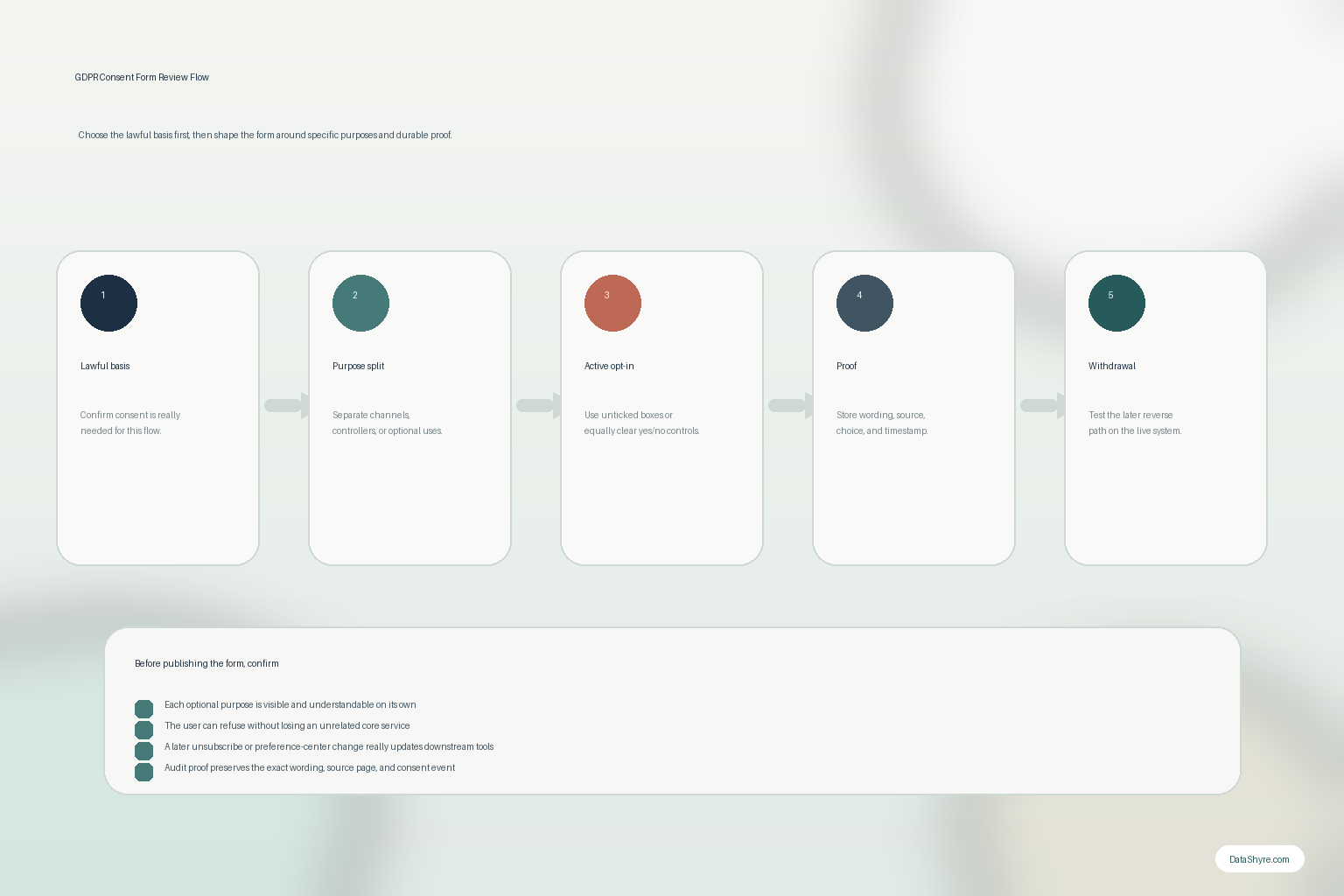
I would judge each example with five questions:
- could the person refuse without losing an unrelated core service;
- is each optional purpose understandable on its own;
- is the opt-in unmistakably active;
- is the later withdrawal route easy to find and use;
- would the record still make sense to another team six months from now.
If the answer to any of those is no, the example is probably better as inspiration than as a template.
Where DataShyre fits
The hard part is usually not writing the checkbox line.
It is making sure the form, CRM, email platform, analytics stack, and preference center all tell the same story after release.
That is where DataShyre can help. We help teams review consent flows against current regulator guidance, tighten purpose-level choices, test the live user path, and keep the proof trail usable after systems change.
FAQ
Can I copy one consent form example across every use case?
Usually no. A newsletter signup, gated download, partner promotion, and sensitive-data workflow often need different structure even if the tone stays similar.
Are pre-ticked checkboxes ever a good GDPR example?
No for optional consent. Current official guidance still rejects silence, inactivity, pre-ticked boxes, and default-on settings as substitutes for a real opt-in.
What makes a GDPR consent form example actually defensible?
Specific purpose wording, active opt-in, easy withdrawal, and proof that captures what the person saw and chose at the time.
Bottom line
The best gdpr consent form examples in 2026 are not the longest ones or the most formal-sounding ones.
They are the ones that ask for one clear thing at a time, leave optional processing off by default, keep the no path real, and preserve evidence another person can still verify later.
That is what makes an example worth copying.
Sources
- European Commission, legal grounds for processing data: https://commission.europa.eu/law/law-topic/data-protection/information-business-and-organisations/legal-grounds-processing-data_en
- European Commission, information for individuals: https://commission.europa.eu/law/law-topic/data-protection/information-individuals_en
- European Commission, are there any specific safeguards for data about children?: https://commission.europa.eu/law/law-topic/data-protection/information-business-and-organisations/legal-grounds-processing-data/are-there-any-specific-safeguards-data-about-children_en
- ICO, what is valid consent?: https://ico.org.uk/for-organisations/uk-gdpr-guidance-and-resources/lawful-basis/consent/what-is-valid-consent/
- ICO, how should we obtain, record and manage consent?: https://ico.org.uk/for-organisations/uk-gdpr-guidance-and-resources/lawful-basis/consent/how-should-we-obtain-record-and-manage-consent/
- EDPB, Guidelines 05/2020 on consent under Regulation 2016/679: https://www.edpb.europa.eu/our-work-tools/our-documents/guidelines/guidelines-052020-consent-under-regulation-2016679_en
- EDPB, practical examples: https://www.edpb.europa.eu/system/files/2026-04/edpb-summary-consent_en.pdf
- EDPB, consent or pay models should offer real choice: https://www.edpb.europa.eu/news/edpb-consent-or-pay-models-should-offer-real-choice_en
—
Published: November 11, 2026. Updated using current official European Commission, ICO, and EDPB materials available at publication time.