

GDPR Consent Form in 2026: 8 Live Checks Before You Publish
If you are reviewing a gdpr consent form in late 2026, the wrong question is whether the checkbox text sounds formal enough.
The better question is whether consent is actually the right lawful basis, whether each choice is specific and active, and whether your team could still prove what happened after the next release, vendor migration, or audit request.
That is still the practical standard in current official guidance. The European Commission says valid consent must be freely given, informed, specific, and based on a clear affirmative act, with the request written in “clear and plain language.” It also says withdrawal should be “as easy to use as giving consent.” The ICO is equally blunt on the upstream choice: if consent is hard to make valid, “another lawful basis is more appropriate.”
If you want the closest companion reads first, start with our guides to GDPR consent requirements, GDPR compliant privacy notice, and GDPR marketing consent. This article stays narrower. It is the eight-check review I would use this week before approving a gdpr consent form for production.
1. Start by asking whether consent is the right lawful basis at all
This is still the first filter because many teams use a consent form to solve the wrong legal problem.
The European Commission continues to present consent as only one lawful basis among several. The ICO says the same thing more directly: if consent is difficult, that often means another lawful basis fits better.
So before you approve a gdpr consent form, ask:
- is the processing really optional;
- can the person refuse without losing a service they actually need;
- would contract, legal obligation, legitimate interests, or another basis better reflect what is really happening.
If the answer to that third question is yes, a cleaner lawful-basis decision is usually safer than a longer checkbox paragraph.
2. Keep the consent request clearly separate from other terms
This is one of the simplest checks and one of the most common misses.
The European Commission and the ICO both still emphasize that consent requests should be presented distinctly, intelligibly, and accessibly. In practice, a gdpr consent form gets weaker when optional permissions are buried inside general terms, account-creation wording, or contract acceptance language.
That means the form should not:
- hide optional marketing or profiling permission inside a wider declaration;
- combine service acceptance and optional consent in one statement;
- force the user to agree to unnecessary processing to finish a separate transaction.
If consent is optional, the form should look optional too.
3. Split choices by purpose, and sometimes by channel or controller
Specific consent is not one big yes button.
The European Commission still says consent must be given for a specific purpose, and the EDPB’s consent materials continue to treat granularity as a core feature of valid consent. A practical gdpr consent form usually separates choices where the user would reasonably understand them as different decisions.
Common examples include:
- email newsletters versus partner promotions;
- product updates versus behavioral advertising;
- SMS marketing versus email marketing;
- your own outreach versus another controller’s use of the data.
Bundling several unrelated purposes into one opt-in can make the record look tidy while making the consent much harder to defend.
4. Require a real affirmative action
This is where design shortcuts still create unnecessary risk.
The European Commission still describes valid consent as something given through an affirmative act, such as a tick box the person explicitly checks. The EDPB’s practical examples say scrolling or swiping through a page is not a “clear affirmative action.”
For a working gdpr consent form, that usually means:
- no pre-ticked boxes;
- no consent inferred from silence or inactivity;
- no passive browse-to-accept logic;
- no default-enabled optional toggles.
The shortest live test is still useful: if the person does nothing, have they consented? If the answer is yes, the form is probably on weak ground.
5. Give enough information for the choice to mean something
Consent cannot be informed if the person cannot tell what they are agreeing to.
The European Commission’s current guidance still ties valid consent to clear reasons for the processing, plain language, and visible withdrawal information. The ICO’s consent guidance also points back to understandable, distinguishable wording rather than vague labels.
A strong gdpr consent form usually tells the person, in plain language:
- who is asking;
- what they are opting into;
- whether the choice covers one purpose or several;
- whether anyone else will receive or use the data;
- how to change their mind later.
That does not require a wall of text. It requires enough context for the yes to be meaningful.
6. Make withdrawal at least as easy as opt-in
Teams often spend more time on collection than reversal.
That is backwards. The European Commission still says withdrawal should be as easy as giving consent. A gdpr consent form is not complete if the opt-in is one click but the opt-out requires logging into a buried settings page, filing a support request, or navigating multiple screens.
So check the whole path:
- can the person reverse the choice from a later email, account area, or preference center;
- is the withdrawal path visible without a scavenger hunt;
- does the system update downstream tools quickly enough to make the reversal real;
- can the team explain what happens to prior records after withdrawal.
This is the point where legal wording and operational hygiene finally meet.
7. Keep proof that survives audits and system changes
A yes-or-no field is not enough evidence by itself.
The EDPB says controllers are responsible for demonstrating that valid consent was obtained. The ICO’s current consent guidance is practical here: keep records of when the person consented, what they were told at the time, and how they consented.
For a defensible gdpr consent form, I would usually want:
- the exact consent statement or version shown;
- the date and time of the action;
- the collection source, page, or form;
- the purposes or channels selected;
- the method of action, such as a checked box or submitted preference center;
- any later withdrawal or suppression event.
That level of proof matters because weak records often surface only after a CRM cleanup, form redesign, or vendor swap.
8. Escalate special-category data and children’s data early
Not every consent form deserves the same review depth.
The European Commission says special categories of personal data can only be processed when an Article 9 condition applies, including explicit consent where available. The Commission also says that for information-society services offered directly to a child, parental or guardian consent is required up to a Member State-defined age threshold between 13 and 16.
So a higher-risk gdpr consent form should trigger extra checks when it involves:
- health, biometric, political, religious, or similar sensitive data;
- children using apps, communities, or direct online services;
- automated profiling or connected downstream uses the person may not expect.
This is where copying a standard newsletter checkbox becomes especially dangerous.
A simple structure that usually holds up better
If I were rewriting a gdpr consent form this week, I would keep it plain:
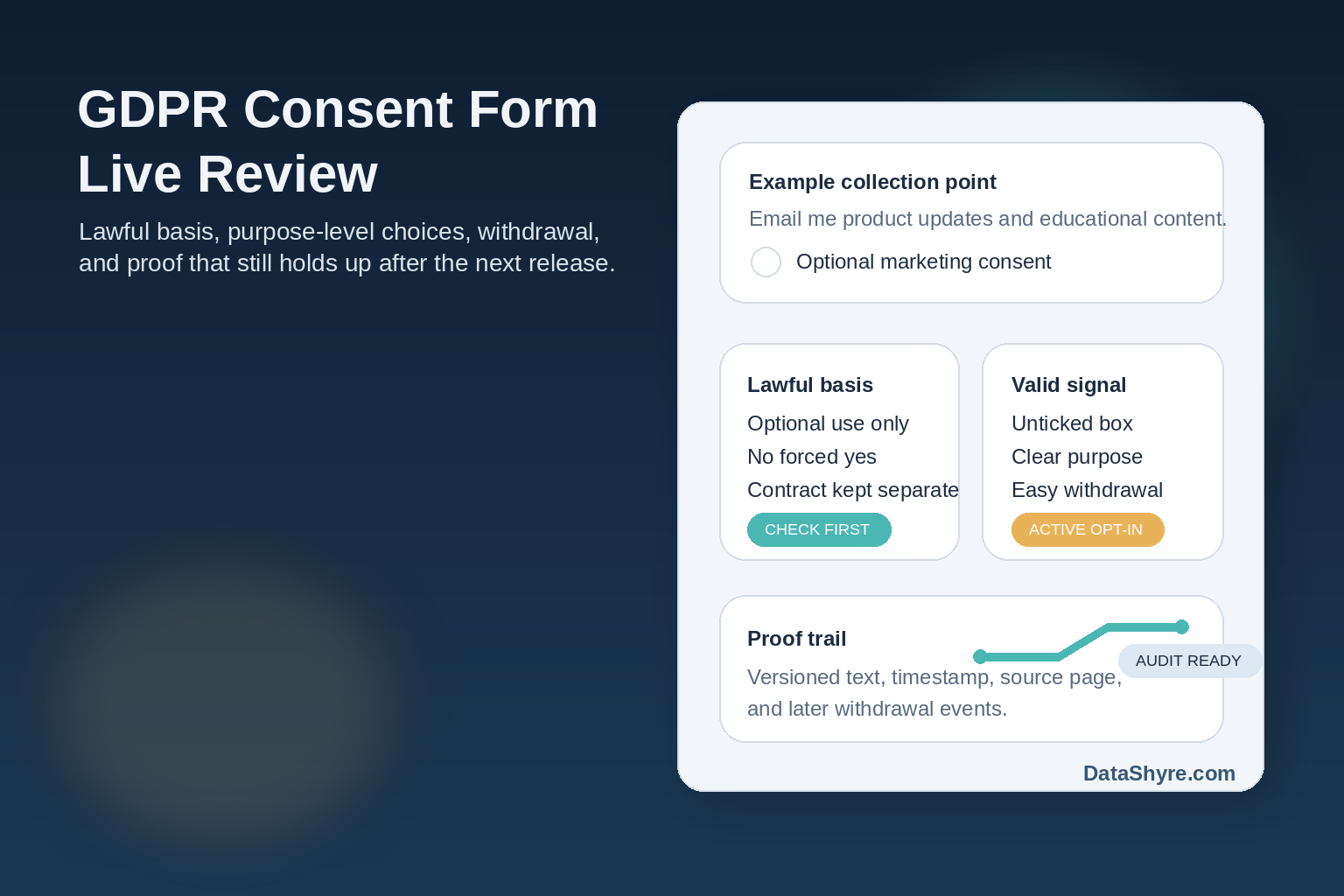
Email me product updates and occasional educational content from DataShyre. I can withdraw my consent at any time using the unsubscribe link or my preferences page.
That sample is not universal legal advice, and it is not enough for every workflow. But it shows the right direction:
- one controller;
- one channel;
- one reasonably clear purpose cluster;
- one visible withdrawal path.
If you need partner marketing, cross-channel promotions, research uses, or sensitive-data processing, expand the structure with separate choices instead of bloating one sentence.
A practical review order for this week
If I were auditing a gdpr consent form today, I would do it in this order:
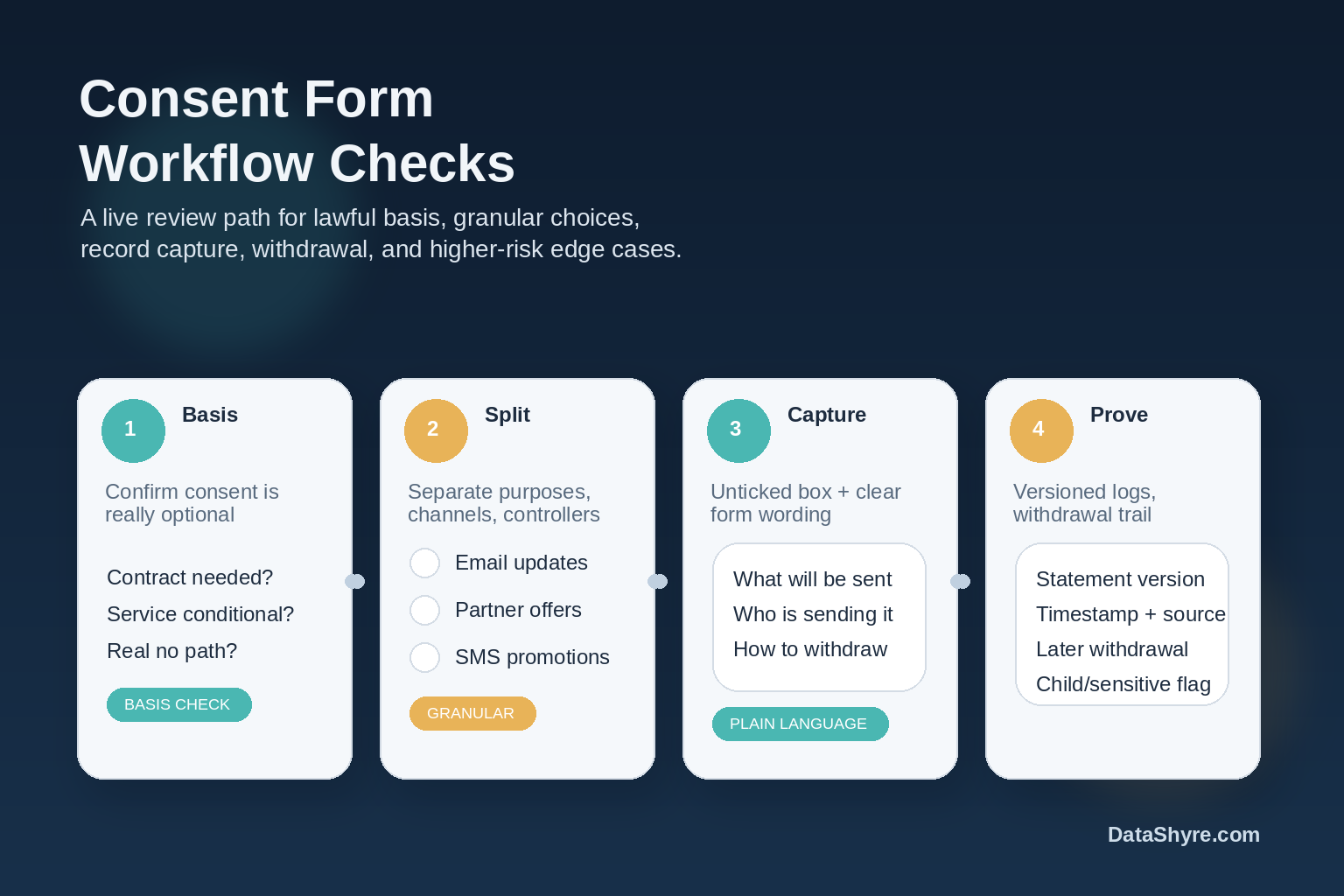
- confirm consent is the right lawful basis;
- separate optional consent from contract or account terms;
- split choices by purpose, channel, and controller where needed;
- remove any passive or default-on consent mechanics;
- tighten the wording until a normal user can explain it back;
- test withdrawal on the live system, not just in policy copy;
- verify records capture the exact text, source, and timestamp;
- escalate special-category and child-data flows for stricter review.
That sequence usually exposes the real weakness faster than debating individual words in isolation.
FAQ
Does every signup form need GDPR consent?
No. Consent is one lawful basis, not the universal default. The first question is whether consent really fits the purpose and relationship.
Can I bundle newsletters, partner offers, and ads in one checkbox?
That is risky. Separate purposes often need separate choices if you want the consent to stay specific and understandable.
What proof should I keep for a consent form?
At minimum, keep what the person saw, when they acted, how they acted, and what purposes or channels they selected. Also keep any later withdrawal record.
Bottom line
The strongest gdpr consent form in 2026 is not the longest one.
It is the one that uses consent only where it fits, asks for it clearly and specifically, requires a real opt-in, makes reversal easy, and leaves behind proof another team can still verify later.
If those pieces are missing, the checkbox is decoration. If they are present, the form becomes much easier to defend.
Sources
- European Commission, legal grounds for processing data: https://commission.europa.eu/law/law-topic/data-protection/information-business-and-organisations/legal-grounds-processing-data_en
- European Commission, information for individuals: https://commission.europa.eu/law/law-topic/data-protection/information-individuals_en
- European Commission, safeguards for children’s data: https://commission.europa.eu/law/law-topic/data-protection/information-business-and-organisations/legal-grounds-processing-data/are-there-any-specific-safeguards-data-about-children_en
- EDPB, Guidelines 05/2020 on consent under Regulation 2016/679: https://www.edpb.europa.eu/sites/default/files/files/file1/edpb_guidelines_202005_consent_en.pdf
- EDPB, practical examples on consent: https://www.edpb.europa.eu/system/files/2026-04/edpb-summary-consent_en.pdf
- ICO, when is consent appropriate: https://ico.org.uk/for-organisations/uk-gdpr-guidance-and-resources/lawful-basis/consent/when-is-consent-appropriate/
- ICO, how should we obtain, record and manage consent: https://ico.org.uk/for-organisations/uk-gdpr-guidance-and-resources/lawful-basis/consent/how-should-we-obtain-record-and-manage-consent/
—
Published: October 23, 2026. Updated using current official regulator and government materials available at publication time.