

Cookie Consent Banner in 2026: Requirements, Examples, and 7 Checks That Still Matter
If you are reviewing a cookie consent banner in 2026, the useful question is not whether the banner appears.
The useful question is whether the choice on that banner actually changes what the site does next.
If you want nearby context first, start with our guides to cookie consent requirements, cookie consent message examples, and cookie consent. This page is narrower. It is the seven-check review I would use this week before trusting any cookie consent banner on a live site.

What a cookie consent banner is supposed to prove now
A cookie consent banner is no longer just a notice.
It has to connect legal language, user interface choices, region-specific routing, and technical behavior in the browser.
That is why the current official guidance still matters so much. The European Commission says a consent request should use “clear and plain language” and that it should be “as easy to use as giving consent” when people want to withdraw. The EDPB’s practical consent examples also still reject two shortcuts teams keep trying to revive: scrolling is not a clear affirmative action, and a cookie wall that blocks content unless the person clicks accept does not produce freely given consent. In the UK, the ICO’s finalized guidance updated on April 29, 2026 makes the compliance surface broader than classic browser cookies by covering tracking pixels, link decoration, device fingerprinting, web storage, and scripts or tags.
So the right review standard for a cookie consent banner is not visual polish. It is whether the banner turns a person’s choice into real runtime behavior.
1. Check whether the first layer offers a genuinely equal choice
The fastest way to assess a cookie consent banner is to compare the refusal path to the acceptance path.
CNIL’s current position remains the clearest phrasing available: “rejecting cookies should be just as easy as accepting them.” That is not a color-theory suggestion. It is an interface rule with enforcement consequences.
A useful first-layer test asks:
- Is
Reject allavailable whereverAccept allis available? - Is the privacy-protective option equally visible on mobile?
- Does saying no take the same number of steps as saying yes?
- Are button labels direct instead of evasive?
If the banner quietly turns refusal into a hidden link, a dim button, or an extra trip into settings, the cookie consent banner is already steering the outcome.
2. Remove scrolling, continued browsing, and cookie-wall logic
Many weak cookie consent banner designs still try to treat passive behavior as agreement.
The EDPB’s practical examples remain direct on this point: scrolling or swiping through a page is not a “clear affirmative action.” The same official examples also say a cookie wall that blocks access unless the person clicks accept does not present a genuine choice, so the consent is not freely given.
That means these patterns are still risky:
By continuing to browse, you agree...- banners with only
OKorContinue - layouts that lock content until optional tracking is accepted
- banners that mix essential site functions and optional advertising into one bundled choice
If a cookie consent banner depends on inertia instead of an unambiguous action, it is solving convenience for the site, not choice for the visitor.
3. Explain real purposes in plain language
A cookie consent banner can look professional and still tell the user almost nothing.
The European Commission’s baseline is still the right one to use: consent must be informed, specific, and presented in “clear and plain language.” That means the first layer should say what optional technologies actually do, not just claim that the site values privacy.
In practice, strong banner copy usually does three things:
- names the real purposes in ordinary language such as analytics, advertising, personalization, or embedded content;
- makes clear which choices are optional; and
- points to a settings path for more detail.
The wording does not need to be long. It does need to be concrete.
4. Test prior blocking beyond classic cookies
This is where many teams over-trust the appearance of the cookie consent banner.
The ICO’s finalized 2026 guidance is useful because it keeps the scope broad. It does not stop at cookies. It explicitly points teams toward tracking pixels, link decoration and navigational tracking, device fingerprinting, web storage, and scripts or tags.
So a real test should inspect more than what lands in the browser cookie jar. I would pressure-test:
- analytics and advertising requests on first load;
- scripts injected by a tag manager;
- embedded video, maps, chat, or social widgets;
- local storage and other device-level identifiers; and
- cached or templated pages most likely to bypass the standard consent path.
If optional technologies still wake up before the right choice exists, the cookie consent banner is documenting preference after the fact instead of controlling behavior beforehand.
5. Separate the California branch from the EU and UK branch
One cookie consent banner can serve visitors from the EU, UK, California, and other U.S. states at the same time.
That does not mean one decision model fits every branch.
For EU and UK traffic, the key question is often whether non-essential technologies wait for valid prior consent. In California, the site may also need to support opt-out handling where sale or sharing is in scope. California’s Department of Justice still describes Global Privacy Control as a “stop selling or sharing my data switch” and says covered businesses must honor it as a valid consumer request. California enforcement is also getting more concrete. On March 5, 2026, the CPPA announced a Ford settlement that said unnecessary friction in the opt-out process violates the CCPA and required easier opt-out methods with minimal steps plus compliance with preference signals including GPC.
That is why I would test the branches separately:
- first EU or UK visit with no saved preference;
- California visit where opt-out rights apply;
- GPC-enabled browser behavior;
- return visits after refusal or acceptance; and
- whether the on-screen banner text still matches the path the person is actually in.
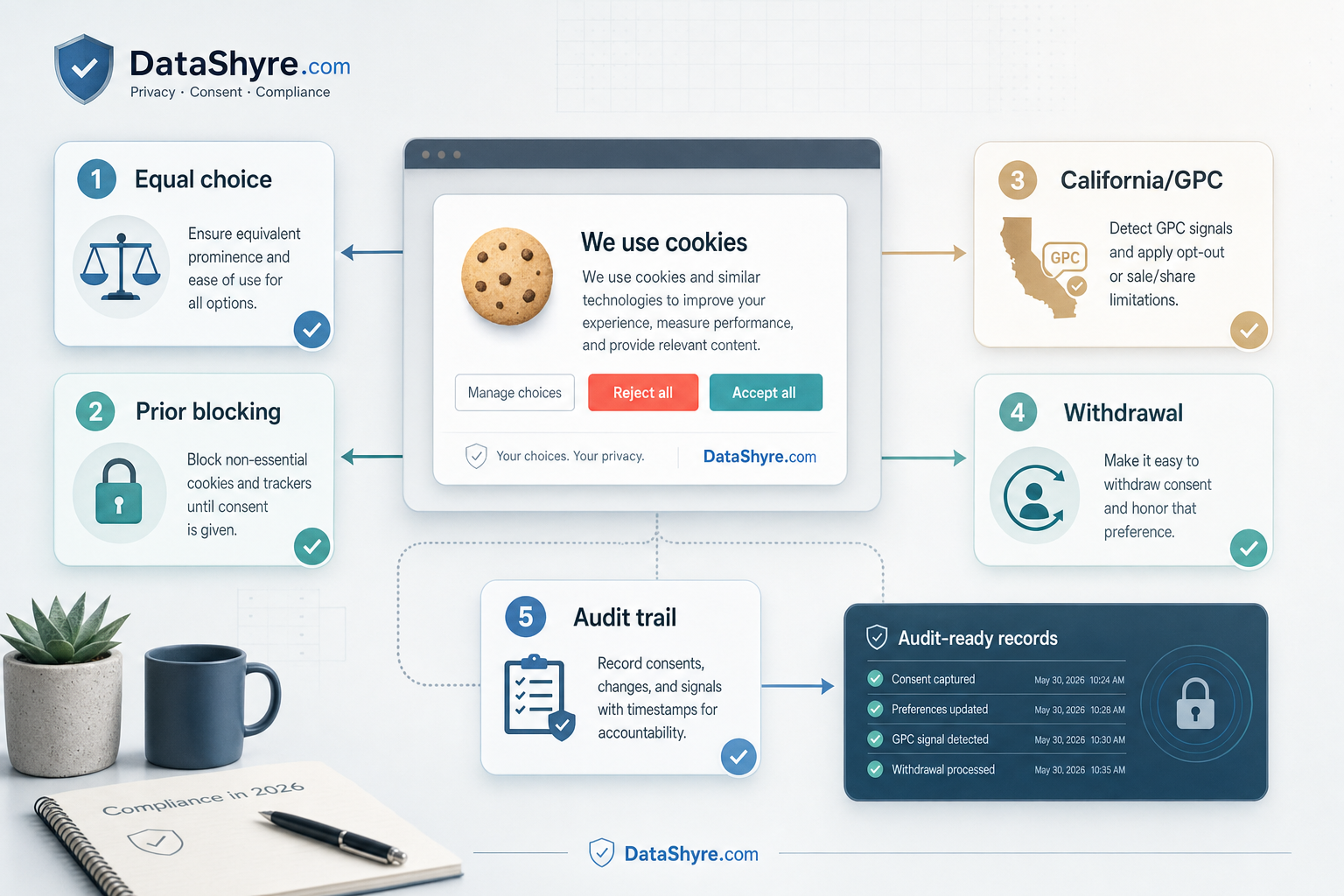
6. Make withdrawal persistent and low-friction
The first interaction is only part of a cookie consent banner review.
The European Commission still says withdrawal should be “as easy to use as giving consent.” That means the banner cannot effectively disappear forever after the first click if the site promised ongoing control.
A practical withdrawal test should ask:
- can the person reopen settings from a visible path later;
- can they reverse an earlier choice without extra hoops;
- does the technical behavior change after that reversal; and
- is the new state preserved on later page loads.
If the cookie consent banner records a withdrawal but the underlying scripts or tags continue behaving as though consent still exists, the site is keeping a log instead of honoring the choice.
7. Keep records that still explain what happened after the stack changes
The long-term test for a cookie consent banner is whether your team can still explain a visitor journey after the next release, campaign launch, or third-party script update.
That means stronger implementations preserve enough evidence to answer basic questions later:
- what banner version and settings text were shown at that time;
- what categories or purposes were presented;
- what the user chose and when;
- whether that choice changed later; and
- whether runtime behavior matched the recorded state.
The CPPA’s warning that “Dark patterns aren’t about intent, they’re about effect.” is useful here too. Teams often do not intend to create a manipulative or broken flow. But if the result is unequal choice, unnecessary friction, or behavior that the records cannot justify, intent does not rescue the outcome.
A short review order for this week
If I were checking a cookie consent banner today, I would use this order:
- compare
Accept allandReject allon desktop and mobile; - remove any scrolling, continuation, or cookie-wall logic;
- rewrite vague purpose language into plain English;
- test whether optional technologies stay off before the right choice exists;
- verify California and GPC handling separately where relevant;
- confirm the user can withdraw later without friction; and
- keep enough records to explain the result after the stack changes.
That sequence usually tells you more than another debate about button styling.
FAQ
Does every cookie consent banner need a reject-all option?
Where the banner offers Accept all on the first layer and prior-consent rules apply, a buried refusal path is a major risk. CNIL’s current position is that rejecting should be just as easy as accepting.
Does Global Privacy Control replace a cookie consent banner?
No. GPC is important for California opt-out handling where sale or sharing is in scope, but it does not erase the need to test the broader banner logic, browser behavior, and regional routing.
Can one cookie consent banner work across multiple regions?
Sometimes, but only if the branching behind it is honest about the differences between prior consent, opt-out rights, GPC handling, and the technical behavior that follows each path.
Bottom line
In 2026, the safest way to think about a cookie consent banner is not as a pop-up.
It is a control layer that has to present a fair choice, explain real purposes, block optional technologies at the right time, route California and GPC cases correctly, support easy withdrawal, and leave behind proof your team can still trust later.
If those pieces line up, the cookie consent banner is doing useful work. If they do not, the interface may look compliant while the behavior underneath it still is not.
Sources
- European Commission: Legal grounds for processing data
- EDPB: Practical examples on consent
- ICO: Guidance on the use of storage and access technologies
- CNIL: Dark Patterns in Cookie Banners: CNIL issues formal notice to website publishers
- California Department of Justice: California Consumer Privacy Act
- CPPA: Enforcement Advisory Stresses the Importance of Avoiding Dark Patterns
- CalPrivacy: Ford to Change Practices, Pay Fine for Adding Unnecessary Friction to Opt-Out Process