

Privacy Policy Creator in 2026: 7 Live Checks Before You Publish
If you are searching privacy policy creator on November 10, 2026, the tempting answer is pick a tool, answer a questionnaire, and publish whatever it gives you.
That is also how teams end up with a page that sounds careful and is still wrong.
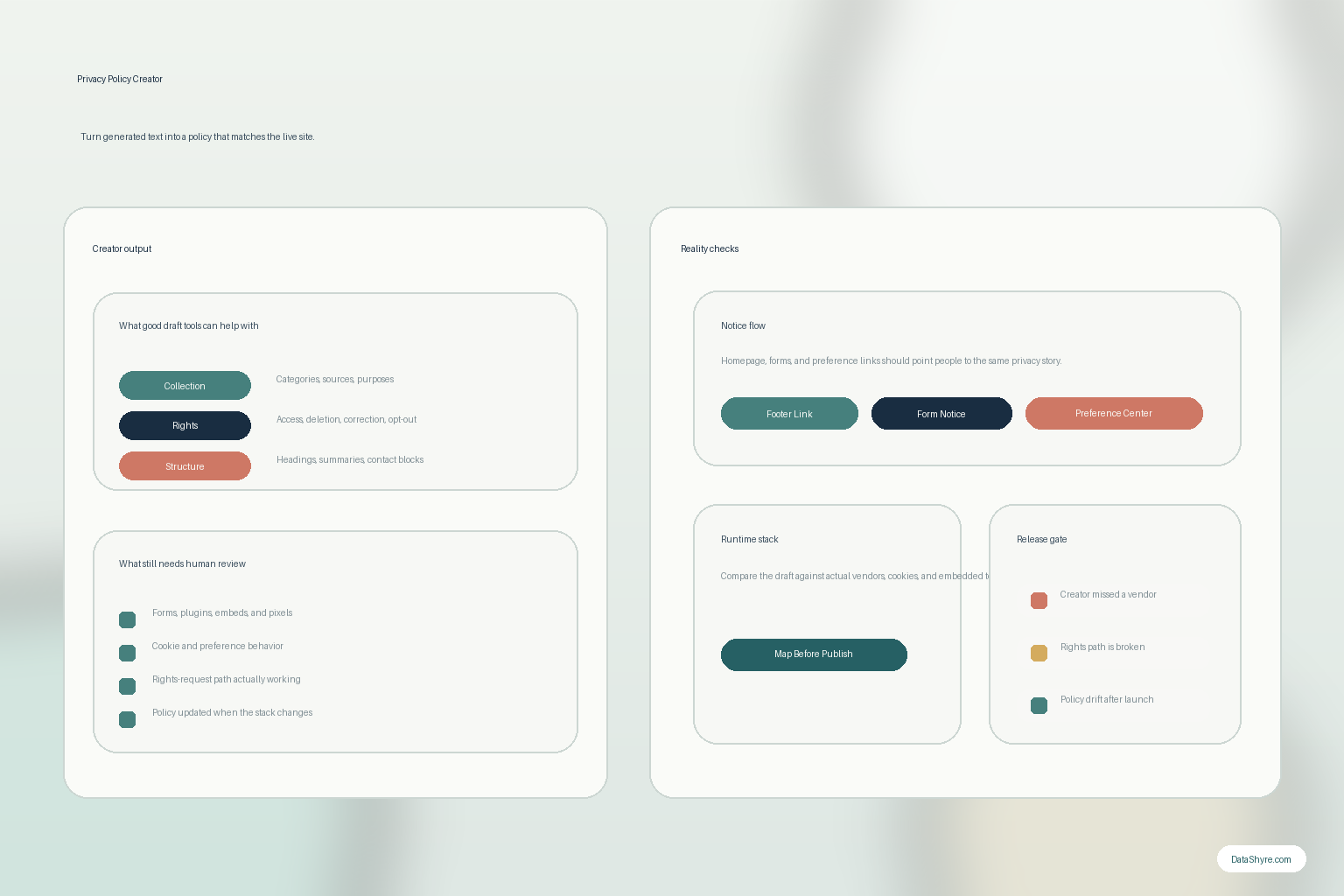
A useful privacy policy creator is a drafting shortcut, not the source of truth. The real job is making sure the final policy matches the live website, app flow, forms, vendors, cookies, embeds, and request paths behind it.
Current official guidance still points in that direction. California’s Department of Justice says a “notice at collection” must be provided at or before collection and must link to the privacy policy for a “fuller description” of practices and rights. The CPPA’s current FAQ says businesses subject to the CCPA must post their privacy policy through a link using the word “privacy” on the homepage and other webpages. Article 12 GDPR still requires privacy information in a concise, transparent, intelligible, and easily accessible form using “clear and plain language.” The ICO still says to “know what personal data you have” before drafting privacy information. And WordPress’s current privacy documentation still says it is the site’s responsibility to keep the final policy “current and accurate.”
If you want nearby context first, start with our guides to privacy policy template, privacy policy page, and website privacy policy generator. This page stays narrower. It is the privacy policy creator review I would use this week before publishing a generated draft on a live site.
If your team needs help turning creator output into a policy that actually matches the systems behind it, DataShyre can help with data mapping, consent management, and DSR automation. The hard part is rarely producing text. It is proving the text still matches the live stack after the next plugin, vendor, or product change.
1. Start with the live data map, not the creator
The most common privacy policy creator mistake happens before anyone edits the first paragraph.
The team trusts the tool before mapping what the business actually collects and where that collection happens.
That is backwards.
The ICO’s current drafting guidance still starts in the right place: “know what personal data you have” and what you do with it before drafting privacy information.
For a real privacy policy creator review, map at least:
- contact, demo, signup, checkout, and support forms;
- analytics, advertising, and consent tools;
- embedded video, chat, maps, schedulers, and social widgets;
- CRM, email, customer-success, and payment vendors;
- account settings, preference centers, and request workflows; and
- any app, portal, or member experience linked from the website.
If that inventory is incomplete, the generated policy can still sound polished while missing the real collection story.
2. Make sure the creator covers the disclosure blocks you still need
A decent privacy policy creator can give you structure.
It cannot decide whether your disclosures are complete.
California DOJ guidance still says people should be able to learn what personal information is collected, how it is collected, why it is collected, how it is used, who can access it, and what choices they have. The current CCPA framework still expects covered businesses to make the privacy policy available online. Article 12 and Article 13 GDPR still add the usual EU notice blocks many generic creator tools under-explain: identity, purposes, legal basis, recipients, transfer details where relevant, retention, and rights.
So before you trust a privacy policy creator draft, check whether it clearly covers:
- who operates the service and how to contact them;
- which categories of personal data are collected;
- where the data comes from;
- the purposes for each category;
- legal basis where GDPR or UK GDPR applies;
- recipients or recipient categories;
- retention periods or retention logic;
- rights and how to exercise them.
If the tool cannot support those blocks cleanly, it is a drafting helper, not a finished answer.
3. Connect the draft to real collection points, not only the footer
This is where a lot of privacy policy creator workflows become too passive.
California’s DOJ still says the notice at collection must be provided at or before collection and must link to the privacy policy for a “fuller description” of practices and rights. The ICO’s current guidance on delivery methods says it is good practice to use the same medium you use to collect personal data to deliver privacy information, including just-in-time notices in online forms with clear links to more detailed information.
That means the practical question is not only does the policy page exist.
It is do people see the right privacy context where they are about to submit data.
For a useful privacy policy creator review, check whether the policy connects cleanly to:
- newsletter signup forms;
- demo, quote, or contact forms;
- checkout or booking flows;
- account creation and member portals;
- app download or onboarding paths; and
- cookie or preference-center entry points.
If the creator draft lives only in the footer, the disclosure story is probably incomplete.
4. Treat cookies, embeds, and third-party tools as a separate review layer
This is where generated policies drift fastest.
WordPress’s current privacy documentation says the Editing Helper can generate starter text from WordPress core and participating plugins, but it also says it remains your responsibility to keep the final policy “current and accurate.” The same documentation says many sites embed third-party tools, including email subscription services, that the helper cannot detect fully.
That limitation is not unique to WordPress.
It is a general privacy policy creator problem.
Most creator tools do not really know:
- which pixels and tags fire at runtime;
- which embeds send data to third parties;
- whether the cookie banner or preference center changes behavior;
- whether a plugin adds new collection or sharing logic after the draft is generated.
So the better workflow is to compare the draft against the live runtime stack before publishing.
If cookies and runtime behavior are the messy part, pair this article with our generate privacy policy and privacy policy example for website guides. They stay closer to what a real final page should look like.
5. Turn the rights section into a path a person can actually use
This is where decorative privacy language usually breaks down.
California’s CCPA enforcement examples still show businesses getting flagged for privacy policies that failed to describe rights properly or failed to explain how authorized agents and consumers could submit requests. That matters because the page is not only a description. It is part of the operating path.
So a serious privacy policy creator review should verify that the final policy tells people:
- which rights may apply;
- how to submit a request;
- whether there is a web form, email path, account path, or phone path;
- where opt-out or preference controls live;
- what to do if the first route does not work.
If the generated page names rights without a working route, the most important part is still missing.
6. Publish it where people can actually find it
Current official guidance is still blunt on this point.
The CPPA’s FAQ says businesses subject to the CCPA must post their privacy policy through a link using the word “privacy” on the homepage and other webpages. Article 12 GDPR still says the information should be easily accessible and written in “clear and plain language.”
That means a strong privacy policy creator result is not simply published.
It is:
- linked clearly with the word
privacy; - available on the pages where people actually need it;
- readable on smaller screens;
- consistent with the labels used in forms, settings, and banners; and
- understandable without legal translation.
A complicated page buried behind vague labels defeats the point.
7. Tie privacy-policy review to stack changes before the next release makes it wrong
The biggest long-term privacy policy creator failure is drift.
California DOJ’s consumer guidance still says a privacy policy should be “updated at least once a year.” That is only the floor. The ICO’s current drafting guidance goes further and says privacy information should be updated before you start using personal data for a new purpose and that you should proactively bring that change to people’s attention.
So a better privacy policy creator workflow triggers review when:
- a new form or flow is launched;
- a new vendor or processor starts receiving data;
- a new analytics, ad-tech, or embedded tool is added;
- the cookie banner or preference center changes;
- the rights-request method changes; or
- the website or app expands into a new market or product line.
If creator output is not tied to release governance, it becomes stale faster than most teams expect.
A practical 7-step review for this week
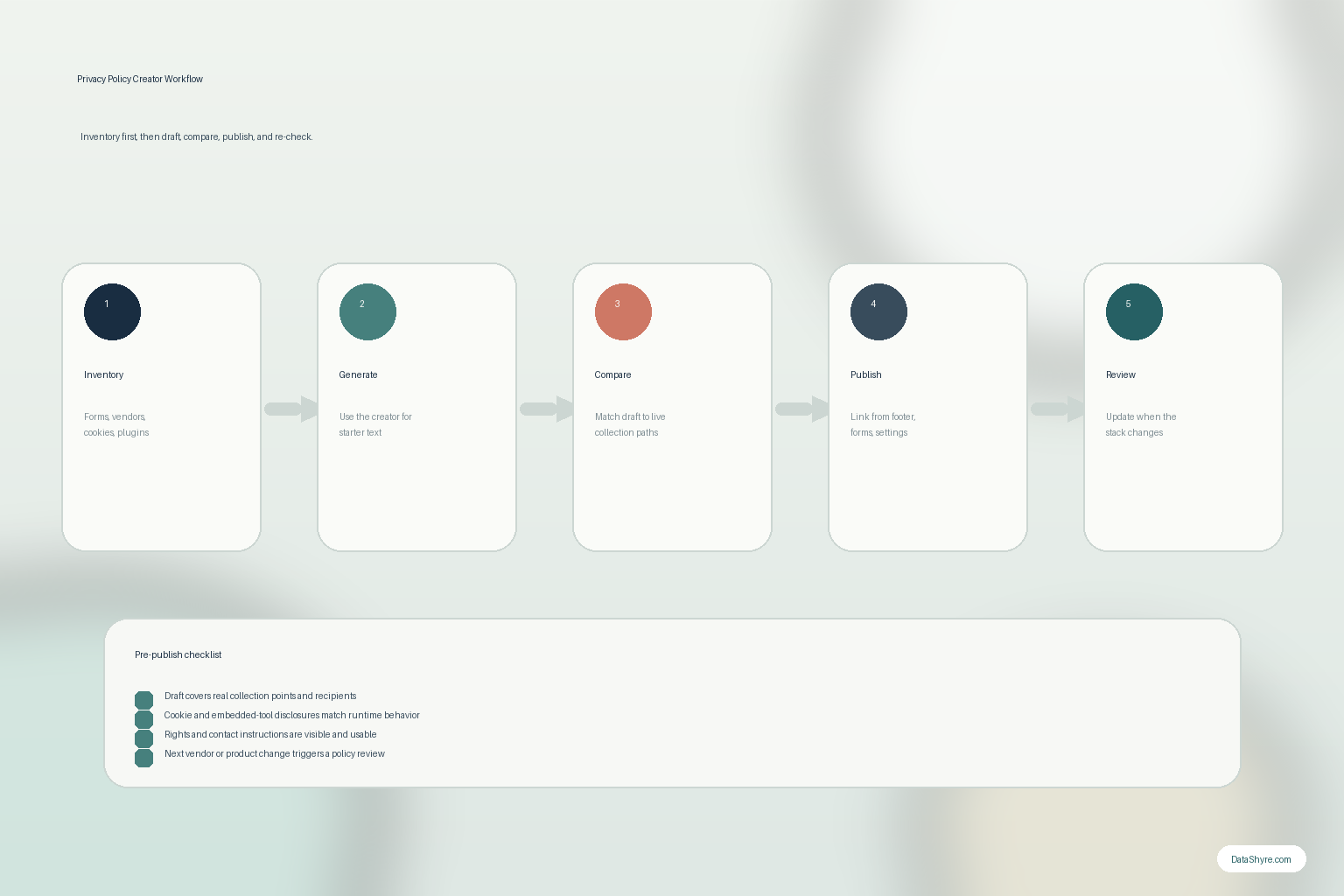
If I were reviewing privacy policy creator output this week, I would use this order:
- map the live collection points and vendors first;
- generate or collect the starter draft;
- fill the missing disclosure blocks for rights, recipients, retention, and contacts;
- match the draft against live forms, banners, embeds, and settings;
- verify the request methods and privacy-choice paths actually work;
- publish the page where users can really find it; and
- tie future stack changes to a required review.
That sequence usually catches more real risk than polishing wording first.
FAQ
Is a privacy policy creator enough on its own?
No. It can speed up drafting, but it cannot confirm your live forms, vendors, cookies, request methods, or product changes on its own.
What does a privacy policy creator usually miss?
It commonly misses runtime tracking, embedded tools, app-linked collection paths, and practical request workflows unless someone reviews the live environment afterward.
Where should I link the privacy policy?
Use a clear link with the word privacy on the homepage and other relevant webpages, then also connect it to the places where people actually submit personal information.
Bottom line
The best privacy policy creator in 2026 is not the one that produces the longest draft.
It is the one your team treats as a starting point, then checks against the live site, the real vendor stack, the actual rights workflow, and the next release before publishing.
Sources
- California Department of Justice, California Consumer Privacy Act (CCPA): https://www.oag.ca.gov/privacy/ccpa
- California Privacy Protection Agency, Frequently Asked Questions (FAQs): https://cppa.ca.gov/faq
- California Department of Justice, How to Read a Privacy Policy: https://www.oag.ca.gov/privacy/facts/online-privacy/privacy-policy
- California Department of Justice, CCPA Enforcement Case Examples: https://www.oag.ca.gov/privacy/ccpa/enforcement
- EUR-Lex, Regulation (EU) 2016/679, Article 12: https://eur-lex.europa.eu/legal-content/EN/TXT/?uri=CELEX:32016R0679
- ICO, How should we draft our privacy information?: https://ico.org.uk/for-organisations/uk-gdpr-guidance-and-resources/individual-rights/the-right-to-be-informed/how-should-we-draft-our-privacy-information/
- ICO, What methods can we use to provide privacy information?: https://ico.org.uk/for-organisations/uk-gdpr-guidance-and-resources/individual-rights/the-right-to-be-informed/what-methods-can-we-use-to-provide-privacy-information/
- WordPress.org Documentation, WordPress Privacy: https://wordpress.org/documentation/article/wordpress-privacy/