

Tag Manager Cookie Consent in 2026: 7 Live Checks Before Your Deny Path Leaks
If you searched tag manager cookie consent on October 14, 2026, you probably do not need another generic banner explainer.
You need to know whether the live stack actually holds tags back before choice, updates cleanly after choice, and leaves enough evidence behind to survive an audit or a debugging session later.
That is the useful framing now. Google’s current consent guidance still says defaults should be set “before any commands that send measurement data.” Google Tag Manager’s own help still says the Consent Initialization trigger runs “before all other tags.” The ICO still says consent “must be more than simply continuing to use the website.” The European Commission still says withdrawal should be “as easy to use as giving consent.”
If you want the adjacent setup guides first, read Cookie Consent Google Tag Manager: 7 Live Checks Before You Publish in 2026, GA4 Consent Mode: 7 Live Checks Before You Trust the Data in 2026, and Cookie Consent Requirements in 2026: What EU, UK, and California Rules Actually Demand. This article is narrower. It is the runtime review for tag manager cookie consent when the real risk is the deny path, not the accept button.
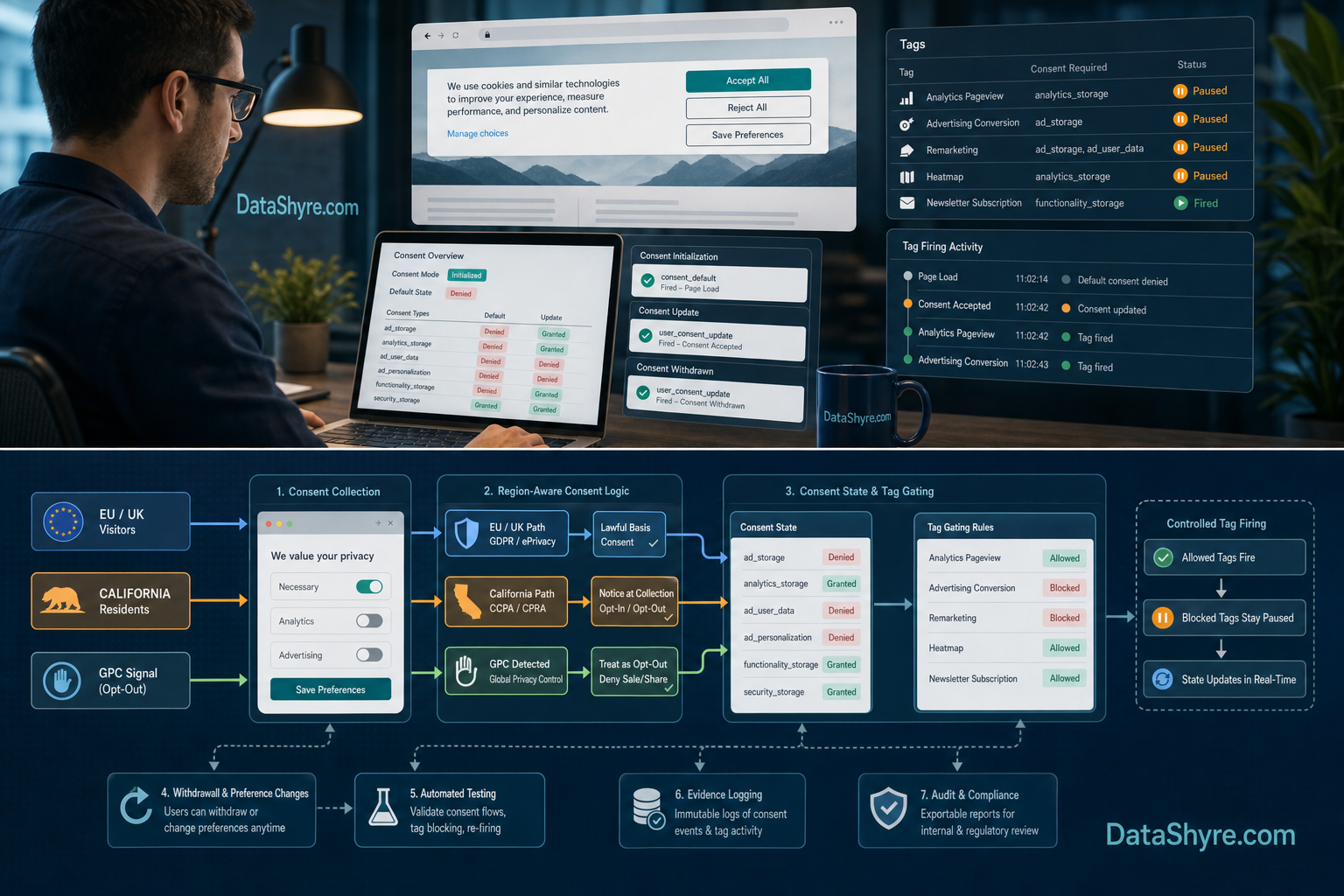
1. Separate banner design from tag behavior
The first mistake teams make with tag manager cookie consent is treating the banner as the implementation.
It is not. The banner is the interface. The implementation lives in the order, conditions, and exceptions underneath it. A banner can look polished while a page still sends analytics, ad-tech, or custom pixel traffic before the user has done anything meaningful.
That is why the legal language matters operationally. The ICO’s current cookies guidance still says consent must involve a real action and “must be more than simply continuing to use the website.” For live reviews, that means your question is not “Does the banner exist?” It is “What actually fires before the first real choice?”
2. Denied defaults need to land before measurement starts
Google’s current consent setup guide still says consent defaults must be sent “before any commands that send measurement data.” For a Google stack, that normally means denied defaults for at least ad_storage, analytics_storage, ad_user_data, and ad_personalization before ordinary page measurement begins.
This is still the fastest way to find a broken setup:
- Load the page with no prior preference.
- Check whether the denied state exists before the main measurement tags initialize.
- Confirm the first pageview does not outrun the consent layer.
If the default state arrives late, the stack may still look compliant in a happy-path demo because later events respect choice. The problem is that the first load already leaked.
3. Use Consent Initialization for consent logic, not as an afterthought
Google Tag Manager’s help is explicit here: the Consent Initialization trigger is meant for tags that set or update consent, and it runs “before all other tags.” That sounds like a small implementation detail. It is not.
For tag manager cookie consent, this is usually the dividing line between a stable setup and a race condition:
- the CMP or consent-state tag runs on Consent Initialization;
- ordinary measurement tags wait on that state;
- later updates reflect the person’s actual choice.
The weaker pattern is familiar:
- the CMP loads on a normal page trigger;
- a Custom HTML tag updates consent in a callback;
- another tag gets a head start.
Google’s own Tag Manager help warns that callback-based commands or gtag() calls in Custom HTML are not guaranteed to be available before the next trigger fires. If your reject path depends on that timing gamble, the implementation is not ready.
4. Review each consent branch instead of assuming one switch covers everything
Older deployments still treat tag manager cookie consent as though analytics_storage alone tells the whole story. In 2026, that is too shallow for most production containers.
Current Google documentation still separates:
analytics_storagead_storagead_user_dataad_personalization
That separation matters more now because Google Analytics says that, starting June 15, 2026, Consent Mode in Google Ads becomes the single control for that advertising-data flow, while the Google Signals setting in Analytics is narrowed to behavioral reporting.
So a real review should ask:
- which tags depend on which consent states;
- whether GA4 and Google Ads are wired to the expected states;
- whether any custom HTML or third-party vendor tag bypasses the same controls;
- whether exception triggers or template settings quietly weaken the deny path.
The failure mode is rarely “nothing works.” It is that one branch obeys the banner while another branch keeps moving.
5. Test reject, accept, and withdrawal as separate runtime states
The European Commission’s GDPR guidance still says it must be possible to withdraw consent and that withdrawal should be “as easy to use as giving consent.” That means a solid tag manager cookie consent setup is not just a first-visit test.
I would test at least these states:
- first visit with no stored choice;
- explicit reject;
- explicit accept;
- later withdrawal through the settings link or preference center;
- reload and second-page behavior after withdrawal.
The important thing is not whether a preference record changes somewhere in the background. The important thing is whether tag behavior changes when the preference changes. If GA4, ads, or custom vendors remain effectively active until some later page template catches up, the stack is weaker than the banner copy suggests.
6. Keep a separate California opt-out path when sale or sharing is in scope
This is where many cross-region setups flatten everything into one legal model.
California’s Department of Justice still describes the Global Privacy Control as a “stop selling or sharing my data switch.” The CPPA’s current FAQ also says businesses must honor qualifying opt-out preference signals as valid requests to opt out of sale or sharing, and notes that its approved regulations became effective on January 1, 2026.
That does not make California identical to an EU prior-consent model. It means a live tag manager cookie consent review should ask whether the California branch behaves distinctly where sale or sharing logic is relevant:
- is a qualifying opt-out preference signal detected;
- does GTM alter downstream behavior when that signal is present;
- is the user-facing state understandable enough for support and QA;
- is that branch kept distinct from EU or UK prior-consent handling.
One banner may span regions. One legal theory should not.
7. Save proof that links the visitor choice to the tag outcome
The last check is evidence.
Most weak implementations can produce a policy page and a screenshot of a banner. Fewer can show the full chain between the user’s action and the tag result on the page that mattered.
For tag manager cookie consent, the useful evidence set normally includes:
- the banner or preference-center version shown;
- the default consent states in force;
- the GTM event path and consent-state changes in Tag Assistant;
- the resulting GA4, Ads, and related vendor behavior;
- the California opt-out signal branch where applicable;
- the retest after the most recent CMP, template, or container change.
That pack is what turns consent from a design claim into an auditable system.
A short review sequence for this week
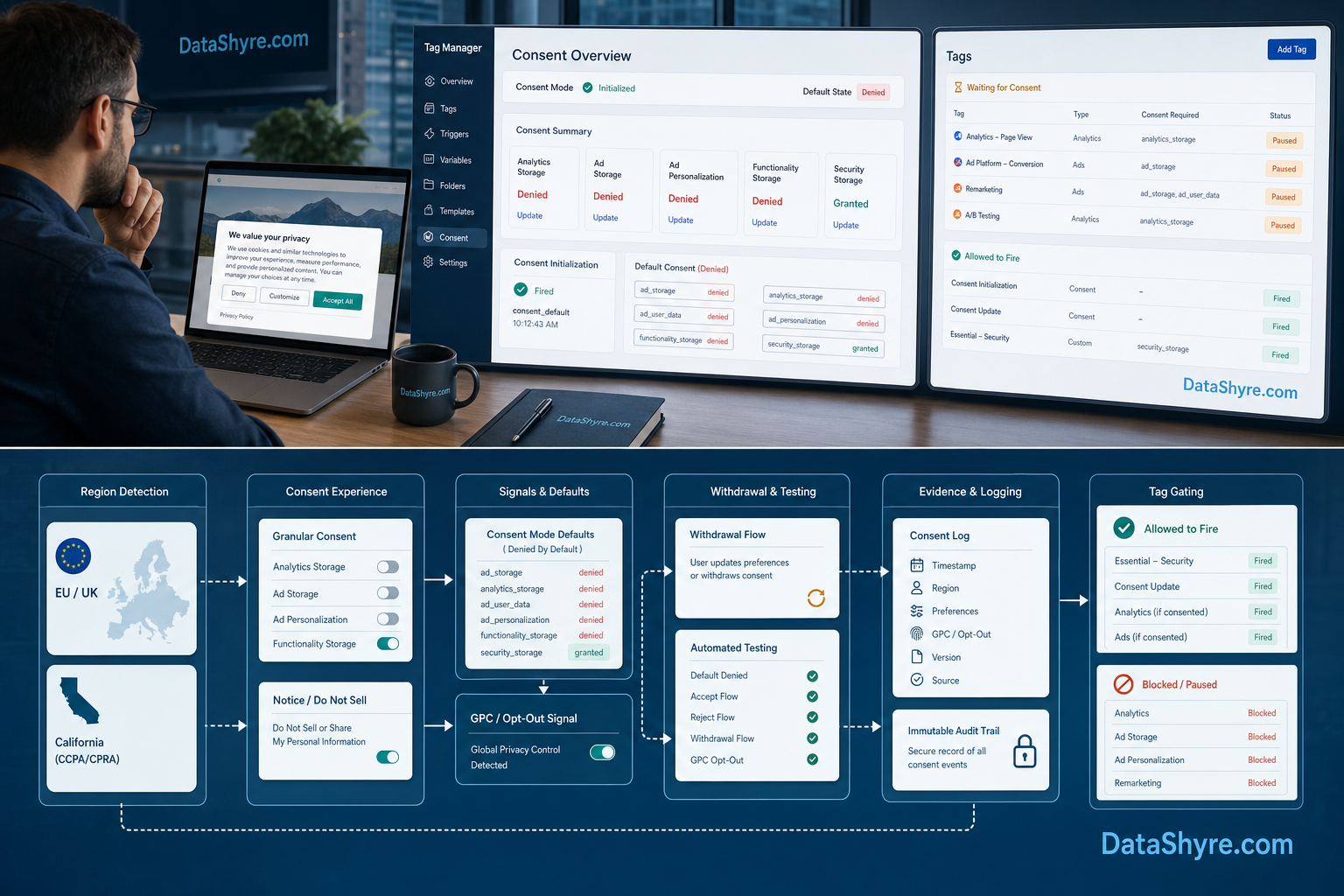
If I were reviewing tag manager cookie consent on a live site today, I would work in this order:
- confirm denied defaults arrive before measurement begins;
- verify consent-writing tags use Consent Initialization;
- inspect tag-level consent settings and any custom HTML bypasses;
- test reject, accept, and withdrawal with live browser checks;
- validate the California opt-out branch if sale or sharing is in scope;
- save the evidence pack before the next release changes the state again.
That sequence usually surfaces the real defect faster than another round of banner copy changes.
Bottom line
The cleanest way to think about tag manager cookie consent in 2026 is this: the project is not finished when a banner appears or when GA4 reports data.
It is finished when denied defaults land early, Consent Initialization wins the race, region-specific opt-out logic branches correctly, withdrawal changes actual runtime behavior, and your team can still prove the outcome later. If you cannot show that chain clearly, the consent program may be live while the deny path is still leaking.
Sources
- Google for Developers: Set up consent mode on websites
- Google Tag Manager Help: Tag Manager consent mode support
- Google Tag Manager Help: Unblock Google tags when using consent mode
- Google Analytics Help: Updates to Google Analytics Data Controls
- ICO: Cookies and similar technologies
- European Commission: Legal grounds for processing data
- California Department of Justice: Global Privacy Control
- California Privacy Protection Agency: Frequently Asked Questions
—
Published: October 14, 2026. Updated using current official Google, regulator, and government materials available at publication time.