

Consent Management Tooling in 2026: 7 Live Checks Before You Trust the Stack
If you are evaluating consent management tooling in 2026, the useful question is not which platform has the most toggles.
The useful question is whether your tooling can carry a privacy choice all the way from the banner or preference center into browser behavior, downstream vendors, regional logic, and audit records. That is where expensive gaps still show up.
Current official guidance keeps pushing in that direction. The European Commission still says withdrawal must be “as easy to withdraw as to give consent.” The ICO said in its April 29, 2026 announcement for finalized storage-and-access-technologies guidance that people need “meaningful control” over how their data is used. California’s Department of Justice still describes Global Privacy Control as a “stop selling or sharing my data switch.” And Google’s current consent-mode setup guide warns that “The order of the code here is vital.”
That is why consent management tooling should be reviewed as live operational infrastructure, not just banner software.
If you want nearby context first, start with our guides to what is consent management, consent preference management, and consent management process. This article stays narrower. It is the seven-check tooling review I would use on a live stack this week.
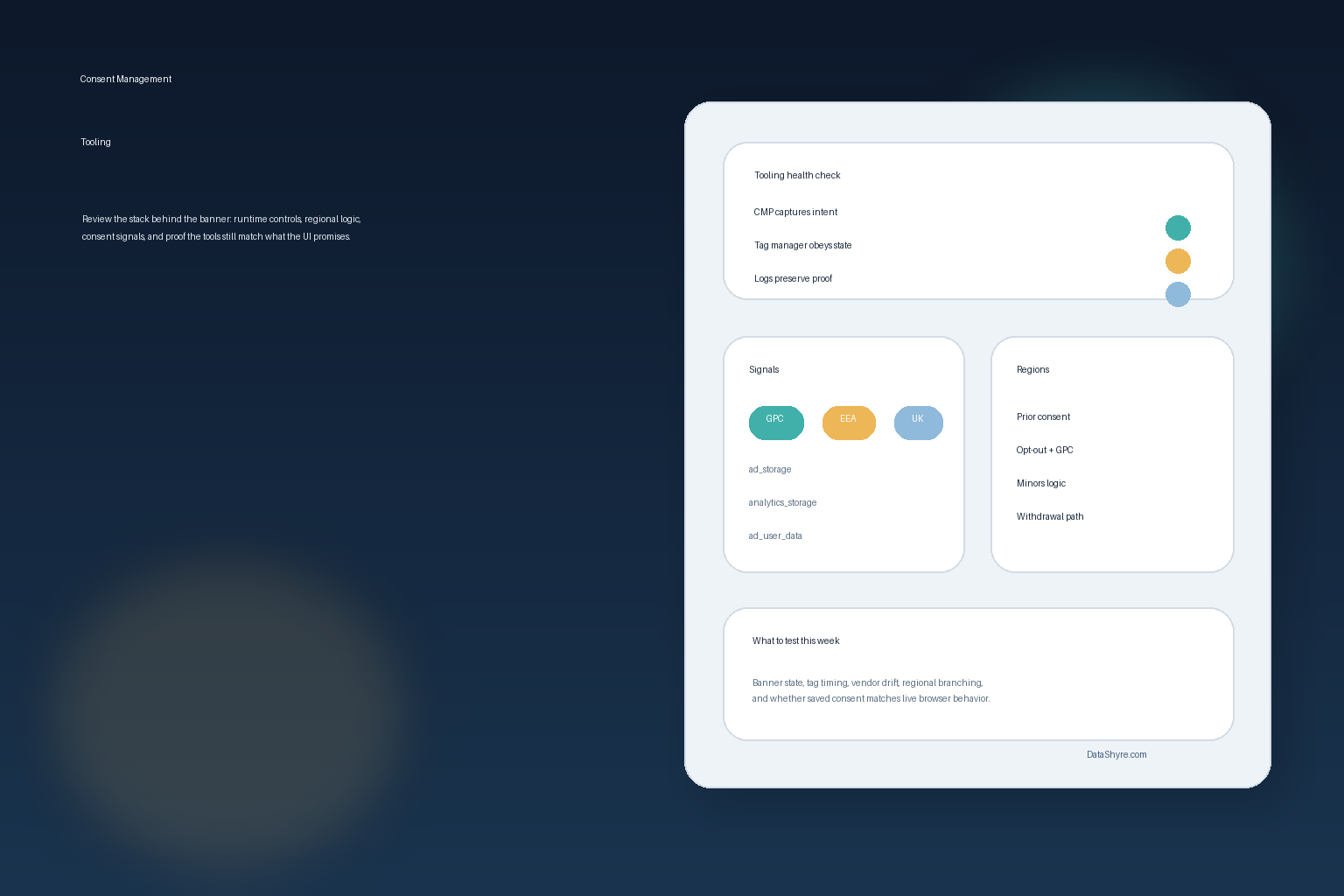
1. Start with the rule set before you compare vendors
The first job of consent management tooling is not presentation. It is correctly modeling the rule you are trying to enforce.
That sounds obvious, but teams still buy a tool before mapping the obligations. In the EU and UK, the practical question often starts with prior consent for non-essential storage or access technologies. In California, the more immediate question may be whether the stack honors opt-out rights and valid GPC signals. If children, sensitive data, or channel-specific marketing are involved, the logic branches again.
So before you score a CMP, tag manager, or preference center, ask:
- which purposes actually rely on consent;
- which regions require prior consent versus opt-out handling;
- which choices need to be purpose-specific or channel-specific; and
- which downstream systems must change when the user changes their mind.
Without that mapping, consent management tooling can look organized while still enforcing the wrong model.
2. Inventory every technology the tooling is supposed to govern
A surprising amount of weak tooling is really weak inventory.
The ICO’s finalized April 29, 2026 guidance announcement is helpful because it explicitly covers cookies, tracking pixels, device fingerprinting, and similar storage-and-access technologies. That means a serious consent management tooling review has to reach beyond the banner itself.
I would map at least these layers:
- CMP or consent UI logic;
- tag manager rules and default states;
- analytics, ad, and personalization scripts;
- embedded chat, video, or scheduling tools;
- mobile SDKs where the same user journey continues in app;
- downstream audience sharing or measurement vendors where they apply.
If even one of those layers runs outside the control plane, the tooling can collect a preference without actually enforcing it.
3. Test whether the tooling can branch cleanly by region
This is where a lot of polished dashboards still fail.
The California DOJ’s current CCPA pages say consumers can exercise opt-out rights, including through a user-enabled GPC. Its GPC page still describes the signal as a “stop selling or sharing my data switch.” That is not the same operational path as an EU or UK prior-consent banner for optional tracking.
So consent management tooling should be tested for regional branching, not just category labels.
That means checking whether the stack can:
- block optional technologies before consent where prior consent applies;
- recognize and honor GPC where California rules apply;
- preserve separate logic for minors or special workflows where needed; and
- keep those branches understandable enough for another team member to audit later.
When one universal banner is asked to do every job, the interface usually hides the branch where the tooling is least reliable.
4. Verify signal timing before any optional data starts moving
This is the most technical and most important check in the set.
Google’s current official setup guide for consent mode says default consent should be set before commands send measurement data, and warns that “The order of the code here is vital.” That line matters well beyond Google tags. It captures the main truth about consent management tooling: if the signal arrives too late, the tooling is mostly paperwork.
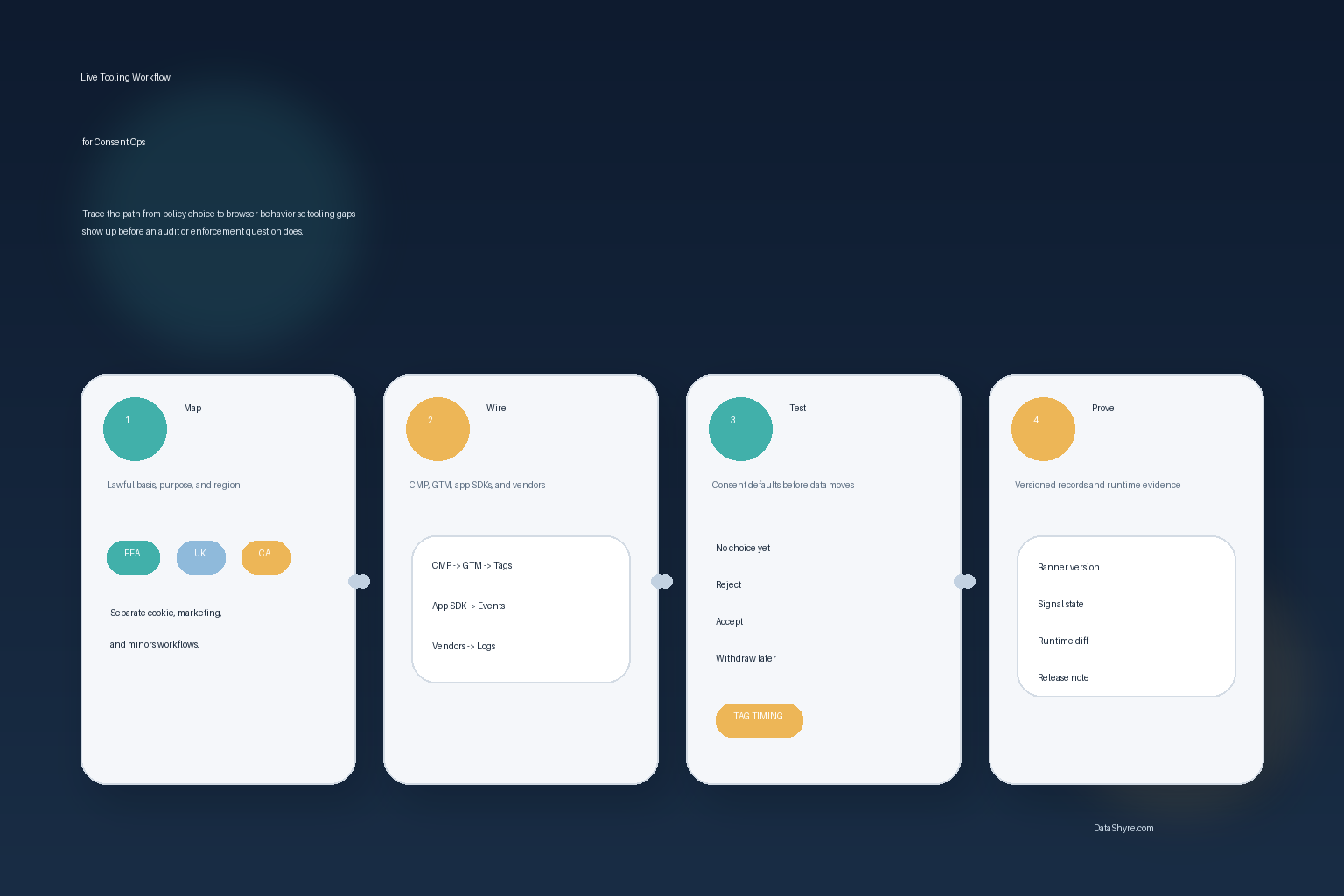
On a live property, I would test at least four states:
- no choice yet;
- explicit reject;
- explicit accept;
- later withdrawal or updated preference.
Then I would compare what the browser actually does:
- do optional requests wait when they should;
- do tags change state immediately enough to matter;
- do hardcoded scripts bypass the tooling;
- do embedded vendors or SDKs keep collecting anyway.
If the tooling only updates after the pageview, the legal text may be current while the behavior is not.
5. Look for vendor drift, not just missing features
Tooling failures often appear months after the original implementation.
The ICO’s 2026 storage-and-access-technologies guidance update reflects the reality that tracking setups keep changing. The same is true operationally: new tags get added, templates get updated, mobile SDKs change defaults, and embedded tools quietly expand their behavior.
That means a strong consent management tooling program should catch vendor drift:
- a newly added pixel not mapped to any category;
- a tag manager template that changed how consent is read;
- a vendor that now sets identifiers earlier than before;
- a partner integration that ignores withdrawal or GPC signals.
This is one reason tooling reviews should be tied to release work, not left as a one-time privacy project.
6. Make sure the tooling produces evidence another team can reconstruct
The European Commission’s current data-protection guidance still emphasizes that consent must be specific, informed, and easy to withdraw. In practice, that means consent management tooling should create records that explain both the promise and the resulting state.
For most teams, the useful record set includes:
- the banner or preference-center version shown;
- the categories or purposes presented;
- the region or rule set applied;
- the timestamp and identifier for the choice;
- the resulting technical state across tags or vendors;
- any later change, withdrawal, or reauthorization.
These records become much more valuable when they can be reconciled with runtime evidence. A database entry that says rejected is weak proof if the browser still fired optional requests on first load.
7. Review current enforcement signals, not only product checklists
This is the governance layer that keeps tooling reviews realistic.
On February 11, 2026, California Attorney General Rob Bonta announced a $2.75 million settlement with Disney over allegations that opt-out requests were not fully effectuated across all associated devices and streaming services. On July 14, 2026, the EDPB said the Belgian DPA had to handle the merits of a cookie-banner complaint instead of dismissing it procedurally. And CNIL’s December 12, 2024 formal-notice announcement on cookie-banner dark patterns reiterated that rejecting cookies should be just as easy as accepting them.
Those are useful reminders that consent management tooling is judged by how it performs under real conditions:
- does the choice propagate across related services;
- does the reject path carry equal weight to the accept path;
- can the organization prove what happened after a complaint;
- do technical controls still match the user-facing promise.
The tooling does not need to be perfect. It does need to stay testable, explainable, and fixable.
A short weekly review sequence
If I were pressure-testing consent management tooling today, I would use this order:
- map the legal model by purpose and region;
- inventory every controlled tag, script, SDK, embed, and vendor;
- test regional branching, including GPC where relevant;
- verify that default signals land before optional data moves;
- look for vendor drift since the last release;
- compare saved records with runtime behavior;
- reread the latest regulator or platform guidance when the stack changes.
That sequence usually reveals more truth than a generic vendor scorecard.
Bottom line
In 2026, strong consent management tooling is not the tool with the most categories or the prettiest admin.
It is the stack that can model the right rule, branch it by region, enforce it early enough to matter, detect vendor drift, and leave behind evidence that still makes sense when a regulator, auditor, or teammate asks what happened.
If your tooling can do that after the next release, it is earning its place. If not, the problem is probably not banner copy. It is control-plane quality.
Sources
- European Commission: Legal grounds for processing data
- European Commission: Information for individuals
- UK ICO: Final storage and access technologies guidance published
- California Department of Justice: California Consumer Privacy Act (CCPA)
- California Department of Justice: Global Privacy Control
- California Department of Justice: Disney settlement announcement
- European Data Protection Board: Belgian DPA must handle the merits of the NOYB cookie-banner complaint
- CNIL: Dark Patterns in Cookie Banners: CNIL issues formal notice to website publishers
- Google for Developers: Set up consent mode on websites
—
Published: October 9, 2026. Updated using current official regulator, government, and platform materials available at publication time.