

Consent Preference Management in 2026: 7 Live Checks Before You Trust the Stack
If you are reviewing consent preference management on October 3, 2026, the useful question is not whether your site has a polished banner or a pretty preference center.
It is whether consent choices and communication preferences still mean the same thing across the website, app, CRM, email platform, SMS tooling, analytics stack, and downstream vendors after the next release.
That is the right frame because the official guidance is still pushing teams toward operational reality. The European Commission’s current GDPR materials still say valid consent must be freely given, informed, specific, and given through clear affirmative action. The ICO’s finalized April 29, 2026 storage-and-access-technologies guidance now clearly covers cookies, tracking pixels, device fingerprinting, and similar technologies. France’s CNIL is still stating the cleanest first-layer banner rule available: “rejecting cookies should be just as easy as accepting them.” California’s Department of Justice still describes Global Privacy Control as a “stop selling or sharing my data switch.” And Google’s current consent-mode implementation guide still requires teams to set defaults and update live states for ad_user_data, ad_personalization, ad_storage, and analytics_storage.
That mix is exactly why consent preference management keeps drifting. The failure is rarely one screen. It is the handoff between lawful basis, runtime choice capture, cross-channel syncing, vendor behavior, and evidence.
If you want the closest companion reads first, start with our guides to consent management challenges, consent management platform, and CCPA cookie consent. This article is narrower. It is the live seven-point review I would run before trusting consent preference management on a production stack this week.

1. Separate lawful basis from channel preference
One of the most common mistakes in consent preference management is using the word “preference” as if it automatically solves the legal basis question.
It does not.
The European Commission’s current guidance still treats consent as only one lawful basis among several, and it still says valid consent must be freely given, informed, specific, and expressed through a clear affirmative act. That matters because a communication preference center can be useful even when another basis applies to a workflow, and a preference center can be useless if the business is pretending that every toggle equals valid consent.
So the first live check is simple:
- identify which choices are true consent choices;
- identify which settings are channel or frequency preferences;
- make sure the interface and records do not collapse those into one vague status.
If your stack cannot distinguish “the user consented to this processing” from “the user prefers fewer messages on this channel,” your consent preference management model is already ambiguous.
2. Make withdrawal as easy as enrollment
This is where many teams quietly fail.
The European Commission’s current consent guidance still says the request for consent must clearly state that it is possible to withdraw consent and that withdrawal must be as easy as giving it. That principle should shape far more than unsubscribe copy. It should shape the whole operating model.
For consent preference management, test:
- whether a person can change a choice without logging a support ticket;
- whether the withdrawal path is as visible as the original opt-in path;
- whether the system propagates that change quickly enough to matter;
- whether the evidence trail shows the before and after state.
A beautiful enrollment flow with a weak withdrawal flow is not a minor UX issue. It is a trust and compliance issue.
3. Audit more than cookies
Another common failure in consent preference management is acting as if the website banner is the whole story.
The ICO’s finalized storage-and-access-technologies guidance matters here because it clearly expands the review surface beyond classic cookies into tracking pixels, device fingerprinting, and similar technologies. That means the preference record and the runtime review both need to be wider than the old cookie checklist.
So I would inspect:
- tags and pixels on the web property;
- app SDK behavior;
- embedded chat, video, or scheduling tools;
- data handoffs into analytics, audience, and messaging systems.
If the interface says a person declined one thing while hidden tags, SDKs, or connectors continue to behave as if nothing changed, your consent preference management layer is decorative.
4. Check first-layer fairness before you trust the downstream logic
This point is still underrated.
CNIL’s current dark-pattern notice says “rejecting cookies should be just as easy as accepting them.” It also lists practical failures that regulators still care about: reject controls hidden in text, weak visual emphasis, and misleading layout choices that steer people into accepting.
That matters for consent preference management because first-layer bias poisons everything that follows. If the capture step is weak, the downstream records are not much comfort.
On a live property, I would test:
- whether reject or decline is available at the right layer;
- whether the reject path is visually and interactionally comparable to accept;
- whether mobile behavior is as usable as desktop behavior;
- whether the site actually behaves differently after refusal.
If the “choice” is only technically present, the preference stack is already undercut at the moment of capture.
5. Treat California opt-out and GPC as their own branch
Many stacks still flatten every region into one global consent flow.
California’s official materials remain a good corrective. The DOJ’s current CCPA page says consumers may request that businesses stop selling or sharing personal information, including via a user-enabled global privacy control. Its GPC page still describes that signal as a “stop selling or sharing my data switch.” The DOJ’s enforcement examples also continue to show the same operational failures: confusing toggles, broken or missing Do Not Sell or Share controls, and businesses that did not process GPC properly until after intervention. The CPPA’s updated regulations also remain current, with the latest rulemaking package effective on January 1, 2026.
That means consent preference management should explicitly test the California branch:
- can the property detect and honor GPC where required;
- does the opt-out suppress relevant sale or sharing behavior in practice;
- are California-specific rights kept distinct from a generic cookie drawer;
- does the evidence trail show what changed after the signal arrived.
If your system treats GPC as a theoretical input instead of a runtime control, your California readiness is overstated.
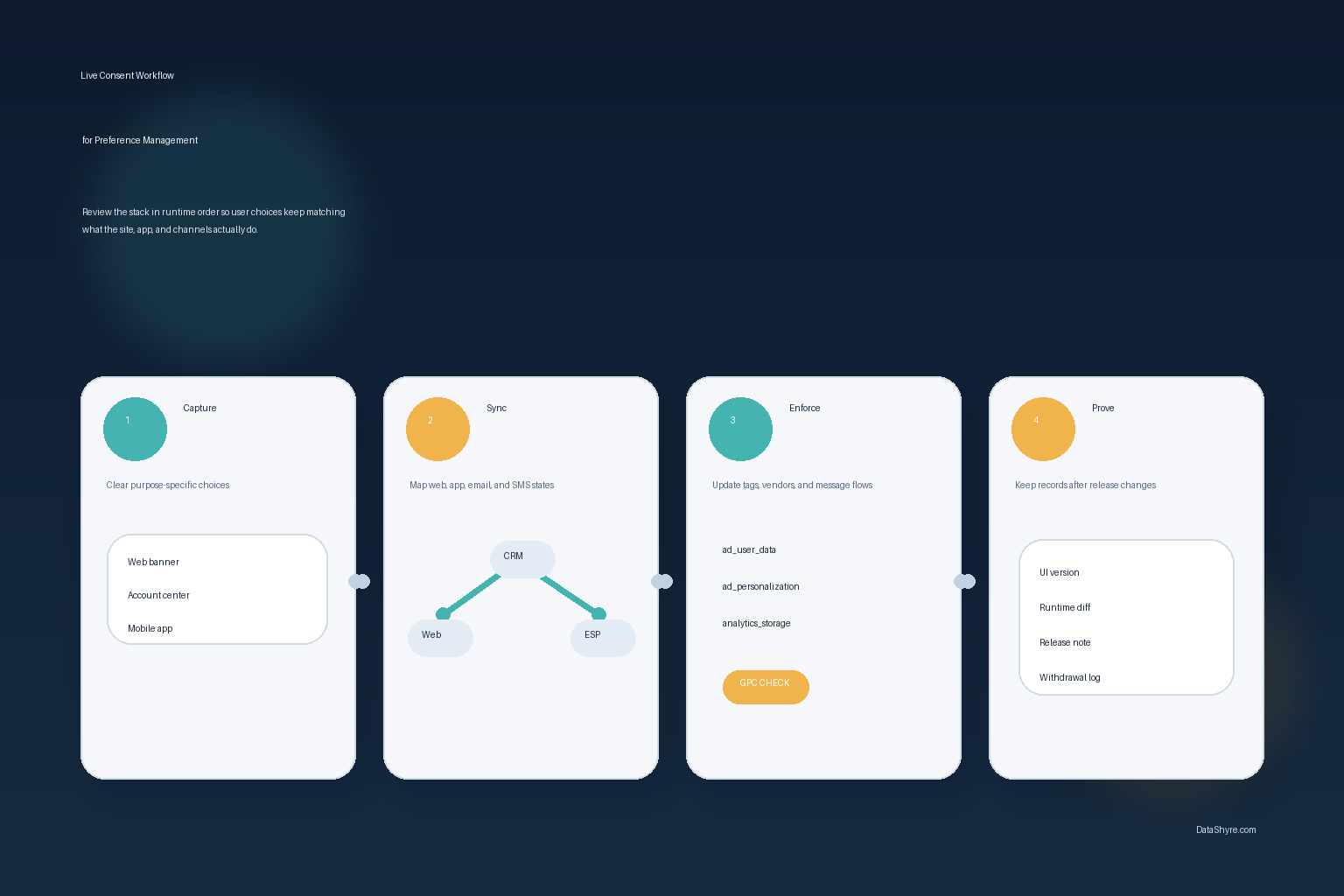
6. Verify Google signal mapping and cross-channel sync together
This is where technical teams often discover that the stack is telling two different stories.
Google’s current developer guide still says consent mode does not save consent choices for you. It also still requires implementers to set default consent states and update them based on user interaction. And the current website setup guide continues to include the v2 fields ad_user_data and ad_personalization alongside ad_storage and analytics_storage.
That has an important consequence for consent preference management: one system may capture the choice, but another system has to translate it into live behavior.
My minimum review would test:
- no choice yet;
- explicit reject;
- explicit accept;
- later withdrawal or account-level update.
Then compare:
- Google consent signals;
- non-Google vendor behavior;
- CRM or messaging preference changes;
- whether those states stay aligned across later visits and later sessions.
If consent-mode fields update correctly while email or SMS preferences drift, or if marketing systems update while tags keep firing as before, the stack is not coordinated enough to trust.
7. Keep evidence that survives the next release
The strongest consent preference management program is not the one with the most elegant dashboard.
It is the one that still lets another stakeholder reconstruct what happened after a user asked, changed a setting, or withdrew consent.
The ICO’s emphasis on practical guidance and “meaningful control” is useful here because it points teams away from screenshots and toward proof. For a usable record, I would want:
- the version of the banner or preference center that was live;
- the timestamped user choice;
- the downstream systems that received the update;
- runtime evidence that relevant tags or flows changed;
- the release or ticket that can explain later drift.
That matters because consent preference management usually breaks after ordinary operational change: a new marketing tag, an app release, a CRM field remap, a vendor script update, or a redesigned account page.
A short review sequence for this week
If I were pressure-testing consent preference management today, I would do it in this order:
- separate true consent from ordinary communication preferences;
- test whether withdrawal is as easy as enrollment;
- expand the audit beyond cookies into tags, pixels, SDKs, and embeds;
- compare
Reject allfriction withAccept all; - run a California-specific GPC and opt-out test;
- verify all four current Google consent-mode fields where Google tools matter;
- export the evidence trail and rerun the checks after the latest release.
That sequence usually exposes the real weakness faster than another feature checklist or vendor demo.
Bottom line
The hardest part of consent preference management in 2026 is not collecting a choice.
It is preserving the meaning of that choice across legal basis, runtime capture, regional branching, downstream enforcement, and post-release evidence.
If your team can still prove those seven areas hold up on the live property today, your stack is much closer to a real operating control than a banner with extra toggles. If not, the gap is probably not in the policy language. It is in the runtime.
Sources
- European Commission: Legal grounds for processing data
- ICO: Final storage and access technologies guidance published
- ICO: Guidance on the use of storage and access technologies
- CNIL: Dark Patterns in Cookie Banners: CNIL issues formal notice to website publishers
- California Department of Justice: California Consumer Privacy Act (CCPA)
- California Department of Justice: Global Privacy Control
- California Department of Justice: CCPA Enforcement Case Examples
- California Privacy Protection Agency: CCPA Updates, Cybersecurity Audits, Risk Assessments, Automated Decisionmaking Technology (ADMT), and Insurance Regulations
- Google for Developers: Set up consent mode on websites
—
Published: October 3, 2026. Updated using current official regulator, government, and platform materials available at publication time.