

WordPress Cookie Consent in 2026: 7 Live Checks Before Your Next Plugin Update
If you are reviewing wordpress cookie consent on September 12, 2026, the real question is not whether the banner appears.
It is whether the user choice still controls what the WordPress stack actually does after the next plugin update, theme change, GTM publish, embed rollout, or performance tweak.
That framing matches the current official pattern. The ICO’s final storage-and-access-technologies guidance, published on April 29, 2026, explicitly covers cookies, tracking pixels, device fingerprinting, and similar technologies. WordPress’s own plugin privacy materials tell developers to think through third-party JavaScript, tracking pixels, iframes, cookies, and local storage. California’s Department of Justice still says a qualifying Global Privacy Control signal is a valid opt-out request and still describes GPC as a “stop selling or sharing my data switch.”
If you want the adjacent context first, start with our guides to cookie consent, cookie consent manager, and Google Tag Manager cookie consent. This article is narrower. It is the live WordPress review I would run before approving another change this week.
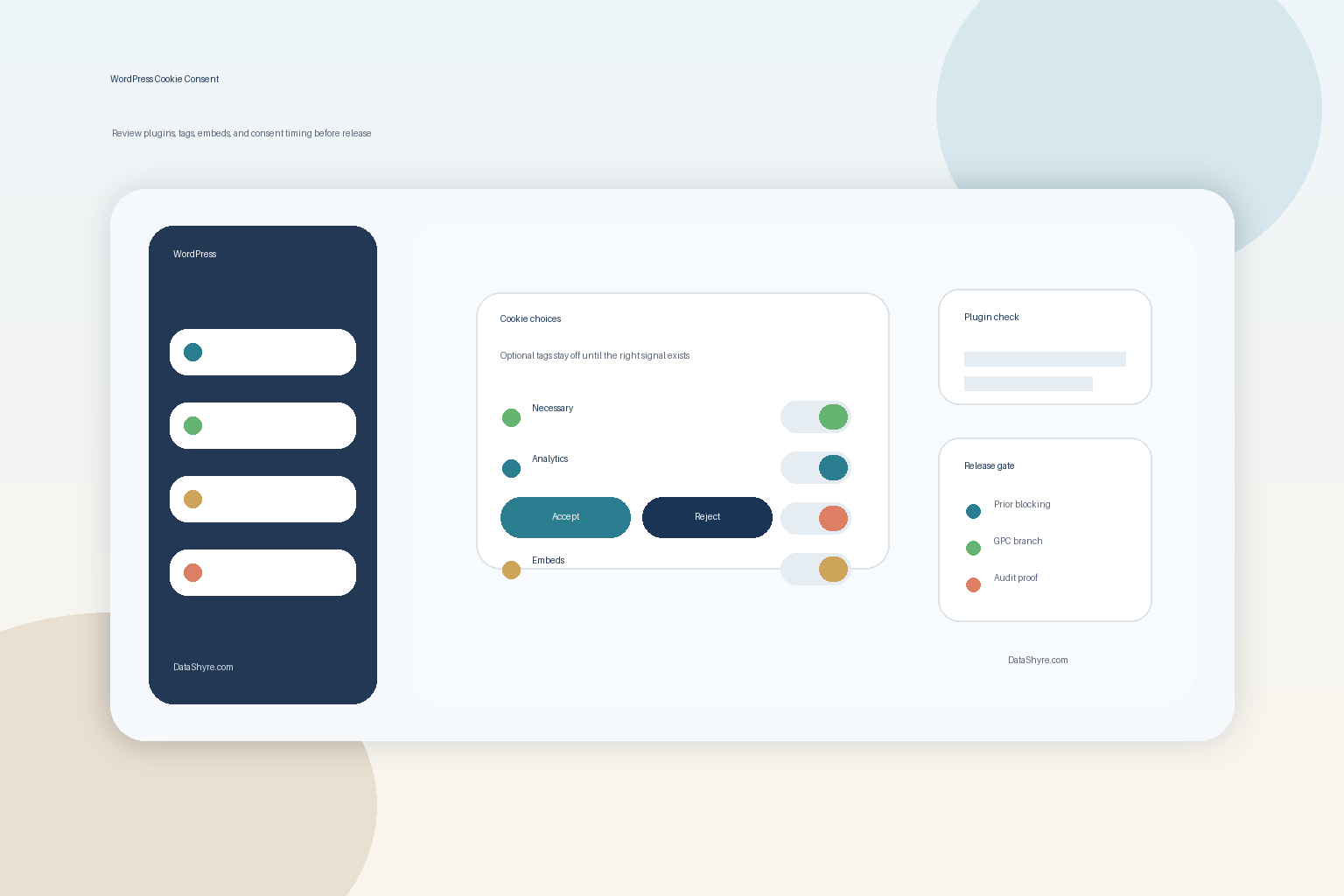
Why WordPress cookie consent breaks after ordinary site changes
Most WordPress consent failures are not dramatic.
They happen because the visible banner and the real data flows stop matching each other.
A typical site may have:
- a consent plugin handling the first layer;
- theme or snippet code loading tags directly;
- GTM or Google tags managing analytics and ads;
- form, chat, map, video, and scheduling embeds;
- caching or optimization plugins changing script order;
- plugins making outbound calls to third-party services.
That is why wordpress cookie consent should be reviewed as runtime behavior, not as one settings page.
1. Inventory every place optional technologies can start
Start with the stack, not the banner.
WordPress’s Plugin Handbook asks plugin authors to consider whether a plugin shares personal data with outside APIs or servers, collects telemetry, enqueues third-party JavaScript, tracking pixels, or iframes, or stores data in the browser such as cookies or local storage.
That is a useful audit prompt for site owners too. Before you trust wordpress cookie consent, list every plugin, theme component, embed, and tag path that can set or trigger optional technologies.
If you cannot explain where tracking can start, you are not reviewing consent yet. You are reviewing only the interface.
2. Test prior blocking on the templates people actually use
The homepage is not enough.
WordPress sites often behave differently on blog posts, landing pages, product pages, support pages, and pages with embedded media. The ICO’s practical consent guidance says that if no exception applies, you must obtain prior consent, and that any consent mechanism must function as intended.
So test real templates with a clean session:
- homepage;
- post or article pages with embeds;
- landing pages with forms or chat tools;
- store or product pages if commerce is in scope.
If optional technologies are already active before a choice, the banner is only decoration.
3. Check whether reject stays as easy as accept
This is still one of the fastest filters for a weak setup.
On December 12, 2024, CNIL said website publishers must avoid misleading banner designs and repeated that “rejecting cookies should be just as easy as accepting them.”
WordPress makes this easy to get wrong because responsive styles, block layouts, popup plugins, and page builders can change the first-layer layout from one template to another. Review both desktop and mobile, not just the plugin preview.
If Reject all becomes lower contrast, moves below the fold, or takes more clicks than Accept all, your wordpress cookie consent implementation is already drifting.
4. Verify consent timing before Google measurement starts
WordPress consent breaks as often on timing as on wording.
Google’s current consent mode setup guide says you should set the default consent state before the user grants consent and make sure consent updates are tracked on the page where they occur, before any page transition.
That timing can fail after a routine WordPress change if:
- a theme injects a tag directly;
- GTM loads earlier than the consent layer expected;
- a performance plugin changes script execution order;
- an SPA-like interaction changes the page state before updates land.
So for wordpress cookie consent, check what Google tools actually receive in runtime, not what the plugin settings claim to send.
5. Treat plugin outbound calls as part of consent scope
This is one of the most WordPress-specific checks in the whole workflow.
WordPress.org’s detailed plugin guidelines, last updated on March 11, 2026, say plugins may not contact external servers without “explicit and authorized consent.”
That matters because many WordPress sites rely on plugins that call remote services for analytics, anti-spam, scheduling, chat, CRM syncing, recommendations, or vendor dashboards.
The practical review is simple:
- which plugins contact external services;
- which calls are strictly necessary;
- which ones should wait for consent or a different regional branch.
If you cannot answer those three questions, the consent review is unfinished.
6. Separate EU and UK consent logic from California opt-out logic
One banner can hide two very different workflows.
In the EU and UK, the operational question is often whether non-essential technologies stay off until valid consent exists. In California, the issue may shift toward sale-or-sharing analysis, opt-out mechanisms, and browser-based preference signals. The California DOJ’s GPC page says covered businesses must honor the signal as a valid request to stop the sale or sharing of personal information.
Enforcement is also practical now. On March 5, 2026, CalPrivacy announced a Ford settlement requiring a $375,703 fine and changes to practices because unnecessary friction in the opt-out process violated the CCPA.
For wordpress cookie consent on a multi-region site, do not assume one default interaction solves every audience. Test the California branch on purpose.
7. Re-test after plugin, theme, cache, or tag changes
This is the control that keeps a good setup from quietly degrading.
WordPress’s moving parts are the reason. New plugins appear. Existing plugins update. Themes change markup. optimization layers reorder scripts. Marketing teams publish new tags. Embedded tools arrive through editorial workflows instead of engineering tickets.
That means wordpress cookie consent should be part of release control. Re-test after:
- plugin installs or updates;
- theme releases;
- cache, CDN, or optimization changes;
- GTM publishes;
- new embeds, forms, or chat tools;
- changes to regional rules or banner copy.
Without that repeat test, today’s compliant flow becomes next month’s broken one.
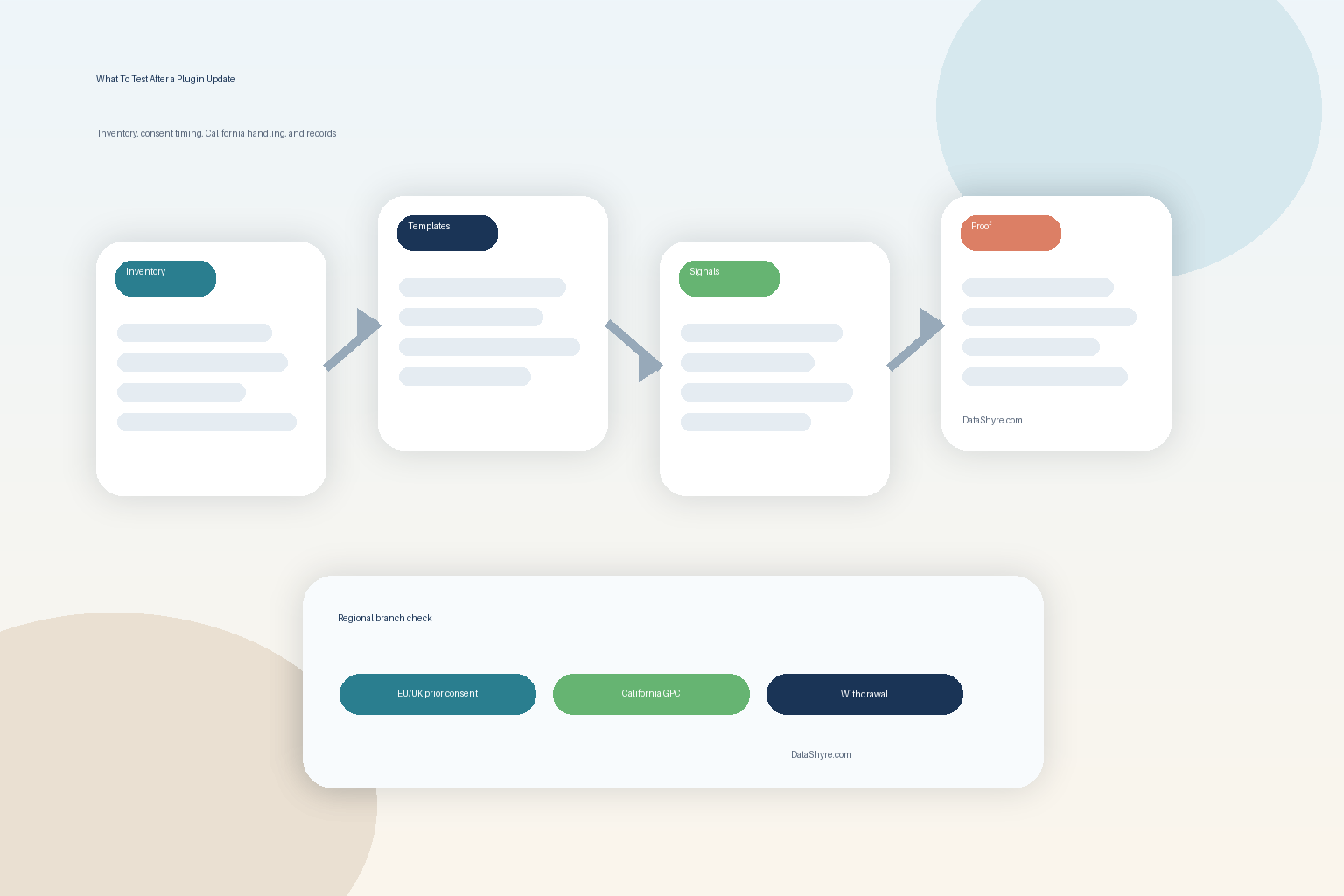
A short release review for this week
If I had ten minutes to review wordpress cookie consent before a deployment, I would do this in order:
- inventory plugins, direct scripts, embeds, and external calls;
- test key templates with a clean browser session;
- compare
Reject allandAccept allon desktop and mobile; - inspect the default and updated consent signals that Google tools receive;
- test a California path with GPC where sale or sharing could apply;
- reopen settings later and confirm withdrawal still changes behavior;
- keep records that a non-technical stakeholder can read later.
That sequence usually tells you more than another plugin comparison page.
Bottom line
The useful way to think about wordpress cookie consent in 2026 is as release governance for a changing site.
If the setup holds optional technologies until the right signal exists, preserves a fair reject path, branches correctly for California where needed, and still works after normal WordPress changes, it is doing the real job. If it cannot survive those checks, the banner may be live while the control behind it is still fragile.
Sources
- ICO: Final storage and access technologies guidance published
- ICO: How do we manage consent in practice?
- CNIL: Dark patterns in cookie banners
- California DOJ: Global Privacy Control
- CalPrivacy: Ford to Change Practices, Pay Fine for Adding Unnecessary Friction to Opt-Out Process
- Google for Developers: Set up consent mode on websites
- WordPress Developer Resources: Privacy – Plugin Handbook
- WordPress Developer Resources: Detailed Plugin Guidelines
- EUR-Lex: Regulation (EU) 2016/679 (GDPR)
This post was updated on September 12, 2026 using current official regulator, government, platform, and WordPress developer materials available at publication time.