

CMPs Consent Management Platform GDPR: What EU-Facing Teams Should Check in 2026
If you are searching for cmps consent management platform gdpr, you are probably not looking for another generic definition of a consent banner. You are trying to figure out whether a consent management platform can actually carry the GDPR workload: clear choice, prior blocking where required, usable records, and enough operational control to survive plugins, tags, ad tech, and site changes.
That is the right buying frame in July 2026. The European Commission’s consent guidance still says valid consent must be freely given, informed, specific, and based on a positive act, and that people must be able to refuse or withdraw without disadvantage. The EDPB’s consent guidelines remain the practical baseline for how that standard should work in real interfaces. If you want the adjacent implementation detail first, pair this article with our guides to GDPR consent management platforms, consent management platform best practices, and cookie consent managers.
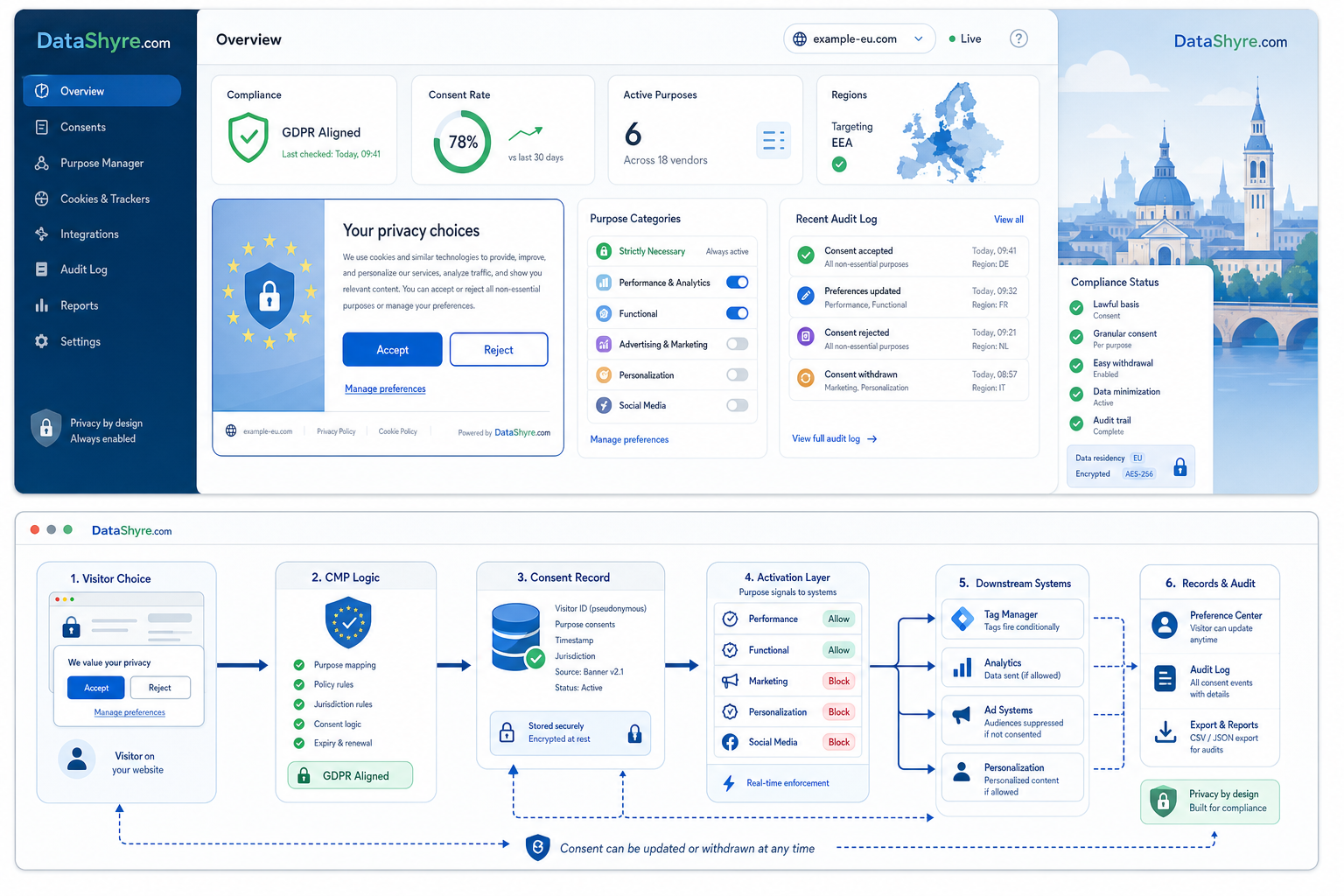
Why CMP buying got harder in 2026
A CMP is no longer just a cookie-bar purchase. On April 29, 2026, the UK ICO finalized its storage and access technologies guidance covering cookies, tracking pixels, device fingerprinting, scripts, tags, and similar technologies. The companion guidance hub makes the same point operationally: this control layer reaches far beyond classic browser cookies.
Regulators are also still actively paying attention to banner behavior. On July 14, 2026, the EDPB required the Belgian DPA to handle the merits of a NOYB cookie-banner complaint involving VRT. In France, the CNIL’s 2024 sanctions summary said 11 organizations were penalized for not letting users refuse cookies as easily as they could accept them. That matters because many teams still compare CMPs by design polish first and technical control second, when regulators keep signaling the opposite priority.
What a GDPR-ready CMP should actually do
For most teams, a good cmps consent management platform gdpr shortlist comes down to six checks.
1. Make refusal as easy as acceptance
This is still the fastest credibility test. The CNIL’s current cookie FAQ says a “reject all” option should appear at the same level and in the same form as “accept all,” or another mechanism must make refusal just as easy. The same FAQ says refusal should not be pushed to the second layer when acceptance is available immediately. If a vendor demo hides rejection behind extra clicks, the product is telling you a lot about its compliance assumptions.
2. Block non-essential technologies before consent where required
Prior blocking is where polished demos often fall apart. The ICO’s consent-in-practice guidance says users must take a positive action before non-exempt technologies are set. A CMP should be able to control scripts, tags, pixels, embeds, and third-party loaders before they run, not merely rewrite the banner after the page is already leaking data.
3. Separate purposes cleanly
A serious CMP should support purpose-level controls for analytics, advertising, personalization, functional features, and any local exceptions your stack needs. That is partly a legal issue and partly a data-operations issue. When categories are vague or collapsed together, teams struggle to explain what the user agreed to and engineers struggle to map that choice cleanly into downstream tools.
4. Keep records your team can actually use
The European Commission’s consent guidance says users must be told how to withdraw, and consent has to stay tied to a specific purpose. In practice, that means your CMP should store timestamped records, banner or policy versions, purpose-level choices, and later changes. If evidence retrieval depends on support tickets or custom exports, you are buying hidden operating cost.
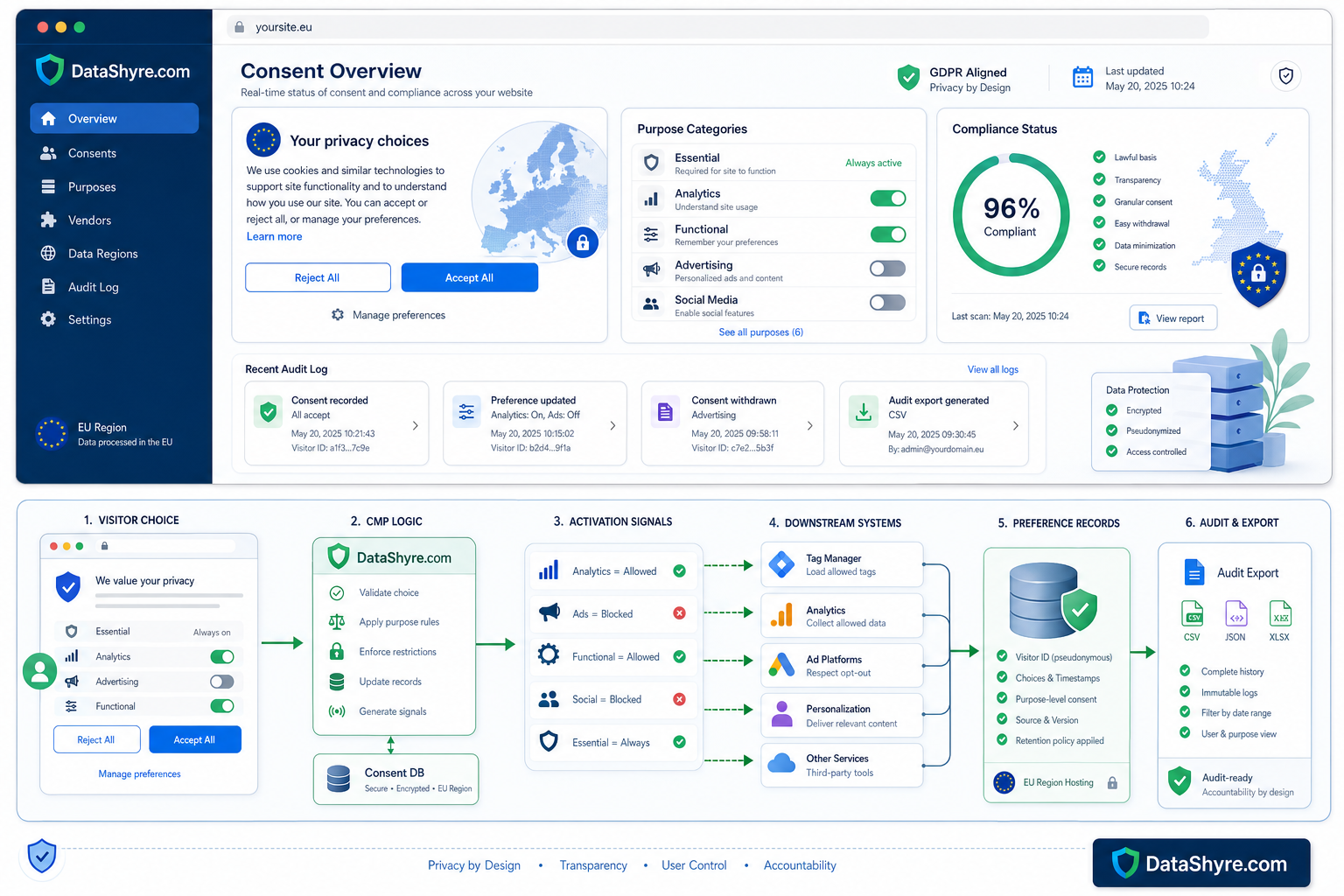
5. Fit your ad and publisher stack
If you serve personalized ads, the commercial requirements matter too. Google’s publisher consent requirements say a certified CMP integrated with the IAB Transparency and Consent Framework is required for personalized ads in the EEA and UK, and also in Switzerland under the later regional deadline listed in the same help page. Google also states that its certification is not the same thing as full legal compliance, which is a useful reminder: product compatibility matters, but it does not replace legal or technical review.
6. Hold up after site changes
The real test is what happens three weeks after go-live when marketing adds a new embed, product adds a tool, or engineering changes tag order. A strong CMP should support rescans, category remapping, preference persistence, and repeatable QA. If the product assumes your site is static, it will age badly.
The live-demo questions worth asking vendors
When you review a vendor, ask them to show these workflows live:
- A first-layer banner with equally easy accept and reject choices.
- A rejected session where non-essential tags do not fire.
- A granular preference update that changes future behavior immediately.
- A consent record export showing what was presented, chosen, and later changed.
- A publisher or ad-tech workflow if your revenue model depends on it.
That demo is usually more useful than a feature matrix. It exposes whether the CMP is a real control layer or just a banner studio.
Current enforcement signals buyers should not ignore
The compliance direction has been getting more concrete, not less. The ICO’s finalized 2026 guidance says its work covers cookies, pixels, scripts, fingerprinting, and related technologies, which widens the technical scope teams need to govern. The EDPB’s July 14, 2026 VRT action shows cookie-banner complaints are still very much alive as enforcement topics. The CNIL’s recent FAQ continues to insist that refusal should be as easy as acceptance, and its 2024 sanctions summary shows that point is not just theoretical.
That combination creates a practical buying standard. A CMP should help your team produce real choice on the first layer, keep optional technologies off until the right legal condition is met, and preserve enough proof to explain what happened later. If it cannot show those basics clearly, it is not solving the hardest part of GDPR consent operations.
Bottom line
The right cmps consent management platform gdpr choice is the product that makes valid consent, prior blocking, usable records, and ongoing change control easier every week after implementation. In 2026, that is what EU-facing teams should buy for: not the nicest banner, but the strongest operating layer behind it.
Sources
- European Commission
- European Data Protection Board
- UK Information Commissioner’s Office
- CNIL
- Google AdSense Help