

GDPR Consent Management Platform in 2026: 7 Live Checks Before You Trust One
If you are evaluating a gdpr consent management platform on August 20, 2026, the useful question is not whether the banner looks polished. It is whether the platform can collect a valid choice, keep non-essential technologies off until the right moment, and leave behind records your team can still explain later.
That is the right frame because the current official baseline is still strict. The European Commission says valid consent must be “freely given, specific, informed and unambiguous,” and the same guidance says organisations must let people “withdraw the consent as easily as it was given.” France’s CNIL still states that “Rejecting cookies should be just as easy as accepting them.” The UK ICO finalized its storage-and-access technologies guidance on April 29, 2026 and makes clear the review is broader than old cookie-only thinking, covering cookies, tracking pixels, link decoration, local storage, device fingerprinting, and scripts or tags. And on July 14, 2026, the EDPB required the Belgian DPA to handle the merits of a NOYB cookie-banner complaint involving broadcaster VRT, which is a good reminder that banner design and consent enforcement are still active scrutiny areas.
If you want the broader category context first, start with our guides to consent management platform, what is a consent management platform CMP, and consent management platform best practices. This article is narrower. It is the live review I would run before trusting a gdpr consent management platform in production this week.
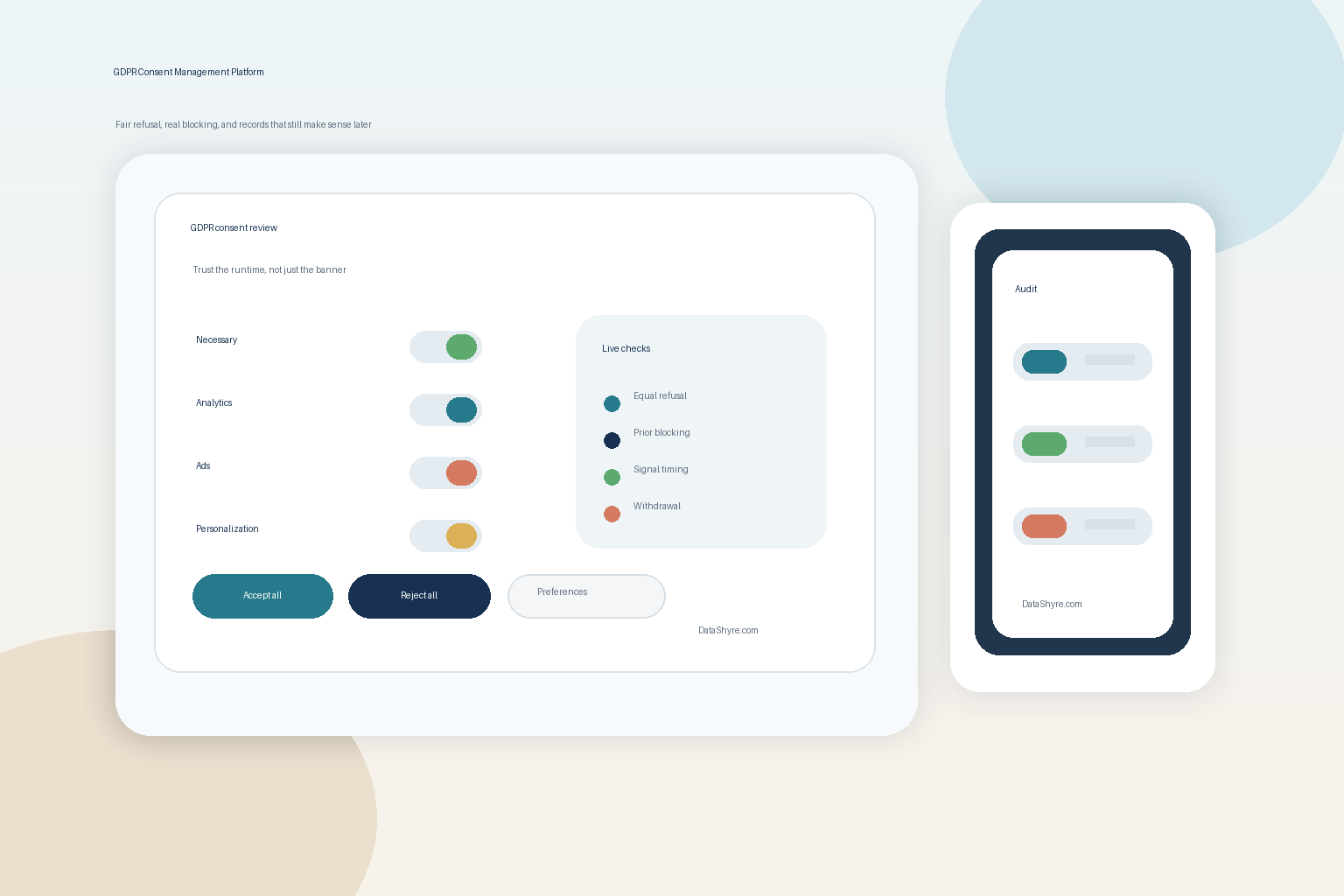
Why a GDPR consent management platform is really an operating control
A gdpr consent management platform is not only a banner tool. It is the control layer between a person’s choice and the technologies that want to store information, access information, or react to that consent state downstream.
That means a serious review has to look across:
- analytics and advertising tags;
- embedded videos, chat widgets, schedulers, and maps;
- purpose and vendor mappings;
- withdrawal and re-prompting behavior;
- logs, receipts, and version history;
- downstream systems that depend on consent state.
If your team reviews only the front-end banner, you can approve a pretty interface while the runtime behavior behind it remains weak.
7 live checks before you trust a GDPR consent management platform
1. Inventory every storage-and-access technology before you score the banner
The ICO’s 2026 guidance is a useful reset because it broadens the review beyond traditional cookies. A gdpr consent management platform may need to govern not only cookies, but also tracking pixels, local storage, fingerprinting techniques, and scripts or tags that touch the user’s device.
So the first question is not, Does the banner copy look compliant? It is, What technologies must this platform actually control on the templates that matter?
Before sign-off, inventory:
- homepage and marketing templates;
- product, pricing, signup, and checkout screens;
- GTM or other tag-manager paths;
- embedded tools and media;
- any app or cross-domain surface that shares consent state.
If you cannot name those technologies, you are not yet reviewing a real gdpr consent management platform implementation.
2. Make refusal as usable as acceptance
This is still the fastest truth test.
The European Commission says consent must be freely given. CNIL gives the clearest short design test: “Rejecting cookies should be just as easy as accepting them.”
For a gdpr consent management platform, that means:
Reject allshould not be dimmed, buried, or delayed where your legal path requires it.- Mobile should not make refusal harder than desktop.
- Purpose-level choices should not be written in vaguer language than the
Accept allpath.
If refusal is slower or more confusing than acceptance, the platform is collecting a less reliable signal than the UI suggests.
3. Verify prior blocking on real templates, not the vendor demo
A polished dashboard can hide weak live enforcement.
Where prior consent is required for non-essential technologies, a gdpr consent management platform should keep optional activity off until the right choice exists. The practical test is simple: what starts before any interaction on the real pages people visit?
Check the homepage, but also test:
- landing pages with extra embeds;
- blog templates with video or social content;
- pricing or form pages with marketing scripts;
- any localized or A/B-tested page variant.
Many failures are timing failures. The banner appears on time, but an optional tracker, pixel, or script has already started underneath it.
4. Keep purposes, vendors, and records intelligible
Granularity matters because it affects both user understanding and later internal review.
A trustworthy gdpr consent management platform should make it easy to answer:
- Which purposes are being offered?
- Which vendors or tools depend on each purpose?
- What happened technically when a purpose was refused?
- Which interface or policy version did the person actually see?
If legal, engineering, and support each describe the same consent choice differently, your platform may be too opaque to rely on when something goes wrong.
5. Make withdrawal easy later, not only at the first prompt
This is where many implementations get thin.
The European Commission’s test is operational, not cosmetic: people must be able to “withdraw the consent as easily as it was given.” In practice, that means a gdpr consent management platform should let users reopen settings without friction and should cause live behavior to change after the update.
Review whether:
- the return path to preferences is easy to find;
- a later refusal changes runtime behavior, not only the stored status;
- downstream tools receive the revised state quickly enough;
- records clearly show the later change.
If the preferences modal exists but the site barely changes after withdrawal, the control layer is weaker than it looks.
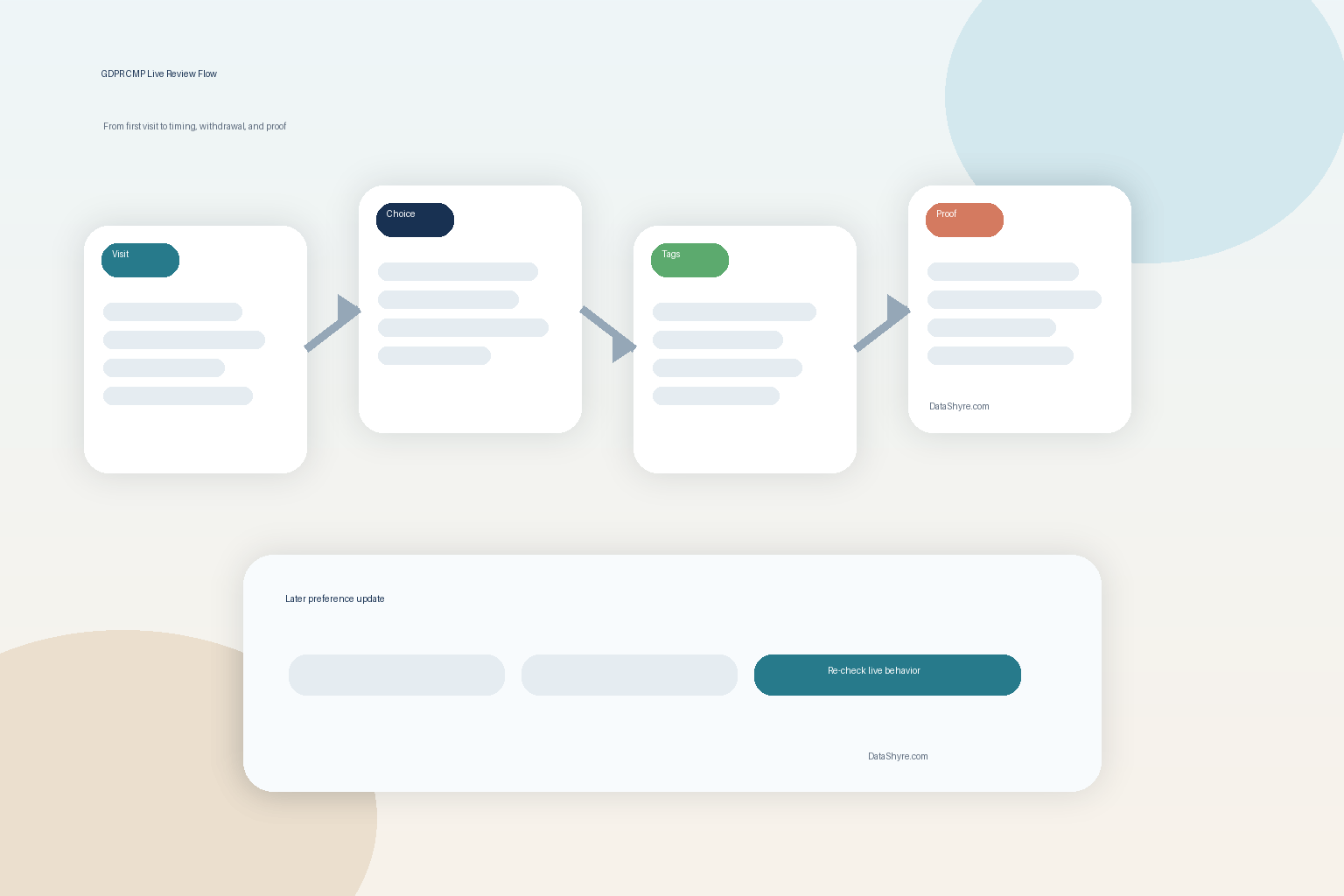
6. Push defaults and updates into Google and downstream tools at the right moment
Many CMP projects look right in screenshots and fail in signal timing.
Google’s current consent mode guidance still says the default consent state should be set before measurement begins and that consent updates should be tracked on the page where they occur before any page transition. That matters because a gdpr consent management platform can store a user’s preference correctly while analytics or advertising tools still behave incorrectly if:
- defaults are set too late;
- updates happen after navigation;
- GTM or another script loader runs ahead of the consent layer;
- SPA behavior changes before the update reaches the dependent tool.
If your stack depends on Google tags or consent-aware measurement, timing review is a separate checkpoint, not a footnote.
7. Treat publisher monetization and release drift as separate checks
Two teams often miss this at the same time.
First, if you serve personalized ads in Google publisher products, Google’s current help still says a certified CMP integrated with the IAB Transparency and Consent Framework is required for users in the EEA, the UK, and Switzerland. Google also says its certification is not a full legal-compliance check by itself.
Second, even a solid gdpr consent management platform can drift after:
- a GTM publish;
- a new pixel or partner tag;
- a CMS or plugin update;
- an embed added by marketing;
- a template or performance rewrite.
That is why launch should not be the end of review. The EDPB’s July 2026 VRT cookie-banner decision is another reminder that active scrutiny continues long after a banner first goes live.
A short review sequence I would run this week
If I had ten minutes to pressure-test a gdpr consent management platform, I would do this in order:
- Inventory every optional technology that can store or access information on user devices.
- Test the first-layer refusal path on desktop and mobile.
- Inspect what fires before any choice on the highest-risk templates.
- Verify purpose-level choices actually change which tools run.
- Confirm Google defaults and updates reach the page in time, where Google tooling is in scope.
- Reopen preferences later and make sure withdrawal changes live behavior.
- Save proof another stakeholder could still understand six months from now.
That short sequence usually reveals more real risk than another procurement matrix or design review.
Bottom line
The best gdpr consent management platform in 2026 is not the one with the nicest banner. It is the one that helps your team collect a fair choice, enforce it technically, make withdrawal practical, and keep evidence that still makes sense later.
If your current setup cannot do those things on a live page, the answer is not another cosmetic refresh. It is a deeper implementation review.
Sources
- European Commission: When is consent valid?
- European Commission: Legal grounds for processing data
- CNIL: Dark Patterns in Cookie Banners: CNIL issues formal notice to website publishers
- UK ICO: Final storage and access technologies guidance published
- UK ICO: Guidance on the use of storage and access technologies
- Google for Developers: Set up consent mode on websites
- Google Ad Manager Help: Google consent management requirements for serving ads in the EEA, the UK, and Switzerland
- European Data Protection Board: Belgian DPA must handle the merits of a NOYB cookie-banner complaint
This post was updated on August 20, 2026 using current official regulator and platform materials available at publication time.