

OneTrust Global Privacy Control in 2026: 7 Checks Before You Trust the Signal
If you are evaluating onetrust global privacy control on August 10, 2026, the useful question is not whether OneTrust can notice a browser signal.
The useful question is whether that signal actually changes what your site, tags, vendors, and downstream systems do next.
California’s Department of Justice still describes Global Privacy Control as a “stop selling or sharing my data switch.” That is a good operational framing. A valid GPC signal is not decorative. It is supposed to trigger a real opt-out effect for covered businesses. OneTrust’s current public materials also frame GPC as more than a banner setting. Its glossary says the platform helps organizations detect and honor GPC signals, apply opt-out logic, restrict tracking technologies, manage downstream vendor behavior, and centralize reporting. Its current Consent & Preferences materials take the same broader view by promising to capture, honor, and activate consent across the customer lifecycle.
If you want the closest companion reads first, start with OneTrust consent tool, California consumer privacy, and cookie consent manager OneTrust. This article is narrower. It is the practical review I would run before trusting onetrust global privacy control on a live stack.

What OneTrust appears to mean by global privacy control now
The current public OneTrust materials point to a bigger job than simple banner display.
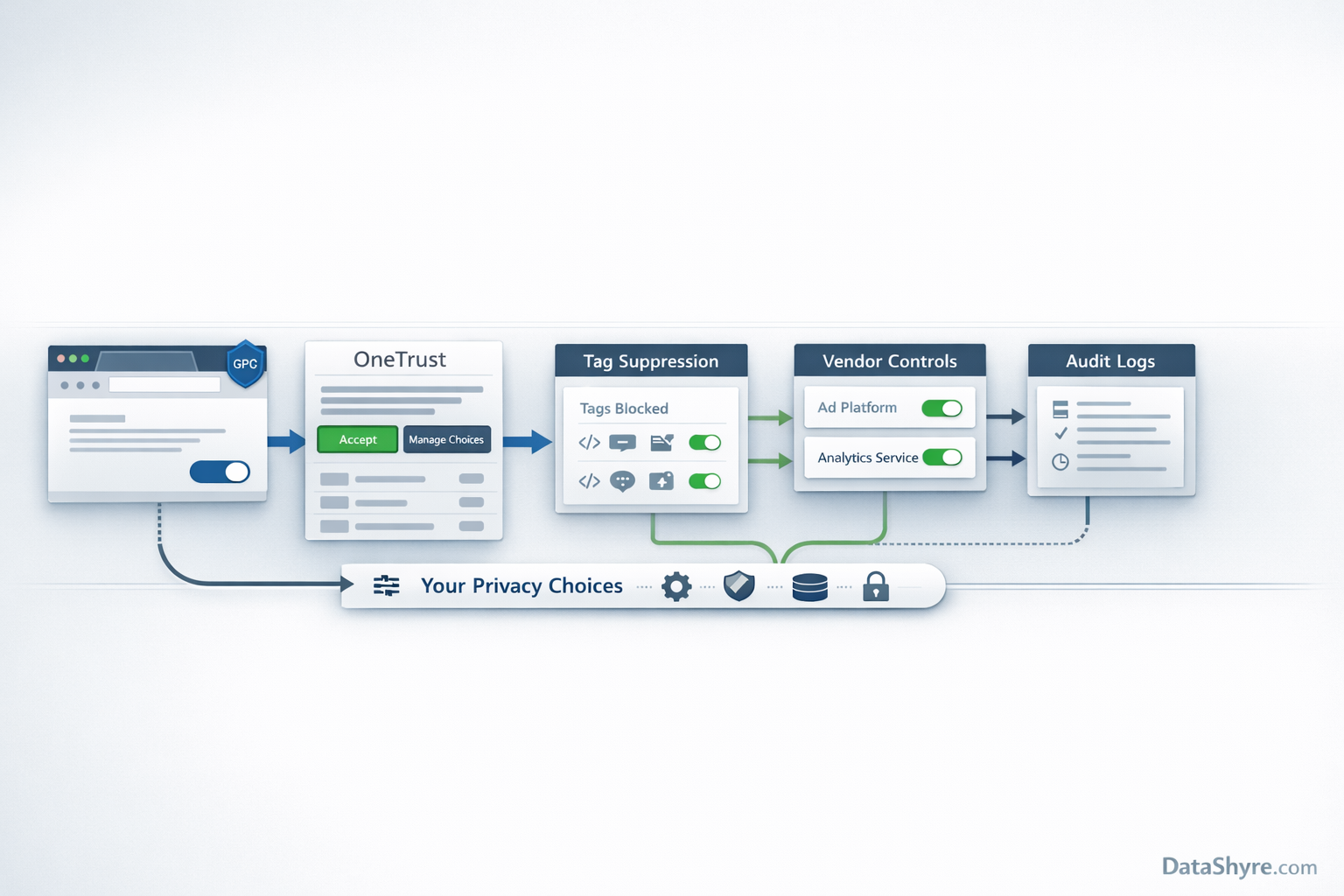
From OneTrust’s current glossary, product pages, and 2026 GPC marketing guidance, onetrust global privacy control appears to involve:
- detecting a browser-based opt-out preference signal;
- applying opt-out logic on the site when that signal is present;
- restricting tracking technologies that should not continue after the signal is received;
- pushing the effect beyond the page into vendors and connected systems;
- keeping centralized logs or receipts that help explain what happened later.
That broader framing is important because a lot of teams still test GPC as if it were only a front-end question. If the browser sends the signal and the banner changes state, they call the project done. OneTrust’s own 2026 marketing-ops guidance argues against that narrow view. It says honoring GPC at the banner is required, but the signal still needs to be respected across tags, vendors, analytics pipelines, and downstream data flows.
That is the right audit lens for onetrust global privacy control in 2026.
1. Treat GPC as a California opt-out path, not as a generic cookie toggle
This is the first check because teams often mix together legal jobs that are not the same.
The California DOJ says a user-enabled GPC is one acceptable method for consumers to opt out of the sale or sharing of personal information online. The CPPA FAQ says businesses must honor qualifying opt-out preference signals such as GPC as valid requests to opt out of sale or sharing. That is a California rights workflow. It is not the same thing as the EU or UK question of prior consent for non-essential cookies.
So for onetrust global privacy control, the first review question is simple: does your implementation keep California opt-out logic distinct from European prior-consent logic, or does it flatten both into one vague privacy modal?
If the site serves multiple regions, that distinction should be visible in the runtime behavior, not only in the policy language.
2. Verify the signal changes behavior before sale-or-sharing flows continue
This is where the real technical risk starts.
The California DOJ’s July 1, 2025 Healthline settlement alleged that Healthline failed to let consumers opt out of targeted advertising, continued sharing data with some advertising third parties even after opt-out requests, and used a consent banner that did not actually disable tracking cookies when a user unchecked a box. That is exactly why onetrust global privacy control should be tested against live browser and network behavior, not just admin settings.
Open a clean browser session with GPC enabled and test what happens:
- before the banner is touched;
- after the signal is detected;
- after navigation to another page;
- after any authentication or account transition.
If sale-or-sharing pathways continue during that sequence, the signal has not been operationalized well enough.
3. Keep the Your Privacy Choices path visible and usable
GPC is powerful, but California does not treat it as the only interface a business may need.
The CPPA FAQ says that in most instances businesses must also provide a clear and conspicuous link such as “Do Not Sell or Share My Personal Information,” “Your Privacy Choices,” or “Your California Privacy Choices.” That matters for onetrust global privacy control because some teams assume browser signaling lets them hide or weaken the site-level privacy path. That is a risky assumption.
This is also where dark-pattern review matters. In its enforcement advisory, the CPPA said businesses should offer symmetrical choices and use clear language, and Michael Macko put the point plainly:
“Dark patterns aren’t about intent, they’re about effect”
>
Michael Macko, CPPA Deputy Director of Enforcement
So the audit is not just does the link exist? It is can a normal person find and use it without friction, even if they never enabled GPC in a browser?
4. Test downstream propagation, not just banner state
This is probably the most important practical check.
OneTrust’s January 2026 guidance on universal opt-outs says the common failure is treating GPC as a page-level or banner-level setting while vendors, analytics pipelines, and activation systems continue to use the data anyway. That is exactly the failure pattern to hunt for in onetrust global privacy control deployments.
The review should check whether GPC-triggered opt-outs propagate to:
- ad and retargeting vendors;
- analytics configurations that depend on sale-or-sharing logic;
- customer data pipelines or audience exports;
- suppression logic in connected marketing systems.
If the banner or preference center records the opt-out but downstream systems continue operating as if nothing changed, the implementation is only partially real.
5. Test known-user, cross-domain, and cross-device behavior
This is where vendor diagrams often look cleanest and production systems look least clean.
OneTrust’s current cross-domain and cross-device documentation says consent can be shared across managed websites and mobile apps through a user profile, but it also makes the conditions clear: purposes have to match, profiles have to be fully synced, the user identifier has to be passed before the OneTrust script or SDK initializes, and consent is stored on the OneTrust cloud for sharing across properties.
For onetrust global privacy control, that creates a few practical questions:
- What happens when a browser sends GPC in an anonymous session and the user logs in later?
- Does the opt-out remain intact when the session becomes a known profile?
- Do web and app properties share the same purpose taxonomy?
- Can the engineering team pass the user identifier early enough for the sync to work as intended?
If those answers are fuzzy, cross-property GPC handling may drift even if the public website demo looks solid.
6. Make sure the proof trail is understandable outside the privacy team
OneTrust’s current CMP page says it can capture and store consent receipts in an audit-ready database with change history and centralized exportable logs. That is useful, but only if the records answer the questions your support, engineering, legal, and marketing teams will actually ask later.
For onetrust global privacy control, a useful record should help your team reconstruct:
- that the browser signal was present;
- which regional rule was applied;
- what tags or vendor flows were suppressed;
- whether a later manual site choice changed anything;
- what happened after the user navigated, logged in, or returned later.
If your evidence only shows a generic preference record without enough operational context, the proof layer is weaker than it looks.
7. Run an enforcement scenario, not just a happy-path demo
Happy-path testing is how weak implementations survive too long.
California’s enforcement posture is still active. The DOJ’s Healthline settlement is one official reminder. The CPPA, together with Colorado and Connecticut, also announced a joint investigative sweep on September 9, 2025 aimed at businesses that appeared to refuse consumers’ right to opt out of the sale of their personal information. In that announcement, the CPPA again emphasized GPC as a simple way for consumers to communicate that choice. The same announcement also reminded businesses that they must wait at least 12 months before asking a consumer to opt back in after an opt-out.
So before trusting onetrust global privacy control, run one scenario that feels uncomfortable:
- GPC enabled on first visit;
- multiple ad-tech vendors present;
- user logs in on a later page;
- support team tries to verify what happened;
- privacy team exports the record for review.
That test usually exposes more truth than a feature matrix.
A short review sequence for this week
If I were auditing onetrust global privacy control right now, I would use this order:
- separate California opt-out logic from EU or UK cookie-consent logic;
- test first-load behavior with GPC enabled;
- confirm site-level privacy-choice links are still easy to find and use;
- verify downstream vendor and activation suppression;
- test anonymous-to-known-user transitions;
- export the record trail and review it with a non-privacy stakeholder;
- re-run the flow as an enforcement-style scenario.
That sequence tends to catch the mistakes that actually become expensive.
Bottom line
Strong onetrust global privacy control work in 2026 is not just signal detection. It is signal interpretation, runtime suppression, downstream propagation, visible choice architecture, and proof.
If the browser sends GPC and your site only updates a preference record, you are not done. If the signal changes tag behavior, reaches downstream systems, survives cross-domain state changes, and leaves a usable record behind, then you are much closer to a setup that will hold up when somebody finally asks hard questions.
Sources
- California Department of Justice: Global Privacy Control
- California Privacy Protection Agency: FAQ
- California Privacy Protection Agency: CPPA Enforcement Advisory Stresses the Importance of Avoiding Dark Patterns
- California Privacy Protection Agency: Joint Investigative Privacy Sweep Announcement
- California DOJ: Healthline settlement announcement
- OneTrust Glossary: Global Privacy Control (GPC)
- OneTrust: From GPC to Do Not Sell Compliance
- OneTrust: Global Privacy Control – How to Honor Consumer Opt-Out Requests
- OneTrust: Consent Management Platform
- OneTrust: Consent & Preferences
- OneTrust Developer Portal: Cross Domain and Cross Device Consent
This post was updated on August 10, 2026 using current official regulator, government, and live vendor materials available at publication time.