

Enterprize Consent Management Platform in 2026: 7 Enterprise Checks Before You Choose One
If you are evaluating an enterprize consent management platform on August 8, 2026, the useful buying question is not whether the vendor can display a banner. It is whether the platform can coordinate privacy choices across regions, websites, apps, vendors, and internal teams without losing control of live behavior or evidence.
That is the right frame because the current compliance baseline is wider than a website popup. The European Commission still says valid consent must be “freely given, specific, informed and unambiguous.” On April 29, 2026, the UK ICO finalized its guidance on storage and access technologies covering cookies, tracking pixels, fingerprinting, and similar techniques. California’s Department of Justice still describes Global Privacy Control as a “stop selling or sharing my data switch,” and the California Privacy Protection Agency says its finalized regulations address automated decisionmaking technology, privacy risk assessments, and cybersecurity audits with an effective date of January 1, 2026.
If you want the adjacent buyer context first, start with our guides to consent management platform in 2026, consent management platform best practices, and website privacy checker. This article is narrower. It is the seven-check enterprise review I would use before trusting a platform this week.

Why the enterprise version is a different buying problem
Enterprise privacy teams rarely manage one website and one tracker. They usually inherit a stack that includes multiple domains, apps, tag managers, analytics tools, ad systems, CRMs, support platforms, data warehouses, and outside vendors. The hard part is not collecting one preference. The hard part is proving that the same preference changed the right systems in the right places.
That matters more in 2026 because regulators and official guidance are still emphasizing runtime behavior. The ICO’s current guidance expressly reaches technologies beyond classic cookie files. CNIL’s 2024 cookie-banner action says rejecting cookies should be as easy as accepting them. The EDPB’s July 14, 2026 VRT cookie-banner decision also shows that cookie-banner complaints are still active enforcement territory rather than old housekeeping.
1. Make sure the platform controls more than a banner layer
An enterprize consent management platform should function like a control system, not a skin.
At a minimum, I would expect it to connect:
- consent and preference prompts on web and app surfaces;
- tag-manager and SDK behavior;
- vendor and partner routing;
- notice and policy references;
- logs that show what changed after the user acted.
If the product mostly offers templates, color controls, and category labels, you may be buying a nicer interface rather than stronger enterprise control.
2. Separate consent, opt-out, and lawful-basis workflows by region
Large organizations usually fail when they flatten unlike legal events into one generic preference model.
The European Commission’s current consent guidance still sets a high bar when consent is the lawful basis. California privacy workflows often depend more on notices, rights handling, and opt-out enforcement than on universal prior consent for every adult data flow. That means an enterprize consent management platform should distinguish at least:
- GDPR or ePrivacy-style consent events;
- US-state opt-out events;
- browser-level preference signals such as GPC;
- later withdrawal or updated choices;
- records explaining which regional logic applied.
If those all collapse into one simple yes-or-no value, the platform may look elegant while hiding material legal differences.
3. Test whether refusal and withdrawal are as usable as acceptance
This is still one of the fastest ways to expose weak implementations.
The European Commission says withdrawal should be as easy as giving consent. CNIL’s dark-pattern enforcement page says, with certain exceptions, rejecting cookies should be just as easy as accepting them. That means an enterprise-grade platform should be tested for:
- first-visit behavior;
- equal visibility of reject and accept paths where consent is required;
- granular choices by purpose or category where relevant;
- reopening preferences later without friction;
- same-session withdrawal that changes real behavior.
If the product can record a narrower choice but the site, app, or vendor stack keeps running as before, the platform is not doing the job an enterprise buyer needs.
4. Treat GPC and US-state signals as operational requirements, not side features
For enterprise stacks with US-state exposure, browser-level opt-out handling should not be treated like an optional add-on.
The California DOJ’s current GPC page still describes the signal as a “stop selling or sharing my data switch.” Enterprise teams should therefore verify whether the platform can:
- detect GPC consistently;
- map the signal to the right suppression logic;
- keep region-aware records of how it was handled;
- pass the state to downstream advertising, analytics, and partner tools.
This matters because a large organization may have different business units and implementations using different data pathways. An enterprize consent management platform that only updates one surface or one tool can create false confidence very quickly.
5. Check change-management resilience across domains, apps, and vendors
Enterprise drift is a bigger problem than banner copy.
Tags change. Mobile SDKs update. New microsites launch. Marketing adds a vendor. Product adds a feature flag. A region-specific rule changes. The visible consent layer may stay identical while the actual compliance posture moves underneath it.
That is why I would ask whether the platform supports:
- multi-domain and multi-app governance;
- repeatable testing after deployments;
- versioning of notices and preference experiences;
- role-based administration and approvals;
- evidence showing when routing or enforcement logic changed.
The better the platform looks in a demo, the more important this question becomes.
6. Review whether the governance model matches 2026 enterprise pressure
This is where a lot of smaller tools start to look too small.
The CPPA’s current regulations page says its finalized regulations cover automated decisionmaking technology, privacy risk assessments, and cybersecurity audits, effective January 1, 2026. The CPPA FAQ page also says those regulations are finalized. Even when a CMP is not the full answer to those obligations, the enterprise buyer should still ask whether the product helps privacy, engineering, security, and legal teams coordinate evidence and workflows.
In practice, that means checking whether an enterprize consent management platform can support:
- internal ownership across several teams;
- exportable records for reviews or audits;
- mappings between consent logic and higher-risk data uses;
- governance notes that survive staff turnover or vendor changes.
If the product is built mainly for one web manager publishing one banner, it may not scale to enterprise review pressure.
7. Demand proof that explains context and downstream outcome
Raw timestamps are not enough in a large environment.
The useful proof set should help another team understand:
- what the user saw;
- which region or rule logic applied;
- what the user chose or what signal was received;
- which systems or vendors were supposed to change;
- whether those changes actually happened;
- how later updates, withdrawal, or opt-out events were handled.
Without that level of proof, enterprise teams often end up defending screenshots of configuration panels instead of explaining what happened on live systems.
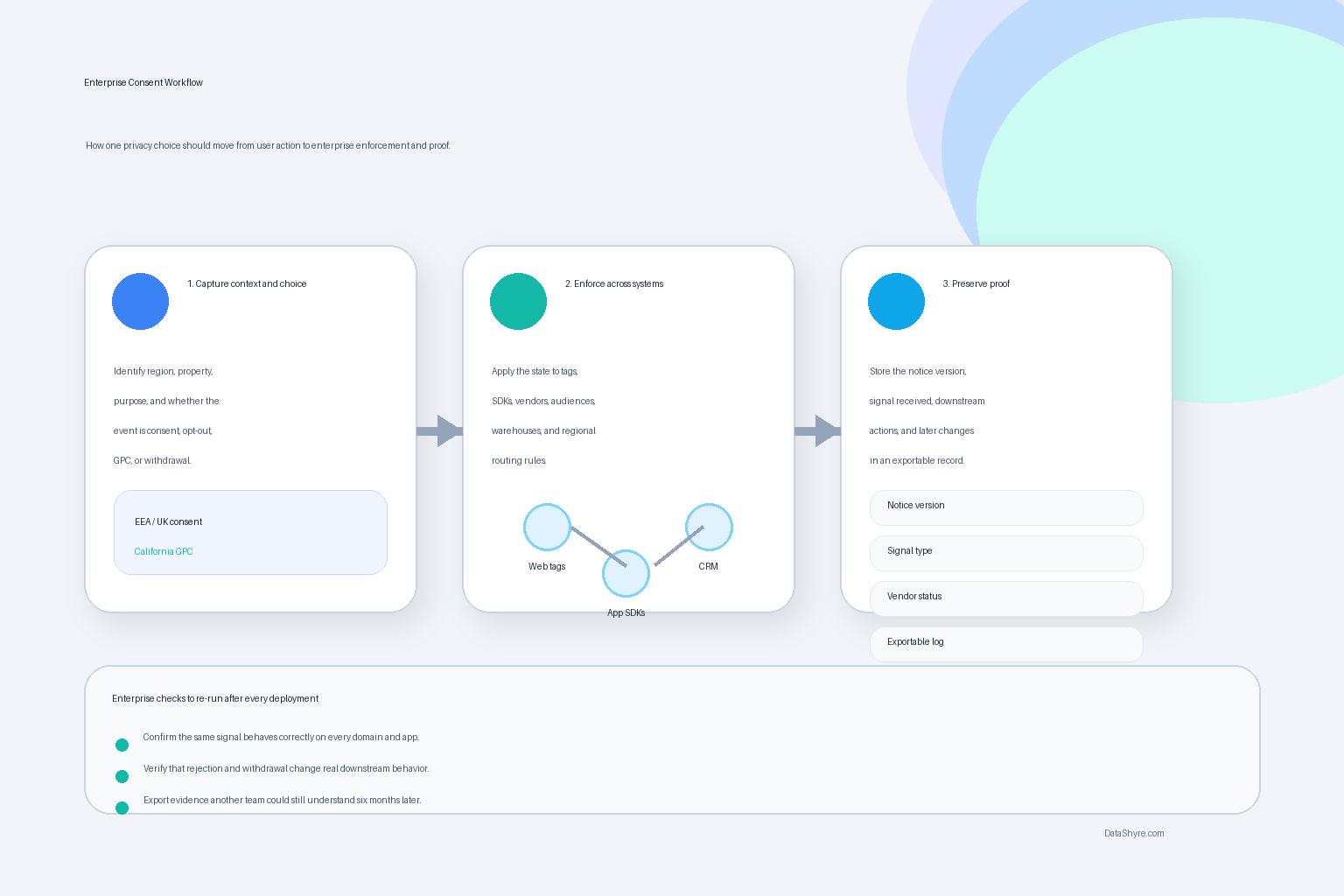
A short enterprise review sequence for this week
If I were comparing tools right now, I would do this in order:
- Map the regions, sites, apps, and business units the platform must support.
- Separate consent, opt-out, GPC, and withdrawal workflows.
- Test equal refusal and easy withdrawal on live-like environments.
- Trace one preference event into tags, SDKs, vendors, and warehouses.
- Review how the platform handles multi-team approvals and change tracking.
- Export the evidence and decide whether legal, engineering, and operations could all use it later.
That sequence usually tells you more than a long feature matrix.
Bottom line
The best enterprize consent management platform in 2026 is not the one with the most polished banner editor. It is the one that can separate unlike privacy events, enforce choices across a messy enterprise stack, keep up with change, and prove what happened after launch.
If your current shortlist cannot do that, the product may still improve presentation. It just will not give you much confidence in a serious privacy review.
Sources
- European Commission: When is consent valid?
- European Commission: What if somebody withdraws their consent?
- UK ICO: Final storage and access technologies guidance published
- UK ICO: Guidance on the use of storage and access technologies
- California Department of Justice: California Consumer Privacy Act (CCPA)
- California Department of Justice: Global Privacy Control (GPC)
- California Privacy Protection Agency: CCPA Updates, Cybersecurity Audits, Risk Assessments, Automated Decisionmaking Technology
- California Privacy Protection Agency: Frequently Asked Questions (FAQs)
- CNIL: Dark Patterns in Cookie Banners: CNIL issues formal notice to website publishers
- EDPB: EDPB requires Belgian DPA to handle the merits of NOYB cookie banner complaint
This post was updated on August 8, 2026 using current official regulator and government materials available at publication time.