Best Consent Management Platform in 2026: 7 Buyer Checks Before You Choose
DataShyre StaffAug 4, 2026
8 min read
Best Consent Management Platform in 2026: 7 Buyer Checks Before You Choose
If you are comparing the best consent management platform on August 4, 2026, the fastest way to waste time is to treat every CMP like the same product.
Some teams need a stronger first-layer banner and better prior blocking. Some need cleaner regional logic across the EU, UK, California, and other U.S. state flows. Some already have a banner, but still cannot prove what happened after a user clicked reject, changed settings later, or sent a browser-level opt-out signal.
That is the right frame for this keyword now. The best consent management platform is not the one with the prettiest demo. It is the one that closes your riskiest gap with the least operational drift.
If you want the category baseline first, start with our guides to consent management platform, consent management provider, and Google consent management platform. This article is narrower. It is the buyer sequence I would use before choosing the best consent management platform this week.
Why this buying decision is still getting sharper
The legal and platform baseline is not static.
On April 29, 2026, the UK ICO published final storage-and-access technologies guidance covering cookies, tracking pixels, device fingerprinting, and similar technologies. The European Commission still says valid consent must be freely given, informed, specific, and expressed through a clear affirmative act, and that withdrawal should be as easy as giving consent. On July 14, 2026, the EDPB required the Belgian DPA to assess the merits of a cookie-banner complaint involving VRT instead of dismissing it on procedural grounds.
California adds a different operational filter. The California Department of Justice still says a valid Global Privacy Control signal must be honored as a request to stop the sale or sharing of personal information, and the CPPA’s current rulemaking page says the updated CCPA regulations became effective on January 1, 2026.
For publishers and ad-supported businesses, Google adds another check. Its current AdSense help says publishers serving personalized ads to users in the EEA, the UK, or Switzerland need a certified CMP integrated with the IAB TCF. The same help page also says Google does not check CMPs for full compliance with the TCF or applicable privacy laws.
That is why the search for the best consent management platform is not really about one abstract winner. It is about fit.
What “best” should mean for a CMP in 2026
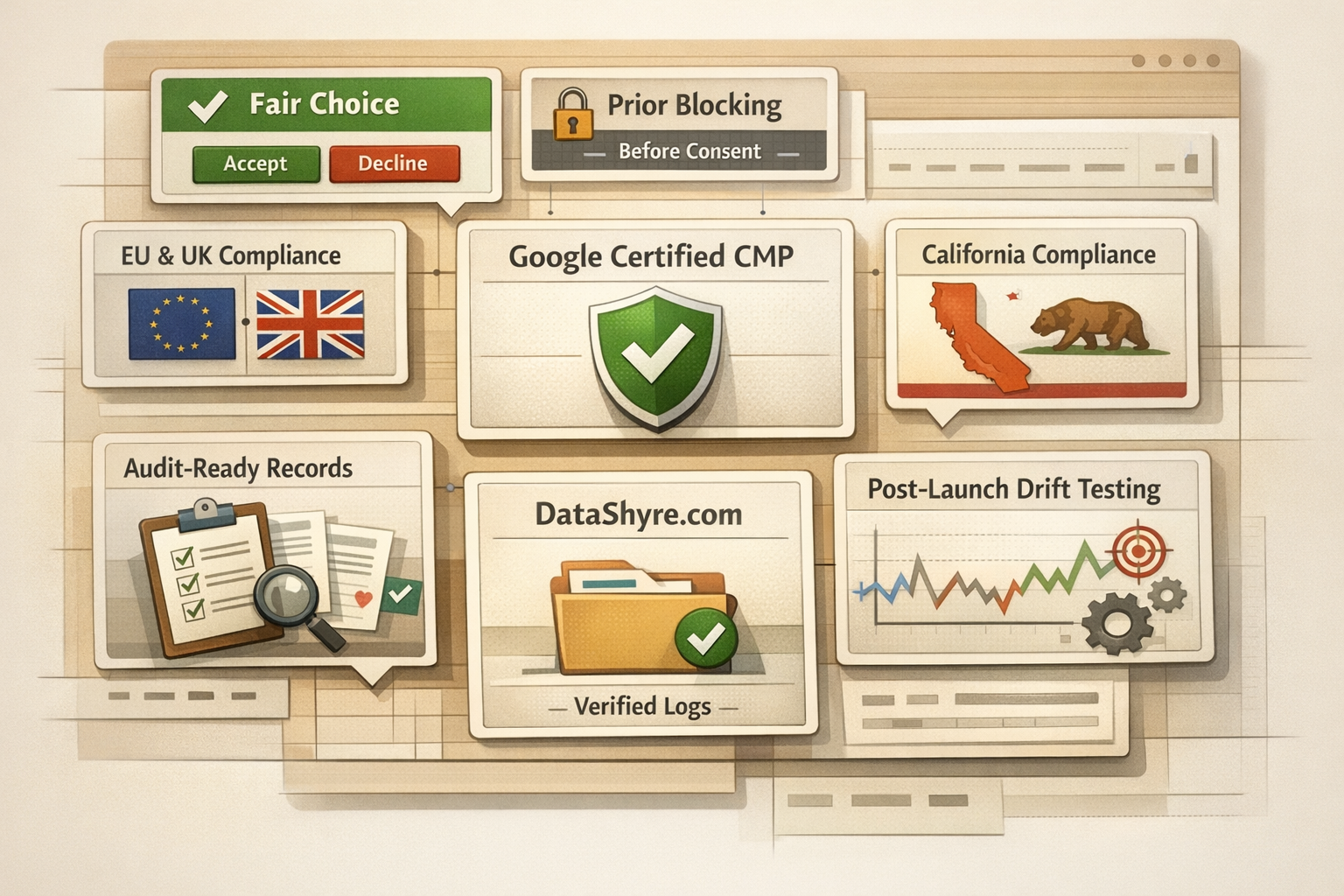
In practice, the best consent management platform should do four things well:
collect a fair, understandable choice;
turn that choice into real technical behavior;
adapt by region without turning into a logic mess; and
leave behind proof another team can still follow later.
If a platform only does the first part, it is not really solving the hard problem.
7 buyer checks that matter most
1. Start with the failure you are actually trying to fix
Do not begin with the vendor page. Begin with the gap.
If non-essential technologies are firing too early, you need stronger runtime control. If the banner exists but nobody trusts the records, you need better logging and version history. If EU and California workflows keep getting flattened into one weak pattern, you need better regional branching.
The best consent management platform for a tag-firing problem is not always the best one for a proof problem.
2. Test whether refusal is as usable as acceptance
This is still the quickest quality filter.
CNIL said in its December 12, 2024 dark-pattern notice that “rejecting cookies should be just as easy as accepting them.” That is useful because it turns design review into a simple buyer test.
When you evaluate a CMP, look for:
a first-layer reject path that is visible right away;
button weight or contrast that does not push people toward accept;
ordinary language for categories and choices; and
a later settings path that is easy to find.
If a platform’s default pattern makes refusal awkward, your team will spend time undoing the vendor’s idea of conversion optimization.
3. Verify prior blocking on a real page, not a sandbox demo
This is where polished CMPs still fail.
The interface can look perfect while analytics, ad, chat, video, or experimentation tags still load before the visitor makes the choice that region requires. The ICO’s 2026 guidance is a good reminder here because the scope is not limited to classic cookies. The review can reach tracking pixels, fingerprinting, and similar storage-and-access technologies too.
The practical test is simple:
load a clean session;
inspect network and storage behavior before any click;
click Reject all;
confirm optional technologies still stay off; and
test category-level choices on the pages that matter most.
If the product only manages banner appearance, it is not the best consent management platform for a live stack.
4. Separate EU and UK consent logic from California opt-out logic
One global flow rarely answers every region well.
For many EU and UK experiences, the critical question is whether non-essential storage-and-access technologies stay off until valid consent exists. In California, the compliance pressure often turns on opt-out mechanics, sale-or-sharing workflows, and browser-level signals such as GPC.
That matters during buying because some CMPs are strong on European-style banners but weaker on California signal handling and downstream opt-out enforcement. A buyer should test both instead of assuming one polished settings center solves everything.
5. Treat Google publisher fit as a separate checkpoint
If your revenue model depends on Google publisher products, this check deserves its own line item.
Google’s current publisher help says only traffic from a certified CMP is eligible for personalized ads in the relevant regions, and the list of certified CMPs is updated weekly. But Google also says its review is focused on certification criteria tied to the TCF and that it does not check CMPs for full compliance with the TCF or applicable privacy laws.
That means Google fit is important, but it is not the whole answer. A CMP can be a good Google fit and still be weak on broader compliance controls. The reverse can happen too: the privacy team may like the workflow while ad operations still has a certification gap.
6. Demand records that support support, legal, and engineering
Many CMPs say they keep logs. Fewer keep records people can actually use later.
The best consent management platform should let your team answer basic questions without forensic work:
What did the user see?
What categories, purposes, or vendors were presented?
What did the user choose and when?
What changed in the live stack after that choice?
Could the user come back later and change or withdraw it?
If the platform cannot answer those questions clearly, the proof layer is weaker than it looks.
7. Buy for drift, not just launch day
The hard part starts after go-live.
New vendors get added. Tag order changes. A plugin writes storage from a different path. Marketing adds a one-off embed. The banner still looks correct while the live behavior underneath it drifts.
The best consent management platform should help you catch that drift with scans, testing hooks, clearer governance, or at least enough visibility to know when the implementation changed.
A practical shortlist sequence
If I were choosing the best consent management platform today, I would do this in order:
Write down the exact failure the purchase is meant to fix.
Test first-layer refusal on desktop and mobile.
Inspect what fires before any click on a real page.
Test regional logic for EU or UK consent and California opt-out handling separately.
Check whether Google-certified CMP status matters to the business model.
Export records and ask whether another team could understand them later.
Re-test after introducing common sources of drift like tag managers, embeds, and plugins.
That sequence usually reveals more than a long feature matrix.
Bottom line
The best consent management platform in 2026 is the one that matches the layer where your risk actually lives.
If your main problem is fair choice, buy for choice quality. If your main problem is tags firing out of order, buy for real runtime control. If your main problem is regional complexity or weak records, buy for branching logic and usable proof.
The ICO described the broader goal well when it said people need “meaningful control over how their data is used.” That is still the best buying test. If the platform cannot create meaningful control in the real stack, it is not the best one for your team.