

Consent Management Platform Conversion Metrics: 6 Numbers That Matter More Than Accept Rates in 2026
Most teams still overrate one number: banner accept rate.
That metric can tell you something about friction, but it is a weak proxy for whether your setup is lawful, trustworthy, or even analytically useful. The better question is whether your consent management platform conversion metrics show that user choice actually changed what happened next.
Google’s consent mode documentation now makes that operational split pretty plain. Tags can adjust behavior based on consent status, Google can use pings and modeling to fill some reporting gaps, and advertisers can review impact results at the domain-and-country level. That is useful. It is not a permission slip to optimize only for higher opt-ins.

If you need the broader implementation picture first, start with our guides to consent management platform, consent management platform best practices, and online consent management. This article stays narrower: which numbers are worth tracking once the CMP is already live.
What changed the measurement baseline
The compliance environment got more concrete, not softer. The ICO finalized updated guidance on storage and access technologies on April 29, 2026, after consultations tied to the Data (Use and Access) Act 2025. In practice, UK teams still need a clean story for prior consent, objection mechanics, and how technologies are used across purposes.
Google has also kept tightening the adtech side of the workflow. Consent mode is built to adjust tagging behavior when people decline, and Google continues to require certified CMP support for certain ad-serving scenarios in the EEA and UK. That makes conversion recovery possible, but it also raises the bar for implementation quality.
The U.S. side has its own warning. California regulators have said a cookie notice or control is not, by itself, an acceptable method for an automated decisionmaking opt-out. Maureen Mahoney of the CPPA used a phrase worth borrowing here: people need “meaningful access” to their choices. If your reporting looks healthy but the rights mechanism is flimsy, the stack is still brittle.
Consent management platform conversion metrics to watch
1. Equal-choice rate
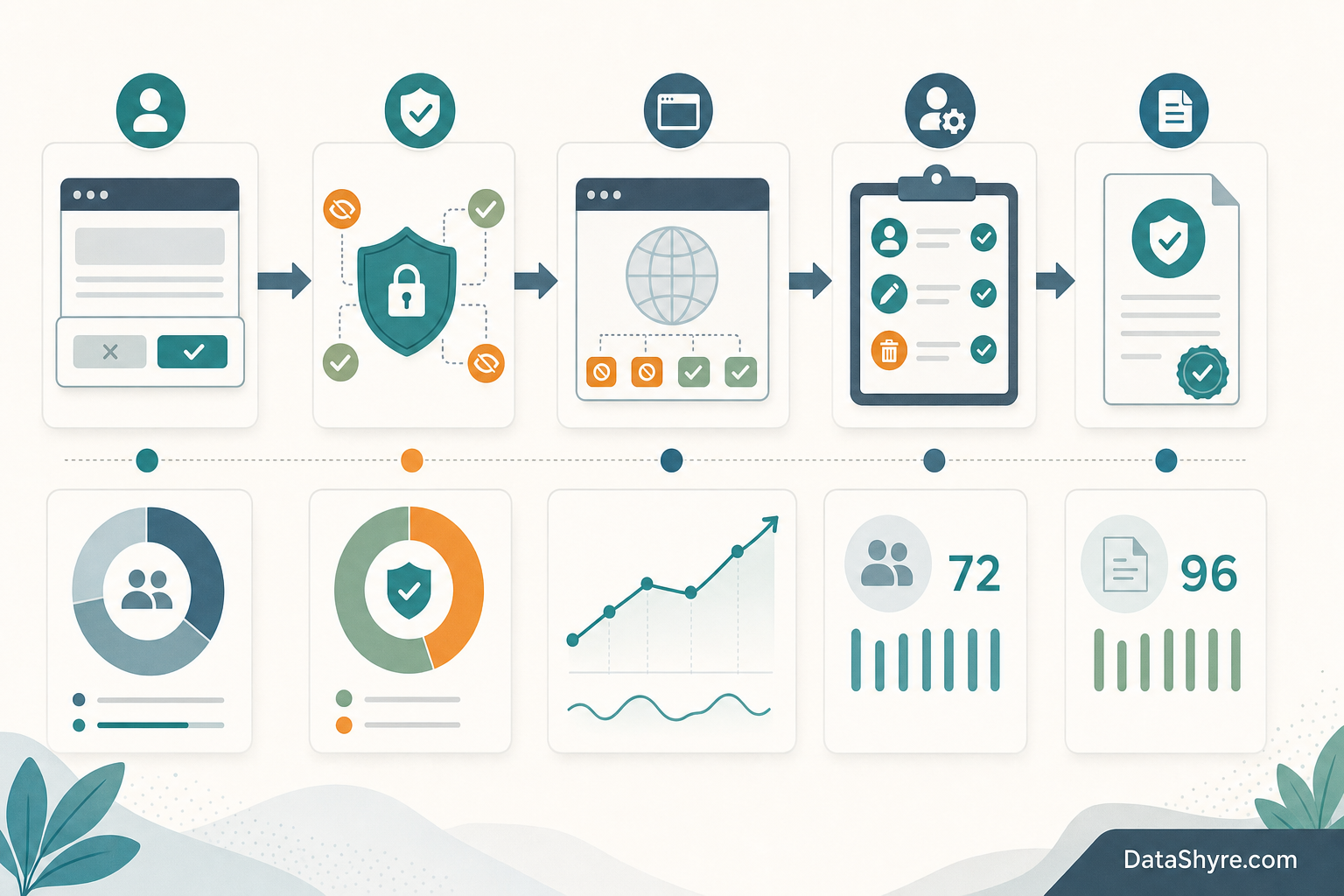
Track whether refusal is presented with the same visibility and effort as acceptance in the regions where that standard matters. This is more useful than raw opt-in rate because it tells you whether your funnel depends on design pressure. If refusal collapses after a banner redesign, that is not automatically a win.
2. Observed-to-modeled conversion mix
Google says consent mode modeling can recover lost measurement when users do not consent. Fine. Measure the split by country, device class, and landing-page family so you know where modeled reporting is carrying the heaviest load. Consent management platform conversion metrics should tell you where direct measurement is thinning out, not just where topline conversions stayed flat.
3. Tag suppression accuracy
Check how often non-essential tags stay blocked when a user rejects, withdraws, or sends a browser-based opt-out signal. This is the metric many teams skip because it sits between privacy engineering and analytics operations. It is also the one that shows whether your CMP is operating as a real control layer instead of a front-end decoration.
4. Withdrawal propagation time
How long does it take for a consent withdrawal to reach analytics, ad platforms, downstream audiences, and CRM suppression lists? Measure the median and the ugly outliers. A nice preference center with a six-hour propagation lag is still a broken system.
5. Preference-signal honor rate
For U.S. traffic, measure whether browser and account-level privacy signals are detected, logged, and honored consistently. Stephen Almond of the ICO recently described fingerprinting as “not a fair means of tracking users online.” That line is a good reminder that measurement workarounds can create the wrong incentive. If users say no through a recognized signal, the system should not hunt for a back door.
6. Evidence completeness
Can you export one record that shows what a user saw, what they chose, which tags fired or stayed blocked, and when downstream systems updated? Your reporting should include proof quality, not just performance quality. When buyers, auditors, or regulators ask questions, stitched-together screenshots are a bad answer.
The metric that deserves less love
Accept rate is still worth watching, just not worshipping. Vidhya Srinivasan of Google wrote that accurate measurement that accounts for consent choices “doesn’t have to be complicated.” She is right, but there is a catch: simpler reporting only works when the consent state, tagging logic, and downstream records all stay aligned.
If accept rate rises while suppression accuracy falls, or if modeled conversions climb because direct signals disappeared, you have not improved the program. You have hidden the problem better.
Bottom line
The strongest programs use reporting to expose tradeoffs, not bury them. In 2026, the useful test is whether your consent management platform conversion metrics help your team protect choice, preserve credible measurement, and prove what happened after the click.
That is a better operating target than chasing one more point of banner acceptance.
Sources
- UK Information Commissioner’s Office
- Google Developers
- Google Ads Help
- Google Ad Manager
- California Privacy Protection Agency