

Online Consent Management: What to Capture, Sync, and Prove in 2026
Most teams do not have a banner problem. They have a systems problem.
That is what online consent management really means in 2026. The first click matters, but the harder part comes after it: whether the site blocks non-essential tags until consent exists, whether later withdrawals actually flow into downstream tools, and whether the business can show what happened if a customer, buyer, or regulator asks.
The legal baseline has not become looser. Under the GDPR, consent still has to be freely given, specific, informed, and unambiguous. UK guidance is equally practical: the ICO says non-exempt storage and access technologies need prior consent, withdrawal has to be as easy as granting it, and if you use a CMP provider you still need to sort out roles and responsibilities. In other words, the interface is only half the job.

If you are comparing tools, our guides to consent management platform, consent management platform best practices, and GDPR consent management platform are useful companion reads. This article stays tighter: what your operating model needs to capture, sync, and prove.
What online consent management has to cover now
For EU and UK traffic, the old standard still applies: no valid consent, no non-essential tracking. But the U.S. picture keeps pushing teams beyond banner logic. California’s Department of Justice says a user-enabled Global Privacy Control can be an acceptable online method for consumers to opt out of sale or sharing, and covered businesses have to honor it. Colorado goes a step further operationally: businesses subject to the CPA must accept the Global Privacy Control as a valid universal opt-out mechanism and explain how those requests are processed in the privacy policy.
That shift matters because it turns consent operations into signal management. A decent first layer is no longer enough. Online consent management now has to reconcile opt-in rules in some markets with browser-based opt-out signals in others, without losing the audit trail in between.
EDPB Chair Anu Talus framed the standard well when she talked about “real choice.” That phrase is short, but it cuts through a lot of noise. If refusal is harder than acceptance, if preferences cannot be revisited cleanly, or if the downstream stack ignores the user’s choice anyway, the system is not giving people real choice. It is performing it.
The four records worth keeping
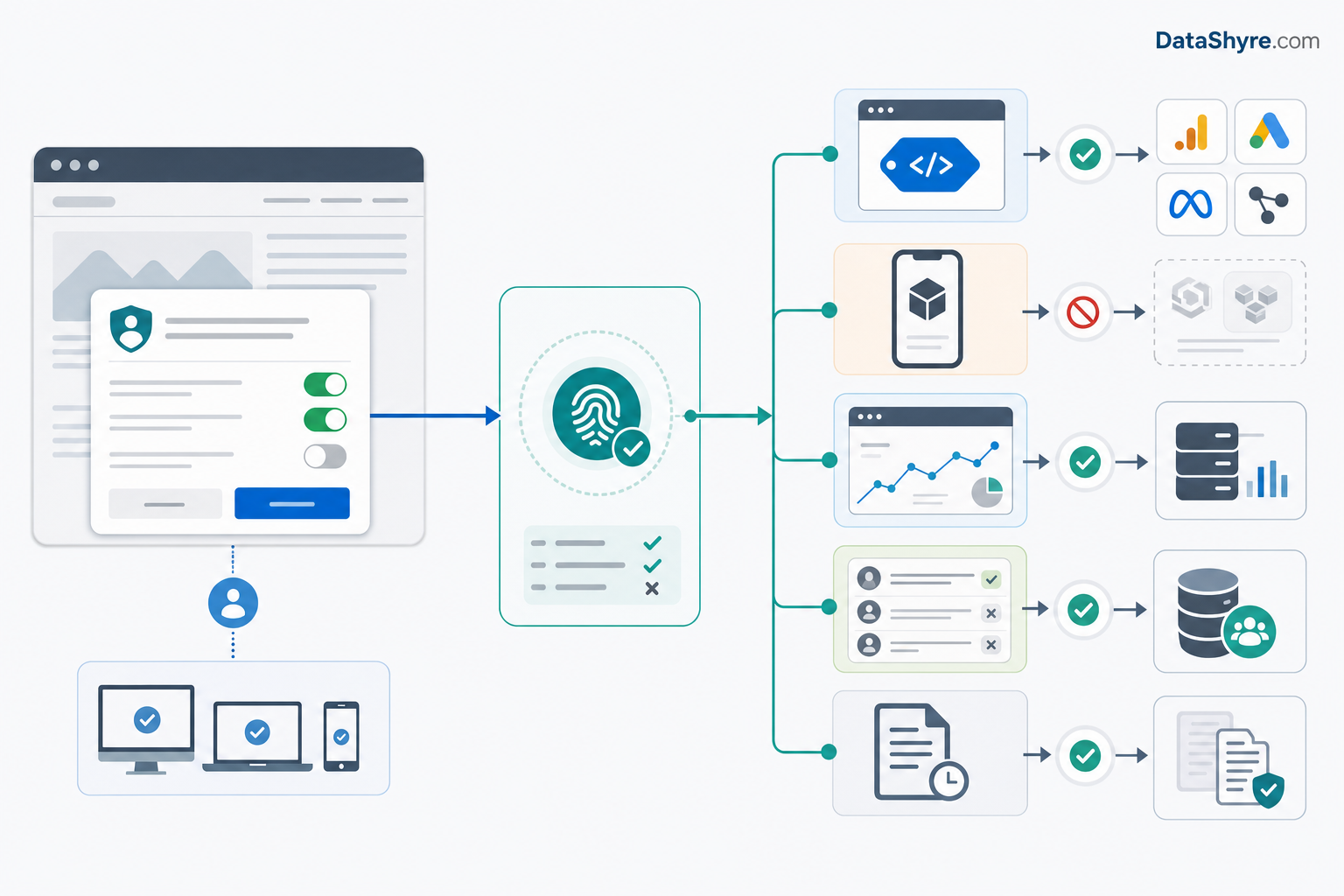
The cleanest programs keep four records tied together.
First, keep the presentation record: what the person saw, on which property, with which notice version, language, geography logic, and button set. If your design changed last month, you should be able to show that.
Second, keep the decision record: accept, reject, granular purpose choices, withdrawal, or browser signal. This sounds obvious, but many teams still store a yes-or-no result without the context that makes it defensible.
Third, keep the enforcement record: what happened in the stack after the choice. Which tags were blocked? Which SDKs were suppressed? Which audience syncs stopped? This is where a lot of programs go soft. The preference gets logged, but nothing else changes.
Fourth, keep the propagation record: where the choice was sent next. Ad platforms, analytics, CDPs, mobile SDKs, marketing automation, and suppression lists should not all have their own idea of consent state.
Where teams usually break the chain
The most common failure is not that a company forgot to buy a CMP. It is that the CMP became a front-end patch.
A user rejects advertising cookies, but the marketing pixels still fire through a stray tag manager rule. A customer withdraws email permission, but the CRM suppression update lags by a day. A browser sends GPC, but the website honors it only on one domain. None of those failures looks dramatic in a demo. All of them look bad when someone asks for proof.
Ashkan Soltani of the CPPA said consumers should be able to “take full advantage of their rights.” California Attorney General Rob Bonta used similarly direct language when he urged people to “take back control of their personal data.” Those quotes land because they describe the operational test. The right is not the banner. The right is whether the choice keeps working after the banner disappears.
A practical review before you ship
Before you call your setup done, check five things:
- Refusal is available at the same decision point as acceptance where the law requires that standard.
- Browser-based opt-out signals are detected, logged, and honored on every relevant property.
- Downstream tools change behavior when a user rejects or withdraws.
- Preference changes can be revisited later without a scavenger hunt through the footer or privacy policy.
- Your team can export a readable evidence trail without stitching together screenshots, logs, and guesswork.
That last point gets underrated. Good online consent management should leave you with exportable proof, not just a nicer banner.
Bottom line
The useful question in 2026 is not whether you have consent tooling. It is whether your consent choices survive contact with the rest of your stack.
If the answer is yes, you are closer to a real program. If the answer is “mostly,” you still have frontend theater hiding backend risk.
Sources
- EUR-Lex
- European Data Protection Board
- UK Information Commissioner’s Office
- California Privacy Protection Agency
- California Department of Justice
- Colorado Attorney General