

What Is a Consent Management Platform? What It Does and Why It Matters in 2026
If your team keeps asking what is a consent management platform, the shortest answer is this: it is the operational layer between your website or app and the tracking, advertising, and analytics tools behind it.
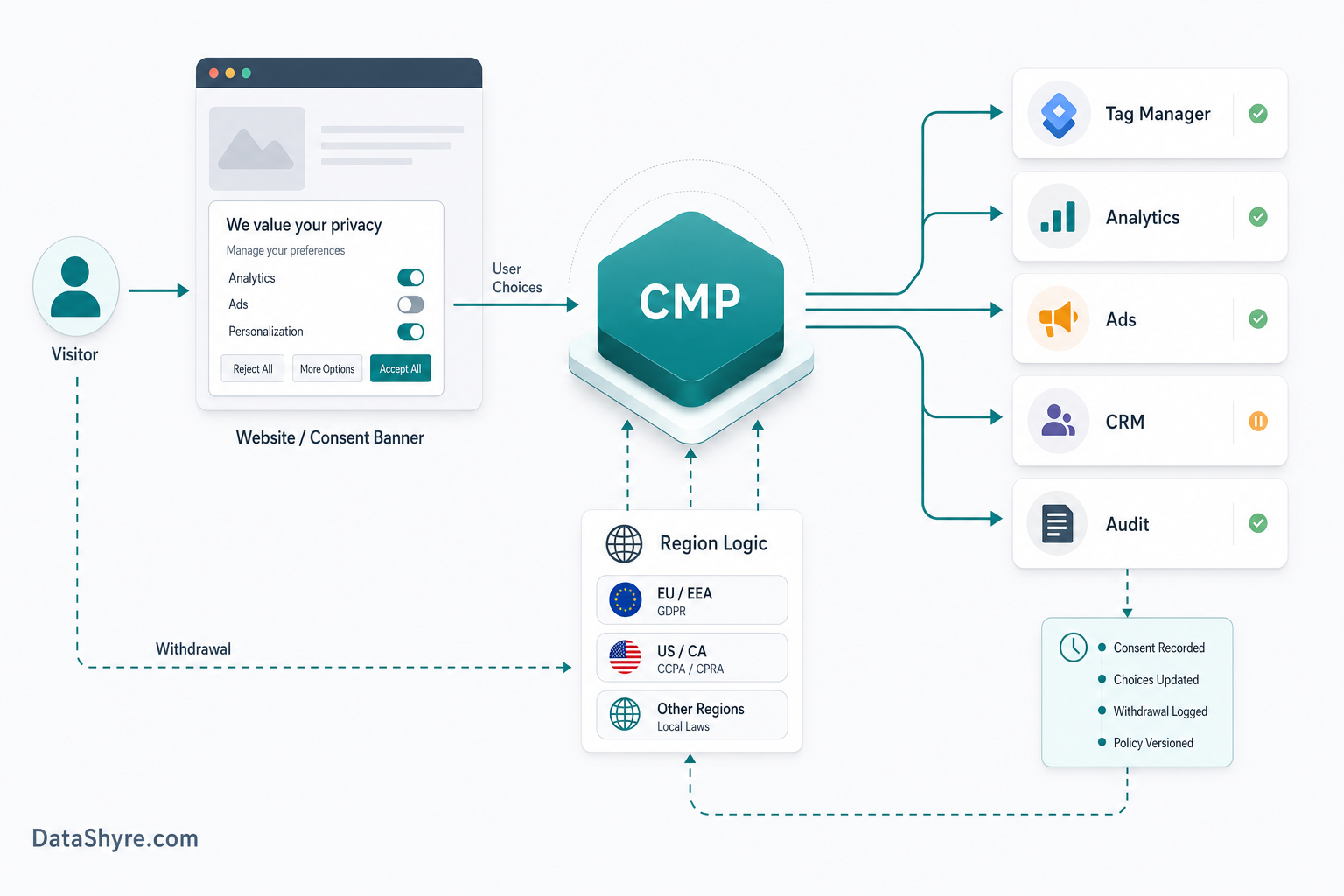
It does not just show a banner. A real CMP captures a user’s choice, decides what can load before and after that choice, sends preference signals to downstream vendors, and keeps records your team can actually use later. That matters because privacy compliance is no longer about a single pop-up. It is about whether the entire stack behaves the way your notice says it behaves.
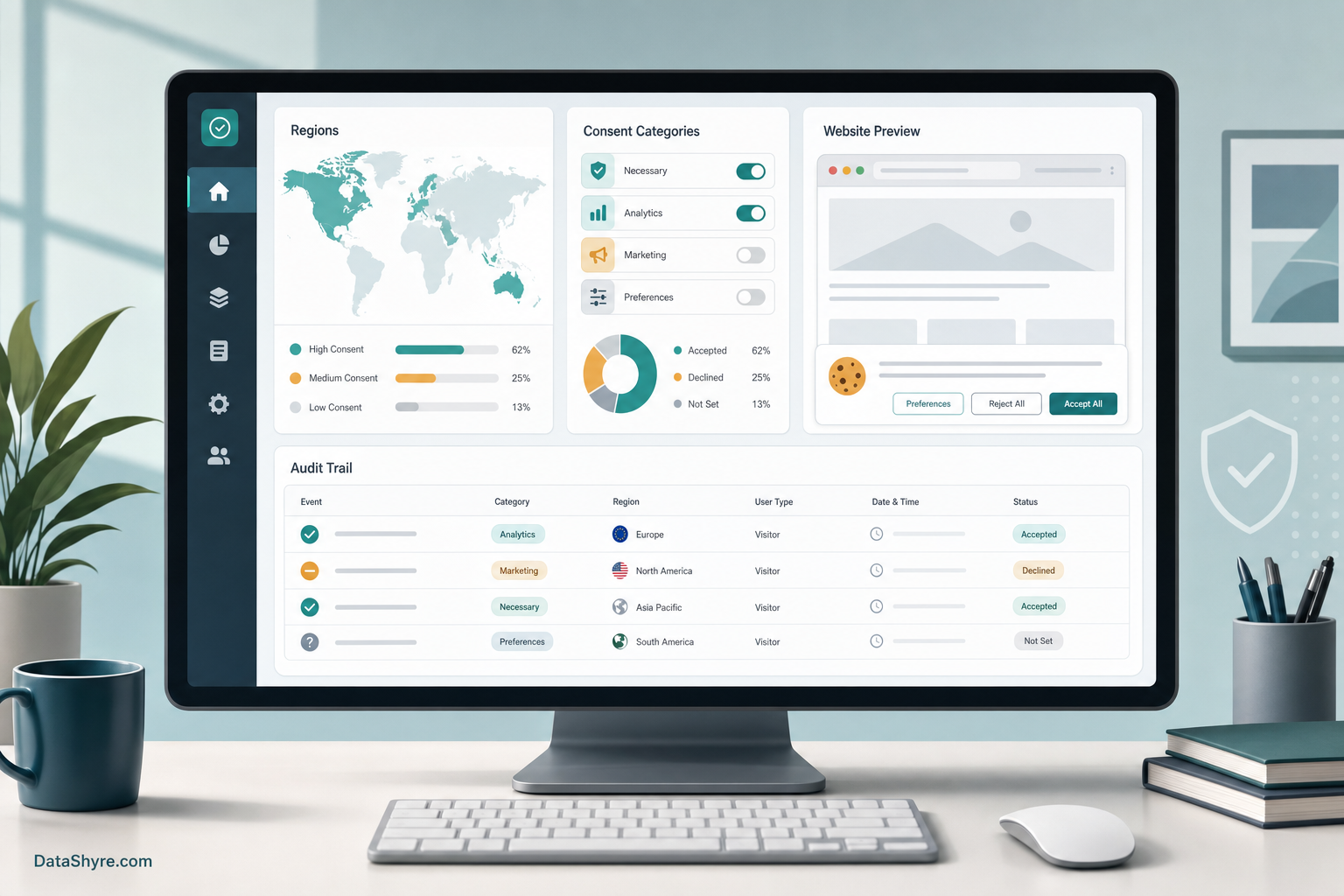
What is a consent management platform, exactly?
A consent management platform is software that helps a business collect, manage, communicate, and document user privacy choices across websites, apps, and third-party tools.
In practice, that usually means five jobs:
- Showing a consent interface that matches the visitor’s jurisdiction.
- Blocking or allowing non-essential technologies based on the user’s choice.
- Storing the consent record and the version of the message that was shown.
- Passing consent or opt-out signals to ad, analytics, testing, and CRM tools.
- Letting the user revisit or withdraw their choice later.
That last part gets overlooked. Under GDPR, consent still has to be freely given, specific, informed, and unambiguous. Under the ICO’s updated 2026 guidance, the scope is wider than old-school cookies alone and covers other storage and access technologies such as tracking pixels, device fingerprinting, local storage, scripts, and tags. So a CMP is really a control point for modern tracking, not just a cookie notice.
If you work in ad-supported publishing, the technical role gets even clearer. Google says publishers using the IAB Europe TCF need an IAB-registered CMP that creates and sends the Transparency and Consent string, which Google’s tags then consume. In other words, the CMP is often the system that turns a legal choice into an actual machine-readable signal.
Why businesses care in 2026
The core problem has not changed: businesses want measurement and personalization, but regulators keep focusing on whether users had a real choice and whether that choice changed what happened on the page.
John Edwards, the UK Information Commissioner, said it plainly: “just as easy to reject all non-essential cookies, as it is to accept them.” That is not a design preference. It is a practical standard that pushes teams to think beyond button color and into platform behavior.
The ICO’s April 29, 2026 guidance update also matters because it refreshed the rulebook around storage and access technologies and linked it to current implementation realities. William Malcolm described the goal as giving people “meaningful control over how their data is used.” A good CMP is one of the few tools built specifically to make that control visible and enforceable.
California adds a different pressure point. Covered businesses must honor Global Privacy Control as a valid online opt-out method for sale or sharing. California has also already set a January 2027 effective date for browser-based opt-out preference signals under the California Opt Me Out Act. Tom Kemp’s description of that direction is useful: privacy choices should be “as simple as clicking a button in your browser.”
What a CMP should do in practice
The safest way to evaluate a platform is to ignore the sales demo for a minute and watch what it does in production.
First, it should stop non-essential technologies before the wrong things fire. If analytics, ad pixels, embedded video, chat, or A/B testing scripts run before the right condition exists, the system is not really governing consent.
Second, it should handle different rule sets cleanly. The EU and UK often focus on valid consent before non-essential tracking. California often turns on notices, opt-out flows, and browser-level signals. One global banner with one global setting is usually a convenience for the website owner, not for the user.
Third, it should keep usable evidence. Not just a yes-or-no flag, but a record of what the user saw, when they acted, what policy or banner version was live, and what changed after withdrawal.
Fourth, it should pass signals downstream. The point is not simply collecting a choice. The point is getting that choice into tag managers, analytics, ad platforms, and internal systems without race conditions or manual patchwork.
Do all websites need one?
Not necessarily in the same way.
A very simple site that only uses strictly necessary technologies may not need a full-featured platform. But most commercial websites are not that simple anymore. Once you add analytics, advertising, embedded media, personalization, multiple regions, or several vendor scripts, manual consent handling tends to become brittle fast.
That is where the category earns its keep. If you are still asking what is a consent management platform, think of it as infrastructure for preference enforcement and proof. The more vendors and jurisdictions you have, the more useful that infrastructure becomes.
How to choose without overbuying
Start with the business problem, not the banner template.
If you need to compare vendors, our guide to consent management platform gives a quick buying framework. If the implementation challenge is bigger than the buying question, consent management platform best practices goes deeper on rollout. If your team is debating self-hosting, the open source consent management platform checklist is the right companion piece.
The wrong purchase usually happens when teams buy for appearances. The better purchase happens when they buy for enforcement, signal flow, evidence quality, and maintainability.
Bottom line
what is a consent management platform is not really a banner question. It is a systems question.
The platform sits at the point where legal requirements, user experience, marketing tooling, and engineering controls all meet. If it can translate user choice into actual blocking, actual signaling, and actual records, it is doing its job. If it cannot, the site may still look compliant while behaving like it is not.
Sources
- ICO
- European Data Protection Board
- Google AdSense Help
- Google Ad Manager Help
- California Department of Justice
- California Privacy Protection Agency