

OneTrust Privacy Management: What Buyers Should Verify in 2026
People searching for onetrust privacy management are usually not asking for a prettier cookie banner. They are trying to work out whether OneTrust can become the operating system for privacy work that already sprawls across spreadsheets, tickets, inboxes, legal memos, and tag-management headaches.
That is the right question. OneTrust’s current product lineup makes an important distinction: privacy operations, DSR automation, and customer consent are related, but they are not the same thing. If you blur them together during procurement, you end up buying the wrong scope and discovering the gap after rollout. For the consent-specific side, our OneTrust cookie consent checklist and broader consent management platform guide are useful companion reads.
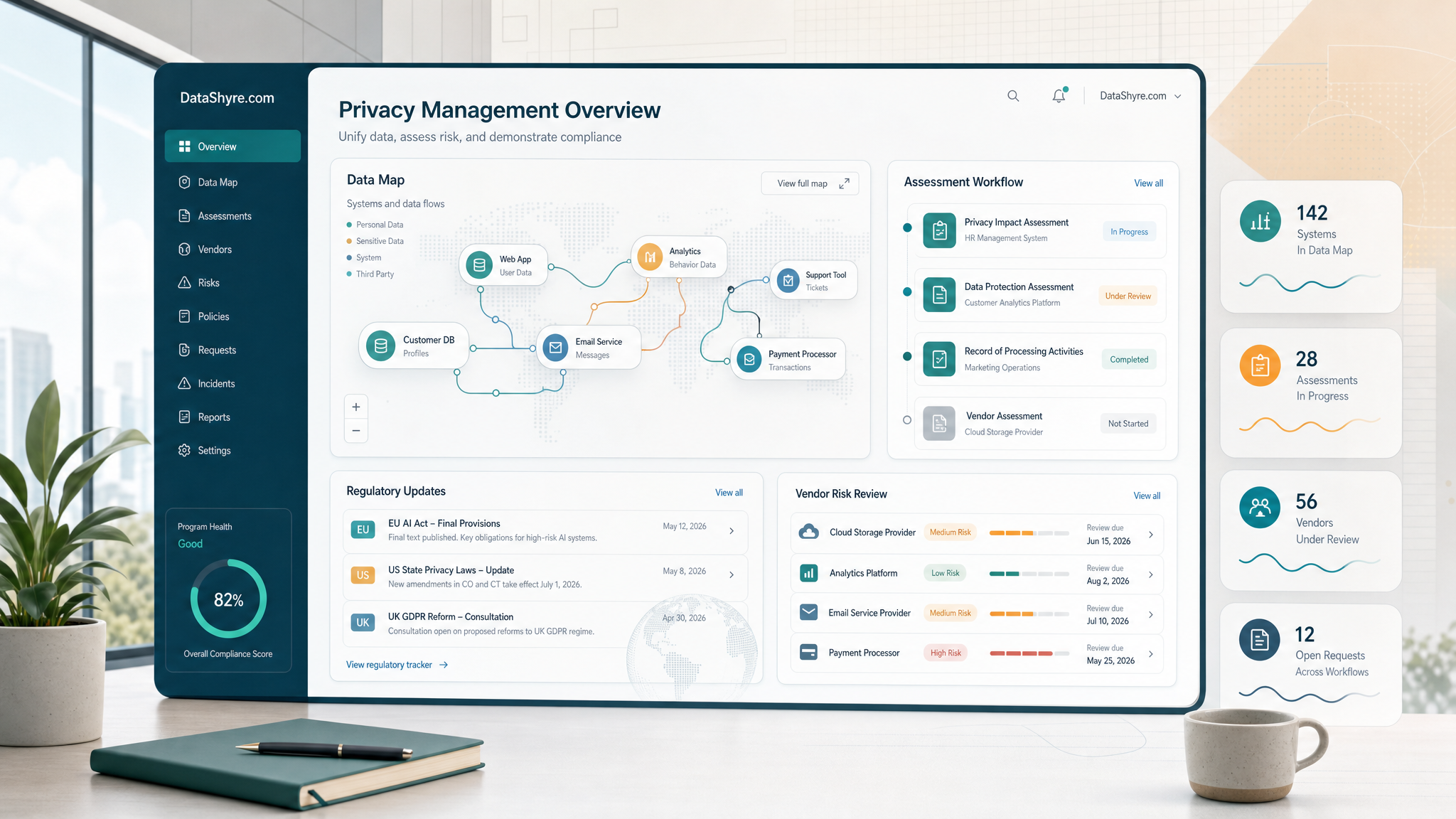
What the platform covers now
The cleanest way to understand onetrust privacy management in 2026 is to split the stack into modules instead of talking about “privacy” as one blob.
OneTrust’s current Privacy Operations materials focus on continuous asset detection, data and activity mapping, privacy risk assessments, and remediation workflows. Its pricing page adds a practical detail buyers should notice: the Privacy Automation Base package centers on data mapping, impact assessments, vendor privacy risk, data transfers, and regulatory-change intelligence. The Suite package adds data subject request fulfillment and privacy incident management. Universal Consent & Preference Management sits separately, with its own positioning around consent capture, preference centers, and synchronization across marketing systems.
That split matters. If your immediate problem is records of processing, assessment workflow, or finding where personal data lives, you are evaluating the privacy-operations side. If you need customer-facing preference centers and consent orchestration, you are also in consent tooling territory. If you need both, say so early.
Troy Lorents of W.L. Gore & Associates described the appeal as having “one tool, one solution” to manage multiple areas of the business. That is the promise. The buying job is to check whether your own processes actually fit inside that promise without a lot of manual patchwork.
The four checks worth making before you buy
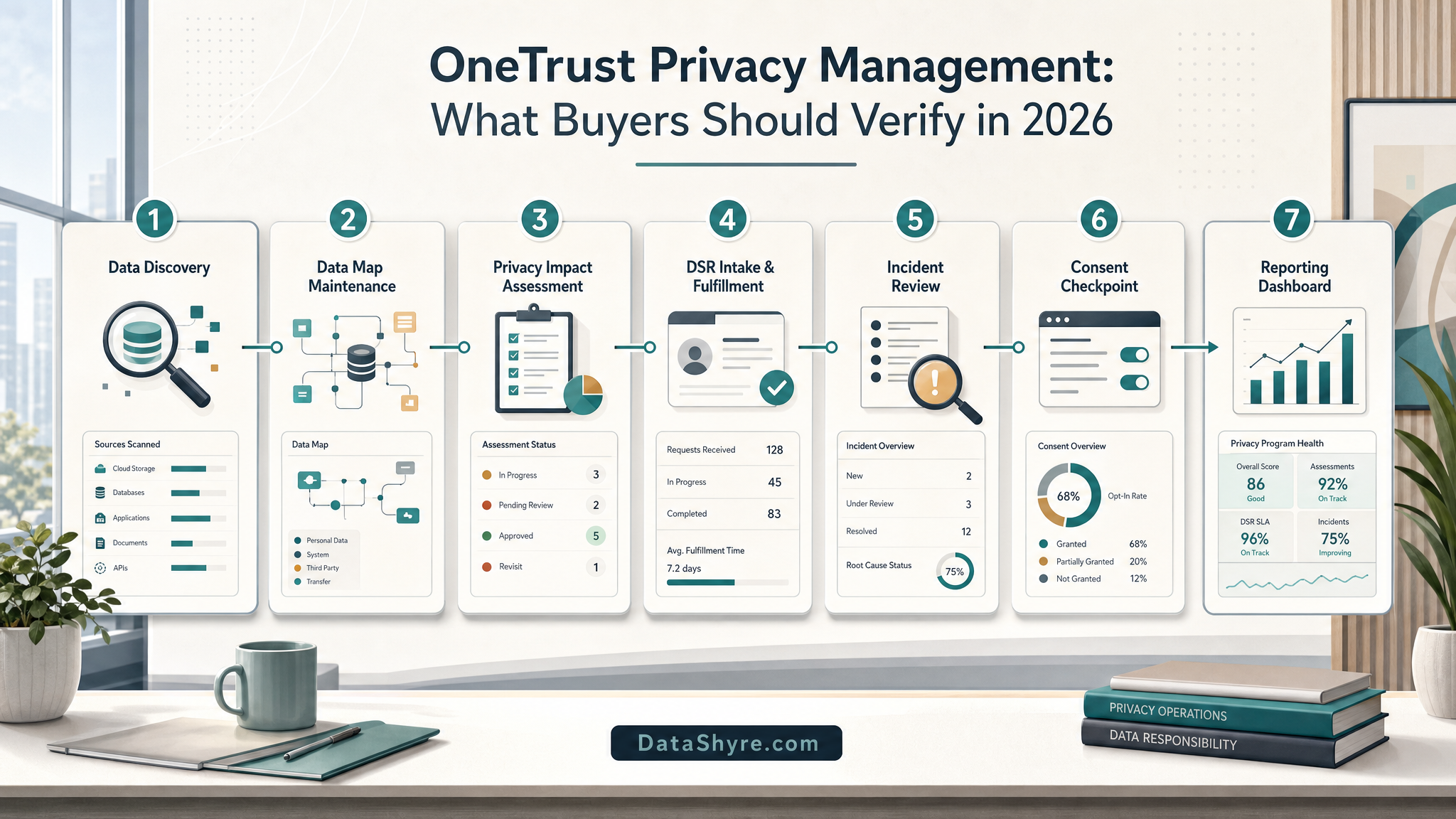
1. Can it map the systems you really use?
OneTrust says Privacy Operations can connect to IAM services, cloud providers, and CMDBs to continuously detect data assets and trigger workflows. That sounds good on a slide. The real test is narrower: can your team connect the sources that actually matter, keep the inventory current, and trust the results enough to use them in assessments and response work?
Ask for a demo based on your real environment, not a generic sample tenant. If your stack includes SaaS sprawl, regional business apps, legacy databases, and a messy vendor list, that complexity needs to show up in the proof of value. Otherwise the “evergreen” map becomes another dashboard your team stops believing.
2. Are you buying privacy operations only, or privacy operations plus DSRs and consent?
This is where many evaluations go sideways. OneTrust’s own packaging makes clear that DSR fulfillment is not identical to the base privacy-operations layer, and customer consent lives in a separate consent-and-preference product line. If your team needs intake, identity verification, retrieval, deletion, secure response, and incident handling, confirm whether you are pricing the Suite tier rather than assuming it is bundled.
The same applies to public-facing websites. If the project includes banners, preferences, or advertising consent, privacy management alone is not the full answer. Google’s Ad Manager documentation says TCF v2.3 became mandatory for new TC strings generated on or after March 1, 2026, and warns that non-compliant strings can cause requests to default to Limited Ads. So if ad revenue or Google advertising integrations matter, ask your OneTrust team where privacy operations ends and CMP obligations begin.
3. Will the workflow leave you with usable evidence later?
Privacy tooling gets tested twice: once during rollout, and again when somebody asks for proof. That may be an auditor, a customer, procurement, or your own legal team after an incident.
Marta Cañas Miralles of Iberia said OneTrust gave the airline “full control” with a tool that supports risk assessment and reporting. That is a useful benchmark. You want evidence that your team can pull records quickly, not just a nice screen during implementation. Check whether the workflow leaves a reliable trail for assessments, approvals, mitigation steps, vendor decisions, transfer reviews, and regulatory changes that affected your process.
If the buying committee also touches consent, the evidence bar is even higher. The ICO’s current guidance says consent is appropriate only when people have real choice and control, and its Storage and Access Technologies guidance now expects refusal to be as easy as acceptance and non-exempt technologies to stay off until valid consent exists. A privacy-management program that cannot connect those expectations to actual operating records is going to feel unfinished.
4. Can your team operate it after the implementation team leaves?
This is the quiet deal-breaker. A strong demo can hide a weak operating model.
On April 29, 2026, the ICO finalized its Storage and Access Technologies guidance after consultations and updates linked to the Data (Use and Access) Act. William Malcolm said organizations wanted “clear, practical guidance” they could rely on. That line lands because privacy teams need the same thing from their software: clear operating logic, not just more places to click.
Ask blunt questions about ownership. Who updates the data map? Who triages new systems? Who reviews assessments? Who maintains jurisdiction logic? Who keeps DSR workflows current? If the answer to all of those questions is “the platform,” you are not hearing a serious answer.
Our website privacy checker is a good reality check here. Run the operational questions before the contract, not after the launch celebration.
Why this matters more in 2026
The compliance environment is getting more specific, not less. The ICO’s finalized 2026 guidance expressly covers cookies, tracking pixels, device fingerprinting, and similar technologies. Google has already moved the publisher ecosystem to TCF v2.3 for new TC strings. And privacy teams are being asked to govern not just notices and requests, but also inventories, risk workflows, incidents, and AI-adjacent data use.
That is why onetrust privacy management should be evaluated as an operating system for evidence and process, not just as a procurement line item. A polished interface is nice. A defensible, maintained workflow is better.
Bottom line
Good onetrust privacy management buying is really scope management. Verify what gets mapped, what gets automated, what still needs another product, and what proof your team can extract later. If the answer is crisp on those four points, you are probably looking at a workable platform. If the answer is fuzzy, the project may still close, but the cleanup work usually shows up later.
Sources
- OneTrust Privacy Operations product page
- OneTrust pricing and packaging page
- OneTrust customer stories page
- UK Information Commissioner’s Office guidance on storage and access technologies
- UK Information Commissioner’s Office guidance on consent
- Google Ad Manager Help