

User Consent Management Platforms in 2026: 7 Checks Before You Buy
If you are searching user consent management platforms on August 8, 2026, the useful question is not which vendor has the prettiest banner.
The useful question is whether the platform can support valid consent where consent is the right basis, separate opt-out handling where consent is not the right basis, and real downstream enforcement after a user changes a choice.
That distinction matters because current official guidance is more operational than many buying guides admit. The European Commission still says valid consent must be “freely given, specific, informed and unambiguous.” The UK ICO still says withdrawal must be “as easy to withdraw as to give consent.” California’s Department of Justice still describes Global Privacy Control as a “stop selling or sharing my data switch.”
If you want adjacent reading first, start with our guides to user consent management, consent management platform, and consent management platform best practices. This article stays narrower. It is the seven-check review I would use before shortlisting user consent management platforms for a live site, app, or mixed digital stack.
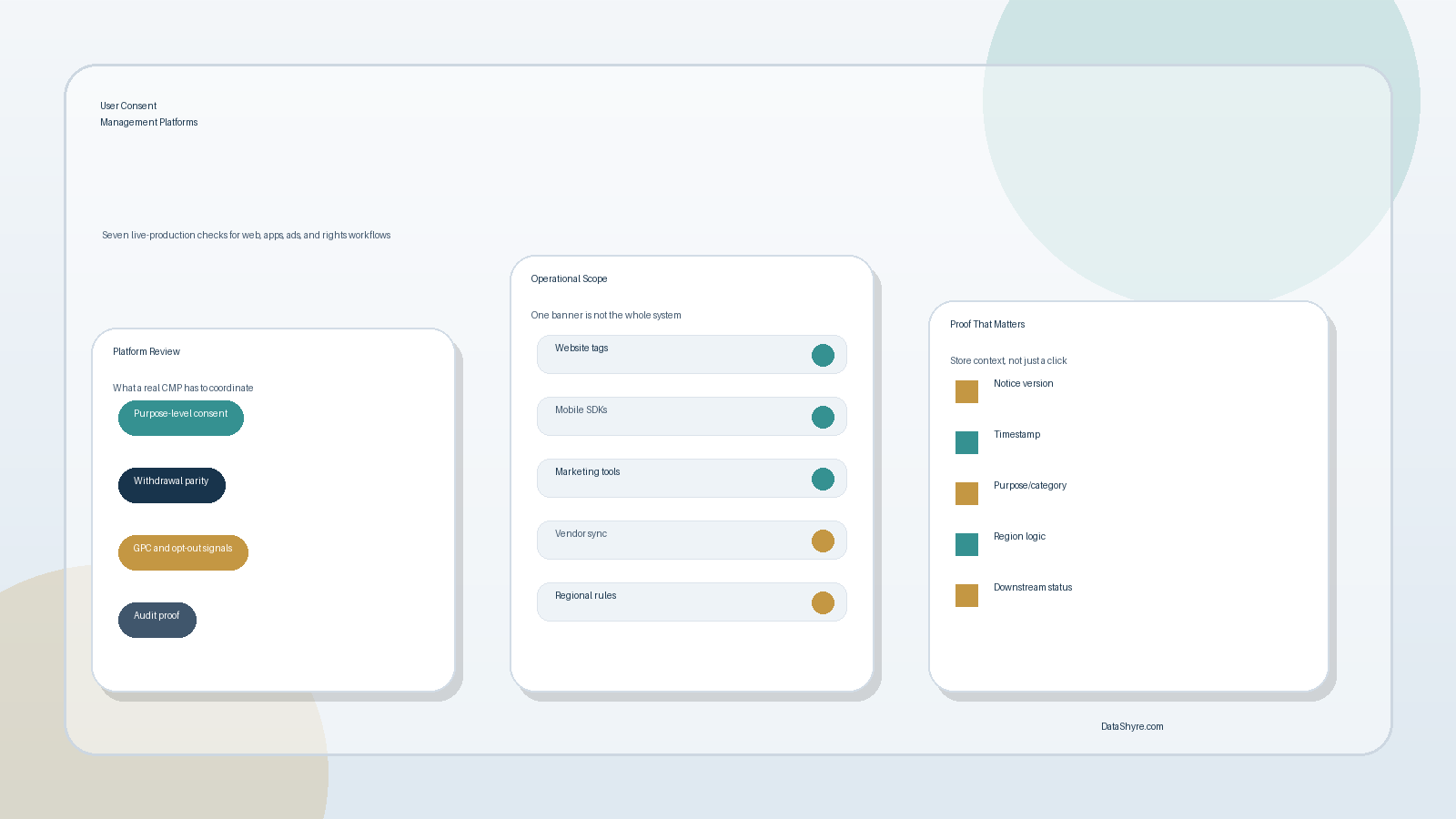
The short answer on user consent management platforms
The fastest useful summary is this:
- the best user consent management platforms do more than display a banner;
- they separate lawful-basis logic, consent prompts, opt-outs, and rights workflows instead of flattening them into one preference;
- they make refusal and withdrawal genuinely easy;
- they propagate the user’s choice into tags, SDKs, vendors, and messaging tools;
- they keep proof strong enough to explain what happened later;
- if ads matter, they also have to fit Google’s current publisher requirements in the relevant regions.
That is why the real product review is not visual. It is architectural.
1. Check whether the platform supports the right legal model
This is the first test because not every privacy choice is the same thing.
The European Commission’s current data protection guidance still treats consent as only one lawful basis among several. That means user consent management platforms should not force every workflow into the same “accept or reject” model. A platform should help your team distinguish between:
- consent for specific processing where consent is actually required;
- contract-based processing that should not pretend to be optional;
- objections or unsubscribe requests;
- California opt-out signals;
- delete, correct, or know requests with their own timelines.
If a platform stores all of those actions as one generic preference state, the reporting may look tidy while the legal model stays blurry.
2. Require purpose-level granularity instead of one blanket toggle
The European Commission and the ICO both continue to push toward specific, understandable consent requests rather than vague blanket permission.
The ICO’s consent guidance says requests should be prominent, concise, easy to understand, and specific enough to match the real purpose. It also says people should not be forced into all-or-nothing consent when separate purposes are involved.
For user consent management platforms, that means the product should let you model choice at a useful level:
- analytics versus advertising;
- first-party product improvement versus partner sharing;
- email marketing versus SMS marketing;
- website tracking versus in-app permissions.
If the platform cannot express those boundaries clearly, it becomes much harder to prove later that the user actually agreed to the thing your systems did.
3. Test withdrawal and refusal as hard as acceptance
Many privacy tools still make acceptance easy and withdrawal awkward.
That is exactly backward. The ICO’s current guidance says withdrawal must be as easy as giving consent and describes an easily accessible one-step process as the practical benchmark where possible. In product terms, the “manage preferences” experience matters as much as the first-layer banner.
When reviewing user consent management platforms, test these paths directly:
- Can a user reject optional choices from the first meaningful layer where that is expected?
- Can the user reopen settings without hunting through the site or app?
- Does withdrawal change live behavior quickly?
- Can support and compliance teams verify that the withdrawal happened and propagated?
If the platform only shines during the first click, it is not ready for production pressure.
4. Make sure it treats web tracking, California opt-outs, and rights deadlines separately
This is where many platform demos oversimplify the problem.
On April 29, 2026, the ICO finalized its guidance on storage and access technologies and added new sub-chapters on topics including what a simple means of objecting looks like. That guidance reaches beyond older cookie-language shortcuts and reinforces that teams should test how storage and access technologies really behave on live services.
California pushes a different operational requirement. The California Department of Justice still says a valid GPC signal must be honored as a request to stop sale or sharing, and the CPPA FAQ still says delete, correct, and know requests must be confirmed within 10 business days and substantively answered within 45 calendar days, while opt-out or limit requests must be honored as soon as feasibly possible and no later than 15 business days.
So a strong review of user consent management platforms asks whether the tool can keep these lanes distinct:
- web or app consent collection;
- browser-level opt-out signals like GPC;
- delete, correct, know, or limit workflows;
- regional rule changes and timers.
If those are mashed together into one preference center, the platform may create more confusion than control.
5. Follow the user’s choice into downstream systems
This is the most important technical check.
The visible prompt is only the beginning. The harder question is whether the chosen platform can push the decision into the actual systems that process data afterward. For user consent management platforms, that usually means testing:
- tag managers and analytics tools;
- mobile SDKs;
- CRM and marketing automation tools;
- audience exports and data warehouses;
- embedded vendors and third-party scripts.
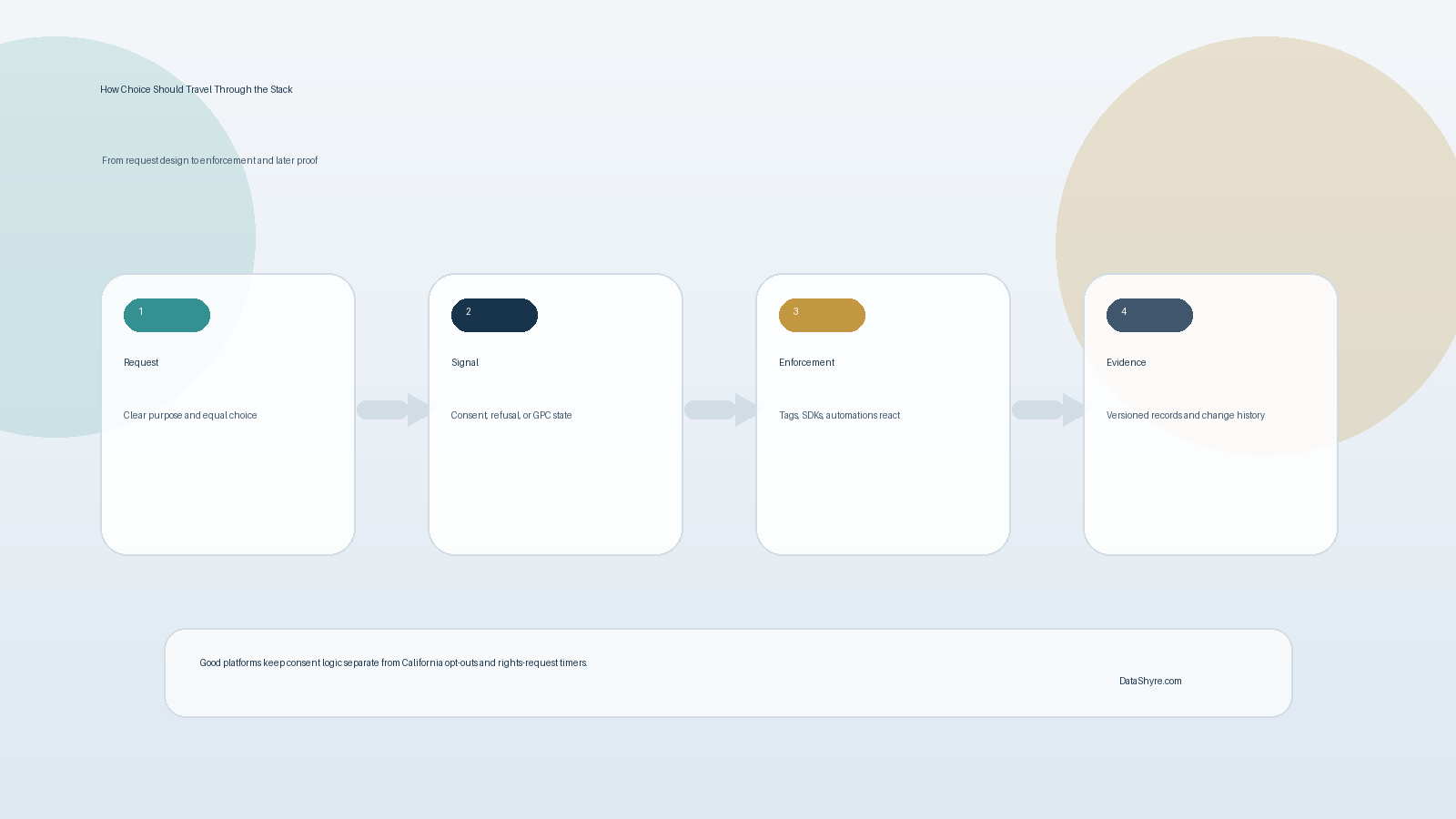
The right platform should make it possible to prove that refusal keeps optional technologies off, that withdrawal reverses later activity where appropriate, and that regional rule logic changes how the stack behaves. If the tool only logs an event and leaves every other system untouched, you do not have a consent platform. You have an event collector.
6. If you run publisher ads, test Google fit separately
This is not relevant to every buyer, but it matters a lot when it does matter.
Google’s current Ad Manager help still says publishers serving personalized ads to users in the EEA, the UK, or Switzerland need a certified CMP integrated with the IAB Transparency and Consent Framework. Google also says its certification review does not check CMPs for full compliance with the TCF or applicable privacy laws.
That means a platform can be a good legal and operational fit for your broader privacy program yet still be the wrong answer for a publisher workflow. It also means a vendor can appear on Google’s certified list and still require separate review for:
- fairness of consent design;
- withdrawal handling;
- California logic;
- internal evidence requirements;
- non-publisher use cases such as apps or logged-in product flows.
For teams comparing user consent management platforms, Google fit is a separate checkpoint, not the whole scorecard.
7. Buy the platform that preserves evidence, not just the one that looks polished
The best buying question is often, “What will this record let us explain six months later?”
The ICO’s current consent guidance says organizations should be able to demonstrate who consented, when they consented, what they were told at the time, how they consented, and whether they later withdrew. That is the practical outline of a useful audit trail.
So before choosing among user consent management platforms, review whether the product preserves:
- the notice or banner version shown;
- the exact purpose or category involved;
- the timestamp and identifier;
- the region or rule set applied;
- the downstream state after the choice;
- the later change, withdrawal, or expiry event.
This is where serious platforms separate themselves from polished demos. Mature evidence design saves time in incident review, complaint handling, vendor oversight, and internal audits.
A shortlist review sequence for this week
If I were comparing user consent management platforms right now, I would use this sequence:
- Separate the workflows that are true consent flows from opt-outs and rights requests.
- Test whether the platform can model purpose-level choice without vague bundling.
- Walk through rejection and withdrawal on live pages or staging builds.
- Validate GPC and US-state handling separately from EU consent handling.
- Trace the signal into tags, SDKs, and downstream tools.
- Review the evidence kept for each event.
- If publisher monetization matters, run the Google certified-CMP check as a distinct final gate.
That process usually exposes whether a tool is built for production or mainly for procurement screenshots.
Bottom line
The right user consent management platforms in 2026 are not the ones that only make privacy choices look neat.
They are the ones that help your team express the right legal model, capture specific choices, make refusal and withdrawal easy, honor browser-level opt-out signals where required, enforce the result across the real stack, and keep proof strong enough to stand up later.
If a platform can do those things, it is worth deeper evaluation. If it cannot, a slick banner will not fix the gap.
Sources
- European Commission: Legal grounds for processing data
- European Commission: Information for individuals
- UK ICO: How should we obtain, record and manage consent?
- UK ICO: Guidance on the use of storage and access technologies
- California Department of Justice: Global Privacy Control
- California Privacy Protection Agency: Frequently Asked Questions
- Google Ad Manager Help: Google consent management requirements for serving ads in the EEA, the UK, and Switzerland (for publishers)
This post was updated on August 8, 2026 using current official sources available at publication time.