

Consent Management Provider in 2026: 7 Checks Before You Choose One
If you are evaluating a consent management provider on August 25, 2026, the first useful question is not which banner looks nicest. It is whether the provider can turn a user’s choice into real runtime behavior across tags, embeds, regional rule paths, and proof your team can still understand later.
That buying lens matters more now because the live baseline keeps getting more operational. On April 29, 2026, the UK ICO finalized its storage-and-access technologies guidance and made clear the review reaches beyond classic cookies into tracking pixels, fingerprinting, scripts, and similar technologies. On July 14, 2026, the EDPB required the Belgian DPA to handle the merits of a cookie-banner complaint involving VRT, which is a useful reminder that banner design and runtime behavior still attract regulator attention. In California, the Department of Justice still says a qualifying Global Privacy Control signal must be honored, and the February 11, 2026 Disney settlement showed that opt-out methods must actually stop sale or sharing across the account-linked experience, not just one surface. Google adds another filter for publishers: when serving personalized ads in the EEA, UK, or Switzerland, publishers using Google’s publisher products need a certified CMP integrated with the IAB TCF.
If you want the category baseline first, start with our guides to consent management platform, what is a consent management platform cmp, and consent management platform best practices. This article is narrower. It is the shortlist review I would use before trusting a consent management provider this week.
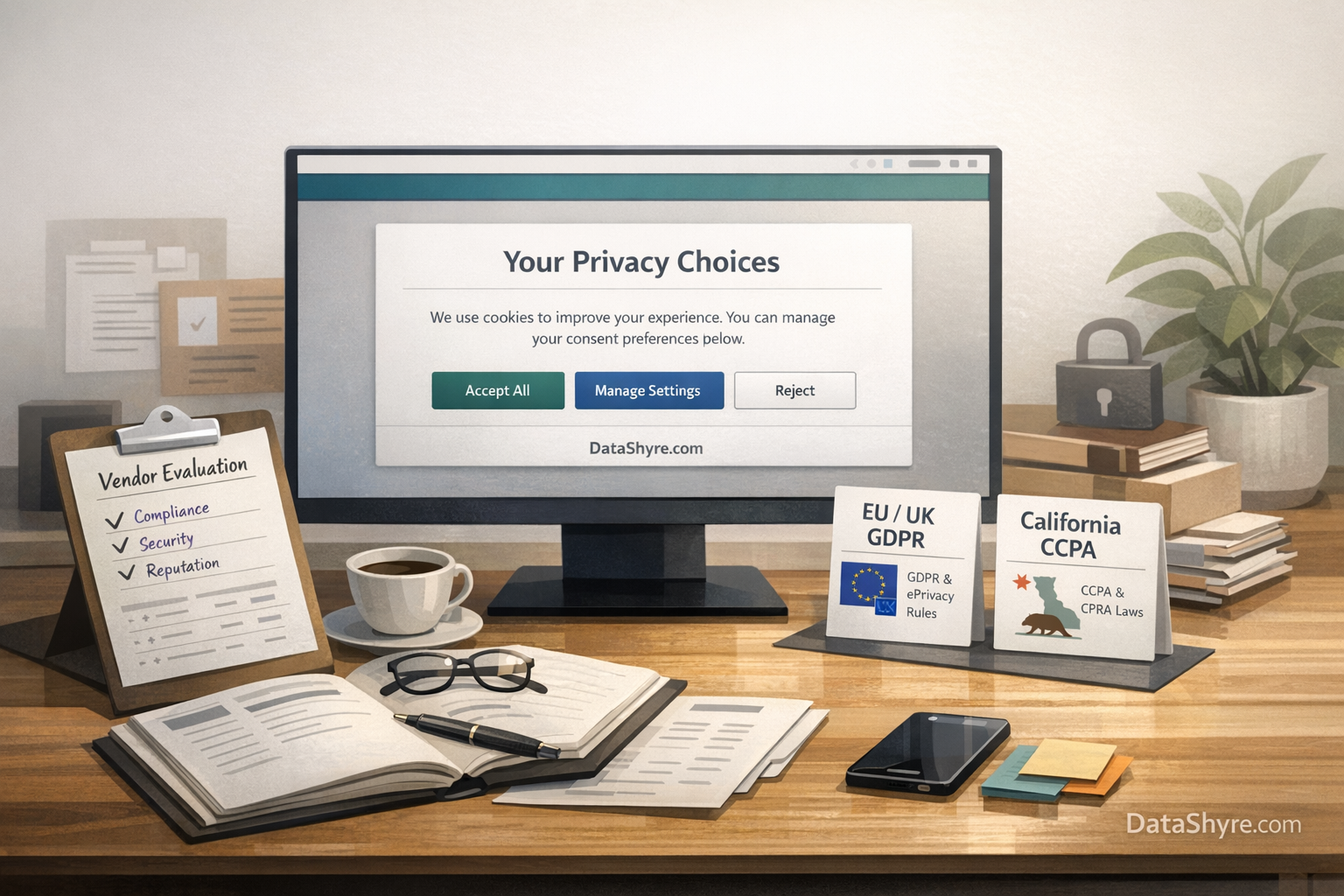
What a consent management provider has to prove now
A serious provider review in 2026 is less about feature grids and more about operating control.
The ICO’s current guidance is one reason. It makes clear the analysis is not limited to old cookie-only checklists. The same review can reach pixels, scripts, fingerprinting, and other storage-or-access techniques on a user’s device. California pushes the buying decision in another direction: browser-level privacy signals and opt-out requests have to reach real downstream behavior, not just a nice settings panel. Google’s own publisher help adds an important nuance for ad-supported sites: certified CMP status matters, but Google also says it “does not check CMPs for full compliance with the TCF or applicable privacy laws.”
That is why a polished demo is not enough.
7 checks before you choose one
1. Verify the provider controls more than banner copy
The provider should be able to influence the technologies that actually matter:
- analytics and measurement tags;
- advertising and remarketing pixels;
- video, chat, map, and form embeds;
- personalization or experimentation scripts;
- downstream consent signals passed to vendors and platforms.
If the product mainly manages text, colors, and layouts while your engineering team still has to wire the real blocking logic by hand, you are not really buying a control layer. You are buying a banner editor with extra steps.
2. Check whether refusal is as usable as acceptance
This is still one of the fastest quality filters.
CNIL put the standard plainly:
“Rejecting cookies should be just as easy as accepting them.”
That matters during provider review because weak defaults still show up as muted Reject all links, second-layer refusal, or mobile layouts that visually pressure the user toward acceptance. If the vendor’s out-of-the-box pattern makes refusal materially harder, your team will inherit cleanup work later.
3. Test prior blocking on a real page, not in a sales demo
Where prior consent is required for non-essential technologies, optional analytics, advertising, and personalization tools should stay off until the user acts.
The cleanest provider test is still the most practical one: load a real page in a clean session and inspect what fires before any click. A banner can look compliant while a tag manager, hardcoded pixel, embedded video, or third-party script still runs early. For a consent management provider, the question is simple: what changes in the browser before choice, after acceptance, after refusal, and after later withdrawal?
If the vendor cannot show that on a live page, the rest of the demo matters much less.
4. Make sure regional logic is genuinely different
One global banner flow is rarely enough.
In the EU and UK, the operational review often turns on prior consent for non-essential storage-and-access technologies. In California, the path often shifts toward sale-or-sharing opt-out handling, notice quality, and opt-out preference signals such as GPC. The Disney settlement from February 11, 2026 is useful because it focused on incomplete opt-out behavior across devices and services tied to the same account.
That is why a strong consent management provider should not force California into a shallow copy of a European consent flow. During evaluation, ask the vendor to show:
- EU or UK prior-consent behavior.
- California opt-out flow and language.
- GPC recognition where applicable.
- What downstream suppression happens after the request arrives.
5. Verify signal timing into Google tags and downstream tools
A choice is only useful if the rest of the stack receives it in time.
Google’s current consent mode guidance still says the default consent state should be set before a user grants consent, and updates should be tracked on the page where they occur before any page transition. For provider review, that means checking how quickly consent or opt-out state reaches tag managers, analytics tools, ad systems, and embedded services.
If the provider can store a preference but not propagate it reliably, measurement and compliance both start drifting.
6. Keep Google certification separate from broader legal review
For ad-supported sites, this deserves its own line item.
Google’s current publisher help says a certified CMP integrated with the TCF is required when serving personalized ads through its publisher products to users in the EEA, UK, and Switzerland. That matters commercially. But it is not the same thing as a full legal review. Google says certification checks focus on its criteria around TCF support, and it expressly says certification does not prove full compliance with privacy law.
So when you evaluate a consent management provider, ask two separate questions:
- Does it meet the Google publisher requirement we need right now?
- Does it still satisfy our wider legal, UX, and engineering requirements outside that narrow certification test?
7. Confirm the provider leaves usable proof and keeps up after launch
Sooner or later, someone will ask what the user saw, what they chose, and what happened after that choice. Another team will also ask what changed after a plugin update, new tag release, or regulatory shift.
The records should let a non-specialist answer:
- Which banner or settings-panel version was shown?
- What categories, purposes, or vendors were presented?
- What did the user choose and when?
- What technologies were allowed or blocked after that choice?
- Could the user later reopen settings and withdraw or change the decision?
You also want evidence that the vendor updates its product when regulator guidance, platform requirements, or state rules move. The ICO’s April 2026 guidance, the EDPB’s July 2026 cookie-banner decision, and California’s effective 2026 regulatory baseline are good examples of why update cadence matters. If the answer is buried in support tickets, raw event logs, or vague promises about future releases, the provider is weaker than it looks.
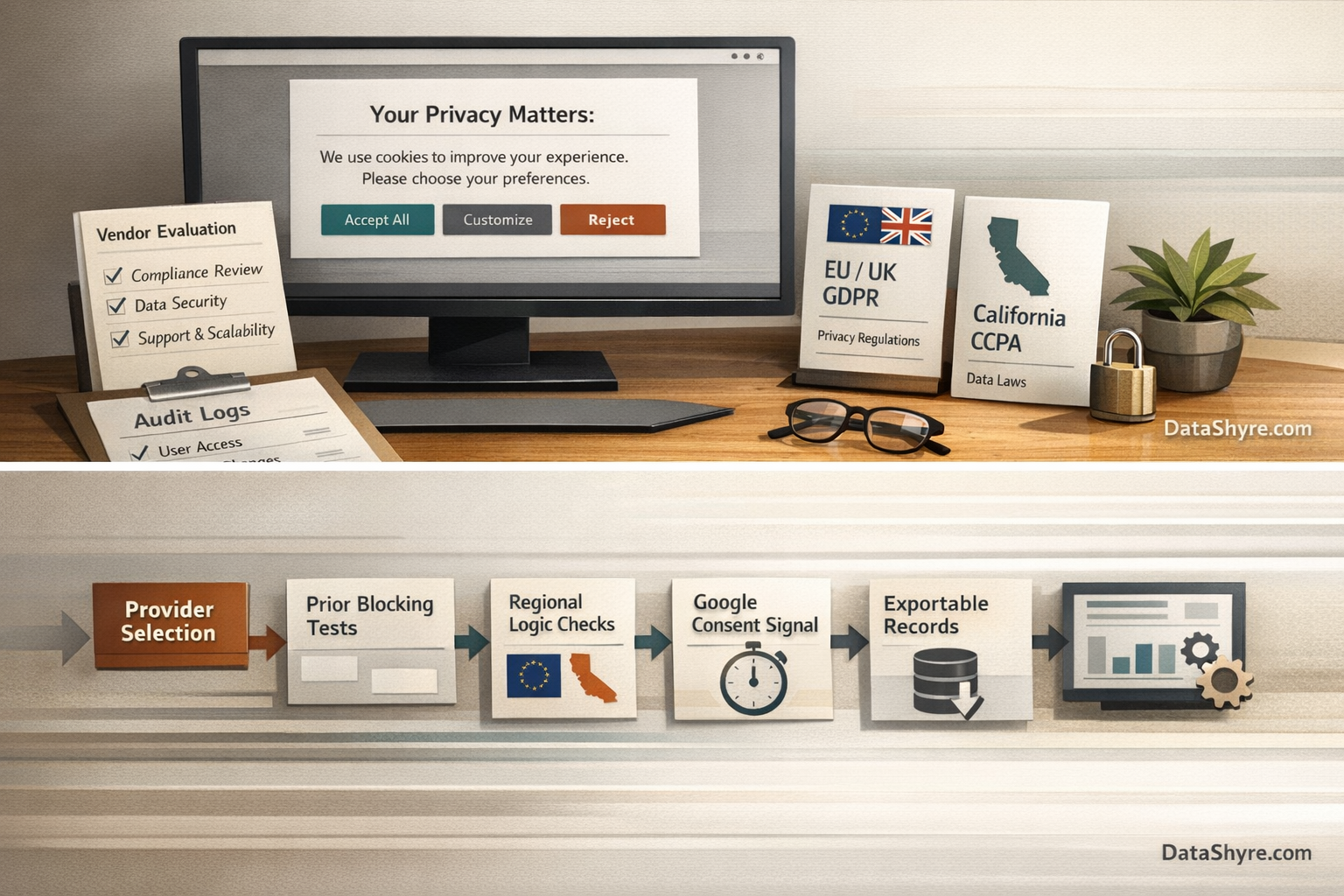
A short shortlist sequence I would use this week
If I were screening vendors right now, I would do this in order:
- Ask which technologies the provider can actually block or reconfigure before consent.
- Inspect the first-layer refusal path on desktop and mobile.
- Test a real page in a clean session to see what fires before interaction.
- Run a California check for opt-out flow and GPC handling.
- Verify consent timing into Google tags and any tag manager in use.
- Review the evidence model for versioning, exports, and later withdrawal.
- If ads matter, verify Google-certified CMP status separately from legal review.
That short sequence usually reveals more than a long feature comparison sheet.
Bottom line
The right consent management provider in 2026 is not the one with the slickest banner editor. It is the one that can collect a fair choice, turn that choice into real runtime behavior, separate regional logic cleanly, pass signals at the right time, and leave behind proof another team can trust later.
William Malcolm captured the larger goal in the ICO’s April 29, 2026 announcement when he said people need:
“meaningful control over how their data is used.”
If a provider cannot deliver meaningful control on the live stack, the interface polish does not matter very much.
Sources
- UK ICO: Final storage and access technologies guidance published
- UK ICO: Guidance on the use of storage and access technologies
- European Commission: When is consent valid?
- European Commission: What if somebody withdraws their consent?
- European Data Protection Board: Belgian DPA must handle the merits of NOYB cookie-banner complaint
- CNIL: Refusing cookies should be as easy as accepting them
- California Department of Justice: Global Privacy Control
- California Department of Justice: California Won’t Let It Go: Attorney General Bonta Announces $2.75 Million Settlement with Disney
- California Privacy Protection Agency: Law & Regulations
- Google for Developers: Set up consent mode on websites
- Google Ad Manager Help: Google consent management requirements for serving ads in the EEA, the UK, and Switzerland (for publishers)
This post was updated on August 25, 2026 using current official regulator, government, and platform materials available at publication time.