

Ketch Cookie Consent in 2026: 8 Live Checks Before You Trust the Setup
If you are evaluating ketch cookie consent in 2026, the useful question is not whether the banner looks cleaner than the last vendor demo.
The useful question is whether Ketch can turn a person’s choice into real behavior across tags, pixels, regional experiences, Google signals, browser opt-out signals, and later audits.
That is the right frame on October 25, 2026. Google’s current Ketch setup guide says the Ketch Smart Tag should be pasted “at the very top of the head tag” so it loads early enough to function properly. Ketch’s own framework and consent materials say the platform supports Google Consent Mode v2, Global Privacy Control, Global Privacy Platform signaling, jurisdiction-aware experiences, and tracker scanning. Regulators are still pushing in the same direction. The UK ICO finalized its storage-and-access-technologies guidance on April 29, 2026, and William Malcolm said people should have “meaningful control over how their data is used.” California’s Department of Justice still describes Global Privacy Control as a “stop selling or sharing my data switch.”
If you want nearby context first, start with our guides to cookie consent requirements, website privacy checker, and OneTrust cookie consent. This article is narrower. It is the eight-check production review I would run before trusting ketch cookie consent on a live site.

Why ketch cookie consent should be judged at runtime
Ketch is not only selling a pop-up.
Its current public materials position the product as a consent-management layer that can route experiences by jurisdiction, sync consent to Google tags, detect browser-based GPC signals, scan trackers, and connect privacy choices to downstream systems. That is much closer to release engineering than to front-end decoration.
So the first review question is not, Did legal approve the banner copy?
It is, What exactly changes on the live site before and after each privacy choice?
That is the test that matters because the European Commission still says valid consent must be freely given, informed, specific, and easy to withdraw, using an option that is as easy to use as giving consent. If Ketch is only changing the interface while optional technologies keep running underneath, the setup is incomplete no matter how polished the banner looks.
1. Load the Ketch Smart Tag early enough to matter
This is the first technical check because it can break everything else.
Google’s official Ketch setup guide says to paste the Ketch script in the head tag of each page and place it “at the very top of the head tag.” That instruction is not cosmetic. It exists because consent logic cannot reliably govern what already fired.
For ketch cookie consent, I would verify:
- the Smart Tag is present on every relevant page;
- it appears before Google tags, ad tags, analytics, and major embeds;
- tag managers or performance plugins are not reordering scripts after deployment; and
- the published site, not just staging, still loads Ketch first enough to control the stack.
If Ketch loads late, the site may still show a nice banner while measurement and advertising technologies have already moved.
2. Separate the banner experience from the enforcement layer
This is where many CMP evaluations drift into privacy theater.
Ketch’s public consent materials emphasize customizable banners, notices, and preference centers. That is useful. But it is only one half of the review. The same materials also emphasize enforcement across systems and orchestration of visitor choices.
For ketch cookie consent, that means you should test both layers separately:
- the experience layer: banner copy, category choices, language, mobile behavior, and withdrawal path;
- the enforcement layer: which cookies, pixels, scripts, and downstream actions actually stop or start.
If the banner says reject but trackers still fire, or if the banner says analytics only while ad technology still receives signals, the problem is not wording. It is control failure.
3. Check whether region-specific experiences actually branch correctly
Ketch’s current consent page says it can automatically serve the right jurisdiction experience to each visitor using location information. That is a practical promise, and it deserves a practical test.
Different regions do not always ask the same question:
- in EU and UK scenarios, the main review often centers on prior consent before optional technologies run;
- in California scenarios, the review often shifts toward opt-out rights, GPC handling, and whether sale or sharing actually stops where required;
- for multinational stacks, the hard part is keeping those branches distinct without losing technical control.
The ICO’s final April 29, 2026 guidance is helpful here because it is not limited to classic cookies. It covers tracking pixels, fingerprinting, web storage, and scripts or tags. So when reviewing ketch cookie consent, do not only compare the banner text from one region to another. Compare the live behavior those visitors actually get.
4. Verify the Google branch on its own terms
Ketch publicly says it is a certified Google CMP partner and that it supports Google Consent Mode v2. Google separately provides a Ketch-specific setup guide and directs implementers to enable consent mode for Google tags.
That is useful, but ketch cookie consent should still be tested as a signal path, not accepted as a badge.
My production checks would be:
- what default Google consent state is present before the visitor acts;
- whether those defaults match the intended regional model;
- whether analytics and ads update after accept or reject on the same page;
- whether later page views preserve the expected state; and
- whether non-Google technologies are governed separately rather than being assumed covered by Consent Mode.
Google’s Ketch guide also points directly to Tag Assistant for verification. That is the right habit. If the signal timing is wrong, ketch cookie consent can fail even when every admin toggle looks correct.
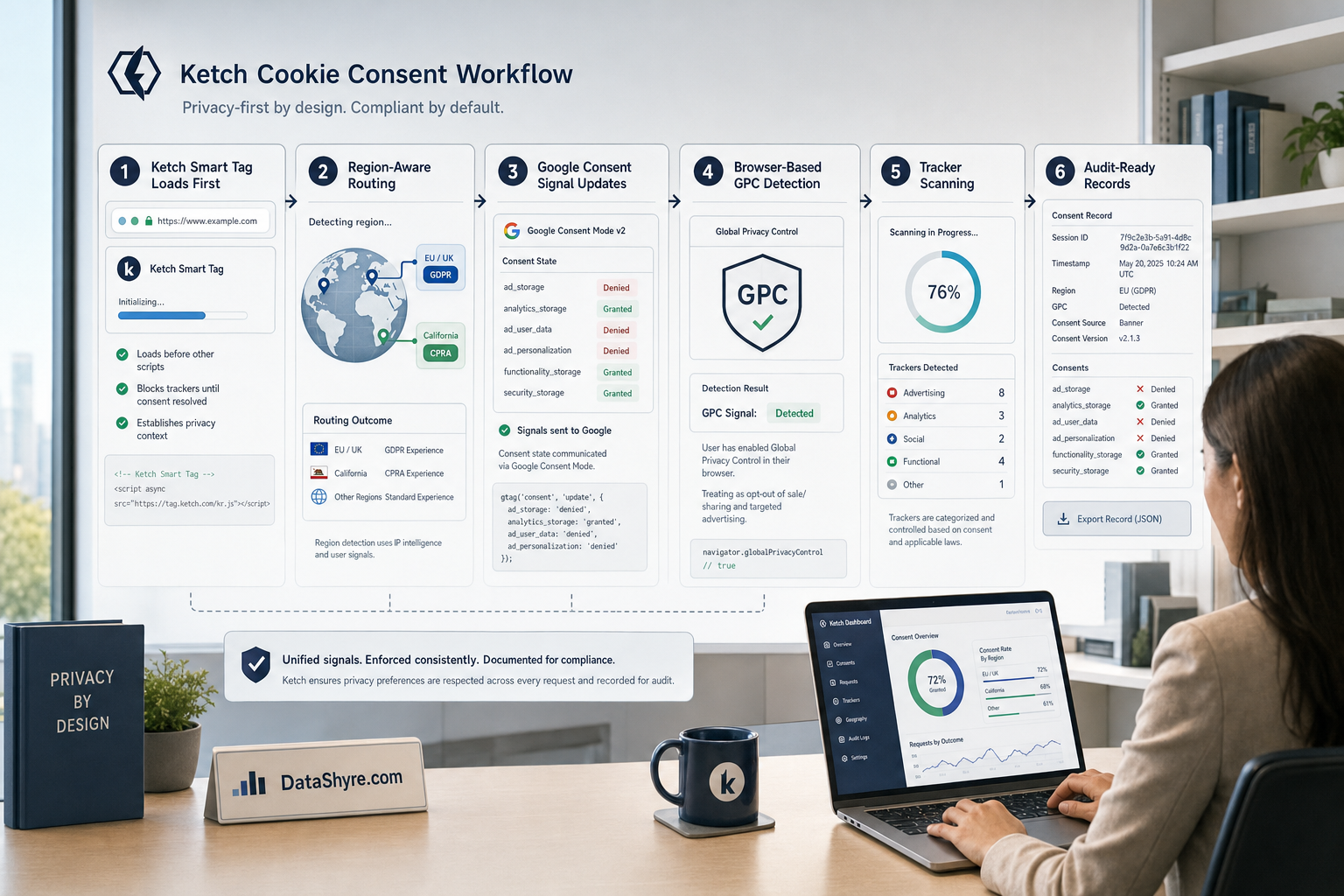
5. Test Global Privacy Control as a runtime behavior, not a policy statement
Ketch’s framework page says it can automatically detect browser-based GPC signals and enforce opt-out requests across systems. California’s DOJ keeps the standard plain: GPC is a “stop selling or sharing my data switch.”
That means the real question for ketch cookie consent is not whether your privacy notice mentions GPC.
It is whether a GPC-enabled browser actually changes what the site does.
I would test:
- a California-relevant visit with GPC enabled before any click;
- whether the site suppresses the relevant sale or sharing behavior;
- whether the result persists across linked experiences that share the same account or identity context; and
- whether your evidence shows the request was received and acted on.
That is especially important after California’s February 11, 2026 Disney settlement, where the Attorney General said Disney failed to fully effectuate opt-out requests across associated devices and streaming services.
6. Use Ketch’s tracker-scanning claims as a starting point, not as proof
One of Ketch’s strongest public messages is that it can scan websites for trackers, classify tags, and detect what slips past consent. The pricing page says tracker scanning is included across plans, and Ketch’s tracker-scanning materials say the platform can help show whether banner choices are actually connecting properly to tag management.
That is valuable, but ketch cookie consent still needs independent runtime checks.
Scanning can help you find what is present. It does not replace testing what actually happens in these states:
- first load before any choice;
- explicit reject;
- explicit accept;
- narrowed category selection;
- later withdrawal.
If your Ketch configuration passes only the inventory layer and fails the behavior layer, the compliance story is still weak.
7. Review the packaging and pricing with your implementation scope in mind
This is the commercial check teams often leave too late.
As of October 25, 2026, Ketch publicly lists a Free tier at $0, Starter at $150/month, Plus at $499/month, and Pro as custom pricing. The same pricing page says consent management, privacy notices, law templates, consent record storage, and tracker scanning are included across plans, while larger privacy-program capabilities expand at higher tiers.
For ketch cookie consent, the practical question is not only Can we start free?
It is:
- how many visitors need to be covered;
- how many integrations you actually need;
- whether your team needs only banner control or broader system orchestration;
- whether audit proof and cross-system enforcement are part of the buying case.
Cheap entry is helpful. Under-scoped deployment is not.
8. Save evidence that another person can review after the next release
The final test for ketch cookie consent is not launch day. It is whether the setup stays defensible after new tags, campaigns, templates, or site changes.
Ketch’s public materials talk about audit trails, consent records, and enforcement across systems. That is a good start. I would still keep a simple evidence pack outside the vendor story:
- screenshots of the first layer and settings layer on desktop and mobile;
- notes from first-load, reject, accept, and withdrawal tests;
- browser or tag-assistant evidence for Google states;
- a California run with GPC enabled if relevant;
- a short record of what changed in the release that was tested.
That is what turns ketch cookie consent from a one-time configuration into an operating control.
A short review order for this week
If I were reviewing ketch cookie consent today, I would do it in this order:
- confirm the Smart Tag loads early enough;
- inventory what Ketch is supposed to govern;
- test regional routing and branch logic;
- verify Google consent defaults and updates;
- run a California GPC test where relevant;
- compare scanner output with live runtime behavior;
- confirm the plan tier matches the real deployment scope; and
- archive proof that survives the next release.
That sequence usually surfaces the real gap faster than another round of banner copy edits.
Bottom line
The strongest ketch cookie consent deployment in 2026 is not the one with the prettiest banner editor.
It is the one that loads early enough, routes visitors correctly, branches by jurisdiction deliberately, updates Google signals at the right moment, honors GPC where required, catches trackers that drift past the intended rules, and leaves behind evidence that another reviewer can still verify later.
If your current setup cannot hold up under those eight checks, the banner may be published while the consent system is not.
Sources
- Google Ads Help, Set up Ketch to obtain user consent: https://support.google.com/google-ads/answer/16609018
- Ketch, Consent Management: https://content.ketch.com/consent-management
- Ketch, Privacy Frameworks: https://www.ketch.com/solutions/privacy-frameworks
- Ketch, Pricing: https://www.ketch.com/pricing
- Ketch, Website Tracker Scanning: https://www.ketch.com/solutions/website-tracker-scanning
- ICO, Guidance on the use of storage and access technologies: https://ico.org.uk/for-organisations/direct-marketing-and-privacy-and-electronic-communications/guidance-on-the-use-of-storage-and-access-technologies/
- ICO, Final storage and access technologies guidance published: https://ico.org.uk/about-the-ico/media-centre/news-and-blogs/2026/04/final-storage-and-access-technologies-guidance-published/
- European Commission, Legal grounds for processing data: https://commission.europa.eu/law/law-topic/data-protection/information-business-and-organisations/legal-grounds-processing-data_en
- California Department of Justice, Global Privacy Control (GPC): https://oag.ca.gov/privacy/ccpa/gpc
- California Department of Justice, California Consumer Privacy Act (CCPA): https://oag.ca.gov/privacy/ccpa
- California Department of Justice, Disney CCPA settlement announcement: https://oag.ca.gov/news/press-releases/california-wont-let-it-go-attorney-general-bonta-announces-275-million
- California Privacy Protection Agency, CCPA Updates effective January 1, 2026: https://cppa.ca.gov/regulations/ccpa_updates.html
—
Published: October 25, 2026. Updated using current official Ketch, Google, regulator, and government materials available at publication time.