

Cookie Consent Requirements in 2026: 8 Live Rules for Banners, Blocking, and Proof
If you are reviewing cookie consent requirements in late 2026, the fastest mistake is treating the whole topic like a copywriting problem.
It is not mainly about whether a banner sounds polite. It is about whether the live site asks at the right moment, blocks the right technologies before the right signal, keeps refusal as usable as acceptance, and preserves enough proof to survive the next release.
That is the right frame because the official materials now line up around runtime behavior. The ICO finalized its storage-and-access-technologies guidance on April 29, 2026, and it explicitly covers cookies, tracking pixels, fingerprinting, scripts, tags, and related technologies. The European Commission still says a consent request should use “clear and plain language” and that withdrawal should be possible through a method that is “as easy to use as giving consent.” France’s CNIL is still using the simplest banner-design test available: “rejecting cookies should be just as easy as accepting them.” Google still says consent defaults should be set “before any commands that send measurement data.” And California’s Department of Justice still describes the Global Privacy Control as a “stop selling or sharing my data switch.”
If you want narrower context first, start with our guides to GDPR cookie consent requirements, CCPA cookie consent requirements, and cookie consent banner. This page stays broader. It is the live review I would use before trusting cookie consent requirements on a production site this week.
1. Separate regional legal logic from one generic banner idea
The first requirement is not visual. It is analytical.
For UK and EU traffic, the live question is usually whether a storage or access technology falls outside the relevant exceptions and therefore needs consent before use. The ICO’s current guidance still says that unless a technology meets one of the exceptions, you must seek consent before using it. The same guidance also keeps repeating the practical divide: what is strictly necessary to provide the service the person asked for is one thing; analytics, advertising, cross-site tracking, and similar extras are another.
For California, the review often turns on a different branch. The current CCPA materials still focus on opt-out rights around sale or sharing, user-enabled Global Privacy Control signals, and dark-pattern rules for privacy choices rather than one universal prior-consent rule for every cookie.
So the first cookie consent requirements question should be: which region-specific outcome are we actually trying to satisfy on this page?
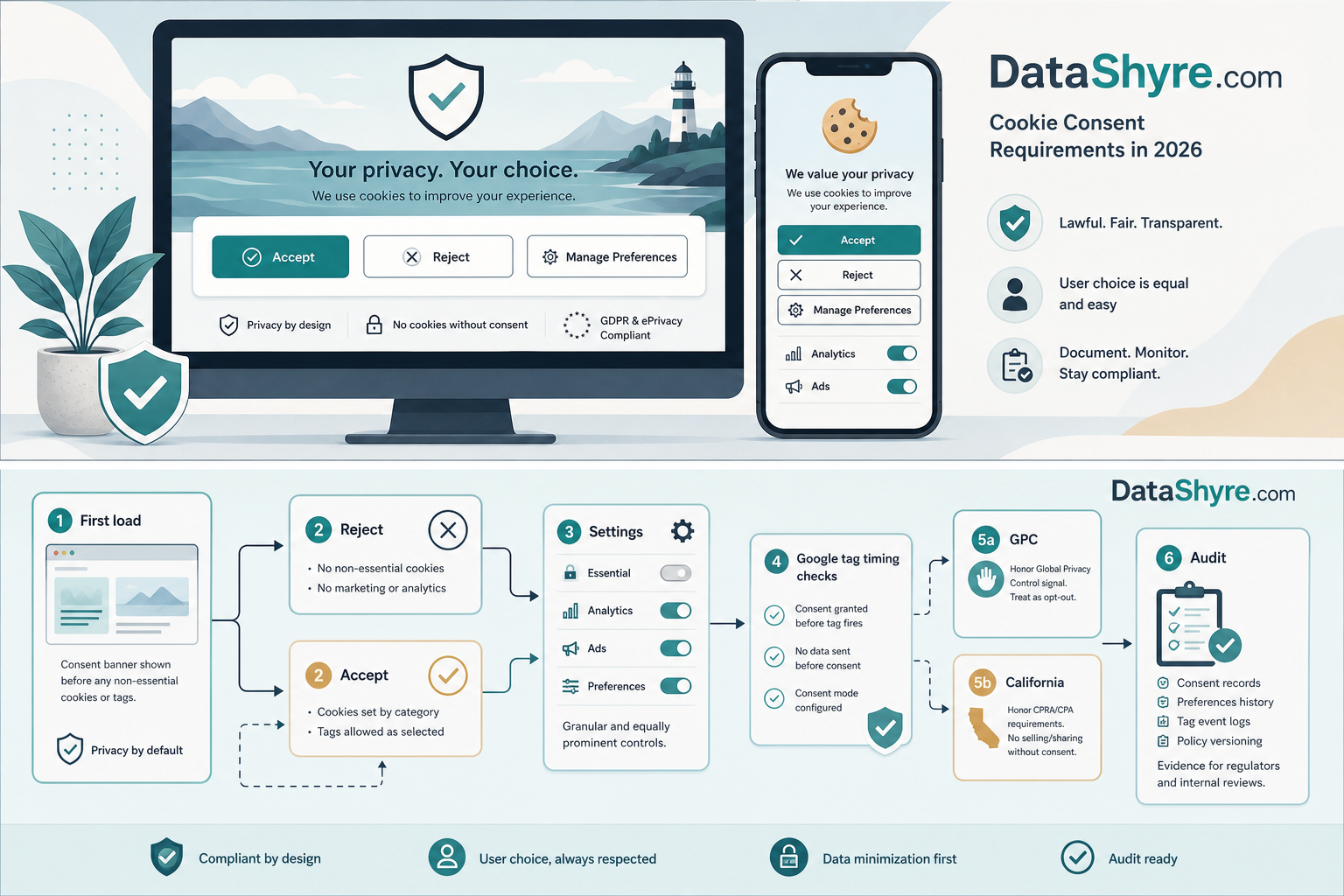
2. Make reject and accept feel equally real on the first layer
This is where compliance debates become visible to ordinary users.
CNIL’s December 12, 2024 notice on dark patterns in cookie banners says the information must be clear and complete and that “rejecting cookies should be just as easy as accepting them.” The CPPA’s dark-pattern advisory uses a similar phrase from a different legal system: “symmetry in choice.”
For practical review, that usually means checking whether:
AcceptandRejectare both visible without hunting;- refusal is not reduced to a small text link while acceptance gets the main button;
- color, spacing, contrast, and placement do not quietly steer the person one way; and
- mobile layout stays as balanced as desktop.
If the interface makes one answer visually easier, the implementation is already on weaker ground.
3. Describe purposes in plain language the site can actually defend
This sounds basic, but it often breaks when teams recycle vendor defaults.
The European Commission still says a consent request should be clearly visible and use “clear and plain language.” That is more demanding than dropping in vague phrases like we use cookies to improve your experience.
For serious cookie consent requirements, the first and second layer should usually tell people:
- what categories or purposes are optional;
- what those categories actually do in human language;
- whether data is shared with third parties for ads, analytics, or embedded services; and
- where the person can come back later to change the choice.
The smaller the distance between the wording and the real runtime behavior, the safer the setup tends to be.
4. Block non-essential technologies until the required choice exists
This is the operational rule that matters more than the banner itself.
The ICO’s 2026 guidance says that if users do not click any option and simply continue through the site, you must not use storage and access technologies that require consent. It also says the requirement for consent applies to online advertising uses of these technologies and that advertising is not strictly necessary to provide the service.
So for many UK and EU reviews, one of the core cookie consent requirements is simple:
- first load should be measured in the no-choice state;
- optional analytics, ad tech, social plugins, and similar technologies should not run early if they depend on consent;
- the reject state should look different in network and storage behavior from the accept state; and
- new purposes should trigger fresh consent rather than piggyback on an old signal.
If the technical behavior does not change with the choice, the interface is only theater.
5. If Google tags are involved, fix timing before you rewrite wording
Many teams tune banner copy while the real bug lives in tag order.
Google’s current consent-mode documentation still says to call the default consent command on every page “before any commands that send measurement data” such as config or event. Its publisher help also still says that when serving personalized ads to users in the EEA, UK, or Switzerland, partners using AdSense, Ad Manager, or AdMob must use a Google-certified CMP integrated with the IAB TCF.
That creates two distinct cookie consent requirements branches:
- get the consent-state timing right for measurement and advertising tags; and
- if you are a publisher in Google’s affected regions, satisfy the certified-CMP branch separately.
The second branch does not prove legal compliance by itself, and Google says that directly. But it is still an implementation requirement many sites miss.
6. Keep withdrawal, reopening, and changed decisions genuinely easy
Consent is not a one-click event that only matters on first load.
The European Commission still says it should be possible to withdraw consent through a route that is as easy to use as giving it. The ICO’s guidance also says that if you introduce new technologies for a different purpose than the one originally stated, you must obtain fresh consent for the new purpose.
For live review, that means cookie consent requirements should include:
- a persistent
Cookie settingsorPrivacy settingsroute; - a working path to revise or revoke prior choices;
- actual runtime enforcement after the settings change; and
- fresh review when new purposes or vendors are added.
A banner that only works once is not a finished control.
7. Treat California as its own opt-out and GPC testing branch
This is one of the most common places where global privacy teams over-generalize.
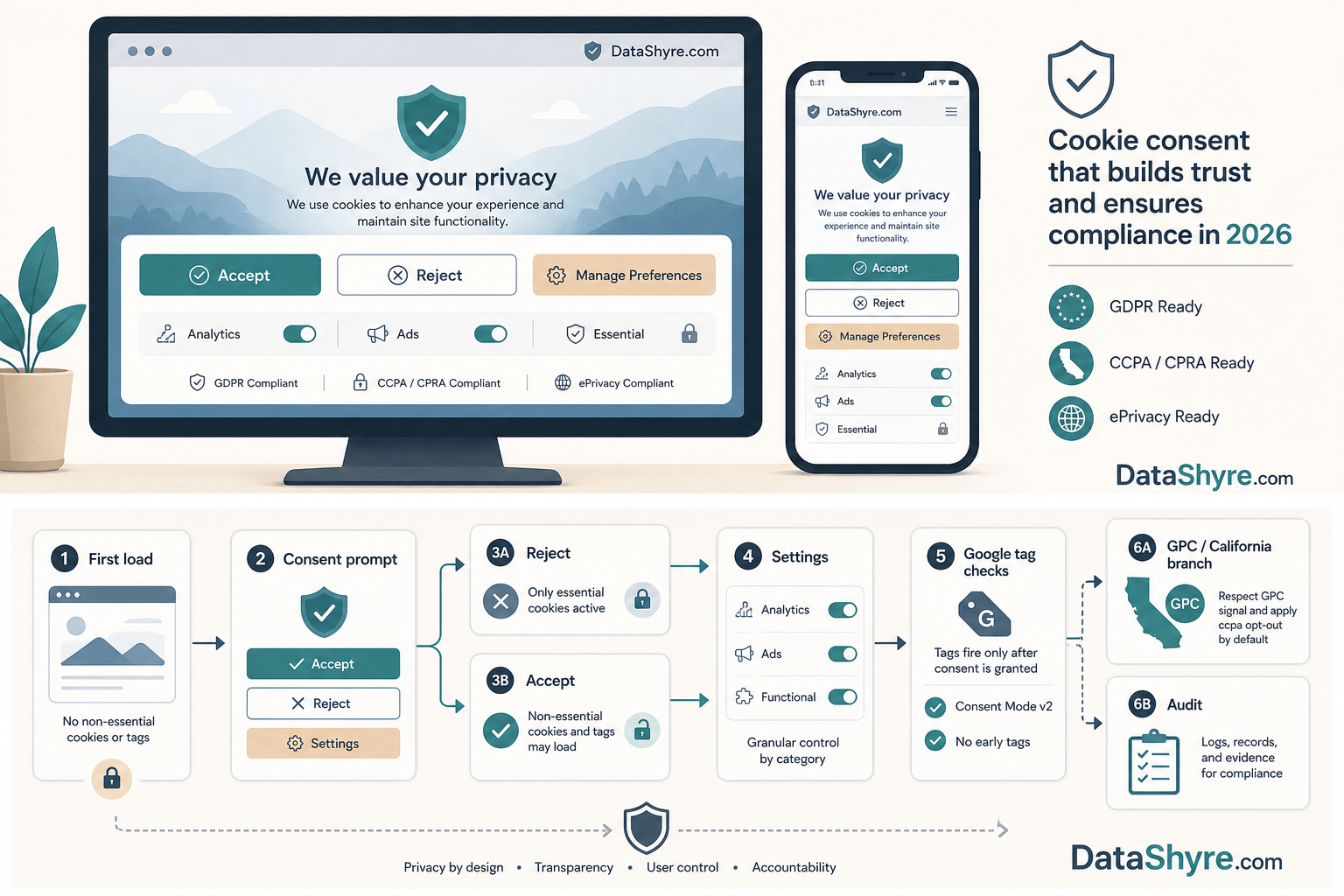
California’s Department of Justice still says the CCPA gives consumers the right to opt out of sale or sharing, including through a user-enabled Global Privacy Control. Its GPC page still describes that signal as a “stop selling or sharing my data switch.” The CPPA’s advisory on dark patterns tells businesses to offer symmetrical choices in privacy interfaces. And California’s enforcement record is getting more concrete: on February 11, 2026, the Attorney General announced a $2.75 million settlement with Disney over allegations that opt-out requests were not fully effectuated across devices and services tied to a consumer account.
So one of today’s most practical cookie consent requirements is to test whether privacy choices travel as far as the data does. On some sites, that means a banner. On others, it means account-level propagation, GPC handling, and cross-service suppression of sale or sharing behavior.
8. Keep proof that survives the next publish
The final requirement is not visual either. It is evidentiary.
The ICO’s 2026 guidance includes practical material on managing consent, keeping records of preferences, and handling withdrawal. That is a reminder that a consent program is not only a UI pattern. It is an operating control that should leave evidence another person can review later.
My minimum evidence pack for cookie consent requirements would include:
- screenshots of the first layer on desktop and mobile;
- notes for no-choice, reject, accept, and withdrawal states;
- a short inventory of what fired before and after each choice;
- any California, publisher, or account-linking branch notes that apply; and
- the release date or ticket tied to the review.
That record is what makes the next audit or remediation pass faster.
A short review order for this week
If I were checking cookie consent requirements today, I would do it in this order:
- define which legal branch applies by region and use case;
- review whether the first-layer choices are symmetrical on desktop and mobile;
- confirm purpose labels are plain enough to match the real tools in use;
- test no-choice behavior before testing acceptance;
- verify Google tag timing or publisher-CMP requirements if Google advertising products are in play;
- test withdrawal and reopened settings;
- test California GPC or opt-out propagation where relevant; and
- save proof before the next release changes the page again.
That order usually finds the real problem faster than another round of banner mockups.
FAQ
Do cookie consent requirements mean every site needs the same banner?
No. The live requirements depend on the technologies in use, the regions served, and whether you are dealing with prior-consent rules, opt-out rules, or publisher-specific platform requirements.
Is a visible reject button enough by itself?
No. It helps, but the network, storage, and downstream tool behavior still need to match the choice the interface presents.
If Google Consent Mode is configured, are we done?
No. Consent Mode covers part of the measurement and advertising path. It does not automatically solve non-Google scripts, embedded features, regional branching, or legal disclosure quality on its own.
Bottom line
The best answer to cookie consent requirements in 2026 is not add a banner.
It is to make the banner balanced, the purposes plain, the non-essential technologies wait when they should, the Google timing honest, the California branch distinct, the withdrawal path easy, and the proof durable enough to survive the next publish.
If your current setup cannot pass those live checks, it is not ready just because the interface appears on screen.
Sources
- ICO, “Guidance on the use of storage and access technologies”: https://ico.org.uk/for-organisations/direct-marketing-and-privacy-and-electronic-communications/guidance-on-the-use-of-storage-and-access-technologies/
- ICO, “How do we comply with the PECR rules?”: https://ico.org.uk/for-organisations/direct-marketing-and-privacy-and-electronic-communications/guidance-on-the-use-of-storage-and-access-technologies/how-do-we-comply-with-the-pecr-rules/
- ICO, “How do we manage consent in practice?”: https://ico.org.uk/for-organisations/direct-marketing-and-privacy-and-electronic-communications/guidance-on-the-use-of-storage-and-access-technologies/how-do-we-manage-consent-in-practice/
- ICO, “How do the rules apply to online advertising?”: https://ico.org.uk/for-organisations/direct-marketing-and-privacy-and-electronic-communications/guidance-on-the-use-of-storage-and-access-technologies/how-do-the-rules-apply-to-online-advertising/
- European Commission, “Legal grounds for processing data”: https://commission.europa.eu/law/law-topic/data-protection/information-business-and-organisations/legal-grounds-processing-data_en
- CNIL, “Dark Patterns in Cookie Banners: CNIL issues formal notice to website publishers”: https://www.cnil.fr/en/dark-patterns-cookie-banners-cnil-issues-formal-notice-website-publishers
- Google for Developers, “Set up consent mode on websites”: https://developers.google.com/tag-platform/security/guides/consent
- Google AdSense Help, “Google consent management requirements for serving ads in the EEA, the UK, and Switzerland (for publishers)”: https://support.google.com/adsense/answer/13554116?hl=en
- California Department of Justice, “California Consumer Privacy Act (CCPA)”: https://oag.ca.gov/privacy/ccpa
- California Department of Justice, “Global Privacy Control (GPC)”: https://oag.ca.gov/privacy/ccpa/gpc
- California Privacy Protection Agency, “Enforcement Advisory No. 2024-02”: https://cppa.ca.gov/pdf/enfadvisory202402.pdf
- California Department of Justice, “California Won’t Let It Go: Attorney General Bonta Announces $2.75 Million Settlement with Disney, Largest CCPA Settlement in California History”: https://oag.ca.gov/news/press-releases/california-wont-let-it-go-attorney-general-bonta-announces-275-million
—
Published: October 24, 2026. Updated using current official regulator, government, and platform materials available at publication time.