GDPR Consent Requirements in 2026: 7 Checks Before You Rely on Consent
DataShyre StaffAug 7, 2026
8 min read
GDPR Consent Requirements in 2026: 7 Checks Before You Rely on Consent
If you are reviewing gdpr consent requirements on August 7, 2026, the important question is not whether your form has a checkbox. It is whether consent is the right lawful basis at all, whether each purpose is explained clearly enough, whether the user takes a real affirmative step, and whether your systems can later prove what happened.
That is still where teams get into trouble. The European Commission’s current guidance still says people must be told the purpose of the processing, the legal basis, who receives the data, and their right to withdraw consent at any time. The ICO’s current consent guidance still says valid consent must be freely given, specific, informed and unambiguous, and its website-tracking guidance keeps pushing the same operational direction in 2026: choices must be real, refusal must be usable, and records have to match the live behavior.
If you want the adjacent guides first, start with our articles on GDPR consent form, GDPR marketing consent, and GDPR cookie consent requirements. This article is broader. It is the seven-check review I would use before trusting gdpr consent requirements in a live program.
Why this topic still gets misread
The phrase gdpr consent requirements sounds simple, but it usually hides several different checks:
whether consent is the right lawful basis for the processing;
whether separate purposes have been bundled together;
whether the request is clear enough for a normal person to understand;
whether refusal and withdrawal are genuinely practical;
whether downstream systems obey the choice after it is made.
That is why a compliant-looking form can still fail a serious review. The visible wording might be tidy while the legal basis is wrong, the purposes are over-bundled, or the back-end keeps doing things the front-end said were optional.
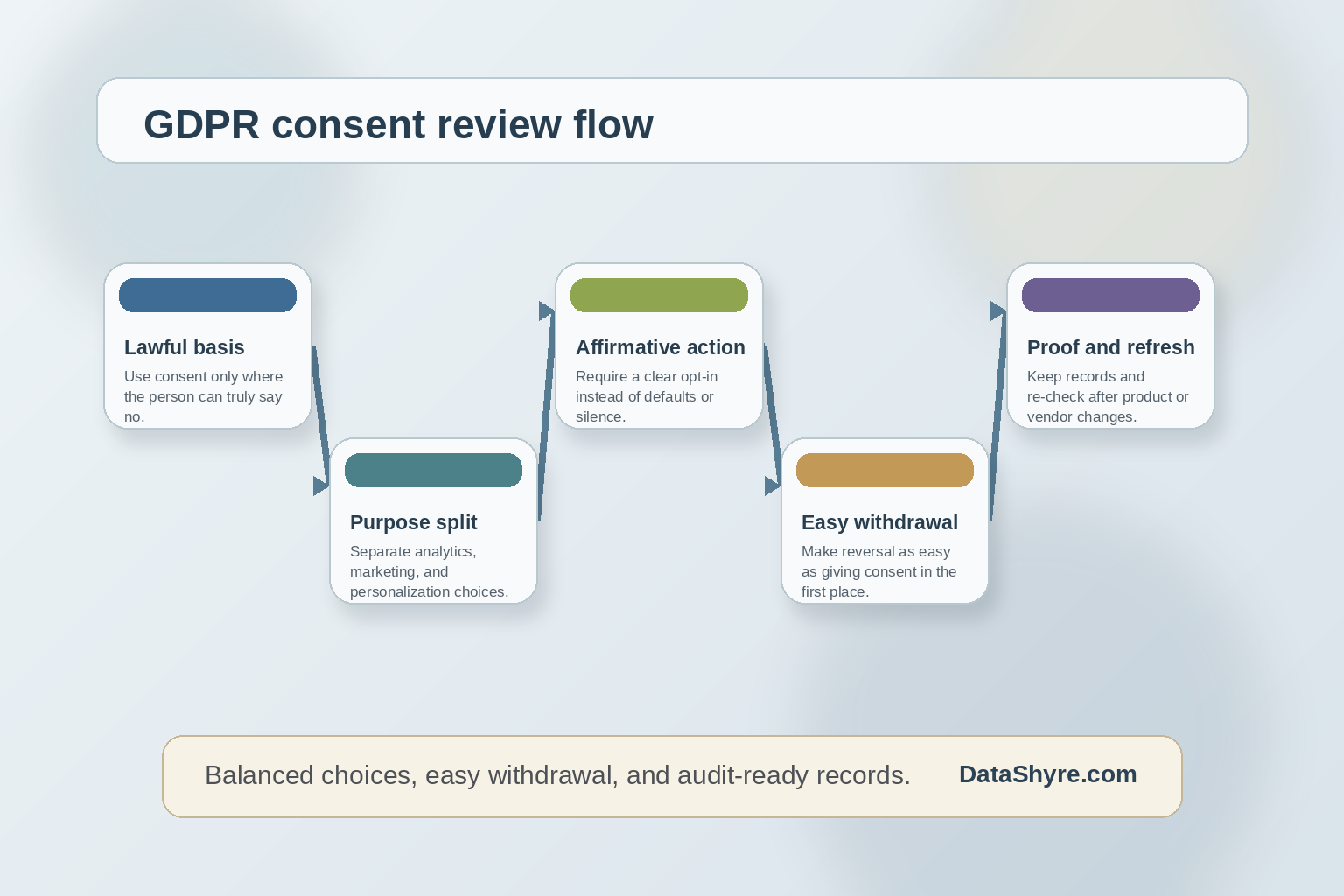
1. Start by asking whether consent is the right lawful basis
This is the first filter because many consent flows are built to solve the wrong problem.
The European Commission still presents consent as only one lawful basis among several. That matters because if a service really depends on a processing activity to perform the contract, or if another lawful basis fits better, adding a consent box can make the explanation worse rather than safer.
The ICO’s current consent guidance says consent is not freely given if the person has no real choice, and it warns against making a service conditional on consent to processing that is not necessary for the service. So one of the most important gdpr consent requirements is upstream from the interface: do not call something consent-driven if the person cannot realistically say no.
2. Split separate purposes instead of flattening everything into one yes
This is where many programs drift from understandable to legally weak.
The ICO’s guidance says separate consent is needed for different processing operations wherever appropriate, and that a consent request must specifically cover all purposes for which consent is sought. That means one broad “I agree” line is often too blunt when several different uses are involved.
For gdpr consent requirements, common separation points include:
account updates versus marketing;
first-party analytics versus advertising;
internal personalization versus third-party sharing;
one communication channel versus another.
Granularity does not mean creating a maze. It means the person can see what they are agreeing to and can say yes to one purpose without being forced into several others.
3. Make the request clear, prominent, and separate from other terms
Consent language still fails when it tries to do too much at once.
The European Commission’s current individuals guidance says the information about processing should be presented in a concise, transparent, intelligible way and drafted in clear and plain language. The ICO says the request must be prominent, concise, separate from other terms and conditions, and easy to understand.
So a solid gdpr consent requirements review checks whether the user can quickly identify:
who is asking;
what data will be used;
why it will be used;
who else will receive it;
how consent can later be withdrawn.
If those answers only appear after several clicks, are hidden inside legal boilerplate, or rely on vague phrases like “improve your experience,” the request is weaker than it looks.
4. Require a real affirmative action and avoid defaults
This is still one of the clearest bright lines in regulator guidance.
The ICO quotes the GDPR standard that consent must come from a clear affirmative act and says silence, pre-ticked boxes, inactivity, and default settings do not count as valid consent. That makes gdpr consent requirements much more concrete in practice than some teams expect.
The operational rule is simple:
unticked boxes are safer than preselected ones;
scrolling or continued browsing is not a substitute for opt-in;
vague acceptance of general terms is not the same as consenting to specific processing;
interface nudges should not manufacture ambiguity.
The person should be able to point to one deliberate action and say, “That is the choice I made.”
5. Make withdrawal as easy as giving consent
This is not an optional usability improvement. It is part of the legal structure.
The European Commission says users must be informed of the right to withdraw consent at any time, and it gives the familiar standard that withdrawal should be as easy as giving consent. The ICO says people must be able to refuse consent without detriment and withdraw it easily at any time.
For gdpr consent requirements, that means the withdrawal path should not depend on:
emailing support and waiting;
navigating several buried settings pages;
losing core access where the processing was not actually necessary;
inconsistent controls across web, app, CRM, or marketing systems.
If consent can be given in one click but takes a support thread to reverse, the program is not in a strong position.
6. Keep records that reconstruct what the person actually saw and chose
Consent without proof gets fragile very quickly.
The ICO’s consent-record guidance says organizations should keep evidence of who consented, when they consented, how they consented, and what they were told at the time. If consent was given online, the records should include the submitted data and a timestamp linked to the relevant version of the data-capture form. The same guidance also says records should show whether consent was later withdrawn, and when.
That is one of the most practical gdpr consent requirements in the whole stack. A checkbox value alone is weak evidence. A stronger record connects:
the version of the request shown to the user;
the purpose or purposes selected;
the time and source of the interaction;
any downstream changes after consent or withdrawal.
This is also where website programs and cookie banners keep intersecting. CNIL’s cookie-banner notice says “rejecting cookies should be just as easy as accepting them”, which means proof should cover not only the stored preference but the behavior that followed it.
7. Re-check consent whenever the purpose or downstream behavior changes
Consent does not quietly stretch to cover everything you decide to do later.
The ICO says consent must stay specific and that organizations should refresh it if purposes or activities evolve beyond what was originally specified. The European Commission’s current guidance also reminds organizations that people must be informed of the purposes, recipients, and key rights tied to the processing.
So the final gdpr consent requirements check is governance:
if a new recipient is added, re-check the disclosure;
if the purpose changes, re-check the legal basis;
if a vendor, tag, or workflow changes the live behavior, re-test the consent path;
if records no longer match the current interface, rebuild the proof model.
This is why mature teams treat consent as release work, not as a one-time copy task.
A short review sequence for this week
If I were checking gdpr consent requirements on a live project right now, I would use this order:
Confirm that consent is actually the correct lawful basis.
List every purpose, recipient, and channel that currently relies on it.
Review the request for clarity, separation, and plain language.
Test that the opt-in action is genuinely affirmative and free of defaults.
Test refusal and withdrawal paths on the same devices and channels users actually use.
Verify that records link the consent text, timestamp, source, and later status changes.
Re-test after any vendor, workflow, or product change that affects the processing.
That sequence catches more real defects than rewriting the checkbox line one more time.
Bottom line
The real lesson of gdpr consent requirements in 2026 is that consent is not just a permission string. It is a legal-basis decision, a UX decision, and a systems decision all at once.
If your team uses consent only where it fits, separates purposes clearly, asks in plain language, collects a real affirmative act, makes withdrawal easy, and keeps records that still make sense later, you are in much stronger shape. If not, the checkbox may be finished while the consent program is not.