

Cookie Declaration in 2026: What It Should Show and 7 Live Checks
If you are searching for cookie declaration on November 16, 2026, the useful answer is not where do I paste the widget.
It is this:
a cookie declaration only helps if it describes the live tracking stack accurately enough for a user, auditor, or internal team to see what is happening right now.
In practice, teams use cookie declaration to mean the structured cookie-and-tracker disclosure layer that lists names, providers, purposes, durations, and categories.
That matters because the official expectations are still practical, not decorative. The ICO’s finalized 2026 guidance says users should get “clear and comprehensive information” about the technologies in use, including third parties and how long the access or storage lasts. Your Europe still says “Not all cookies require your consent.” The European Commission still says consent information should use “clear and plain language” and withdrawal should be as easy as giving consent. And on October 22, 2026, the CNIL fined FNAC DARTY companies 7 million euros over a mobile-app tracker used without prior consent.
So a strong cookie declaration is not a decorative appendix.
It is part disclosure, part runtime inventory, and part evidence that the banner, policy, and site behavior tell the same story.
If you want nearby context first, start with our guides to cookie policy, cookie checker, and website privacy checker. This page stays narrower. It is the cookie declaration review I would use this week before trusting a CMP export, a policy update, or a vendor claim.
If your declaration is being generated by a CMP but the live site keeps drifting, DataShyre can help audit the stack, clean up the categorization, and make sure the published declaration matches what users actually face.
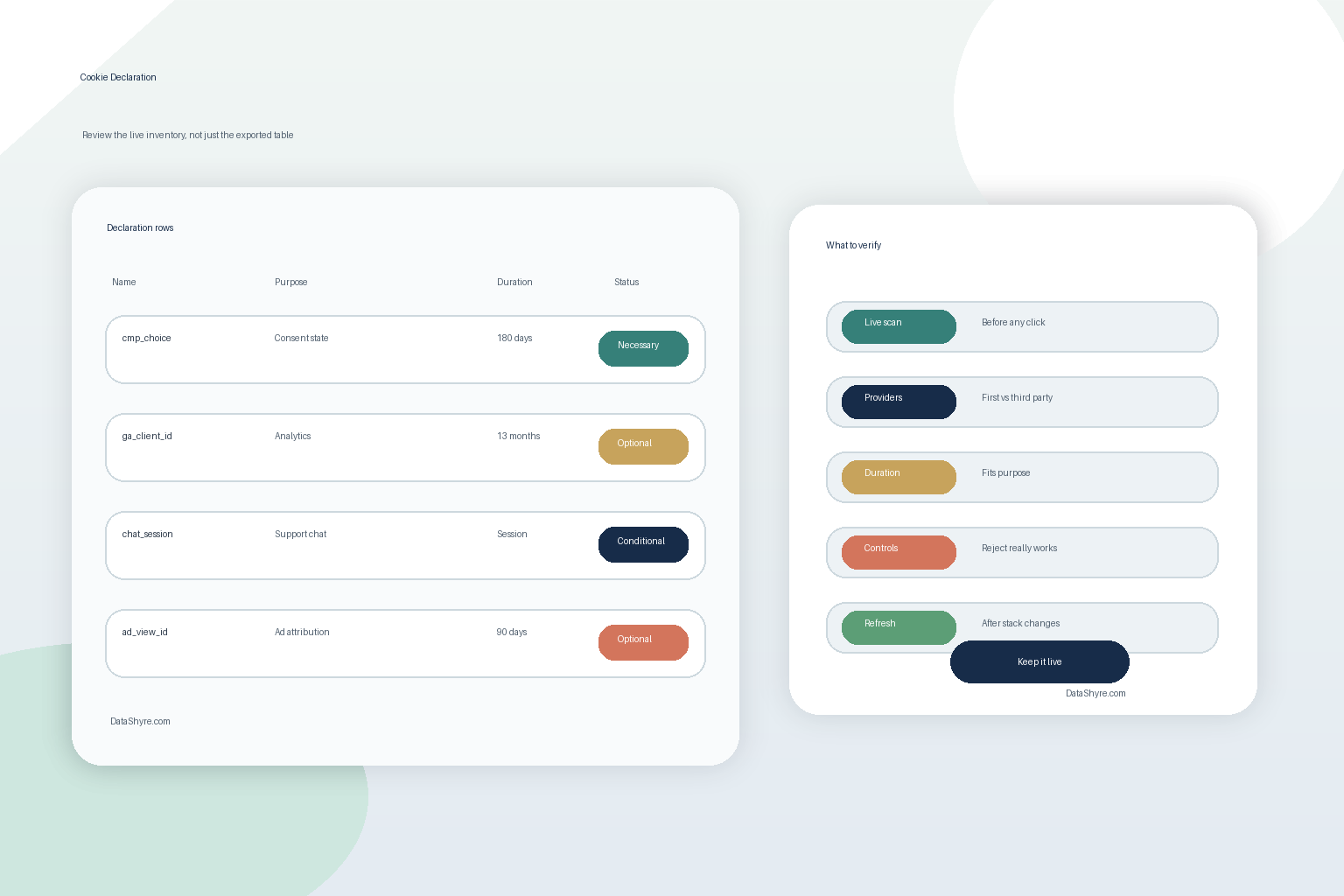
1. Start from the live site, not from the declaration itself
The most common cookie declaration mistake is assuming the table is the source of truth.
Usually it is not.
It is only a view of whatever the scan, CMP, or tagging setup managed to detect at a given time.
The ICO’s current guidance is a good reality check because it says the disclosure needs to cover what technologies are in use, what they do, whether third parties are involved, and how long they operate. That means the declaration should begin with a live inventory review, not with formatting.
Before approving a cookie declaration, confirm:
- what cookies or similar technologies appear before choice;
- what changes after reject, necessary-only, and accept paths;
- which provider controls each technology;
- whether the purpose label matches the real behavior; and
- whether the table covers scripts, pixels, SDKs, or storage beyond classic cookies.
If the live runtime changed after the last scan, the declaration may already be stale.
2. Show purpose, provider, and duration in language a normal person can use
A weak cookie declaration lists technical names and assumes the job is done.
That is not enough.
The ICO still points directly to the fields people actually need: purpose, third-party involvement, and duration. The European Commission’s wider transparency guidance keeps the readability bar high by requiring information to be clear, concise, and easy to understand.
So a useful cookie declaration should let a reader answer, fast:
- what this technology is for;
- who sets or receives it;
- whether it is first-party or third-party;
- how long it lasts; and
- where the user can control or withdraw the related choice.
If the declaration is only readable to someone who already knows the vendor stack, it is under-explaining the part that matters.
3. Separate necessary functions from optional tracking honestly
This is where a cookie declaration often becomes misleading without sounding misleading.
Your Europe still explains that some cookies do not require consent when they are used only for transmitting a communication or for a service explicitly requested by the user, such as load balancing or a shopping basket. That same page also makes clear that consent is generally needed before installing other cookies.
So a working cookie declaration should distinguish at least:
- strictly necessary or service-requested functions;
- measurement or analytics tools;
- personalization features;
- advertising or cross-context tracking technologies; and
- third-party embeds that add tracking behavior.
If every item ends up under necessary, the declaration is not helping anyone assess risk or choice.
4. Make the declaration agree with the banner, settings panel, and withdrawal route
A cookie declaration cannot be reviewed in isolation.
It has to line up with the controls the user actually sees.
The CNIL’s current FAQ says users should be able to refuse trackers as easily as they accept them. The European Commission still says withdrawal should be as easy as giving consent. So if the declaration says the user can change or withdraw later, that route should be easy to find and actually work.
For a practical cookie declaration review, compare it against:
- the first-layer banner copy;
- the category labels inside the preference center;
- the reject-all and accept-all paths;
- the later
manage cookiesor equivalent route; and - the actual change in runtime behavior after the user changes their mind.
If the declaration promises control but the page behavior stays the same, the declaration has turned into theater.
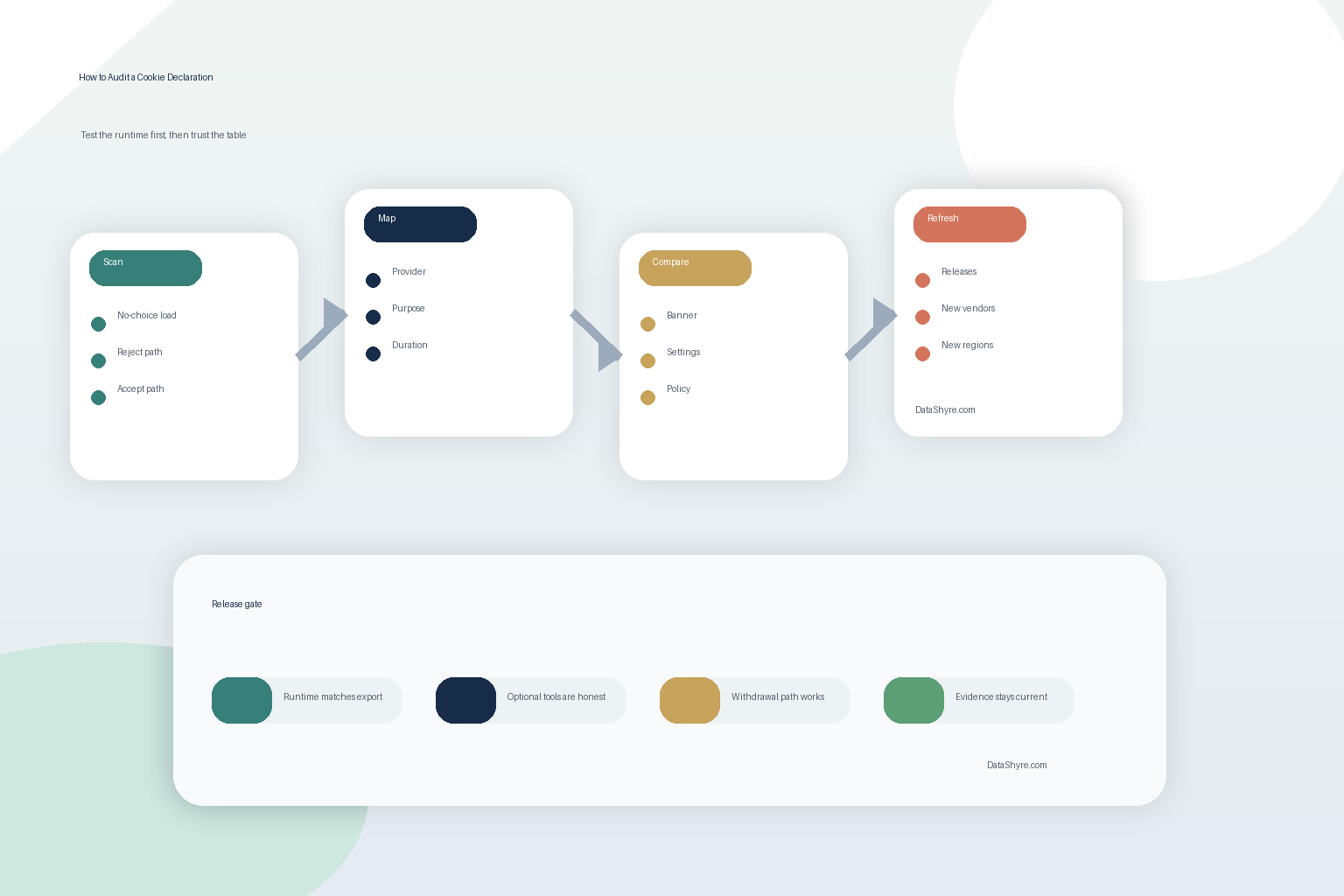
5. Cover more than classic cookies
Older cookie declaration pages often go stale because they behave as if the review ends at named browser cookies.
The ICO’s April 29, 2026 guidance uses the broader concept of storage and access technologies. That includes cookies, but also other ways of storing or accessing information on a device. The FNAC enforcement notice is another reminder that regulators care about tracker behavior, purpose, and timing, not only about whether a cookie table exists.
That means a serious cookie declaration review should also account for:
- pixels and tracking beacons;
- local or session storage;
- mobile SDKs where relevant;
- embedded video, chat, or map tools;
- tag-manager-delivered scripts; and
- third-party calls that create user-linked identifiers.
If the declaration only reflects one browser cookie export, it may miss the riskiest part of the stack.
6. Treat the declaration as evidence that needs refresh triggers
The best cookie declaration is still only a snapshot.
That is why maintenance matters so much.
The ICO says you should consider whether the duration of a cookie is appropriate for its purpose. CNIL says keeping accept or reject choices for about six months is generally appropriate. Those points matter because stale durations, stale vendor lists, or stale classifications undermine the credibility of the whole page.
I would refresh a cookie declaration when:
- a new vendor, plugin, or embed goes live;
- tag-manager logic changes;
- consent categories or defaults change;
- the business launches a new region, domain, or app surface;
- retention windows or identifiers change; or
- the privacy team discovers uncategorized technologies in testing.
If the page was last reviewed months ago but releases are happening weekly, the declaration is probably lagging reality.
7. Keep the declaration aligned with the wider privacy notice
A cookie declaration should go deeper on tracking detail.
It should not replace the rest of the privacy notice.
That is especially important if your site also has California-facing obligations around broader data collection, sharing, and rights disclosures. The declaration can support those disclosures by being more precise about technologies, providers, durations, and controls, but it should not become the only disclosure layer.
In practice, that means:
- the cookie declaration explains technologies and user controls;
- the privacy policy explains the wider collection, sharing, retention, and rights picture; and
- both pages should agree on who receives data, why, and what the user can do next.
That is another place where DataShyre can help. If your declaration, banner, and privacy notice have drifted apart, DataShyre can help reconcile the stack and implementation so the disclosure layer is operational again.
A practical cookie declaration review order
If I were reviewing a cookie declaration today, I would use this order:
- inspect the live site before any choice is made;
- compare reject, necessary-only, and accept behavior;
- map each technology to provider, purpose, and duration;
- confirm necessary versus optional classifications;
- compare the declaration against the banner and settings panel; and
- set the next re-review trigger before the next release cycle.
That usually catches the real problems faster than polishing the table layout first.
FAQ
What is a cookie declaration?
Usually it is the structured disclosure layer that lists cookies or similar tracking technologies, their providers, purposes, durations, and categories, often alongside a route to manage consent later.
Is a cookie declaration the same as a cookie policy?
Not exactly. A cookie declaration is usually the detailed table or inventory view. A cookie policy is the broader explanatory page around technologies, purposes, controls, and related disclosures.
Does a cookie declaration prove compliance by itself?
No. It helps only if it matches the live runtime, the banner behavior, the settings panel, and the wider privacy notice.
Bottom line
The strongest cookie declaration in 2026 is not the longest exported table.
It is the one that stays accurate about purpose, provider, duration, consent status, and withdrawal routes because those details still match the site users are actually visiting.
Sources
- ICO, Guidance on the use of storage and access technologies: https://ico.org.uk/for-organisations/direct-marketing-and-privacy-and-electronic-communications/guidance-on-the-use-of-storage-and-access-technologies/
- ICO, What are the PECR rules?: https://ico.org.uk/for-organisations/direct-marketing-and-privacy-and-electronic-communications/guidance-on-the-use-of-storage-and-access-technologies/what-are-the-pecr-rules/
- ICO, How do we comply with the PECR rules?: https://ico.org.uk/for-organisations/direct-marketing-and-privacy-and-electronic-communications/guidance-on-the-use-of-storage-and-access-technologies/how-do-we-comply-with-the-pecr-rules/
- European Commission, Legal grounds for processing data: https://commission.europa.eu/law/law-topic/data-protection/information-business-and-organisations/legal-grounds-processing-data_en
- Your Europe, Data protection and online privacy: https://europa.eu/youreurope/citizens/consumers/internet-telecoms/data-protection-online-privacy/index_en.htm
- CNIL, Questions-réponses sur les lignes directrices modificatives et la recommandation « cookies et autres traceurs »: https://www.cnil.fr/fr/cookies-et-autres-traceurs/regles/cookies/FAQ
- CNIL, Cookies and mobile application: 7 million euros fine against FNAC DARTY PARTICIPATIONS ET SERVICES and FNAC DIRECT: https://www.cnil.fr/en/sanction-app-cookies-fnac