

Cookie Consent Banner in 2026: A Live-Site Checklist for Equal Choice, Blocking, and Withdrawal
If you are reviewing a cookie consent banner on August 19, 2026, the practical question is not whether the banner looks polished in a design review. It is whether the visitor gets a fair choice, whether optional technologies stay off until that choice is made where required, and whether the result still holds up on the live site after tags, embeds, and regional logic all start interacting.
That framing still matches the current regulatory baseline. The UK ICO finalized its storage-and-access technologies guidance on April 29, 2026 and made clear the review reaches beyond classic cookies into tracking pixels, device fingerprinting, scripts, tags, and similar technologies. The European Commission still says valid consent must be freely given, specific, informed, and unambiguous, and that people must be able to refuse or withdraw consent without disadvantage. On July 14, 2026, the EDPB required the Belgian DPA to handle the merits of a NOYB cookie-banner complaint involving broadcaster VRT. In California, the Department of Justice still says a qualifying Global Privacy Control signal must be honored by covered businesses as a valid request to stop the sale or sharing of personal information, and the CPPA’s laws-and-regulations page lists the current CCPA law and regulations as effective on January 1, 2026.
If you want the adjacent implementation detail first, start with our guides to cookie consent message, Google Tag Manager cookie consent, and CCPA consent requirements. This article is narrower. It is the live-site checklist I would use before trusting a cookie consent banner this week.

Why a cookie consent banner should be reviewed as runtime behavior
A cookie consent banner is only the visible front layer of a much larger control system.
The real review has to cover where optional technologies may start across:
- direct site tags;
- Google Tag Manager or other tag managers;
- analytics and advertising scripts;
- video, map, chat, scheduling, and form embeds;
- pixels and server-side connectors;
- region-specific privacy logic;
- later withdrawal and preference updates.
That is why the ICO’s April 2026 guidance matters so much. It explicitly reaches storage-and-access technologies beyond old cookie-only checklists. If your review stops at button labels and screenshots, you are probably checking presentation more than behavior.
The same logic applies to consent design. The European Commission still gives the simplest user test:
“It should be as easy to withdraw as to give consent.”
If the banner promises control but the live site cannot actually honor rejection or later withdrawal, the implementation is weaker than the interface suggests.
7 checks before you trust a cookie consent banner on a live site
1. Check whether Reject all is as usable as Accept all
This remains the fastest first-layer test.
CNIL still puts the design rule plainly:
“rejecting cookies should be just as easy as accepting them.”
For a cookie consent banner, that means testing the real first interaction on desktop and mobile, not only reviewing a design mockup. If Accept all is immediate while rejection is hidden behind extra clicks, weaker contrast, or softer wording, the banner is nudging the decision rather than simply collecting it.
2. Test what fires before any choice on the templates that matter
The homepage is not enough.
The useful review is whether optional technologies stay off on the pages where they are most likely to appear:
- marketing landing pages;
- blog posts with embedded video;
- support pages with chat;
- product or pricing pages with ad and analytics tags;
- checkout or account flows with extra scripts.
The ICO’s current guidance matters here because it reaches cookies, pixels, scripts, and fingerprinting-like technologies, not just one storage mechanism. A cookie consent banner that looks compliant while optional tools still activate too early on key templates is not working as a control.
3. Verify the region logic instead of assuming one banner solves every audience
One polished banner can still mask multiple legal paths.
In the EU and UK, the operational issue is often whether non-essential technologies stay off until valid consent exists. In California, the path may center more on notice, opt-out, sale-or-sharing analysis, and preference-signal handling. The California DOJ’s GPC page still says the signal must be honored by covered businesses as a valid request to stop sale or sharing.
That means a cookie consent banner review should force separate tests for:
- EU or UK prior-consent behavior;
- California privacy-choice language and downstream suppression;
- qualifying browser privacy-signal handling where relevant;
- later return-to-settings behavior in each path.
4. Follow the banner choice into Google consent timing
This is where many teams stop too early.
Google’s current consent mode guidance still says you should set the default consent state before a user grants consent and make sure consent updates are tracked on the page where they occur before any page transition. In practice, that means a cookie consent banner cannot be approved only because the correct buttons appear. You also need to verify whether the downstream Google tags actually receive the expected default and update states at the right time.
This matters most after:
- tag-manager publishes;
- performance-plugin changes;
- script deferral or lazy-loading changes;
- SPA navigation or custom page transitions;
- banner-plugin updates.
If the banner stores a preference but tags behave as if nothing changed, you have a record of intent, not a reliable enforcement path.
5. Treat ad-supported implementations as their own checkpoint
Publisher and ad-supported sites need an extra pass.
Google’s current publisher help still says a certified CMP integrated with the IAB Transparency and Consent Framework is required when serving personalized ads to users in the EEA, the UK, or Switzerland, and Google also says certification does not amount to full legal compliance by itself.
So for a cookie consent banner, ad-supported teams should test both layers:
- the user-facing fairness and blocking behavior;
- the separate publisher requirements that determine whether personalized ads remain eligible.
6. Reopen settings and confirm withdrawal changes real behavior
Many banners pass the first click and fail the second.
Accept optional categories, browse a little, reopen preferences, withdraw those categories, and test what happens next. The Commission’s standard is still the right one: withdrawal should be as easy as giving consent.
The practical question is whether the site actually changes behavior after withdrawal:
- do optional tags stop or remain suppressed on later pages;
- do embeds stay blocked again where they should;
- do advertising or analytics settings update consistently;
- do records reflect the revised choice clearly enough for later review.
If not, the cookie consent banner is documenting a choice more than enforcing one.
7. Re-test after every meaningful release change
This is the control that keeps a good setup from quietly drifting.
The EDPB’s July 14, 2026 VRT decision is a reminder that cookie-banner scrutiny is still active. The implementation behind the banner matters. On live sites, that implementation changes whenever teams update themes, plugins, tags, embeds, consent categories, or infrastructure settings.
That is why a cookie consent banner should be tied to release review after:
- new vendors or embeds;
- tag-manager container changes;
- cache, CDN, or optimization changes;
- consent-plugin updates;
- regional copy and category updates.
If those changes happen without a re-test, the banner may still look identical while the control path underneath it has materially shifted.
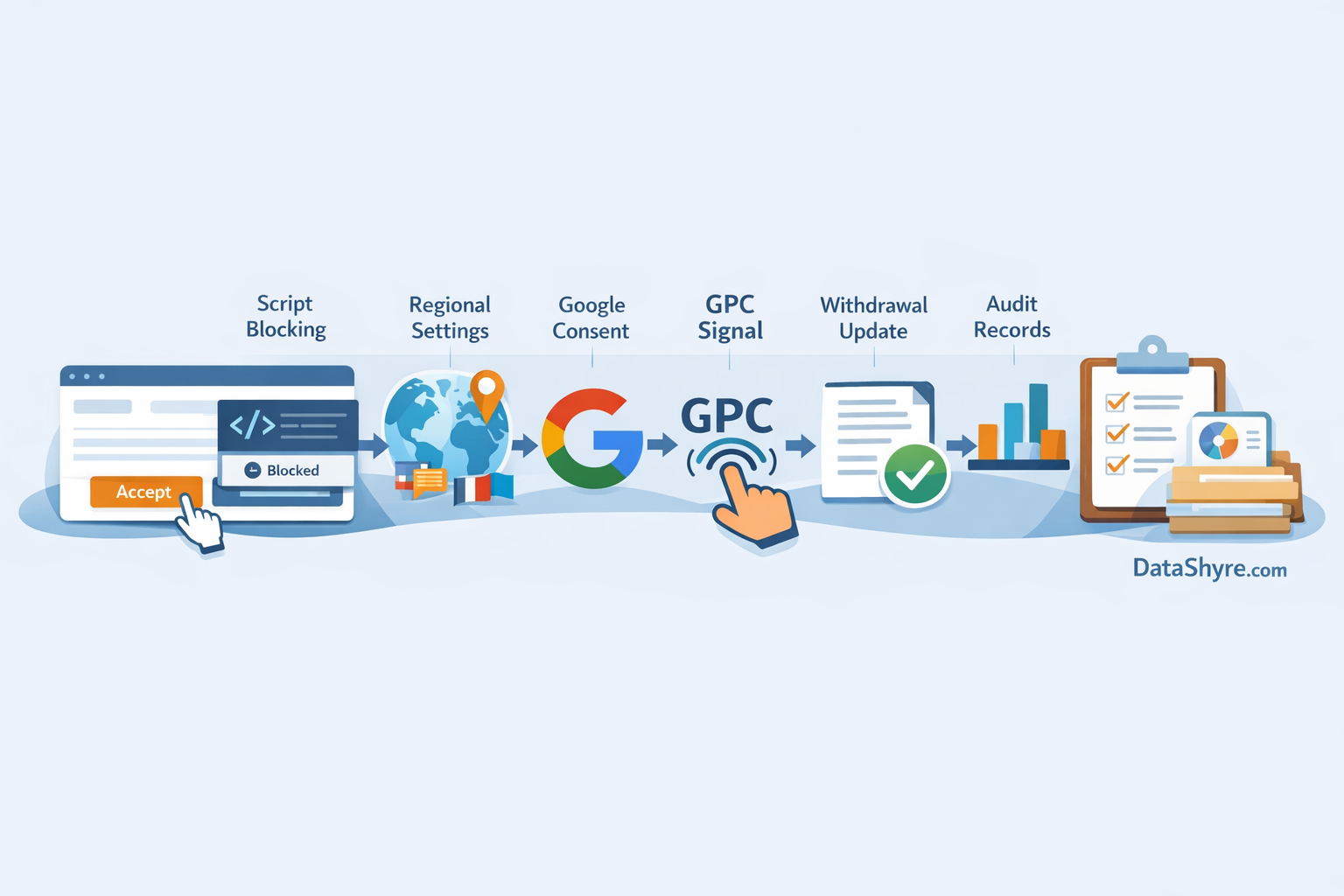
A short live-site review sequence I would run this week
If I had ten minutes to review a cookie consent banner before launch, I would do this in order:
- Open the site in a clean browser session and note what runs before any interaction.
- Test
Reject allfirst on the pages that carry the most optional technologies. - Allow one optional category only and verify the downstream behavior changes.
- Reopen settings and confirm withdrawal still changes later behavior.
- Run a California-facing test with GPC enabled where sale-or-sharing rules could apply.
- Check whether Google consent defaults and updates land before measurement starts.
- Save a simple record that another stakeholder could understand later.
That sequence usually reveals more real risk than another hour spent refining banner copy.
Bottom line
The strongest cookie consent banner in 2026 is not the one with the nicest layout. It is the one that preserves fair choice, keeps optional technologies aligned with that choice, separates regional rule paths where needed, and still works after the next release.
The ICO’s April 2026 launch note captured the point well when William Malcolm said people should have “meaningful control over how their data is used.” That is still the right operating standard. If your live site cannot provide that, the banner work is not finished yet.
Sources
- UK ICO: Guidance on the use of storage and access technologies
- UK ICO: Final storage and access technologies guidance published
- European Commission: When is consent valid?
- European Commission: Legal grounds for processing data
- California Department of Justice: Global Privacy Control
- California Privacy Protection Agency: Law & Regulations
- European Data Protection Board: Belgian DPA must handle the merits of a NOYB cookie-banner complaint
- CNIL: Dark Patterns in Cookie Banners: CNIL issues formal notice to website publishers
- Google for Developers: Set up consent mode on websites
- Google Ad Manager Help: Google consent management requirements for serving ads in the EEA, the UK, and Switzerland
This post was updated on August 19, 2026 using current official regulator, government, and platform materials available at publication time.