

Data Protection Consent in 2026: When You Need It, When You Don’t, and 8 Live Checks
If you are reviewing data protection consent in 2026, the first question is not how quickly you can add another checkbox or banner.
The first question is whether consent is actually the right legal basis for the processing you are doing.
That distinction matters because teams still overuse consent in places where another lawful basis may fit better, and they still underbuild consent where it really does need to be freely given, specific, informed, and easy to withdraw. The result is a messy system: legal text says one thing, the website runtime does another, and no one can prove which branch a user actually experienced.
If you want the narrower implementation angles first, start with our guides to cookie consent, GDPR consent form, and GDPR compliant privacy notice. This page is broader. It is the operating review I would use this week for data protection consent across websites, forms, and account flows.
1. Start by deciding whether consent is even the right legal basis
The biggest data protection consent mistake is treating consent as the default answer for every data use.
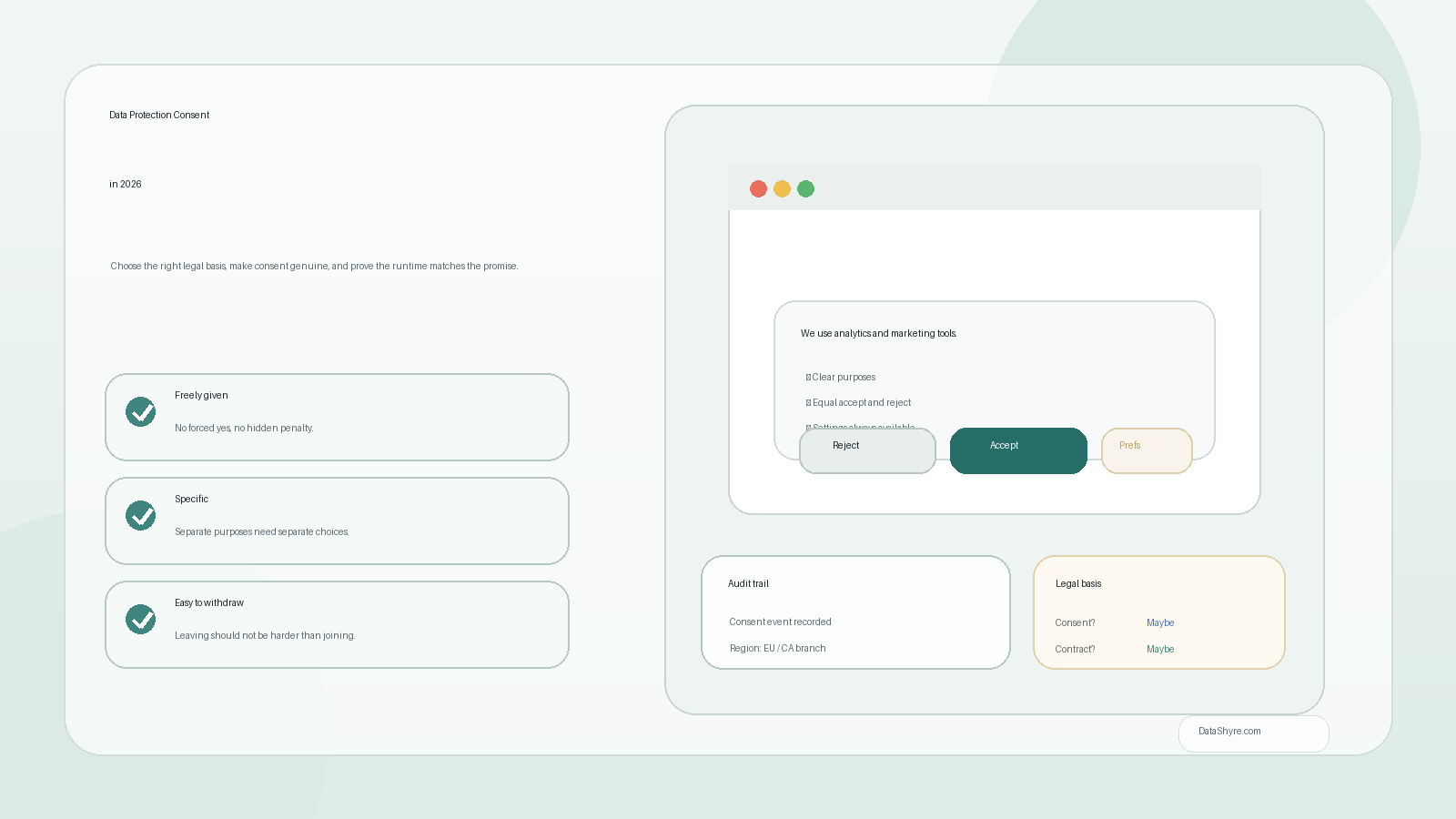
The European Commission’s current guidance still lists consent as only one of several possible legal grounds for processing. It also makes clear that valid consent must be freely given, informed, tied to a specific purpose, given through an affirmative act, written in “clear and plain language,” and withdrawable as easily as it was given.
That means a serious data protection consent review should start with purpose mapping:
- what personal data is being processed;
- for which exact purpose;
- whether consent is actually required for that purpose; and
- whether another lawful basis is being stretched into consent language for convenience.
If a team cannot explain why consent is needed, the checkbox is usually decoration, not compliance.
2. Check whether the consent is genuinely freely given
This is where many forms fail before any cookie banner is even involved.
The EDPB’s May 2026 consent summary says consent is invalid if a person feels compelled to agree or would face negative consequences for refusing. The same summary also warns against conditionality and imbalance of power.
That matters for data protection consent in real operating flows such as:
- job applications;
- employee data collection;
- sales or support forms;
- gated downloads;
- account registration; and
- loyalty or community programs.
If the person cannot realistically say no without losing something unnecessary to the core service, the consent model is already weak.
3. Separate purposes instead of bundling everything into one yes
Another common data protection consent failure is purpose bundling.
The EDPB says consent must be specific and granular. If you process data for multiple purposes, people should be able to choose which purpose they accept. The European Commission’s guidance points the same way by requiring the reasons for the processing to be stated clearly.
So if your flow mixes:
- account setup;
- product analytics;
- email marketing;
- remarketing;
- partner sharing; or
- personalization,
you should not compress all of that into one consent line.
For data protection consent, one visible checkbox covering five unrelated downstream uses is usually a signal that the legal and product layers were merged too lazily.
4. Make the consent action unmistakable, and stop using passive behavior as a shortcut
Valid data protection consent still depends on a real affirmative action.
The EDPB’s consent guidelines remain explicit that actions such as scrolling or swiping through a webpage do not satisfy the requirement for clear affirmative action. That is still one of the simplest live checks to run, because many interfaces quietly try to convert continued use into consent through layout, timing, or ambiguity.
For data protection consent, test whether the person is clearly:
- told what they are agreeing to;
- given a real action to take;
- able to refuse without hunting for the answer; and
- able to continue using the service where consent is not actually necessary.
If the flow depends on confusion, momentum, or silence, it is not a strong consent flow.
5. Treat cookie consent as a runtime-control problem, not a wording problem
This is the most visible branch of data protection consent, and it is still where many teams confuse banner copy with actual control.
On April 29, 2026, the ICO published its finalized storage-and-access-technologies guidance and said it covers cookies, tracking pixels, device fingerprinting, and similar technologies, not only classic cookie names. In the same announcement, the ICO said focused work had pushed 99% of the UK’s top 1,000 websites to its cookie-banner compliance standards and described the broader goal as giving people “meaningful control” over how their data is used.
CNIL’s December 12, 2024 notice on misleading cookie banners remains equally practical: rejecting cookies should be “just as easy as accepting them.”
So for data protection consent on the web, the live checks are not just textual:
- are non-essential technologies blocked before consent where prior consent is required;
- does
Reject allappear with similar prominence toAccept all; - are purposes explained clearly;
- are optional categories off by default where consent is required; and
- can users return to settings later without friction.
If the page loads trackers first and explains later, the site is not doing consent. It is doing post-hoc narration.
6. If you use Google tags, verify timing instead of trusting the settings screen
Many teams say they have data protection consent under control because a CMP or plugin looks configured correctly.
Google’s current developer guidance for consent mode still says the default consent command should be called on every page before commands that send measurement data such as config or event. It also says updates should occur on the page where the user acts, before any page transition.
That makes timing a concrete test:
- load the page with no stored preference;
- confirm denied defaults are present before measurement tags run;
- accept and verify the update lands immediately;
- reject and confirm optional measurement stays denied; and
- repeat on templates with different widgets, embeds, or scripts.
For data protection consent, a good dashboard is not enough. The browser has to show the right sequence.
7. Keep the California opt-out branch separate from the EU or UK consent branch
One data protection consent model does not fit every jurisdictional problem.
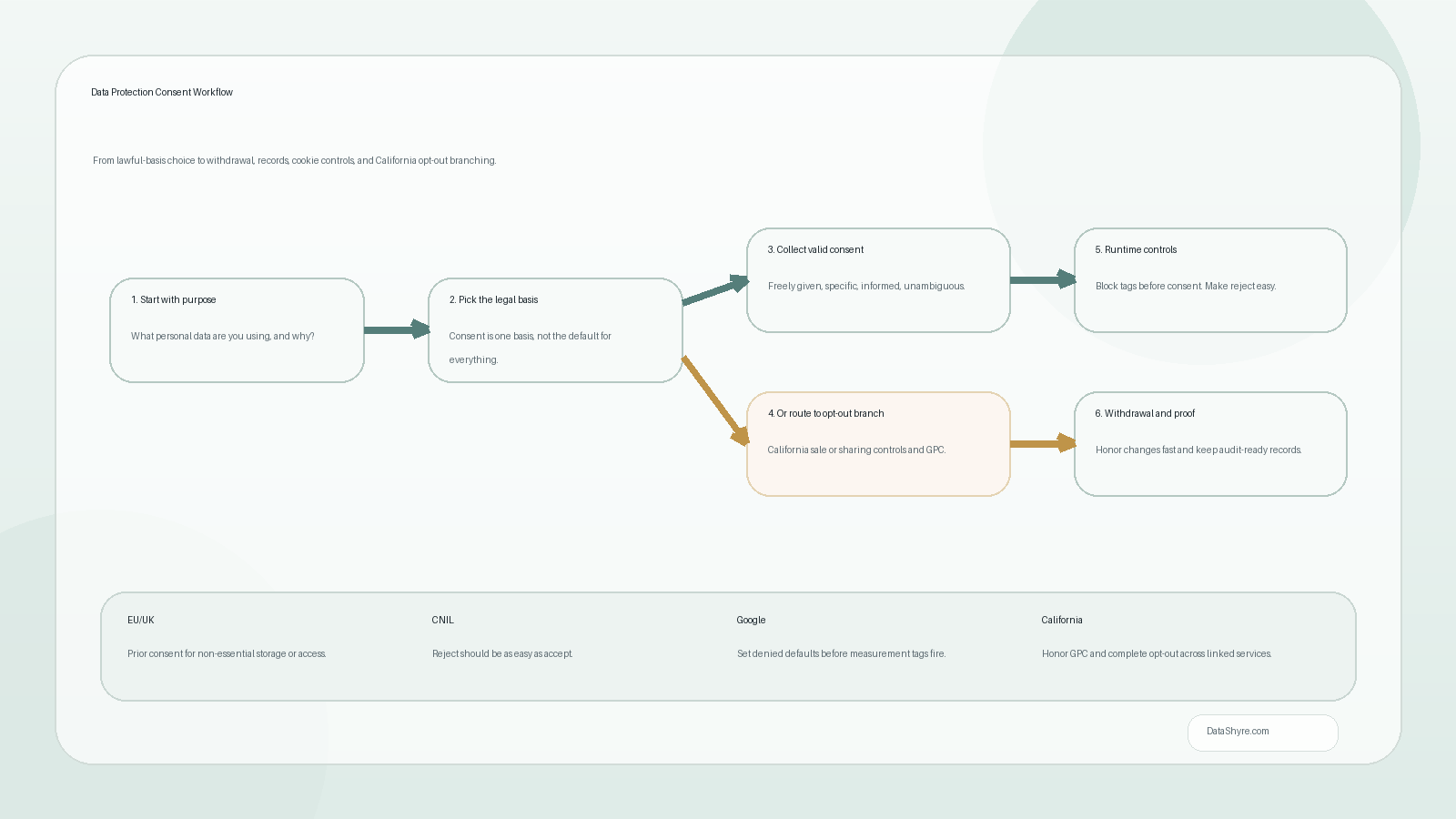
For EU and UK cookie or tracker scenarios, the live question is often whether non-essential storage or access waits for valid prior consent. California often asks a different question when sale or sharing is involved.
The California DOJ still describes Global Privacy Control as a “stop selling or sharing my data switch” and says covered businesses must honor it as a valid request to stop the sale or sharing of personal information.
That means some data protection consent reviews need a separate California branch:
- enable GPC in the browser;
- load the site with no saved preference;
- verify the sale-or-sharing path changes where it should;
- confirm notice text matches the actual opt-out behavior; and
- repeat on linked experiences, not only the homepage.
Teams get into trouble when they assume one polished consent layer automatically satisfies a distinct opt-out obligation.
8. Use recent enforcement to test whether your controls actually travel across accounts, devices, and services
This is the operational test many organizations still fail.
On February 11, 2026, California Attorney General Rob Bonta announced Disney’s $2.75 million settlement and said Disney failed to fully effectuate opt-out requests across devices and streaming services associated with consumers’ Disney accounts.
That matters well beyond streaming media. For data protection consent, it is a warning that a control can look finished in one interface while connected systems continue behaving as if nothing changed.
I would test whether the user’s choice actually propagates across:
- account-linked products;
- mobile and web surfaces;
- embedded tools;
- ad-tech or sharing layers; and
- vendor systems that receive downstream signals.
If the control stops at the first screen and nowhere else, the privacy experience is incomplete even if the UI looks polished.
A short review order for this week
If I were auditing data protection consent today, I would use this order:
- map the purpose and decide whether consent is the right legal basis;
- check whether refusal is genuinely possible without unnecessary detriment;
- separate purposes into granular choices;
- remove any passive or ambiguous consent shortcuts;
- test cookie and tracker behavior in the browser, not only in admin screens;
- verify Google tag timing where measurement is involved;
- run a separate California GPC and opt-out branch where sale or sharing may matter; and
- confirm the choice propagates across linked products, devices, and vendors.
That order catches more real failures than another round of banner-copy edits by itself.
FAQ
Is consent always the safest legal basis for personal data processing?
No. Consent can be the wrong basis if the person does not have a real choice, if the purpose is bundled too broadly, or if another lawful basis is actually the one carrying the processing.
Does continuing to browse count as valid consent?
No. The EDPB’s consent guidance still says scrolling or swiping through a webpage does not count as a clear affirmative action.
Is a cookie banner enough for data protection consent?
No. A banner is only one layer. You still need to test the real browser behavior, downstream tags, withdrawal path, and any separate California opt-out handling that applies.
Bottom line
Good data protection consent work in 2026 is not mainly about adding more prompts.
It is about choosing the right legal basis first, collecting consent only when it is actually appropriate, making that consent real instead of performative, and proving that the website or product runtime respects the user’s choice afterward.
If those pieces line up, consent becomes a defensible control. If they do not, the business is usually left with attractive screens, weak evidence, and a privacy story that breaks the moment someone tests it.
Sources
- European Commission, legal grounds for processing data: https://commission.europa.eu/law/law-topic/data-protection/information-business-and-organisations/legal-grounds-processing-data_en
- European Commission, information for individuals: https://commission.europa.eu/law/law-topic/data-protection/information-individuals_en
- EDPB, Guidelines 05/2020 on consent under Regulation 2016/679: https://www.edpb.europa.eu/documents/guideline/guidelines-052020-on-consent-under-regulation-2016679_en
- EDPB, Consent under GDPR: when to act and what to do: https://www.edpb.europa.eu/system/files/2026-04/edpb-summary-consent_en.pdf
- ICO, final storage and access technologies guidance published: https://ico.org.uk/about-the-ico/media-centre/news-and-blogs/2026/04/final-storage-and-access-technologies-guidance-published/
- ICO, guidance on the use of storage and access technologies: https://ico.org.uk/for-organisations/direct-marketing-and-privacy-and-electronic-communications/guidance-on-the-use-of-storage-and-access-technologies/
- CNIL, dark patterns in cookie banners: https://www.cnil.fr/en/dark-patterns-cookie-banners-cnil-issues-formal-notice-website-publishers
- Google for Developers, set up consent mode on websites: https://developers.google.com/tag-platform/security/guides/consent
- California DOJ, Global Privacy Control: https://oag.ca.gov/privacy/ccpa/gpc
- California DOJ, privacy enforcement actions: https://oag.ca.gov/privacy/privacy-enforcement-actions
- California DOJ, Disney settlement announcement: https://oag.ca.gov/news/press-releases/california-wont-let-it-go-attorney-general-bonta-announces-275-million
—
Published: October 25, 2026. Updated using current official regulator, government, and platform documentation available at publication time.