

Marketing Consent Examples in 2026: 8 Patterns You Can Still Defend
The useful marketing consent examples in 2026 are not the ones that only show a neat checkbox.
They are the ones that still make sense after you ask four harder questions:
- was consent actually needed for this activity;
- was the request specific to the channel and purpose;
- could the person refuse or withdraw just as easily; and
- did the live systems behave the way the wording promised.
That is the right frame now. The European Commission still says valid consent must be tied to a clear affirmative act, written in “clear and plain language,” and withdrawable in a way that is “as easy to use as giving consent.” The ICO’s direct-marketing guidance still says consent for electronic mail has to be “specific to the particular type” of message. And California’s Department of Justice still describes Global Privacy Control as a “stop selling or sharing my data switch.”
If you want close companion guides first, start with our breakdowns of marketing consent, GDPR marketing consent, and GDPR consent email. This page is narrower. It focuses on marketing consent examples you can compare against a live workflow this week.
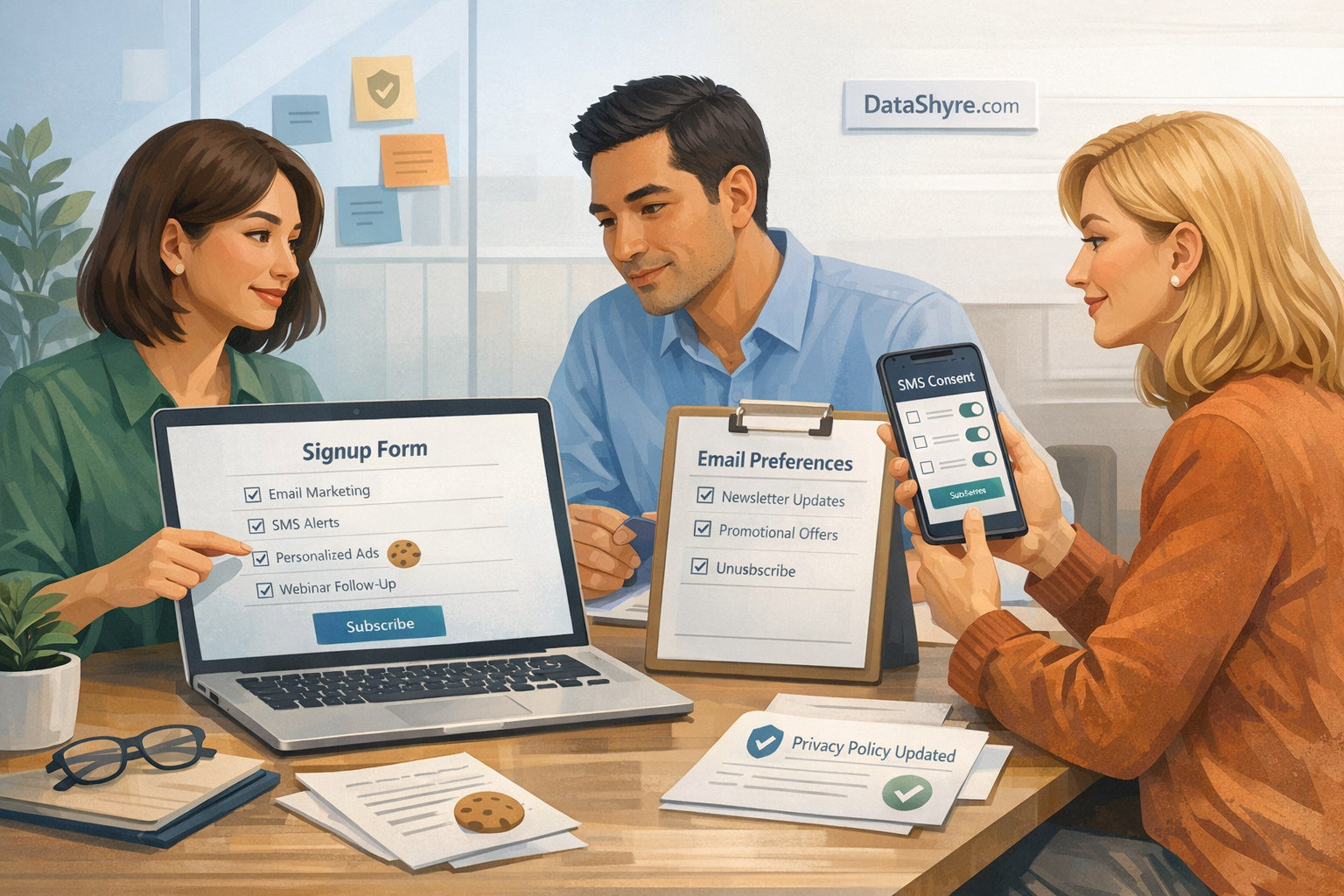
What strong marketing consent examples have in common
Before looking at patterns, it helps to define what a credible example is proving.
A strong marketing consent example usually shows:
- one clear purpose instead of bundled permissions;
- one clear channel instead of a catch-all marketing label;
- a named sender or at least an identifiable organization;
- an obvious no path;
- a visible way back to change the choice later; and
- a record that another team could still explain months from now.
That is why marketing consent examples are more useful when treated as operating patterns instead of copy snippets.
1. The newsletter signup with a separate promotional email checkbox
This is still the cleanest starting pattern for many brands.
The basic version looks like this:
- an email field for the content or account action the user actually wants;
- a separate unticked checkbox for promotional email;
- short wording that says who will send the messages and what kind of messages they are; and
- an unsubscribe route that is easy to find later.
Why it holds up:
- the user can get the core service without being forced into marketing;
- the email permission is tied to one channel;
- the ask is easier to document and prove later.
This is one of the safest marketing consent examples when the goal is a straightforward newsletter or product-update list.
2. The webinar form that separates attendance messages from later campaigns
This is where many teams still blur service communication and promotion.
A useful pattern lets the person register for the webinar first, then makes any later campaign permission a separate step. The follow-up about joining the session can be operational. Ongoing newsletters, sales follow-up, or partner messages should not be smuggled into the same line.
Why it holds up:
- it reduces bundling;
- it makes the purpose easier to explain;
- it avoids turning every event registration into an overbroad consent record.
If your form promises a replay, reminders, and event logistics, but also wants to add the attendee to unrelated campaigns, this is one of the marketing consent examples worth copying.
3. The ecommerce soft-opt-in branch for your own similar products
Not every good example is a pure opt-in checkbox.
In the UK, the ICO’s current electronic-mail guidance still says organizations can sometimes rely on the soft opt-in for their own similar products or services if the details were collected during a sale or negotiations for a sale, and the person had a clear chance to opt out when their details were collected and in every later message.
That means a realistic marketing consent example can look like this:
- the customer enters an email during checkout;
- the checkout clearly offers an opt-out from later promotional email;
- later campaigns stay limited to the sender’s own similar products or services;
- every message repeats a usable unsubscribe route.
This is a useful pattern to study because it shows that marketing consent examples are not always identical across regions and legal routes. Some are consent examples. Some are permission-model examples.
4. The charity email route using the UK charitable soft opt-in
This is one of the more important 2026 updates.
The ICO updated its guidance on April 28, 2026 to explain the new charitable soft opt-in, and its detailed electronic-mail guidance says the charitable purposes soft opt-in commenced on February 5, 2026. That gives qualifying charities a narrower route to send some fundraising-related electronic mail without consent if the published conditions are met.
So a good charity-focused marketing consent example is not just please tick here for updates.
A stronger example shows:
- whether the charity is relying on consent or the charitable soft opt-in;
- whether the message furthers the charity’s purposes;
- whether the person was given a clear chance to opt out up front;
- whether later emails keep the opt-out path easy.
This pattern matters because charities should not copy ordinary retail email logic without checking whether the rule set is actually different.
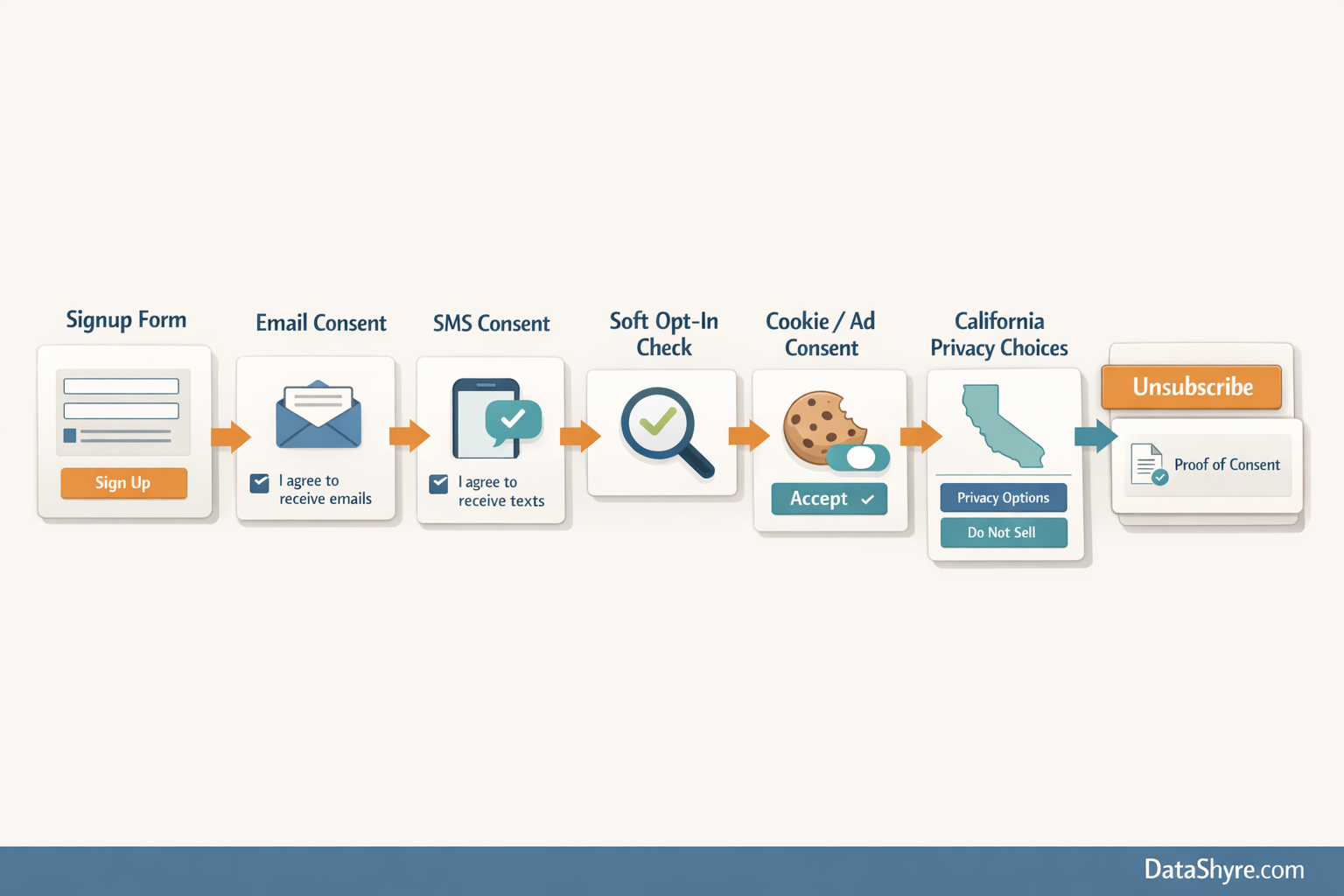
5. The SMS opt-in that stands on its own
This is one of the easiest channels to get wrong with broad wording.
The ICO’s planning guidance says consent for direct marketing has to be specific enough for the method used, and it explicitly says consent to use a phone number for live or automated marketing calls does not cover direct marketing by text message. Its PECR guidance also says consent for electronic mail should be specific to the particular type of message, such as email or text.
So one of the most useful marketing consent examples is the one that keeps SMS separate:
- email consent is one choice;
- SMS consent is another choice;
- the sender identifies what texts will cover;
- stop instructions are clear and workable.
If your form says only I agree to receive marketing communications, it is usually weaker than the workflow needs.
6. The cookie-banner branch for personalized advertising
Some marketing consent examples are not in lead-gen forms at all.
They are on the website runtime path.
If the business wants to use remarketing, personalized advertising, or similar optional tracking, the review often shifts from outreach wording to browser behavior. That is why a strong marketing consent example for websites usually includes:
- a clear first-layer choice for optional advertising or marketing cookies;
- a refusal path that is as visible as acceptance;
- no pre-consent firing of the optional tracking where prior consent is required;
- a settings path that remains available later.
This is also where California can diverge. The CCPA materials from the California DOJ still focus on opt-out rights and GPC rather than a single global opt-in model for every marketing use.
7. The partner-marketing checkbox with named recipients or a tight recipient set
This is one of the highest-risk examples to borrow carelessly.
The European Commission still says that if a business acquires contact data from another organization and wants to use consent as the basis, that consent should also have covered the transmission to other recipients for their own direct marketing. That means vague selected partners language is a weak foundation.
One of the better marketing consent examples for partner activity therefore does three things:
- it separates partner marketing from the brand’s own marketing;
- it identifies the partner group clearly enough to be meaningful;
- it leaves a record that shows what the person was told at the moment they agreed.
This is not the pattern to use by default. But when teams really do need partner permissions, it is one of the marketing consent examples most worth tightening.
8. The California privacy-choices route that does not pretend to be an EU checkbox
If your audience includes California users, a strong pattern may look less like a generic marketing consent box and more like a privacy-choices control.
The California DOJ’s CCPA pages still say consumers have the right to opt out of sale or sharing, including through a user-enabled Global Privacy Control. The DOJ’s GPC page still calls it a “stop selling or sharing my data switch.”
So a practical California-oriented marketing consent example often includes:
- a visible
Your Privacy Choicesroute or equivalent; - logic to honor GPC where it applies;
- behavior changes in downstream ad-tech or audience-sharing flows;
- language that does not confuse opt-out rights with an unrelated EU-style opt-in.
This is one of the best reminders that marketing consent examples have to match the regional model instead of flattening every audience into one banner.
Common mistakes that weaken otherwise good examples
Many examples look acceptable until you test the details. The weak patterns still show up in familiar ways:
- one checkbox covers email, SMS, calls, cookies, and partner offers;
- the wording says
communicationsinstead of naming the real message type; - refusal exists, but only after extra clicks or harder-to-find links;
- unsubscribe works in email, but not in SMS, CRM suppression, or ad audiences;
- cookie-related marketing choices are promised in the UI but not enforced in the browser;
- California privacy choices are hidden behind an EU-style consent frame that does not match the right itself.
This is why marketing consent examples should always be tested as live workflows rather than reused as static copy.
A fast review order for this week
If you are borrowing from other marketing consent examples, use this order before you publish:
- identify the exact channel first;
- decide whether the legal model is consent, soft opt-in, opt-out, or another path;
- make sure the ask is purpose-specific and channel-specific;
- compare the yes path with the no path;
- test later withdrawal or opt-out behavior;
- check what proof the system keeps;
- if cookies or ad targeting are involved, inspect runtime behavior too.
That seven-step review usually reveals more than another round of button-copy edits.
FAQ
Do all marketing consent examples need a checkbox?
No. Some valid patterns rely on another published rule set, such as a narrow soft opt-in or a California opt-out flow. The important point is that the pattern must match the actual legal and technical model.
Is one marketing permission enough for email and SMS?
Usually no. Current ICO guidance points toward method-specific permission, and a text-message permission should not be assumed from an email or calling permission.
Can a cookie banner count as a marketing consent example?
Yes, when the marketing activity involves optional tracking or personalized advertising. In that case, the consent review is partly a browser-behavior review, not only a copy review.
Bottom line
The most useful marketing consent examples in 2026 are not the broadest ones.
They are the narrowest examples that still fit the real workflow.
That usually means separating channels, naming purposes honestly, keeping refusal and withdrawal easy, and matching the example to the region instead of forcing every audience into one template.
If your current example cannot survive that test, it is probably not a reusable pattern yet.
Sources
- European Commission, legal grounds for processing data: https://commission.europa.eu/law/law-topic/data-protection/information-business-and-organisations/legal-grounds-processing-data_en
- European Commission, information for individuals: https://commission.europa.eu/law/law-topic/data-protection/information-individuals_en
- ICO, guidance on direct marketing using electronic mail: https://ico.org.uk/for-organisations/direct-marketing-and-privacy-and-electronic-communications/guidance-on-direct-marketing-using-electronic-mail/
- ICO, plan direct marketing: https://ico.org.uk/for-organisations/direct-marketing-and-privacy-and-electronic-communications/direct-marketing-guidance/plan-direct-marketing/
- ICO, key concepts for direct marketing using electronic mail: https://ico.org.uk/for-organisations/direct-marketing-and-privacy-and-electronic-communications/guidance-on-direct-marketing-using-electronic-mail/key-concepts-for-direct-marketing-using-electronic-mail/
- ICO, charities given new flexibility to contact supporters under data law change: https://ico.org.uk/about-the-ico/media-centre/news-and-blogs/2026/04/charities-given-new-flexibility-to-contact-supporters-under-data-law-change/
- California Department of Justice, CCPA: https://www.oag.ca.gov/privacy/ccpa
- California Department of Justice, Global Privacy Control: https://www.oag.ca.gov/privacy/ccpa/gpc
- FTC, CAN-SPAM Act: A Compliance Guide for Business: https://www.ftc.gov/business-guidance/resources/can-spam-act-compliance-guide-business
—
Published: October 25, 2026. Updated using current official regulator, government, and platform materials available at publication time.