

What Is Cookie Consent in 2026? Plain-English Definition, Live Rules, and 7 Checks
If you are asking what is cookie consent in late 2026, the shortest useful answer is this: it is the control layer that decides whether a site can place or read non-essential cookies or similar tracking technologies when the law requires user choice first.
That answer is still too small for a real website.
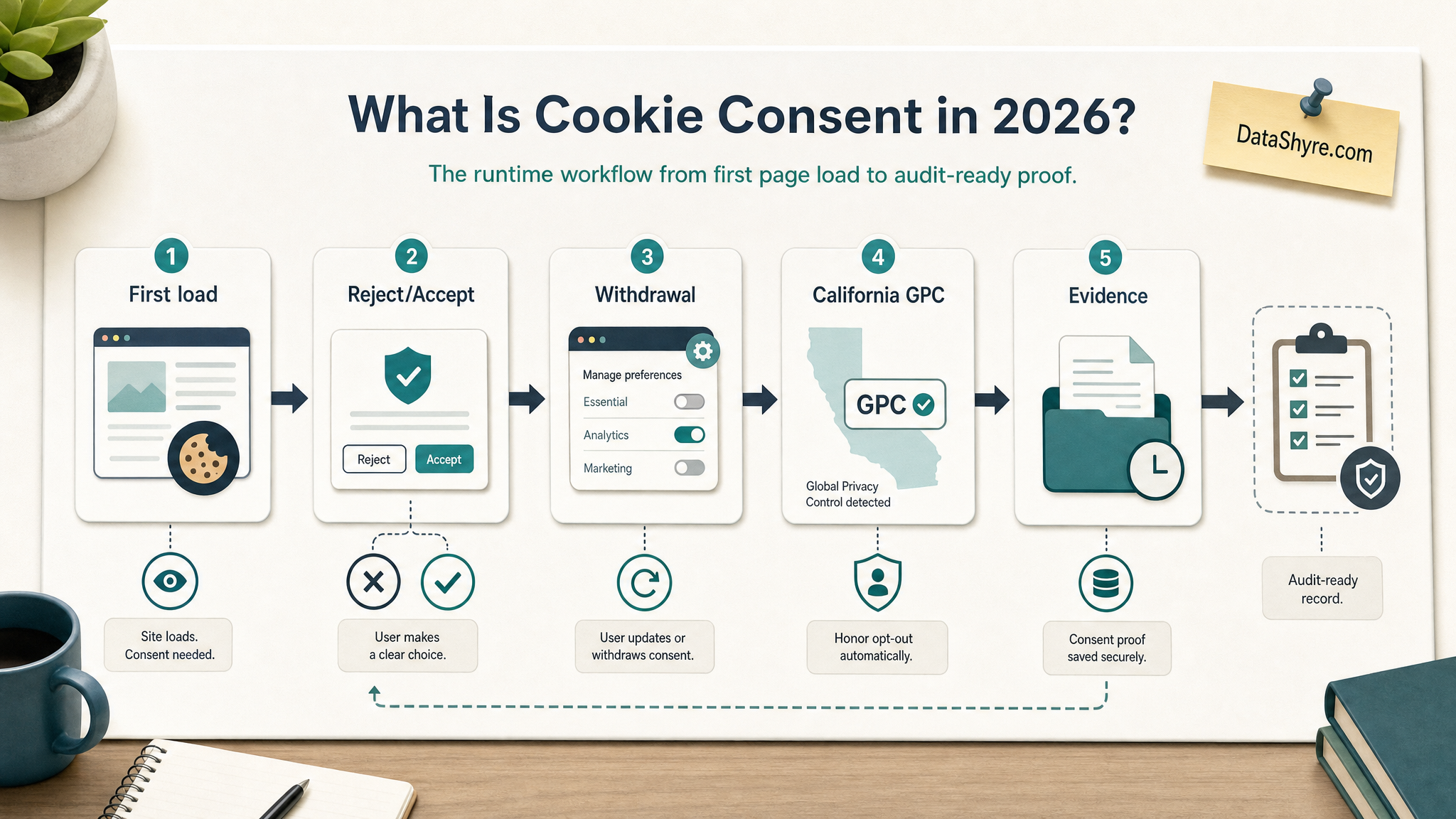
Cookie consent is not just a popup. It is the combination of notice, choice, technical blocking, later withdrawal, and evidence that the site actually behaved the way it said it would.
If you want nearby context first, start with our guides to cookie consent requirements, GDPR vs. CCPA, and website privacy checker. This page stays at the foundation: what is cookie consent, when does it matter, and what should a live setup actually do?

The plain-English definition
In plain English, cookie consent is the moment a person gets a real choice about optional tracking.
On a serious site, that usually means the site should:
- explain what optional technologies it wants to use and why;
- separate necessary functions from optional analytics, advertising, or personalization;
- let people accept, reject, or customize those optional uses;
- keep non-exempt technologies off until the right choice exists where prior consent is required; and
- make the choice easy to revisit later.
The European Commission still gives the cleanest short test for valid consent. It says the request should use “clear and plain language” and that withdrawal should be possible through a route that is “as easy to use as giving consent.”
That is one of the best practical answers to what is cookie consent. It is not only first-click permission. It is an ongoing control that must remain usable after the first choice.
Why the answer is broader than “a cookie banner”
The legal and technical baseline is wider now than the old phrase suggests.
The UK ICO finalized its storage-and-access-technologies guidance on April 29, 2026. That guidance is important because it expressly covers cookies, tracking pixels, device fingerprinting, scripts, tags, and similar technologies, not only classic browser cookies. In other words, the live compliance question is often about the whole tracking stack.
That is why what is cookie consent is really a question about runtime behavior:
- what loads before any choice;
- what changes after rejection;
- what changes after acceptance;
- whether the site lets the person come back later and reverse the decision; and
- whether the wording matches what the page actually does.
If the interface looks compliant but the runtime behavior does not change, the site does not really have cookie consent. It has a cosmetic layer.
When cookie consent is usually required
This is where the answer stops being universal.
For many EU and UK website-tracking situations, prior consent is still the default rule for non-essential storage or access technologies. The ICO’s final guidance says the rules apply unless an exception is available, and it also explains that the exceptions are purpose-specific rather than broad vendor labels.
So the honest answer to what is cookie consent is not every cookie always needs opt-in.
The more accurate answer is:
- many optional analytics, advertising, and personalization technologies still need prior permission in the EU and UK;
- some technologies may fit a narrow exception depending on the real purpose and live behavior; and
- teams should test the real implementation, not rely on what a platform or vendor calls the tool.
That practical distinction matters because many weak setups still label tracking as functional or experience even when the runtime behavior looks more like measurement, cross-site advertising, or profiling.
Why California is often a different workflow
California is one of the biggest reasons people get confused when they ask what is cookie consent.
For many California-facing websites, the hardest legal issue is not a blanket EU-style prior-consent flow. The California Department of Justice says consumers have the right to opt out of sale or sharing, including through a user-enabled Global Privacy Control. Its GPC page still describes that signal as a “stop selling or sharing my data switch.”
That means a California review often asks different questions:
- is there a usable opt-out path for sale or sharing;
- is GPC honored where it applies;
- do downstream advertising or sharing behaviors actually change after the signal arrives; and
- do the notice and rights flows match what the business really does?
California is also getting more concrete in enforcement. On February 11, 2026, the Attorney General announced a $2.75 million settlement with Disney over allegations that consumer opt-out requests were not fully effectuated across devices and streaming services tied to the same account. That is a useful reminder that privacy choice has to travel as far as the data does.
So one good answer to what is cookie consent is that, in California, it may be less about a universal Accept cookies step and more about whether opt-out and sharing controls genuinely work.
Why banner design still matters
Even though cookie consent is broader than a banner, the first layer still matters because that is where valid choice either survives or gets weakened.
CNIL’s current notice on dark patterns in cookie banners remains one of the clearest design references available. It says “rejecting cookies should be just as easy as accepting them.”
That is a practical standard, not just a slogan.
For a live review, it usually means checking whether:
Reject allis visible whereAccept allis visible;- refusal is not reduced to a faint text link while acceptance gets the main button;
- contrast, spacing, color, and placement are not quietly steering the person toward one outcome; and
- the mobile version stays as balanced as the desktop version.
California’s privacy regulator has used similar language from a different legal angle. The CPPA’s enforcement advisory warns against dark patterns and calls for symmetry in choice. Different regimes, same operational lesson: if one path is visually easy and the privacy-protective path is awkward, the implementation is already on weaker ground.
What the site should do technically after the choice
This is where the best answer to what is cookie consent becomes technical instead of theoretical.
The live site should behave differently depending on the user’s state:
- no choice yet;
- reject optional uses;
- accept optional uses; and
- later withdrawal or changed preferences.
If Google tags are involved, timing still matters. Google’s current consent-mode documentation says the default consent command should run “before any commands that send measurement data” such as config or event.
That does not solve everything by itself, but it gives a good technical checkpoint. If optional measurement or ad logic fires before the consent default and update logic is established, the implementation order is already wrong.
A separate branch applies if a publisher serves personalized ads with AdSense, Ad Manager, or AdMob in the EEA, UK, or Switzerland. Google’s current publisher help still says those partners must use a Google-certified CMP integrated with the IAB TCF for that traffic. That is not the same thing as full legal compliance, and Google says so directly, but it is still a real platform requirement many teams overlook.
Seven live checks that answer the real question
If I were answering what is cookie consent for a live site this week instead of as a glossary entry, I would run these seven checks:
- Inspect a clean session and see what fires before any interaction.
- Separate truly necessary technologies from optional ones only being described as necessary.
- Test whether reject is as easy to reach and use as accept on desktop and mobile.
- Compare no-choice, reject, accept, and withdrawal states in browser storage and network behavior.
- Check whether Google or other tag logic starts in the right order.
- If California rights are relevant, test GPC or opt-out propagation across the parts of the service that share data.
- Compare the runtime behavior with the banner copy, cookie table, and privacy notice, then save evidence.
That sequence usually answers the practical version of what is cookie consent faster than a long abstract debate.
What cookie consent is not
It is not just:
- a design component;
- a plugin setting page;
- a one-time click on first visit;
- a vague statement that
we use cookies to improve your experience; or - a log entry that records acceptance after optional scripts already fired.
If a site cannot explain its optional purposes in plain language, make refusal genuinely usable, and show technical differences between consent states, it does not really answer the user’s choice.
FAQ
Is cookie consent the same as a cookie banner?
No. A banner can be part of cookie consent, but cookie consent also includes the logic behind the choice, the blocking behavior, the preference history, and the withdrawal path.
Does every U.S. website need the same cookie consent flow?
No. The answer depends on the site’s data practices, audience, and jurisdictions. California often focuses more on opt-out rights and GPC than on an EU-style blanket opt-in flow.
What is the fastest way to spot a weak setup?
Look at behavior, not only copy. If optional technologies run before the right choice exists, or if rejection is much harder than acceptance, the setup is weak even if the wording looks polished.
Bottom line
So, what is cookie consent in 2026?
It is the system that tells a site whether it may use non-essential cookies or similar storage-and-access technologies when law requires real user choice. In the EU and UK, that often means prior consent unless a narrow exception truly applies. In California, the more important branch may be notice, opt-out, GPC handling, and making sure the choice propagates across the service.
The useful test is simple: can a person refuse, can they change their mind later, and does the site actually behave differently when they do?
If the answer is no, you do not really have cookie consent. You have a banner.
Sources
- European Commission, “Legal grounds for processing data”: https://commission.europa.eu/law/law-topic/data-protection/information-business-and-organisations/legal-grounds-processing-data_en
- ICO, “Guidance on the use of storage and access technologies”: https://ico.org.uk/for-organisations/direct-marketing-and-privacy-and-electronic-communications/guidance-on-the-use-of-storage-and-access-technologies/
- ICO, “Final storage and access technologies guidance published”: https://ico.org.uk/about-the-ico/media-centre/news-and-blogs/2026/04/final-storage-and-access-technologies-guidance-published/
- CNIL, “Dark Patterns in Cookie Banners: CNIL issues formal notice to website publishers”: https://www.cnil.fr/en/dark-patterns-cookie-banners-cnil-issues-formal-notice-website-publishers
- Google for Developers, “Set up consent mode on websites”: https://developers.google.com/tag-platform/security/guides/consent
- Google AdSense Help, “Google consent management requirements for serving ads in the EEA, the UK and Switzerland (for publishers)”: https://support.google.com/adsense/answer/13554116?hl=en-GB
- California Department of Justice, “California Consumer Privacy Act (CCPA)”: https://oag.ca.gov/privacy/ccpa
- California Department of Justice, “Global Privacy Control (GPC)”: https://oag.ca.gov/privacy/ccpa/gpc
- California Privacy Protection Agency, “Enforcement Advisory No. 2024-02”: https://cppa.ca.gov/pdf/enfadvisory202402.pdf
- California Department of Justice, “California Won’t Let It Go: Attorney General Bonta Announces $2.75 Million Settlement with Disney, Largest CCPA Settlement in California History”: https://oag.ca.gov/news/press-releases/california-wont-let-it-go-attorney-general-bonta-announces-275-million
—
Published: October 25, 2026. Updated using current official regulator, government, and platform materials available at publication time.